Agentic AI vs Generative AI: Which One Actually Runs Your Plant?

The debate around agentic AI vs generative AI keeps showing up in manufacturing boardrooms, and most of the time, people are talking past each other. One side wants autonomous systems that act. The other wants smart tools that draft, summarize, and generate. The truth? Your plant probably needs both, but they do very different jobs, and confusing them costs money.
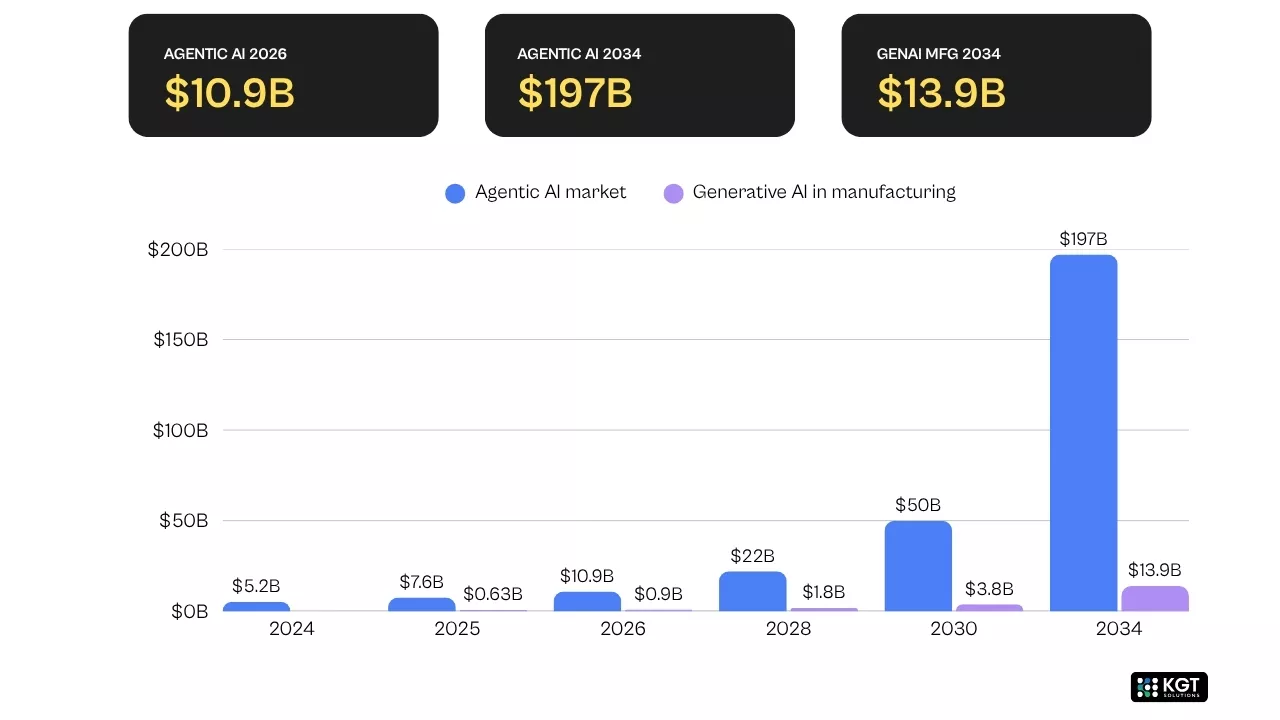
Agentic AI operates autonomously to make decisions, coordinate actions, and execute multi-step workflows without waiting for a human prompt. Generative AI creates content, summaries, code, or designs in response to a specific request. The agentic AI market alone is projected to hit $10.86 billion in 2026, growing at a 43.8% CAGR toward $196.6 billion by 2034, according to Precedence Research. That is not speculative growth. That is capital being reallocated from manual processes.
What generative AI actually does on a factory floor
Generative AI handles the thinking-on-paper side of manufacturing. It drafts maintenance reports, generates product design variations, writes troubleshooting guides, and summarizes shift logs. Bosch used generative AI to cut inspection system development from years down to six months while boosting annual productivity in their MEMS sensor design workflow. The generative AI in manufacturing market sits at roughly $630 million in 2025 and is projected to reach $13.9 billion by 2034, per Precedence Research.
Where generative AI development services have found real traction is in knowledge retrieval. Engineers query an LLM to pull up wiring diagrams, past maintenance records, or safety procedures instead of digging through filing cabinets. IoT Analytics estimates that generative AI accounted for 6% of industrial AI projects in 2024, up from 1% in 2023, and is on track to represent a quarter of all industrial AI use cases by 2030.
But generative AI waits. It needs a prompt. It produces an output and stops. That limitation matters when you are running a production line where seconds count.
How agentic AI vs generative AI plays out in real operations
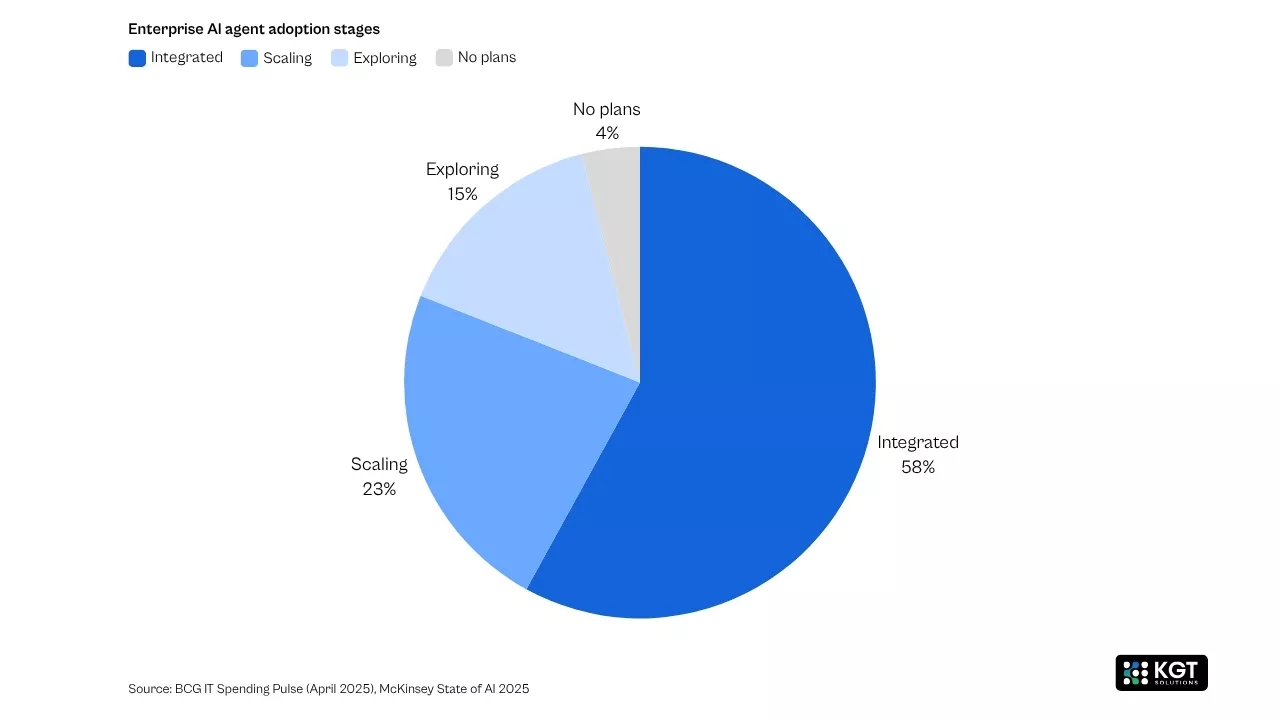
Agentic AI does not wait for instructions. It monitors sensor feeds, catches anomalies, adjusts machine parameters, and reroutes production schedules on its own. According to a BCG survey from April 2025, 58% of companies have already integrated AI agents into their operations, and another 35% are actively exploring them.
The split is pretty clear once you watch both systems in action. Generative AI might draft a maintenance checklist after you ask for one. Agentic AI notices that a bearing vibration pattern has shifted, cross-references the part's history, orders a replacement, and reschedules the production run around the downtime window. Gartner projects that by 2028, 33% of enterprise software will include agentic AI capabilities, up from less than 1% in 2024.
A generative AI development company building tools for manufacturers usually starts with document generation and chatbot interfaces. That is useful work. But the companies seeing the biggest operational returns are the ones layering agentic systems on top of those generative foundations. McKinsey's 2025 State of AI report found that 62% of mid-sized and large businesses are experimenting with autonomous multi-step AI, while 23% are scaling it in at least one business process.
Where each type fits in your plant
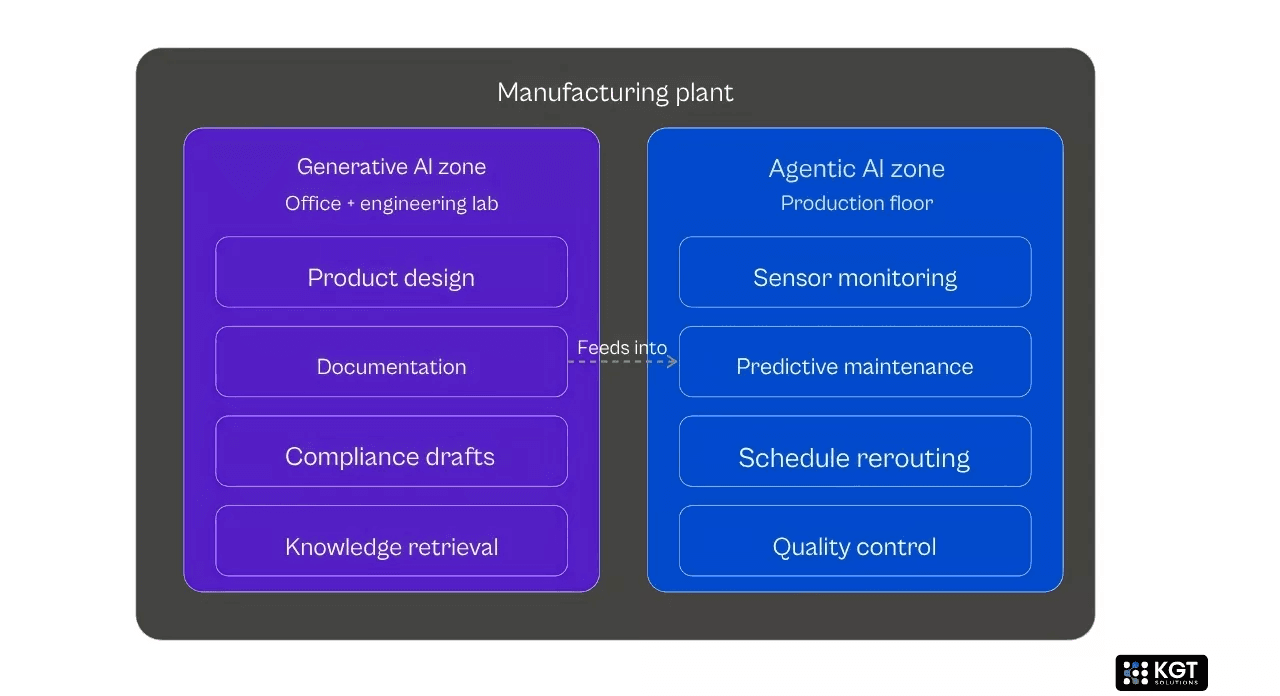
Generative AI belongs in the office and the engineering lab. Agentic AI belongs on the production floor. That is an oversimplification, but it is directionally right.
Generative AI integration services typically plug into product design, where engineers use generative models to test thousands of prototype configurations before committing to tooling. They also power enterprise generative AI solutions for supply chain documentation, regulatory compliance drafts, and training material creation. The global generative AI market is expected to grow at 41% CAGR through 2034, with product design and predictive maintenance as the top manufacturing applications, per Precedence Research.
Agentic AI sits on the other side of that wall. It handles the messy, unpredictable work that happens in real time. LLM development services now feed into agent architectures where language models serve as the reasoning layer, but execution happens through connected actuators, PLCs, and robotic systems. Siemens reported 90% touchless processing across industrial workflows after deploying coordinated AI agents, saving roughly EUR 5 million annually, according to Mordor Intelligence.
For generative AI in healthcare adjacent to manufacturing (think pharmaceutical production or medical device assembly), the stakes are even higher. An agent that catches a contamination event 30 seconds faster than a human operator is not a nice-to-have. It is a compliance requirement.
Why the "which one" question misses the point
The most effective manufacturing AI strategies use generative and agentic AI together, not as competing alternatives. Gartner expects 40% of enterprise applications to embed task-specific AI agents by end of 2026. Most of those agents will use generative models as a reasoning component inside a larger autonomous workflow.
A generative AI consulting services engagement might start by building a knowledge base that maintenance technicians can query in natural language. The next phase wires that same knowledge base into an agentic system that monitors equipment conditions, surfaces relevant documentation automatically, and initiates work orders without waiting for someone to ask.
The industrial AI market reached $43.6 billion in 2024 and is forecast to hit $153.9 billion by 2030, per IoT Analytics. That growth is being driven by companies that stopped treating AI as a single tool and started treating it as an operating layer.
Agentic Orchestration Explained for Enterprise CTOs

What to consider before choosing
If your operation still relies on manual reporting, start with generative AI. Build the knowledge infrastructure. Get your documentation and data pipelines in order. A generative AI for business deployment that organizes tribal knowledge into searchable, queryable form is often the highest-ROI first move.
If your data infrastructure is already solid, look at agentic AI. Fortune Business Insights values the agentic AI market at $9.14 billion in 2026, with North America holding 33.6% market share. The adoption curve is steep, and the companies that moved early are already reporting 30% cuts in operational costs, according to market.us.
Either way, the gap between experimenting and producing results is where most manufacturers stall. According to McKinsey, 88% of organizations use AI in at least one business function, but only a third have scaled it across the enterprise. The technology is not the bottleneck. The org chart is.
Frequently Asked Questions
What is the core difference between agentic AI and generative AI?
Can agentic AI and generative AI work together in industrial settings?
Which type of AI is better for manufacturing plant automation?
What are real-world examples of agentic AI in factory operations?
How much does it cost to implement agentic AI versus generative AI?
Sources:
Precedence Research, "Agentic AI Market Size to Hit USD 199.05 Billion by 2034"
Precedence Research, "Generative AI in Manufacturing Market Size 2025 to 2034"
BCG IT Spending Pulse Survey, April 2025
Gartner, Agentic AI predictions (2025-2028)
McKinsey, "The State of AI in 2025"
IoT Analytics, "Industrial AI Market: 10 Insights on How AI Is Transforming Manufacturing" (August 2025)
Fortune Business Insights, "Agentic AI Market Size, Share | Forecast Report [2026-2034]"
Mordor Intelligence, "Agentic AI Market Share, Size & Growth Outlook to 2031"
Market.us, "Agentic AI Market Size, Share, Trends | CAGR of 43.8%"
Masterofcode, "Generative AI in Manufacturing: Use Cases + Real-life Examples"
Protocol AI Newsletter
Practical insights on AI, automation, and intelligent systems focused on real-world applications, not hype.