What AI Agents Actually Do And Why It Matters


If you have been anywhere near a tech conversation in the last year, you have heard the term AI agents thrown around like confetti. Everybody is talking about them. Fewer people can explain what they actually do. And even fewer understand why their business should care right now, not in some vague future.
Here is the short version: AI agents are autonomous software systems that go beyond answering questions. They reason through problems, plan multi-step actions, use external tools through APIs, and execute tasks like research, scheduling, and customer service without someone babysitting every click. They are not chatbots with better marketing. They are a genuinely different category of software
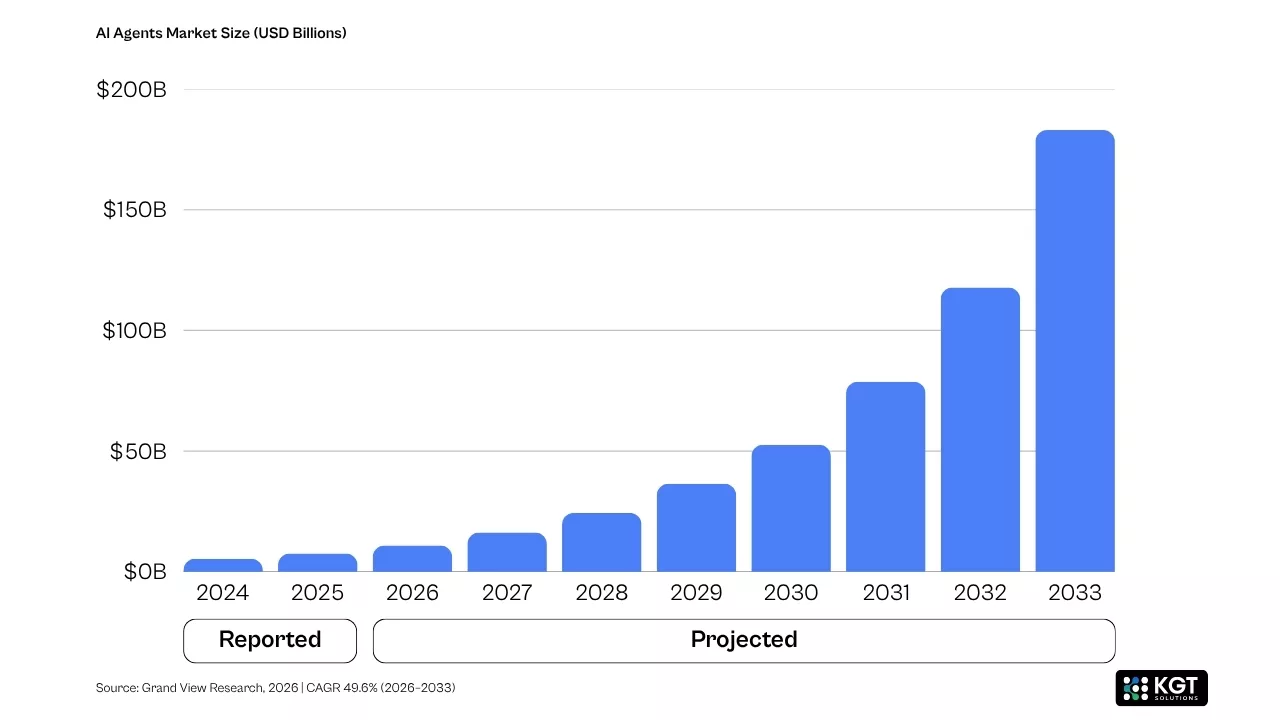
The global AI agents market was valued at approximately USD 7.63 billion in 2025 and is projected to reach USD 182.97 billion by 2033, growing at a CAGR of 49.6% (Grand View Research, 2026). Those numbers are not hypothetical. Around 51% of companies have already deployed them in some form, and another 62% are actively experimenting (Bayelsa Watch, 2026). This is not a niche technology waiting for a use case. It is already here, already working, and the organizations ignoring it are falling behind in ways they may not fully grasp yet.
How AI Agents Actually Work (Without the Buzzwords)
Most explanations drown you in jargon. I want to try something different.
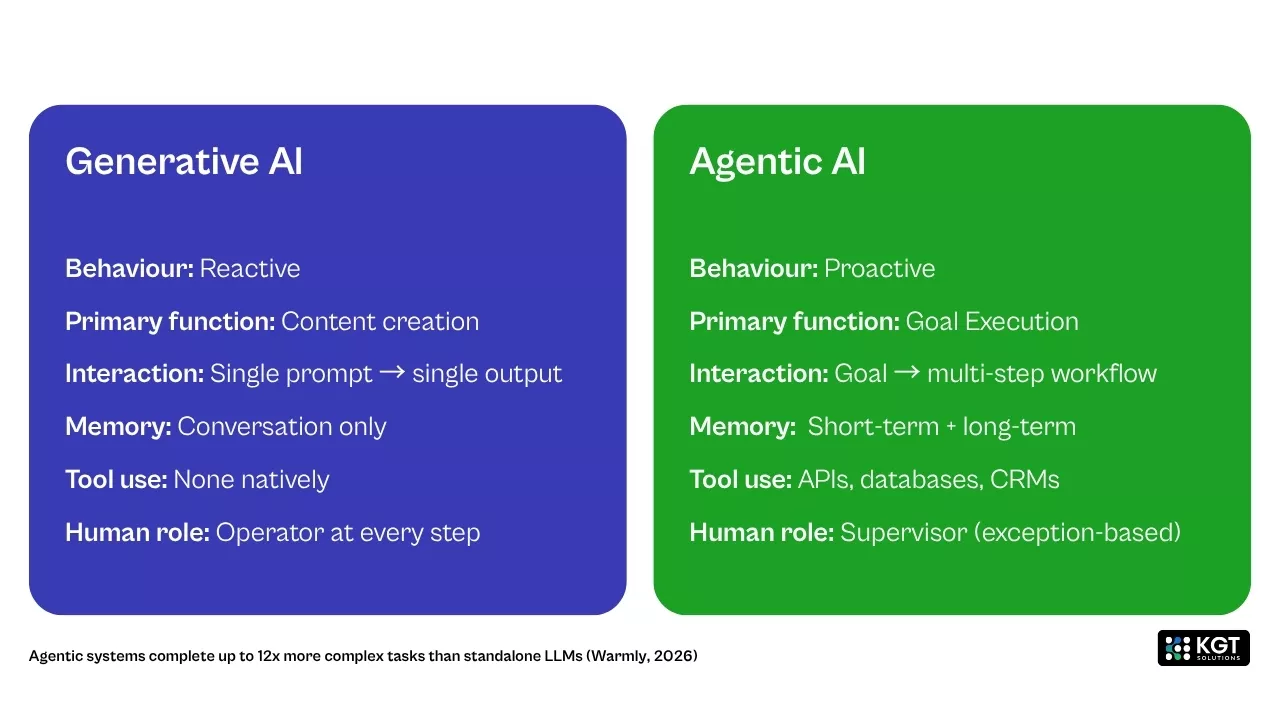
Think about what happens when you ask a traditional chatbot a question. It takes your input, runs it through a model, and spits out a response. One prompt, one output. Done. That is generative AI in its simplest form, and it is useful, but it is fundamentally reactive.
An AI agent does something different. You give it a goal, not just a prompt. The agent then figures out the steps needed to reach that goal. It breaks the problem into smaller tasks. It decides which tools to use. It calls APIs, searches databases, reads documents, and takes actions across multiple systems. When something goes wrong midway through, it adjusts.
According to IBM, the core distinction is that agentic AI is proactive while generative AI is reactive to user input. Agentic AI adapts to changing situations and has the agency to make decisions based on context. A McKinsey report found that while 78% of enterprises have deployed generative AI in at least one function, 80% say it has not meaningfully improved productivity, cost, or revenue. The reason is simple: generative AI stops at generation. It assists, but it rarely acts.
Here is a concrete example. Say you run a customer service operation and a shipment is delayed. A generative AI tool can write a nice apology email if you prompt it. An AI agent, on the other hand, checks the tracking system, identifies the delay, pulls up the customer's order history, writes a personalized message with the updated delivery date, sends it, and closes the support ticket. No human had to copy-paste anything or switch between five different tabs.
According to the UiPath 2025 Agentic AI Report, 93% of U.S. IT executives surveyed expressed strong interest in agentic AI, and 32% planned to invest within six months. That urgency is not coming from hype. It is coming from the realization that workflow automation services built on agents can handle the tedious multi-system coordination that eats up employee hours.
Agentic AI vs Generative AI: Why the Distinction Matters for Your Business
I keep hearing people use "agentic AI" and "generative AI" interchangeably, and it drives me a little nuts. They are related, sure. But confusing them is like confusing a blueprint with a construction crew.
Generative AI creates content. It writes text, generates images, produces code. It is a creative tool that reacts to prompts. Agentic AI uses those same foundational models but adds planning, memory, tool use, and autonomous execution on top. An agentic AI system might use a generative model as one of its internal tools, the way a construction crew might use a blueprint as part of building a house.
Salesforce puts it well: an AI agent is not merely a tool for content creation. It is a system capable of independently pursuing defined, multi-step tasks while still having a human in the loop for oversight. The planning module breaks complex tasks into smaller steps. Memory lets the agent remember past actions and learn from mistakes. And tool access lets it interact with the external world.
Research from Warmly indicates that agentic systems can complete up to 12 times more complex tasks than traditional large language models, thanks to autonomous decision-making and dynamic feedback loops. That multiplier effect is why companies investing in agentic AI development services are seeing returns that simple chatbot deployments never delivered.
For businesses evaluating custom AI solutions, understanding this distinction is not academic. It determines whether you build a tool that answers questions or a system that actually does work. One requires a human operator at every step. The other requires a human supervisor who steps in only when needed. The cost difference, over time, is enormous.
What AI Agents Do Across Industries
The use cases are not theoretical anymore. They are running in production across sectors that most people would not expect.
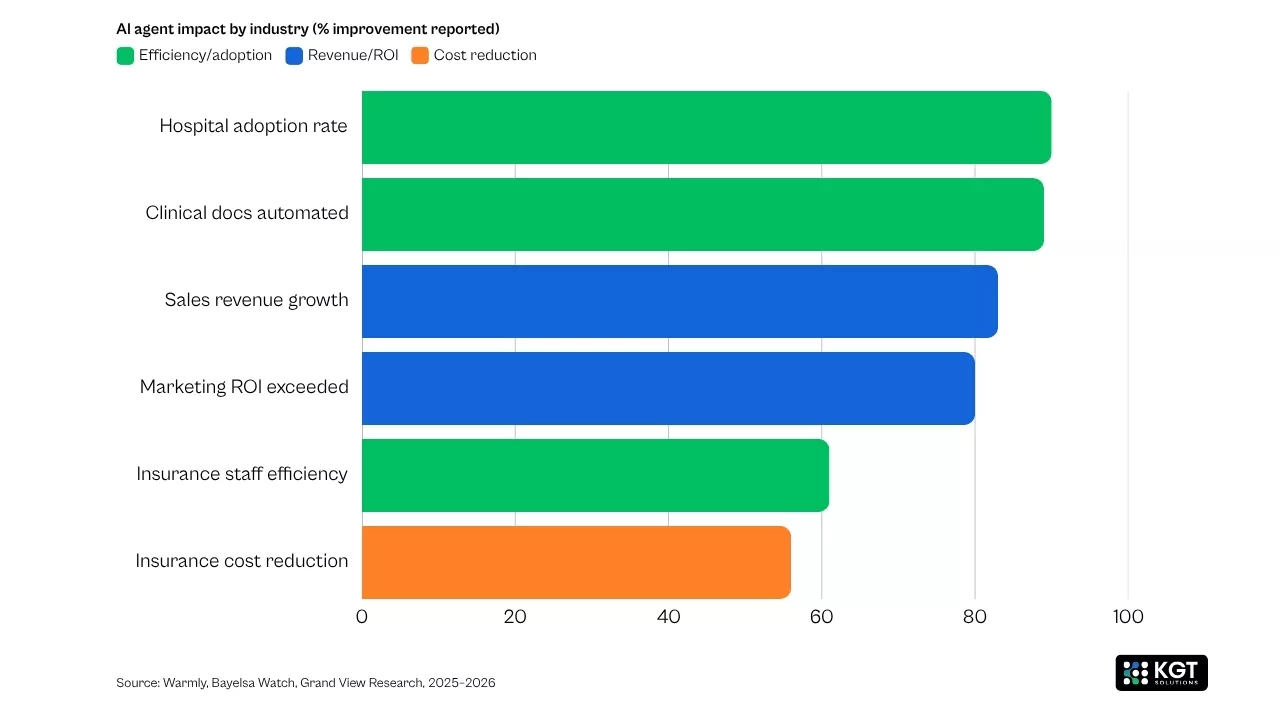
Insurance and Financial Services. AI for insurance agents is one of the fastest-growing applications. Agents handle claims processing, risk assessment, fraud detection, and customer communication. JPMorgan Chase uses these systems to analyze millions of transactions in real time for fraud detection (MarketsandMarkets, 2025). The insurance sector reached 48% AI adoption in 2026, with companies reporting a 61% improvement in staff efficiency and 56% reduction in costs (Bayelsa Watch, 2026).
Real Estate. The best AI for real estate agents can handle lead qualification, property matching, market analysis, and follow-up scheduling. The automotive sector, which shares similar sales-cycle dynamics, saw these systems improve lead conversions by 37% and test-drive appointments by 26% (Bayelsa Watch, 2026). Real estate firm are adopting similar agentic workflows to manage the high-touch, multi-step nature of property transactions.
Healthcare. About 90% of hospitals worldwide are expected to adopt these systems, using them for predictive analytics and patient outcomes. Autonomous agents are automating 89% of clinical documentation tasks (Warmly, 2026). These are not experimental pilots. They are production systems handling real patient data.
Manufacturing and Industrial Automation. AI in industrial automation uses agents for supply chain management, predictive maintenance, inventory optimization, and quality control. Computer vision defect detection systems work alongside agentic workflows to catch manufacturing flaws before products ship. The industrial end-use segment is expected to grow at a CAGR of 49.2% through 2033 (Grand View Research, 2026).
Marketing and Sales. Marketing teams using these systems reported that 80% saw returns exceeding their expectations in 2025 (Warmly, 2026). Sales teams integrating agents reported 83% revenue growth. Coca-Cola increased ROI by 20% through marketing automation AI. Salesforce boosted deal sizes by 15% and shortened sales cycles by 25%. These are not marginal improvements.
Customer Service. AI chatbot development services have evolved far beyond simple FAQ bots. Modern AI chatbot development takes an agentic approach where the chatbot does not just answer, it resolves. It accesses order data, processes returns, initiates refunds, and updates CRM records. According to Zendesk's CX Trends 2025 report, 70% of consumers see a widening performance gap between companies that use AI well in customer service and those that do not.
How to Create an AI Agent: The Building Blocks
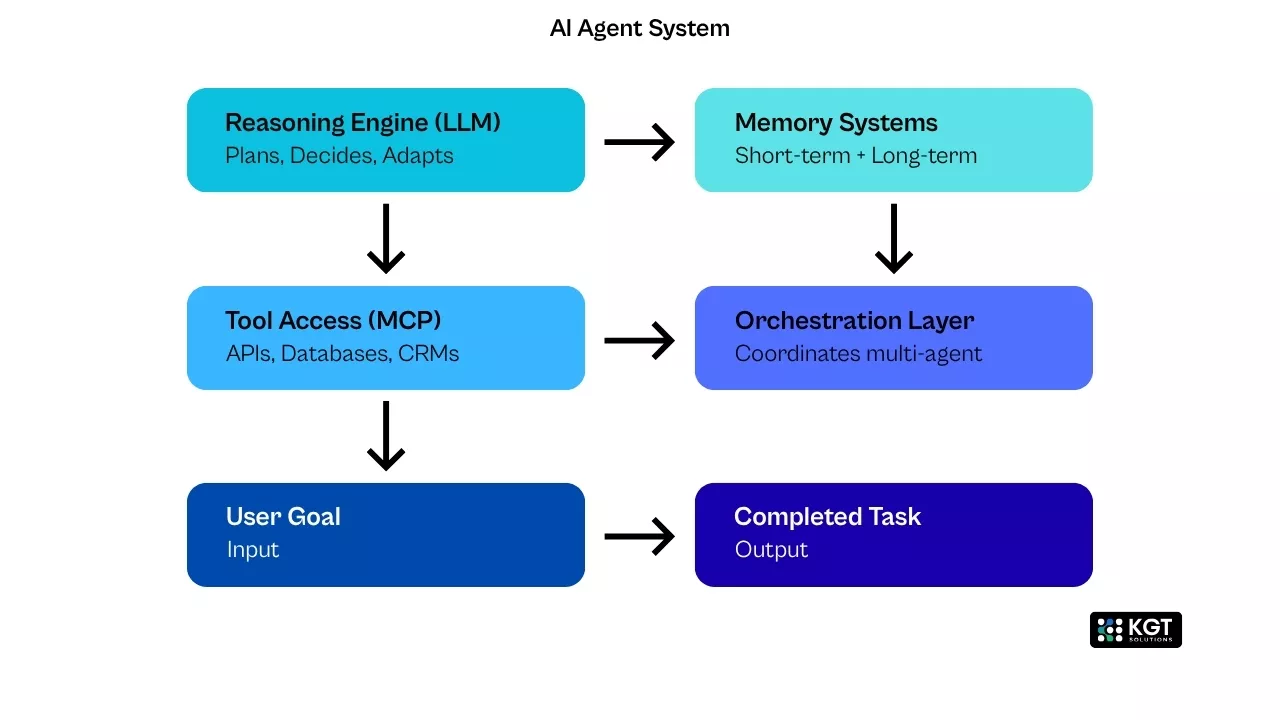
If you are wondering how to create an AI agent, the architecture is more accessible than most people assume. The core components are consistent regardless of whether you are building a simple task manager or a complex multi-agent system.
The reasoning engine. This is usually a large language model (LLM) that provides the agent's ability to understand instructions, plan actions, and make decisions. Machine learning technology accounted for 30.56% of the agentic AI market in 2025 (Grand View Research, 2026), with NLP and deep learning filling complementary roles.
Memory systems. Agents need both short-term memory (what happened in this conversation) and long-term memory (what the agent has learned over time). Without memory, every interaction starts from scratch, which defeats the purpose of autonomous operation.
Tool access. This is where Model Context Protocol (MCP) comes in. MCP is an open-source protocol that standardizes how AI systems connect to external services, databases, CRMs, calendars, and enterprise software. Think of it as a universal adapter that lets agents plug into your existing tech stack. Without tool access, agents can think and plan but cannot interact with anything outside their own model.
Orchestration layer. For complex deployments, you need workflow management software that coordinates multiple agents. Single-agent systems held 59.24% of the market in 2025 because they are simpler to deploy, but multi-agent systems are growing at 46.3% CAGR as organizations tackle more complex workflows (Fortune Business Insights, 2026).
The best agents combine all four components into systems that feel less like software and more like capable coworkers. AI prototype generators and low-code platforms are making it easier for teams without deep ML expertise to build their first agents, though production-grade systems still benefit from professional agentic AI development services.
Agentic Orchestration Explained for Enterprise CTOs
AI Agents and Workflow Automation: Where the Real Value Live
Here is something that does not get talked about enough: the biggest value is not in any single task they perform. It is in workflow automation. The ability to string together dozens of actions across multiple systems without human handoffs.
Think about accounting workflow software. A traditional setup might involve an employee downloading bank statements, matching transactions, flagging discrepancies, updating the general ledger, and generating reports. Each step involves a different tool, a different login, a different interface. An AI agent can handle that entire chain. It monitors accounts, categorizes transactions, reconciles data, flags anomalies for human review, and generates automated financial reporting with AI. The human reviews exceptions. The agent handles everything else.
According to the Langchain report surveying over 1,300 professionals, 58% cited research and information summarization as their primary use case, followed by 53.5% for personal productivity and process automation, and 45.8% for customer service (Master of Code, 2026). These are not exotic applications. They are the daily grind of knowledge work.
Workflow automation solutions powered by agents are different from traditional tools like Zapier or IFTTT. Those tools follow rigid if-this-then-that logic. They break when inputs are unexpected. Agents built on agentic architectures, by contrast, handle ambiguity. If a document arrives in an unexpected format, the agent can still parse it. If an API call fails, the agent can try an alternative approach. That flexibility is what makes agentic automation genuinely useful in messy, real-world environments.
Employees using agents report a 61% increase in efficiency (Bayelsa Watch, 2026). Agentic tools reduced trip-planning time from 38.5 minutes to 9.2 minutes, a 76% time savings (Bayelsa Watch, 2026). One report found a 34% productivity increase among workers using AI tools in 2026. These numbers add up fast across an organization.
AI Chatbots vs AI Agents: Understanding the Cost and Value
Let me address something that comes up in almost every client conversation: AI chatbot pricing and AI chatbot cost.
Traditional chatbots are cheap to build and deploy. You can spin up a basic FAQ bot for a few hundred dollars a month. But those bots are limited. They follow scripted flows. They break on unexpected inputs. They cannot access external systems. They frustrate customers who have anything beyond a cookie-cutter question.
An SMS AI chatbot built on agentic principles costs more upfront. It requires integration work, tool configuration, and testing. But the value curve is completely different. A Zendesk study found that early AI adopters are 128% more likely to report high ROI in customer experience than companies using traditional approaches. Businesses have reported an average 6.7% boost in customer satisfaction scores in areas where these systems have been deployed.
The cost question is really a scope question. If you need a bot that answers "what are your business hours" and "where is my order," a simple chatbot is fine. If you need a system that resolves complex issues end-to-end, processes returns, manages escalations, and learns from every interaction, you need an agent. The AI chatbot development company you work with should be able to articulate exactly where a basic chatbot ends and an agentic system begins.
Consumption-based pricing has emerged as the dominant model, with 55% of organizations preferring to pay only for actual usage (Bayelsa Watch, 2026). This makes sense for agents because their workload varies. Some weeks they handle thousands of interactions; other weeks, far fewer. Fixed-cost models penalize you during quiet periods and cap you during busy ones.
The Role of ML Services, NLP, and Computer Vision in Agentic Systems
These autonomous systems do not exist in isolation. They sit on top of a stack of specialized capabilities that give them their intelligence.
NLP companies and NLP technologies provide the language understanding layer. Without natural language processing, agents cannot parse human instructions, read documents, or generate coherent responses. NLP is also what powers sentiment analysis APIs that let agents detect customer frustration and escalate appropriately. According to Grand View Research, NLP ranked among the top technologies driving agentic AI adoption in 2025.
Computer vision adds another sensory channel. Retail computer vision solutions let agents monitor shelf inventory, detect misplaced products, and track foot traffic patterns. Computer vision and robotics applications in warehouses let agents coordinate picking and packing operations. Even 2D vision systems are being integrated into quality control workflows where agents inspect products for defects.
Best predictive analytics software feeds agents the forecasting data they need to make informed decisions. An AI agent managing inventory does not just react to current stock levels. It uses predictive models to anticipate demand spikes, supplier delays, and seasonal patterns. This is where ML consulting services add real value: building the predictive layer that agents rely on for forward-looking decisions.
The convergence of these technologies is what makes modern agentic systems so much more capable than the rule-based bots of five years ago. A single agent can read a customer email (NLP), check a product image for damage (computer vision), predict whether the customer is likely to churn (predictive analytics), and take corrective action (workflow automation), all in one continuous flow.
Best AI Agents and Platforms to Watch
The market for top-performing agents is crowded, but a few categories stand out.
Enterprise platforms. Microsoft, Google, Salesforce, and IBM all offer agent frameworks integrated with their broader ecosystems. Microsoft's Copilot agents work across Office 365, Azure, and Dynamics. Salesforce's Agentforce is designed specifically for CRM workflows.
Developer tools. For teams building custom agents, frameworks like LangChain, CrewAI, and AutoGen provide the scaffolding. About 40% of Fortune 500 companies have already adopted CrewAI agents (Bayelsa Watch, 2026). GitHub integrated a coding agent into Copilot in 2025 to help developers write and review code.
Vertical solutions. Specialized AI business consultant platforms target specific industries. Generative AI consulting services firms are helping mid-market companies identify which workflows to automate first and which agent architectures to adopt.
AML software companies are deploying agents for anti-money laundering compliance, where the ability to monitor transactions, flag suspicious patterns, and generate regulatory reports autonomously is saving compliance teams hundreds of hours monthly.
AI agent startups raised USD 3.8 billion in 2024, nearly tripling the previous year's investments (Warmly, 2026). That capital is flowing into both horizontal platforms (agents that work across industries) and vertical solutions (agents built for specific domains). For companies evaluating generative AI development services, the question is no longer whether to build agents but which problems to hand them first.
AI Developer Jobs and the Talent Landscape
There is something ironic about this technology. The systems that automate tasks are creating an enormous demand for the people who build them.
AI developer jobs are among the fastest-growing roles in tech. Front end developers with AI training are in high demand, particularly for building the interfaces and dashboards that let humans supervise and interact with agent systems. These roles are increasingly remote, reflecting the distributed nature of modern AI development teams.
The talent gap is real. According to the EY Technology Pulse Poll, 48% of tech specialists report they are already adopting or fully deploying agentic technology within their organizations (Master of Code, 2026). But finding engineers who understand both the ML pipeline and the integration challenges of agentic systems remains difficult. Generative AI development companies are competing fiercely for people who can bridge the gap between model development and production deployment.
For anyone evaluating career moves, the skillset to build is clear: proficiency in LLM APIs, experience with workflow orchestration, understanding of MCP and tool integration, and the ability to design human-in-the-loop systems that know when to act autonomously and when to escalate. AI for task management is not glamorous, but it is where the money is moving.
Why This Matters Right Now
I will be direct about something. The window for competitive advantage with agentic systems is narrowing.
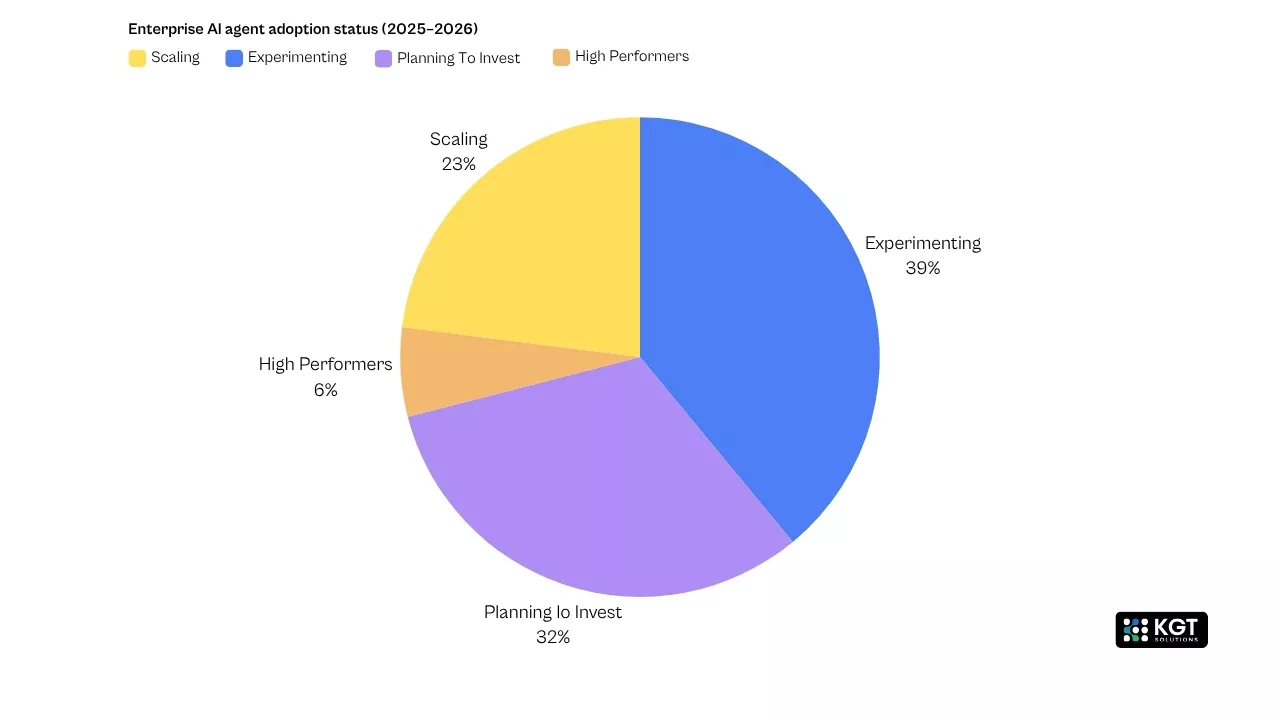
Around 45% of Fortune 500 companies are actively piloting agentic systems (Bayelsa Watch, 2026). Another 40% of enterprise applications are expected to embed task-specific agents by the end of 2026. GenAI adoption with agentic systems is expected to grow from 25% in 2025 to 50% by 2027 (Bayelsa Watch, 2026). If your competitors are in that 45%, and you are still debating whether to start, you are already behind.
The numbers on worker productivity are hard to ignore. Employees using these tools report a 61% increase in efficiency. Developers using AI coding assistants complete tasks 126% faster. Customer service organizations using agents are 128% more likely to report high ROI. These are not projections. These are measurements from organizations that have already deployed.
The risks of inaction compound. Every month you delay, your competitors accumulate data from agent interactions that make their systems smarter. Every customer interaction handled by an agent generates training data. That flywheel effect means the gap between early adopters and laggards will not stay linear. It will accelerate.
Whether you start with a custom solution for a single workflow or engage an AI business consultant to map your entire operation, the first step matters more than the perfect step. Seventy percent of business leaders already say agentic AI is both strategically vital and market-ready (Master of Code, 2026). The question is not whether these systems work. It is whether you will let them work for you.
Frequently Asked Questions
What do AI agents actually do in a business context?
How are AI agents different from chatbots and traditional AI tools?
What business functions benefit most from AI agent deployment?
Are AI agents safe enough to handle sensitive business operations?
What should businesses measure to evaluate AI agent performance?
Sources:
Grand View Research. (2026). AI Agents Market Size and Share, Industry Report 2033. grandviewresearch.com
Bayelsa Watch. (2026). Agentic AI Statistics by Market Size and Trends. bayelsawatch.com
Bayelsa Watch. (2026). AI Agent Statistics by Market Size and Economic Impact. bayelsawatch.com
MarketsandMarkets. (2025). AI Agents Market Report 2025-2030. marketsandmarkets.com
Master of Code Global. (2026). 150+ AI Agent Statistics. masterofcode.com
Warmly. (2026). 35+ Powerful AI Agents Statistics: Adoption and Insights. warmly.ai
Fortune Business Insights. (2026). Agentic AI Market Size, Share, Forecast Report 2026-2034. fortunebusinessinsights.com
IBM. (2026). Agentic AI vs. Generative AI. ibm.com
Salesforce. (2025). Agentic AI vs Generative AI: Key Differences Explained. salesforce.com
Red Hat. (2026). Agentic AI vs. Generative AI. redhat.com
UiPath. (2025). 2025 Agentic AI Report. uipath.com
Zendesk. (2025). CX Trends 2025 Report. zendesk.com
EY. (2025). Technology Pulse Poll. ey.com
LangChain. (2025). State of AI Agents Report. langchain.com
Kore.ai. (2025). Agentic AI vs Generative AI: Key Differences Enterprises Need to Know. kore.ai
Protocol AI Newsletter
Practical insights on AI, automation, and intelligent systems focused on real-world applications, not hype.