Secrets of Successful Blockchain Development Projects

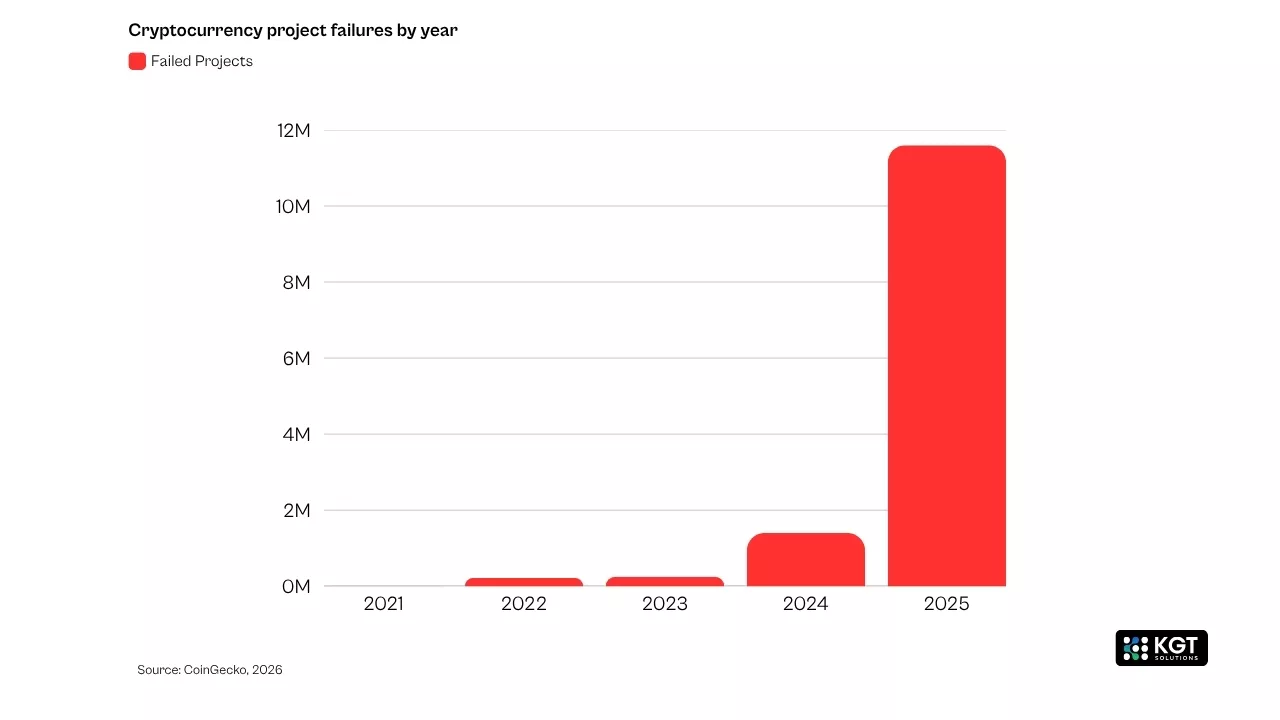
Most blockchain projects die. That's not pessimism, it's arithmetic. CoinGecko's 2026 data shows that 53.2% of the roughly 20.2 million tokens launched since 2021 have already stopped trading. In 2025 alone, 11.6 million projects collapsed, accounting for 86.3% of all recorded failures in the five-year window (CoinGecko, 2026). Meanwhile, Crunchbase numbers suggest that 80% of blockchain startups fold within their first three years.
So what separates the projects that survive from the ones that end up as footnotes on a dead explorer page? After spending years watching blockchain development cycles up close, I think the answer comes down to a handful of unglamorous habits that most teams skip in a rush to ship.
Successful blockchain development projects rarely succeed by accident. They are the result of clear problem definition, security-first engineering, and community building that starts before the first line of code ships
Why Most Blockchain Development Projects Fail
Before getting into what works, it helps to understand the failure modes. A 2025 study published in Frontiers in Blockchain examined the TradeLens collapse through the lens of commons theory, and found three recurring killers: poor stakeholder engagement, unclear governance structures, and unresolved confidentiality concerns (Najati, 2025). A separate analysis from the Journal of Operations Management studied five blockchain technology providers and concluded that projects with founders who looked outside the blockchain ecosystem for design inspiration outperformed those that stayed insular (Zhan et al., 2025).
The GameFi sector tells a particularly brutal story. A study of 3,279 GameFi projects found that roughly 93% were functionally dead, defined as having lost over 90% of peak token value with fewer than 100 daily active users (ChainPlay/Mavis Digital, 2025). The average lifespan of a GameFi project in 2024 was four months.
These aren't fringe experiments. These are funded projects with development teams that shipped code. They failed because they skipped the fundamentals.
Secret #1: Start With a Real Problem, Not a Technology
The first secret of successful blockchain development is choosing a problem that actually requires a distributed ledger. A 2025 paper from Frontiers in Blockchain noted that IBM Food Trust, VeChain, and Walmart Canada's blockchain freight system all struggled with adoption, not because the technology was wrong, but because the problem-technology fit was weak (Najati, 2025).
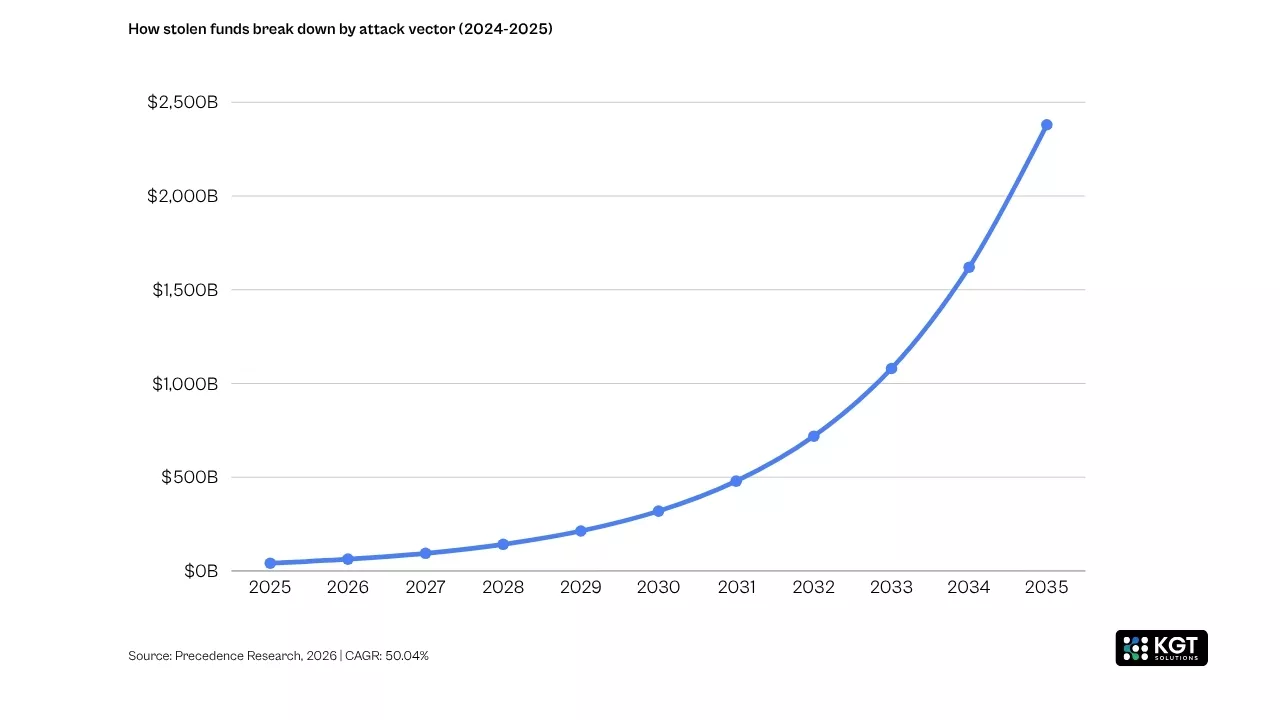
This sounds obvious, but it gets ignored constantly. The blockchain development services market is projected to hit $62.91 billion by 2026, growing at a 50.04% CAGR through 2035 (Precedence Research, 2026). That kind of money attracts teams who build first and find a use case later. It rarely works.
The projects that last tend to start with a specific, painful problem cross-border settlement friction, supply chain provenance gaps, or fragmented digital identity and then evaluate whether blockchain is the right tool. Sometimes it isn't, and that's fine.
Smart contract development companies that survive tend to work this way too. The best ones push back on clients who want "a blockchain" without a clear reason. They ask hard questions about whether the project needs decentralized consensus at all, or whether a traditional database with better access controls would do the job.
Secret #2: Security Is Not a Phase, It's a Culture
Here's a number that should keep every blockchain developer awake at night: between 2020 and 2025, more than $3.8 billion was stolen through smart contract vulnerabilities alone, according to Chainalysis data cited by Beltsys Labs (2026). In 2024, smart contract logic exploits accounted for 40% of all stolen funds in the crypto ecosystem.
And it got worse. Q1 2025 was the worst quarter on record for crypto hacks, with Immunefi estimating $1.64 billion lost in a single quarter. The $1.5 billion Bybit breach in February 2025 didn't even exploit a smart contract directly. Attackers compromised a developer's workstation and injected malicious code into a wallet signing interface. The FBI attributed the attack to North Korea's Lazarus Group (SigIntZero, 2026).
A smart contract audit is not a checkbox exercise. Audited contracts saw 98% fewer exploits from logic vulnerabilities compared to unaudited ones, according to 2025 data compiled by CoinLaw.
But audits alone aren't enough. A SigIntZero analysis of the 100 largest distributed software breaches (totaling $10.77 billion in losses) found that only 20% of exploited applications had undergone a professional security audit. However, audited applications accounted for just 10.8% of total value lost. The problem? Most audits reviewed code correctness while the actual exploits targeted business logic and operational processes (SigIntZero, 2026).
What does a security-first culture actually look like in practice?
It means running multiple audit layers. Static analysis tools like MythX and Slither can catch roughly 92% of known vulnerabilities in test environments, but they miss edge-case logic issues (CoinLaw, 2025). Manual audits detect over 90% of business logic problems that automation misses. Smart contract development companies working on anything serious should budget for both.
It means launching bug bounty programs. Platforms like Immunefi have paid out over $100 million in rewards to ethical hackers. A bug bounty isn't a replacement for a formal audit, but it extends your security perimeter past deployment. In 2025, one Layer-2 network set its critical bug bounty cap at $1 million (SQ Magazine, 2025).
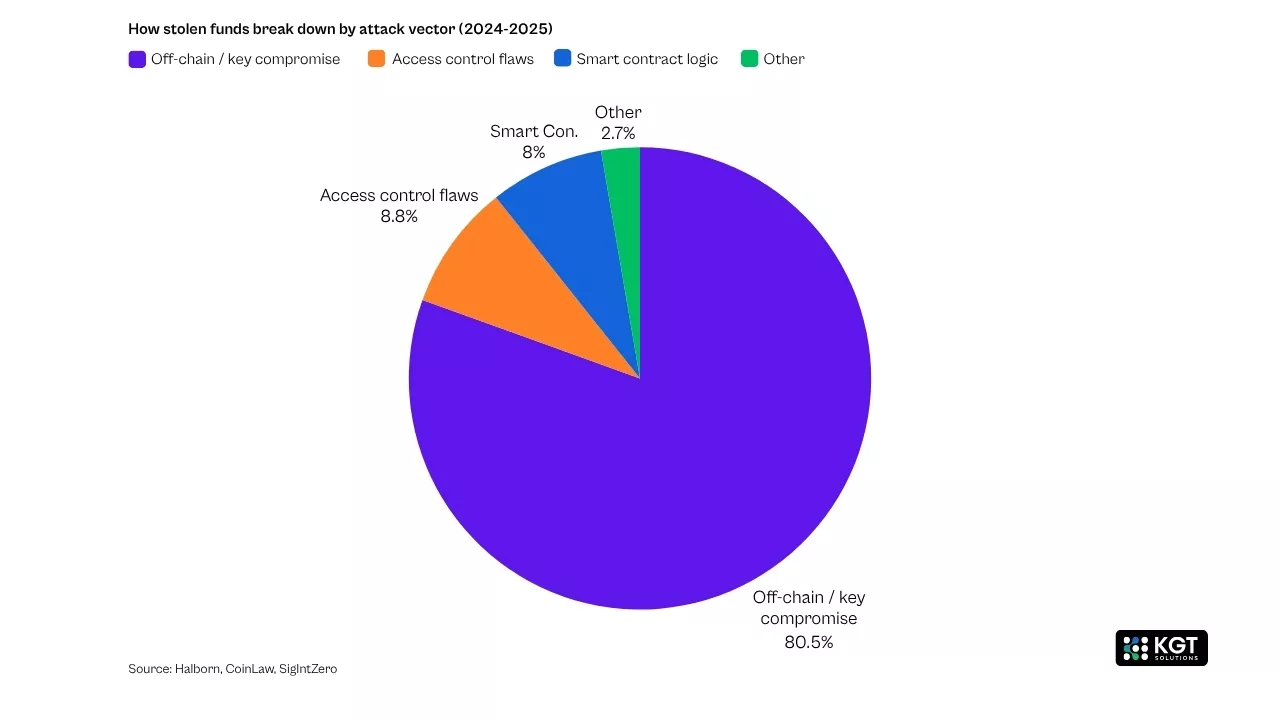
It means locking down your operational stack. Only 19% of hacked DeFi protocols in 2024 used multi-signature wallets, and just 2.4% employed cold storage, according to Halborn's Top 100 DeFi Hacks Report. Off-chain attacks accounted for 80.5% of stolen funds that year.
Secret #3: Pick Your Tech Stack Like Your Business Depends on It
Because it does. The choice between Layer 1 and Layer 2, between Solidity and Rust, between permissioned and public chains - these aren't academic questions. They shape everything from transaction costs to developer hiring.
Blockchain development solutions built on the wrong infrastructure create technical debt that compounds over time. In 2025, over 65% of new smart contracts were deployed on Layer 2 chains, according to CoinLaw's developer activity analysis. Layer 2 networks processed more than 1.9 million daily transactions and held roughly $39.39 billion in total value locked through November 2025.
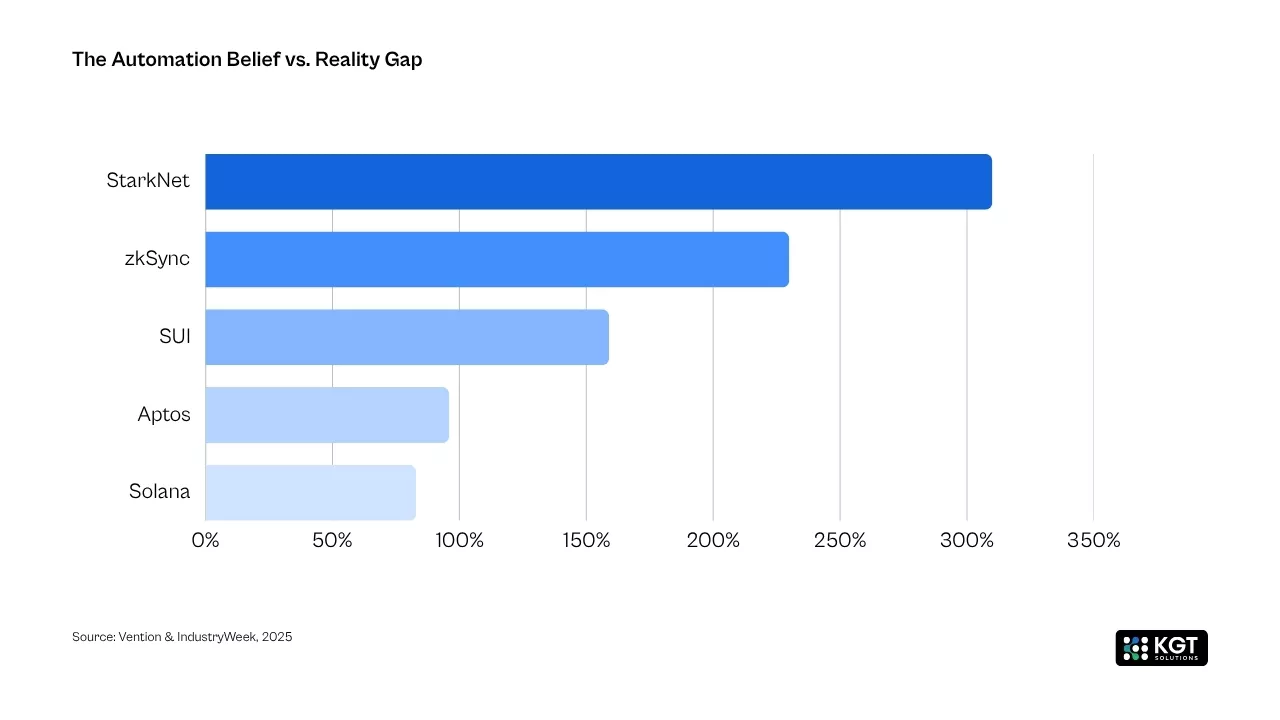
The developer ecosystem has shifted in ways that matter for hiring. Solana saw 83% year-over-year growth in new developers between 2023 and 2024. Aptos grew its developer base by 96%. Sui surged by 159%. Meanwhile, zkSync developer growth jumped 230% and StarkNet activity climbed 310% thanks to Cairo bootcamps (CoinLaw, 2026).
For a web3 development company building client applications, these numbers directly affect talent availability, community support, and long-term ecosystem viability. Building on a chain with a shrinking developer community is a slow-motion risk that doesn't show up in sprint planning.
Custom blockchain development requires matching the consensus mechanism to the use case. Proof-of-stake has become the default for energy efficiency, but permissioned networks using practical Byzantine fault tolerance still make sense for enterprise supply chain applications where participant identity matters more than censorship resistance.
Vertical SaaS Trends: Why Niche Platforms Win

Secret #4: Tokenomics That Survive Contact With Reality
I keep seeing projects fail for the same tokenomics mistakes. Inflationary supply with no cap. No compelling reason for users to hold the token. Massive insider allocations that destroy trust. Dependence on speculation instead of utility-driven demand.
A token model needs to capture value from actual business activity, not from the hope that someone else will buy it for more later. The 2025 crypto market made this point brutally clear. The October 2025 liquidation cascade wiped out $19 billion in leveraged positions within 24 hours, and the projects hit hardest were the ones with shallow liquidity and no fundamental usage.
Crypto token development services that build sustainable models tend to share a few characteristics. They tie token utility to specific actions within the platform: governance votes, fee discounts, staking for security, or access to features. They implement vesting schedules that prevent early insiders from dumping. They plan for deflation or buyback mechanisms funded by actual protocol revenue.
The Web3 development services market is valued at $4.63 billion in 2025 and is projected to reach $176.32 billion by 2034, growing at a 49.84% CAGR (Fortune Business Insights, 2025). That growth will reward projects with real revenue models and punish those relying on token inflation.
Secret #5: Build Community Before You Build Features
This one runs counter to most engineering instincts, but the data supports it. The projects that survive market downturns are the ones with communities that stick around when the price drops. Ethereum onboarded 16,181 new developers in the first nine months of 2025 alone, maintaining strong inflows even during periods of market stress (CoinLaw, 2026).
Community is the moat. Code can be forked. Liquidity can be mercenary. A committed user and developer base is the one asset that can't be replicated by a competing dApp development company.
A web3 application development project should treat community building as a product function, not a marketing afterthought. This means transparent governance from day one, regular public development updates, and feedback loops that give users real influence over the roadmap. The projects that have navigated bear markets successfully - Ethereum, Bitcoin, a handful of DeFi protocols - all share this trait.
Secret #6: Interoperability Is Table Stakes Now
The era of single-chain thinking is over. In 2026, the blockchain market is estimated at $13.7 billion (Research Nester, 2025), and the money is flowing toward projects that work across multiple ecosystems. Cross-chain bridges, multi-chain deployments, and interoperability protocols have gone from nice-to-have to mandatory.
Blockchain development services that ignore cross-chain compatibility are building for a smaller market every quarter. The Nomad Bridge exploit ($190 million lost) showed what happens when cross-chain infrastructure is treated as an afterthought. Only 18.6% of the critical contract matched what auditors had originally reviewed, because the code had been modified post-audit (SigIntZero, 2026).
Emerging technology solutions in this space increasingly combine blockchain with AI, IoT, and extended reality. Metaverse development services are building on decentralized infrastructure where AR/VR environments require persistent digital ownership, and that ownership layer needs to work across chains. This convergence is opening new territory for XR development services that understand both immersive experience design and on-chain asset management.
Secret #7: Regulatory Compliance Is a Feature, Not an Obstacle
In 2024, 22% of blockchain organizations faced fines for non-compliance, according to data compiled by SQ Magazine (2025). Meanwhile, 61% of trade-related smart contracts failed at least one local regulation check. Only 29% included automated compliance features.
Treating compliance as an engineering problem rather than a legal nuisance separates lasting projects from dead ones. The regulatory landscape is tightening globally. The SEC has established clearer frameworks, European regulators are moving toward recognizing smart contracts as enforceable, and Asia-Pacific governments are mandating blockchain adoption in specific sectors. India's telecom regulator, TRAI, required telcos to migrate SMS headers to a blockchain-based DLT platform by late 2024 (Fortune Business Insights, 2025).
Blockchain development solutions that bake compliance into the protocol layer, rather than bolting it on later, save months of rework and avoid regulatory risk that can kill a project outright.
Secret #8: Ship Incrementally, Not All at Once
The blockchain industry has a weakness for grand launches. A big TGE, a massive marketing push, and then... silence as the team tries to build what they promised. The projects that last usually ship the other way around: small releases, early testnet access, progressive feature rollouts, and continuous deployment.
This approach works for several reasons. It surfaces bugs before they become exploits. It builds community confidence through visible progress rather than promises. And it creates a feedback loop that lets the team adjust before they've committed to an architecture that doesn't fit the market.
VR development companies and AR VR development companies entering the blockchain space face a version of this challenge. The temptation is to announce a fully immersive decentralized metaverse and then spend two years building it in silence. The teams that succeed tend to launch simpler, more focused experiences first and expand based on what users actually want.
Secret #9: Invest in Developer Experience
About 23,615 open-source crypto developers were active monthly as of 2024, down from roughly 25,419 in 2023 (CoinLaw, 2026). Developer counts fluctuate by 5 to 10% annually, and the competition for this talent is intense. The average blockchain developer salary in the U.S. runs around $107,000, reaching $132,400 in Singapore.
An advance tech solution that's hard for developers to build on will lose to one that's easy, regardless of technical superiority. Base, Coinbase's Layer 2, onboarded over 1,600 developers within its first year of launch and accounted for 42% of new Ethereum ecosystem code in 2024, largely because the development experience was smooth.
Blockchain development services need to invest in documentation, SDKs, example applications, and developer relations. The chains winning the developer mindshare war in 2025-2026 are the ones that reduced friction, not the ones with the most impressive whitepapers.
Secret #10: Plan for What Happens After Launch
Most blockchain project postmortems point to post-launch neglect as a leading cause of failure. The team raises funds, ships a product, and then either burns through their treasury or loses focus.
Successful blockchain development projects plan their post-launch operations from the start. This means treasury management that extends runway beyond the next market cycle. It means upgrade paths that don't require migrating the entire user base. It means monitoring infrastructure that catches anomalies before they become exploits. Real-time monitoring audits prevented over $100 million in potential losses on decentralized platforms in 2023 (CoinLaw, 2025).
It also means governance mechanisms that let the project evolve. DAOs aren't the answer for everything, but some form of decentralized decision-making helps projects survive the inevitable departure of founding team members.
A crypto wallet development company building custodial infrastructure, for instance, needs upgrade mechanisms that don't put user funds at risk during migration. The projects that plan for this from day one avoid the scramble that kills so many post-launch.
The Blockchain Development Landscape in 2026
The global blockchain technology market was estimated at $41.14 billion in 2025, and forecasts put it at $62.91 billion for 2026 (Precedence Research, 2026). North America holds about 46% of that market, with Asia-Pacific growing fastest. The payments segment alone contributed 45% of total revenue in 2025.
The Web3 market tracks a parallel curve, valued at $4.63 billion in 2025 and projected to hit $176.32 billion by 2034 (Fortune Business Insights, 2025). The convergence of blockchain with AI, IoT, and extended reality is creating new categories that didn't exist three years ago.
For teams entering this space now, whether as a blockchain development company, a crypto wallet development company, or a firm offering broader emerging technology solutions, the rules haven't changed as much as the scale of opportunity. Build something people need. Secure it properly. Ship it incrementally. Listen to your community. Don't assume the token price will save you.
The projects that will still be running in 2030 are the ones that treat these habits as non-negotiable, not optional extras to consider once the mainnet is live.
Frequently Asked Questions About Blockchain Development
What makes a blockchain development project successful?
Successful blockchain development projects share a common DNA: they solve a genuine problem that benefits from decentralization, they treat security as a continuous practice rather than a one-time audit, and they build communities that survive market downturns. According to the data, projects with professional security audits accounted for just 10.8% of total exploit losses, compared to 89.2% for unaudited ones (SigIntZero, 2026). That gap alone tells you where priorities should sit.
How much does a smart contract audit cost in 2026?
Costs vary widely depending on complexity. Simple ERC-20 token audits typically run $8,000 to $20,000, while advanced cross-chain or DeFi protocol audits cost $75,000 to $150,000 or more (CoinLaw, 2025). Auditor reputation also matters. A review from a top-tier firm like OpenZeppelin or Trail of Bits carries more credibility but costs two to three times more than lesser-known outfits (Beltsys Labs, 2026).
What is the failure rate of blockchain projects?
The numbers are sobering. CoinGecko data from January 2026 shows that 53.2% of all cryptocurrency projects launched since 2021 have stopped trading. Earlier research from the China Academy of Information and Communications Technology put the historical failure rate at 92%, with an average project lifespan of just 1.22 years. The blockchain development projects that survive tend to be the ones with real utility, sustainable tokenomics, and active developer communities.
Which blockchain should I build on in 2026?
There's no universal answer, but developer activity is a strong signal. In 2025, Layer 2 networks accounted for over 65% of new smart contract deployments, and chains like Base, Arbitrum, and Optimism are attracting significant builder attention (CoinLaw, 2026). Solana, Aptos, and Sui are growing rapidly on the Layer 1 side. The right choice depends on your use case, target users, and the ecosystem's tooling maturity for your specific application.
Frequently Asked Questions
What separates successful blockchain development projects from those that fail?
How important is smart contract auditing for blockchain project success?
What is the average timeline for a blockchain development project from concept to launch?
What blockchain platform should businesses choose for enterprise development projects?
How can businesses avoid common pitfalls when hiring a blockchain development company?
Sources:
CoinGecko. (2026). "Cryptocurrency Project Failures 2021-2025." Reported via CoinDesk, January 2026.
Najati, I. (2025). "Exploring the Failure Factors of Blockchain Adopting Projects: A Case Study of TradeLens." Frontiers in Blockchain, Vol. 8.
Zhan et al. (2025). "Success and Failure of Blockchain Technology Providers." Journal of Operations Management, Vol. 71, No. 7.
ChainPlay / Mavis Digital. (2025). "GameFi Project Failure Analysis."
Precedence Research. (2026). "Blockchain Technology Market Size, Share, Growth 2026-2035."
Research Nester. (2025). "Blockchain Market Size & Share, Growth Trends 2035."
Fortune Business Insights. (2025). "Blockchain Technology Market & Web 3.0 Market Reports."
CoinLaw / CoinLedger. (2026). "Blockchain Developer Activity Statistics 2026."
SigIntZero. (2026). "2026 Software Security Report: Audited Applications Account for Only 10.8% of Exploit Losses."
Halborn. (2025). "The Top 100 DeFi Hacks Report 2025."
Beltsys Labs. (2026). "Smart Contract Auditing: Why It's Non-Negotiable."
SQ Magazine. (2025). "Smart Contract Bug Bounties Statistics 2025."
CoinLaw. (2025). "Smart Contract Security Risks and Audits Statistics 2025."
MarketsandMarkets. (2025). "Blockchain Market Report 2025-2030."
Crunchbase. (2025). Blockchain startup failure rate data.
OWASP. (2025). "Smart Contract Top 10."
Immunefi. (2025). Q1 2025 crypto losses data.
Stay Ahead of Systems Innovation
AI-first SaaS, Web3, and XR insights covering systems, product thinking, and technologies that move from idea to production.