Best AI Agents That Actually Deliver Results

Picking the right generative AI development company to build your agents is the difference between a demo that impresses your board and a system that actually saves money. I've watched dozens of businesses get burned by tools that worked fine in controlled environments and fell apart the moment real data hit them. So here's what's working right now, who's doing it, and what to look for when you're ready to build.
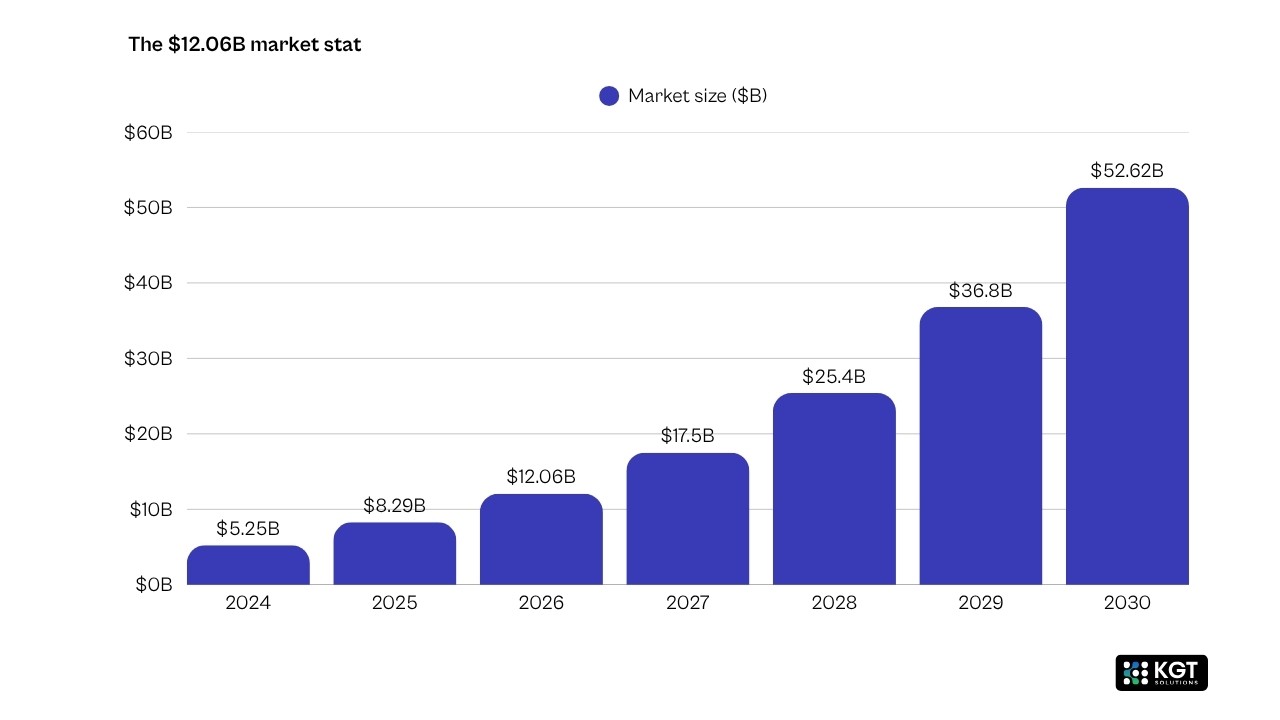
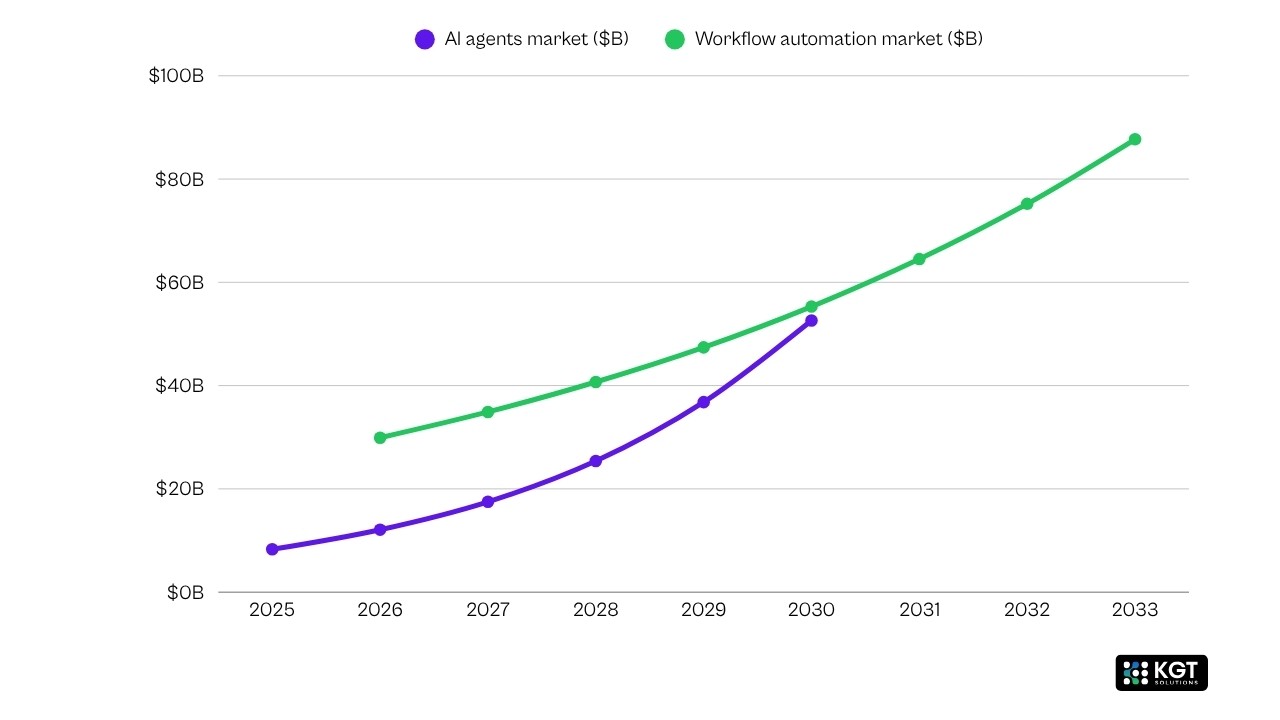
The best AI agents delivering results in 2026 focus on specialized automation, executing multi-step workflows across finance, CRM, and customer service rather than general-purpose chat. The market hit $12.06 billion in 2026, growing at a 45.5% CAGR, according to Research and Markets. That's not hype money. That's enterprises paying for tools that replaced manual work.
What separates the best AI agents from expensive chatbots
The distinction matters more than most vendors will admit. Traditional chatbots match keywords to scripted responses. Agentic systems use natural language processing and machine learning to understand intent, hold context across a conversation, and take action inside your business systems. They process refunds, update CRM records, trigger workflows, and handle multi-step operations without a human babysitting them.
Effective agents resolve problems instead of deflecting them. Gartner predicts that by the end of 2026, 40% of enterprise applications will include task-specific agents, up from less than 5% in 2025. Salesforce's Agentforce already resolves 84% of customer queries internally, which freed the company to redeploy 2,000 support positions. That's a concrete number from a company eating its own cooking.
Which AI agents are producing real ROI
A few names keep showing up in production environments, not just pitch decks.
Salesforce Agentforce handles CRM workflows end to end. Fisher & Paykel reported that agentic AI now responds to 66% of its web queries and makes proactive customer suggestions, per Coherent Market Insights. Oracle's Fusion Cloud processes millions of financial transactions per hour with built-in SOX and GDPR compliance logging. Sierra focuses exclusively on customer service, and companies using it report measurable drops in resolution time.
For teams that need custom AI solutions rather than off-the-shelf platforms, a specialized development partner can fine-tune models on proprietary data, build retrieval-augmented generation (RAG) pipelines, and deploy systems that understand your specific industry language. According to MarketsandMarkets, the broader market is projected to reach $52.62 billion by 2030. The companies capturing that growth are the ones building vertical-specific solutions, not horizontal everything-bots.
Early adopters of workflow automation services report an average 171% ROI on their AI automation investments, according to a Landbase analysis of enterprise data. That return comes from agents handling repetitive, high-volume tasks that previously ate hundreds of staff hours per week.
How to create an AI agent that doesn't fail in production
Here's where most projects go wrong. According to Gartner's AI Reliability Index, 85% of organizations cite production stability and the "maintenance trap" as their primary concerns, where agents require more human hours to fix than they save. And roughly 90% of legacy agents fail within weeks of deployment because they lack the architectural depth for real enterprise conditions.
To create an AI agent that survives production, start with one workflow, get feedback, and iterate before trying to automate everything. The successful pattern looks like this: pick a single high-friction process (claims processing, lead qualification, invoice reconciliation), build an agent for that, measure the results, then expand.
The workflow automation market is valued at $29.9 billion in 2026 and projected to reach $87.7 billion by 2033 at a 16.6% CAGR, per Coherent Market Insights. That growth is coming from companies that got the first agent right and then scaled, not from companies that tried to automate twelve departments simultaneously.
Where AI agents work best across industries
Financial services leads adoption at 84%, achieving 60% faster transaction processing and $12.5 million in annual savings per mid-size bank, according to McKinsey's State of AI research. Healthcare follows at 71% adoption, with AI handling patient intake, clinical documentation, and claims processing. Retail and e-commerce use agentic tools for personalized recommendations, inventory management, and the checkout fraud detection that human staff can't keep up with.
AI workflow automation now handles everything from accounting workflow software to insurance claims routing, replacing manual processes that used to require dedicated teams. In insurance specifically, agentic systems manage policy quoting, claims triage, and customer follow-up. Real estate firms use them for lead scoring, property matching, and transaction coordination. These aren't experimental pilots. Companies using workflow automation tools across multiple business functions report that 39% have seen productivity double, per data cited by HumanizeAI.io.
The pattern is clear: these systems work when they're trained on domain-specific data and deployed against a defined workflow. An ai business consultant will tell you the same thing. General-purpose tools that promise to "handle anything" usually handle nothing particularly well.
Agentic Orchestration Explained for Enterprise CTOs
What to look for in a generative AI development company
If you're evaluating partners, focus on four things. First, do they have production deployments in your industry, not demos, not proofs of concept. Second, can they implement RAG architecture to ground their models in your actual company data. Third, do they handle compliance (particularly if you're in finance, healthcare, or insurance). Fourth, can they show you measurable before-and-after numbers from real clients.
The best workflow management software combined with custom agents creates systems that learn from each cycle, getting faster and more accurate over time rather than staying static. IBM and Salesforce estimate over one billion agents will be in operation worldwide by the end of 2026. The gap between companies deploying these systems and those still running manual processes is about to become very difficult to close.
Custom AI solutions built on your data will outperform generic platforms every time. The question isn't whether these tools work. It's whether you're building the right one for the right job.
Frequently Asked Questions
What makes an AI agent different from a regular chatbot?
Which AI agents are best for small and mid-size businesses?
How do you measure whether an AI agent is actually delivering results?
What are the biggest risks of deploying AI agents in production?
Can AI agents work together as a team on complex tasks?
Sources:
Research and Markets, "AI Agents Market Report 2026" (2026)
MarketsandMarkets, "AI Agents Market Report 2025-2030"
Gartner, AI Reliability Index and enterprise application predictions (2026)
Coherent Market Insights, "Workflow Automation Market Size, Share & Analysis, 2026-2033"
Salesforce, Agentforce internal deployment data (2024-2026)
McKinsey, "State of AI" research on industry adoption rates
Landbase, "39 Agentic AI Statistics Every GTM Leader Should Know in 2026"
HumanizeAI.io, "AI Agents Growth Statistics 2026"
Google Cloud, "AI Agent Trends 2026 Report"
Protocol AI Newsletter
Practical insights on AI, automation, and intelligent systems focused on real-world applications, not hype.