Is A Generative AI Development Company Hype or Help?

Every few months, a new vendor pitches AI as the answer to problems you didn't know you had. The demos look impressive. The slide decks promise transformation. But when budgets get approved and pilots go live, results get complicated fast. So where does a generative AI development company actually land between marketing noise and measurable value?
A generative AI development company builds custom AI systems using large language models and other generative architectures to automate content creation, code generation, drug discovery, and business workflows for enterprises.
The short answer: both, depending on execution. The market hit $22.21 billion in 2025 and is projected to reach $324.68 billion by 2033 at a 40.8% CAGR, according to Grand View Research. That money isn't flowing into vaporware. But it's not all flowing into production systems either.
Why Most Pilots Stall
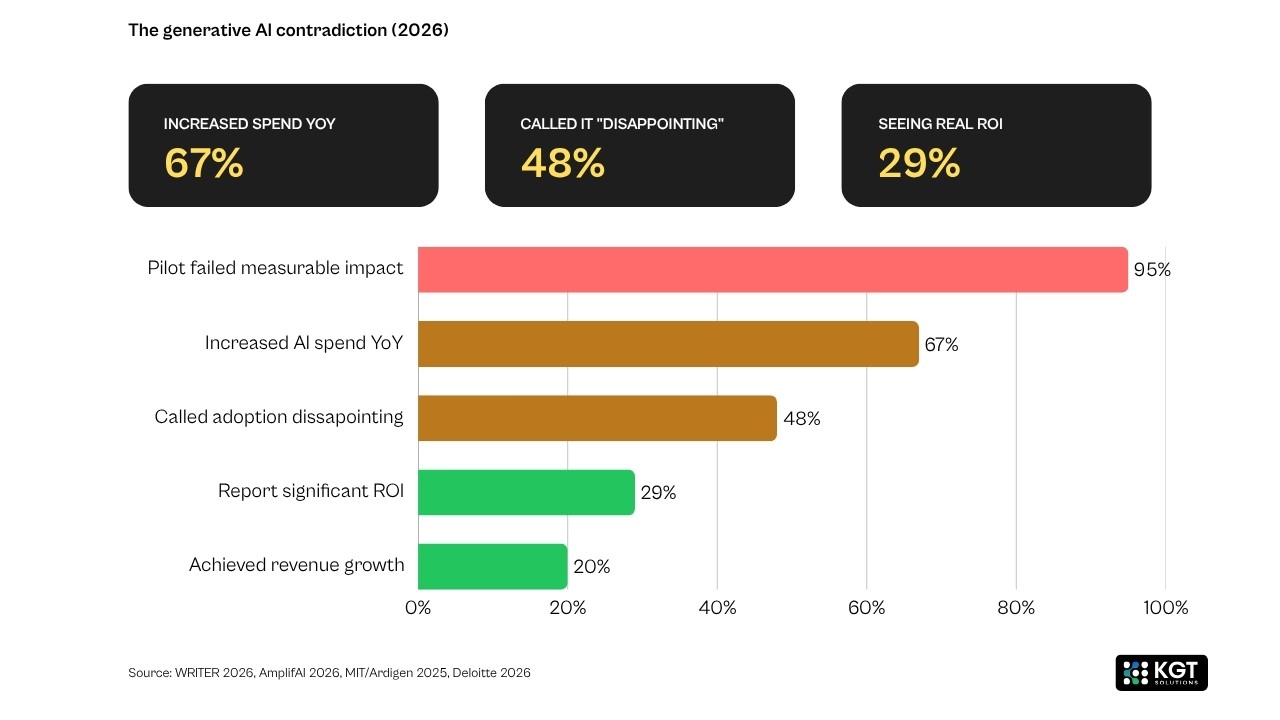
A 2025 MIT study found that nearly 95% of enterprise AI pilots failed to deliver measurable business impact (Ardigen, citing MIT research). The failures weren't about bad models. They were about disconnected workflows, poor data foundations, and nobody owning the outcome.
WRITER's 2026 enterprise survey sharpens the picture: 48% of executives called AI adoption a "massive disappointment," up from 34% the year before. Only 29% of organizations reported significant ROI. And yet, 67% increased their spend year over year (AmplifAI). Companies believe in the potential but struggle to close the gap between a demo and a deployed system.
Generative AI development services earn their keep when they map solutions to specific revenue outcomes, with governance baked in from day one, rather than wrapping a chatbot in a slide deck. The companies doing this are in the 29% seeing real returns.
What Separates Generative AI Consulting Services That Deliver
Deloitte's 2026 State of AI report, surveying 3,235 leaders, found that two thirds of organizations reported productivity and efficiency gains from AI. But only 20% had achieved revenue growth. The pattern is clear: AI works well for operational savings. It struggles when companies expect it to magically generate top-line revenue without redesigning workflows.
Enterprise generative AI solutions succeed when they tie AI directly to cost or revenue outcomes, give business teams autonomy while IT retains oversight, and treat adoption as organizational redesign rather than a technology rollout (WRITER, 2026).
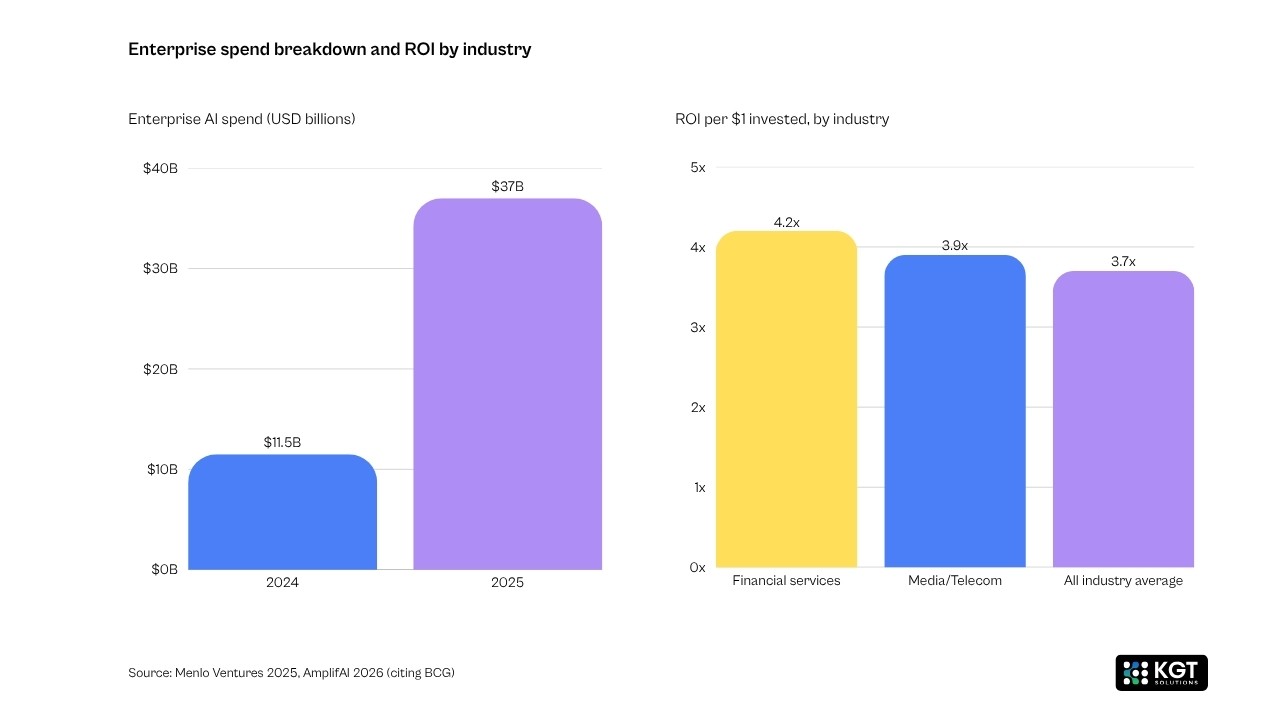
Menlo Ventures' 2025 report found that enterprise AI spend jumped from $11.5 billion to $37 billion in a single year, a 3.2x increase. More than half went to applications rather than infrastructure, meaning enterprises want immediate productivity gains. Generative AI development services built around this preference have a structural advantage.
Agentic AI vs Generative AI: Where the Market Is Heading
Agentic AI refers to systems that plan, execute multi-step tasks, and act autonomously within defined guardrails, while generative models focus on creating content, code, or data from learned patterns. The two aren't competitors. They're converging.
Gartner predicts agentic AI will resolve 80% of common customer service issues without human intervention by 2029, cutting operational costs by 30% (AmplifAI). Enterprise applications featuring task-specific AI agents are expected to jump from under 5% in 2025 to 40% by end of 2026. Integration companies that can combine LLM development services with agentic capabilities will capture a disproportionate share of that spend.
For any development company focused on India or other high-growth markets, this shift matters. The India market alone is projected to reach $2.756 billion by 2026 (Fortune Business Insights).
Generative AI in Healthcare: Where Results Are Hardest to Dismiss
If you want to know whether the technology is hype or help, look at drug discovery. Traditional development costs about $2.5 billion and takes 12 to 15 years per approved compound. AI is compressing both numbers.
In April 2025, Rentosertib became the first drug where both the target and the compound were discovered using generative models to receive an official name from the USAN Council (Delve Insight). Insilico Medicine moved ISM001-055 into Phase IIa trials for idiopathic pulmonary fibrosis with positive results, developing it in under 30 months, roughly half the conventional timeline (ScienceDirect, 2025).
The AI-driven drug discovery market is expected to grow from $250 million in 2024 to $2.85 billion by 2034, at a 27.42% CAGR (Towards Healthcare). These aren't theoretical projections. There are named compounds in human trials with regulatory milestones. Generative AI for business in pharma isn't a pitch deck. It's clinical data.
Agentic Orchestration Explained for Enterprise CTOs

How to Evaluate a Generative AI Development Company
Look for a partner that starts with your workflow, not their model. The best generative AI app development services build backward from a measurable outcome and use the simplest architecture that achieves it.
A few filters worth applying: Does the company show you failed projects and what they learned? Do they have a governance framework, or do they bolt one on after launch? Can they explain the difference between an ai prototype generator and a production system, and have they shipped both?
The Wharton 2025 AI Adoption Report found that three out of four leaders who formally measured ROI saw positive returns. The keyword there is "formally measured." Companies that treated AI as a cost center with no tracking got exactly the results you'd expect.
Generative AI integration services work best when the development partner acts less like a vendor and more like an embedded team. The enterprises crossing what MIT calls "the GenAI divide" are the ones where domain managers surfaced problems, vetted tools, and led rollouts, with executive accountability on top.
The Bottom Line
The 29% of organizations seeing real ROI aren't lucky. They picked problems worth solving, hired partners who understood those problems, and measured results from day one.
For every $1 invested, companies see an average return of $3.70, with financial services leading at 4.2x (AmplifAI, citing BCG data). Those numbers describe the best performers, not the average. The gap between the two is where a good generative AI development company makes the difference.
Frequently Asked Questions
What does a generative AI development company actually build?
How do you tell if a generative AI company is legitimate or just riding the hype?
What industries are getting real value from generative AI right now?
How much does it cost to hire a generative AI development company?
What questions should you ask before signing a contract with a generative AI vendor?
Sources:
Grand View Research, "Generative AI Market Size, Share | Industry Report, 2033"
Ardigen, "AI in Biotech: 2026 Drug Discovery Trends" (February 2026), citing MIT 2025 study
WRITER, "Enterprise AI Adoption in 2026" (April 2026)
AmplifAI, "90+ Generative AI Statistics You Need to Know in 2026" (March 2026)
Deloitte, "State of AI in the Enterprise 2026" (February 2026)
Menlo Ventures, "2025: The State of Generative AI in the Enterprise" (December 2025)
Wharton/GBK Collective, "2025 AI Adoption Report" (October 2025)
Fortune Business Insights, "Generative AI Market Size, Share & Growth Report, 2034"
ScienceDirect, "Leading AI-driven Drug Discovery Platforms: 2025 Landscape" (November 2025)
Delve Insight, "Generative AI in Drug Discovery: Transforming Pharma R&D" (July 2025)
Towards Healthcare, "Generative AI in Drug Discovery Market 2025" (October 2025)
Protocol AI Newsletter
Practical insights on AI, automation, and intelligent systems focused on real-world applications, not hype.