Quality's Secret: The Industrial Automation Magic


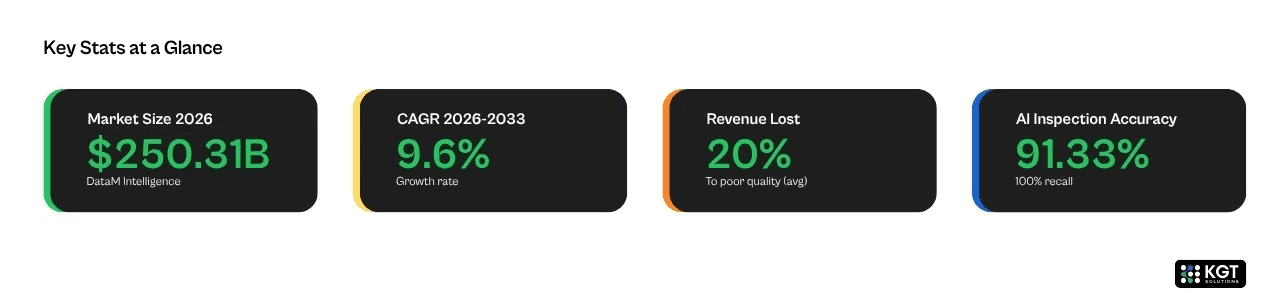
Industrial automation is how factories get quality right without depending on someone's Monday morning alertness. Today's systems combine PLCs, machine vision, IoT sensors, and AI to inspect, adjust, and correct production in real time. The global market hit $226.72 billion in 2025 and is expected to reach $250.31 billion in 2026 (DataM Intelligence), growing at a 9.6% CAGR through 2033.
Industrial automation is the use of control systems, robotics, sensors, and software to run manufacturing processes with minimal human intervention, improving speed, consistency, and product quality. The full stack includes PLC industrial automation handling machine logic, industrial control systems managing process variables, and industrial AI solutions making faster decisions than any operator could.
How Industrial Automation Actually Improves Quality
The average manufacturing company loses about 20% of revenue to poor quality costs, according to Overview.ai. On a $10 million line, that's $2 million gone to scrap, rework, and warranty claims. Automation attacks this problem at the source.
Automated quality systems process every single unit on a production line without fatigue or drift, unlike human inspectors whose accuracy drops measurably after extended shifts. An AI-driven inspection system tested on laser-engraved nameplates hit 91.33% accuracy with 100% recall, meaning it flagged every defective unit (arXiv, 2025). Keyence's CV-X updates reduced false positives from 8% to under 2% in automotive stamping, saving one Michigan supplier $1.2 million annually (Mordor Intelligence).
These aren't lab results. Cognex shipped over 500,000 In-Sight 3D systems in 2025 to electronics lines inspecting solder joints at 1,200+ units per hour. No human team matches that throughput, and no human team maintains that accuracy at 3 AM on a Friday.
Why Industrial IoT Development Services Matter for Production Monitoring
Industrial IoT solutions connect sensors, machines, and analytics platforms across a factory floor, giving engineers a real-time view of production health, equipment condition, and quality metrics. Production monitoring systems earn their keep here. When something drifts outside tolerance, the system flags it before defective parts pile up.
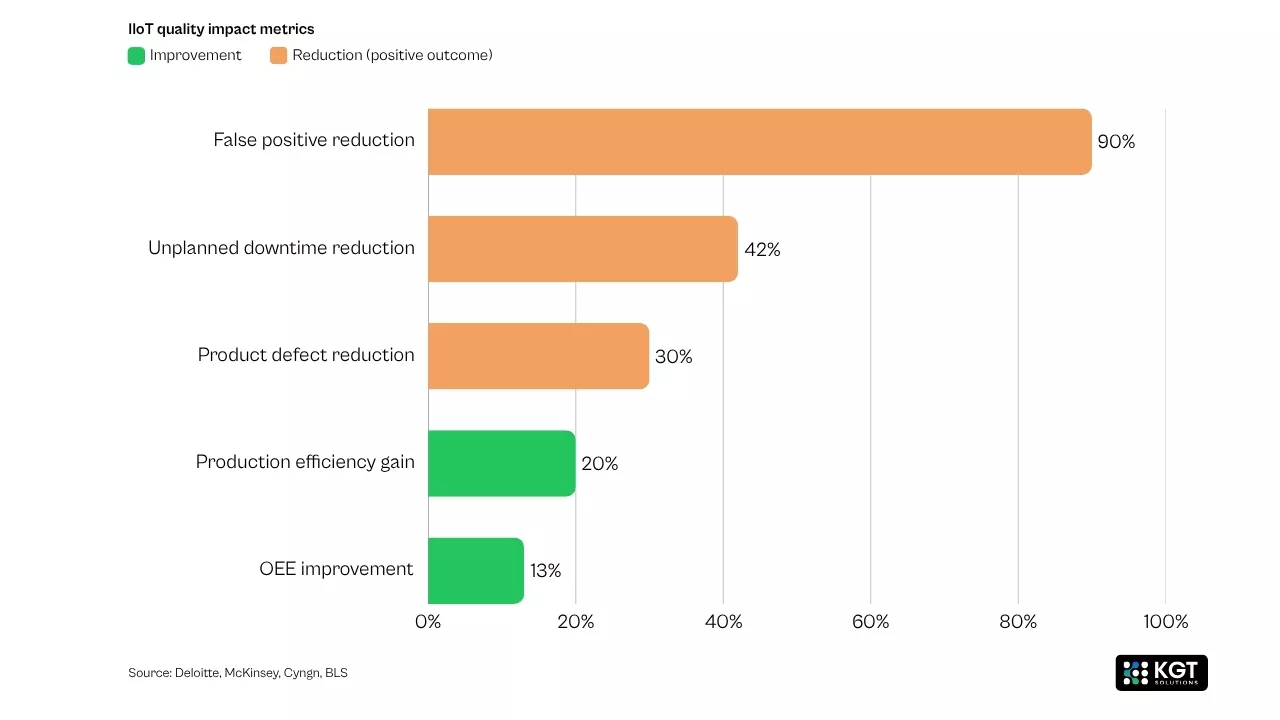
A German automotive manufacturer that implemented IIoT-based quality monitoring reduced product defects by 30% and increased production efficiency by 20% through real-time adjustments (GlobalLogic). Manufacturing facilities using edge-deployed neural networks for quality control have cut false positives in defect detection by up to 90% compared to manual inspection (World Journal of Advanced Engineering Technology and Sciences, 2025).
Around 65% of manufacturers are now shifting toward automated systems, and nearly 58% are using robotics to improve efficiency (Global Growth Insights, 2026). IIoT isn't optional anymore for anyone serious about consistent quality. It's the infrastructure that makes warehouse automation and production monitoring systems actually work.

What PLC Programming Handles Behind the Scenes
A PLC, or programmable logic controller, is the workhorse of factory automation, executing control logic for machines and processes in real time with response times measured in milliseconds. The PLC segment holds about 30% of the automation market (DataM Intelligence), and around 68% of industries rely on PLC and SCADA systems for real-time operations (Global Growth Insights).
Industrial PLC programming handles the sequencing, timing, and condition-based logic that keeps a production line running within spec. When a sensor detects a parameter outside range, the PLC adjusts the process or stops the line before defective units move downstream. The hardware component captured 69.6% of the market in 2025 (Mordor Intelligence), and PLCs sit at the center of that stack.
Where Digital Twin Software and AI-Driven Quality Fit In
Digital twins create live virtual replicas of physical manufacturing assets, synchronized through IoT sensor data, allowing simulation and optimization without disrupting actual production. The global digital twin market is valued at roughly $36.19 billion in 2025 and is projected to reach $180.28 billion by 2030 (PatSnap/Research and Markets). Patent filings in this space surged 600% between 2017 and 2025.
About 34% of companies cite quality improvement as the primary use case for digital twins (industry surveys). One mid-sized manufacturer reduced unplanned downtime by 42% and increased OEE from 65% to 78% using this approach (ManufactureNow, 2026). AI tools layer on top of these twins and sensor networks, delivering 200 to 300% ROI through defect reduction and faster inspection cycles (Tech-Stack, 2026). The same sensor-and-AI principles now show up in logistics monitoring and even healthcare settings.
IT OT Convergence in Manufacturing Explained
What a Modern Automated Quality Setup Looks Like
Picture a control room with a 5 monitor setup. One screen shows the SCADA overview. Another tracks quality metrics from the vision system. A third runs the digital twin simulation. The fourth handles data warehouse automation tools aggregating quality data across shifts and plants. The fifth monitors robotic process automation RPA services handling compliance reporting and batch records.
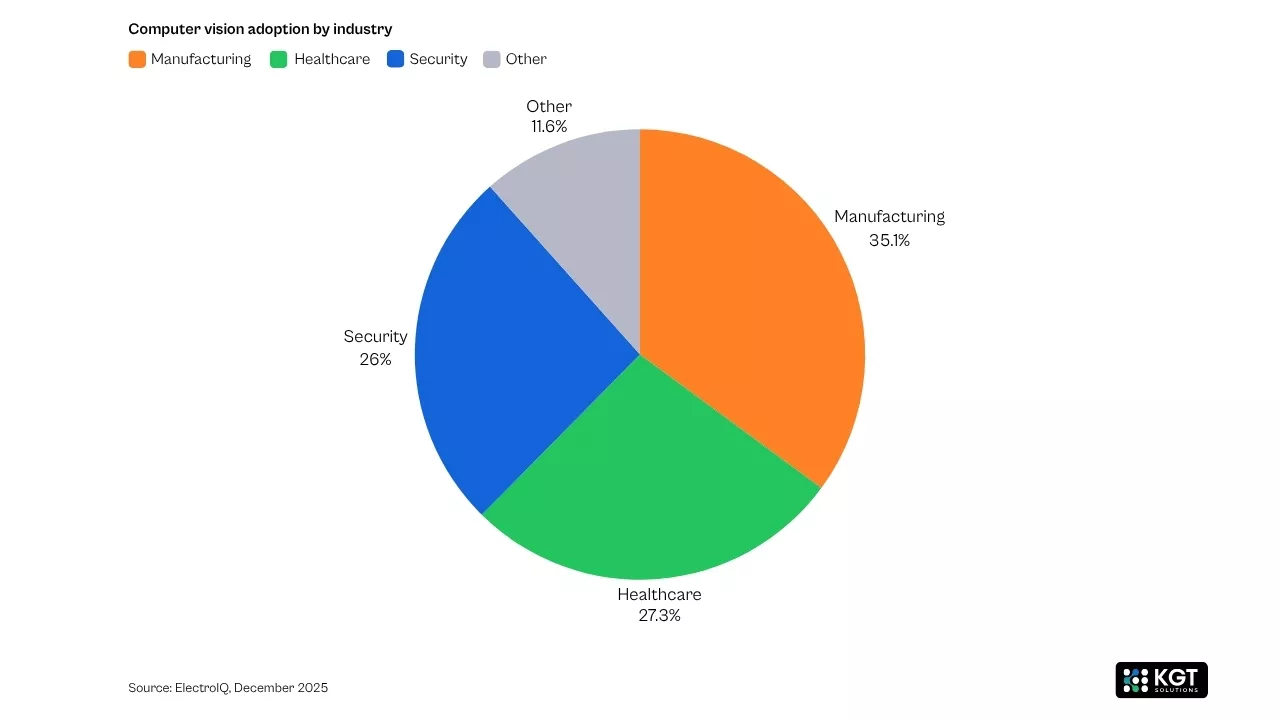
The inspection and quality assurance application commanded 41.08% of total market revenue in 2025 (Mordor Intelligence). Manufacturing accounts for 35.1% of computer vision adoption (ElectroIQ), healthcare follows at 27.3%, security at 26%. These are fields where missing one anomaly has real consequences.
What's Ahead for Industrial Automation Products
Asia Pacific held 43.1% of the market in 2025 and is expanding at a 12.3% CAGR (Mordor Intelligence). Cloud deployments in automation are growing at a 15% CAGR through 2031. More than 40% of manufacturers are in the pilot phase of digital twin adoption, signaling a move toward enterprise-wide rollout (Manufacturing IT/OT Trend Report, 2025).
The AI-driven segment of the computer vision market alone is projected to reach $254.51 billion by 2033, growing at a 32.8% CAGR (Coherent Market Insights). Edge deployment held 47.33% of market share in 2025, meaning more processing happens right where the camera and sensor sit, not in a data center across the country.
I keep coming back to a simple point: automation doesn't make quality perfect. It makes quality measurable, repeatable, and fast enough to matter. The companies investing in it aren't chasing a buzzword. They're closing the gap between what they think they're producing and what they actually are.
Frequently Asked Questions
How does industrial automation improve product quality?
What types of quality checks can be automated in manufacturing?
Does automation reduce the need for manual quality inspectors?
What industries benefit most from automated quality control?
How quickly can a factory see quality improvements after implementing automation?
Sources:
DataM Intelligence, "Industrial Automation Market Size to Reach USD 250.31 Billion in 2026" (April 2026)
Overview.ai, "100% Accuracy AI Vision: The Real Cost of Manufacturing Defects" (October 2025)
arXiv, "AI-Driven Multi-Stage Computer Vision System for Defect Detection in Laser-Engraved Industrial Nameplates" (March 2025)
Mordor Intelligence, "Industrial Automation Market Size, Share & Growth, 2031" (February 2026)
Mordor Intelligence, "Computer Vision Market Competition Analysis" (March 2026)
GlobalLogic, "IIoT: The Future of Manufacturing" (April 2025)
World Journal of Advanced Engineering Technology and Sciences, "IT in Manufacturing: Industry 4.0 and Beyond" (April 2025)
Global Growth Insights, "Industrial and Factory Automation Market Size" (April 2026)
PatSnap, "Digital Twin Tech Landscape for Manufacturing 2026" (April 2026)
ManufactureNow, "Digital Twin Case Study: Optimize Production in 2026" (March 2026)
Tech-Stack, "AI Adoption in Manufacturing: Insights, ROI Benchmarks & Trends" (March 2026)
ElectroIQ, "Computer Vision Statistics and Facts" (December 2025)
Coherent Market Insights, "AI in Computer Vision Market Share and Forecast, 2026-2033"
Manufacturing IT/OT Trend Report 2025
Industrial Autonomous Floor
Newsletter
Actionable insights on industrial AI, automation, and smart operations built for safe, secure, and compliant real-world environments.