Industrial Automation: Your Factory's Life Jacket

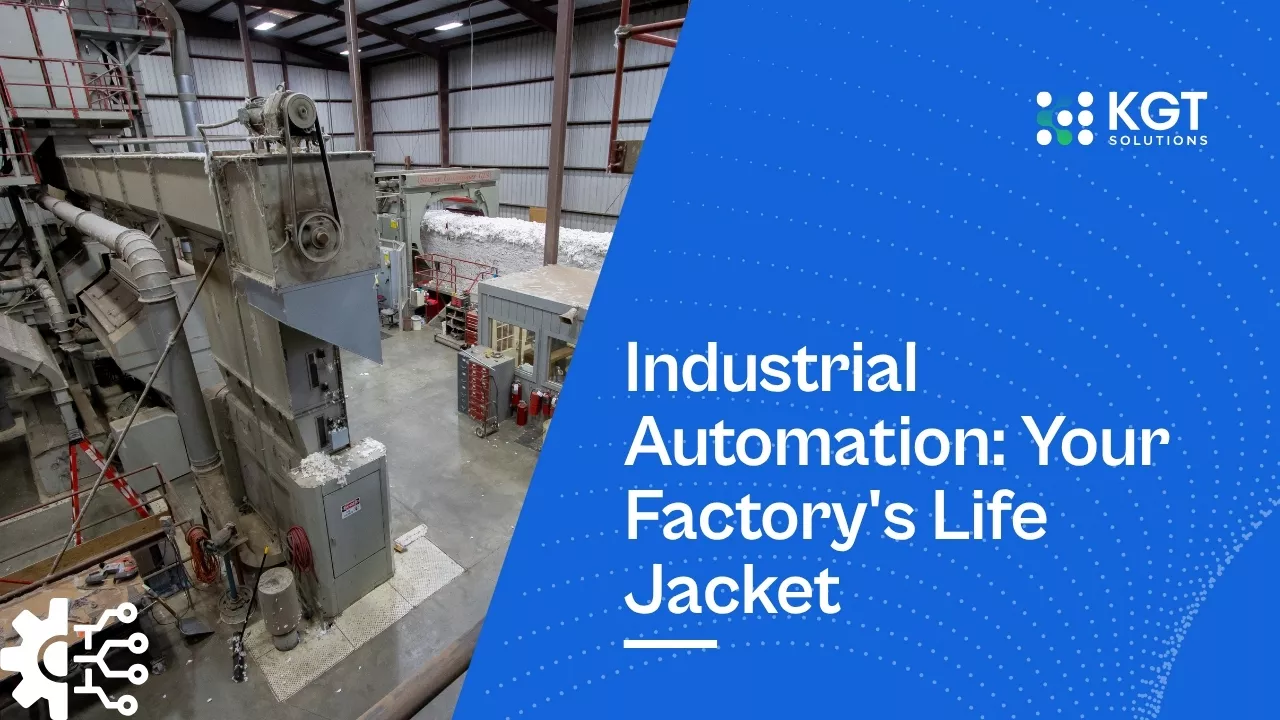
Factories don't sink all at once. They take on water slowly one unplanned breakdown, one missed defect, one avoidable injury at a time. Automation is the life jacket that keeps operations afloat when everything else pulls them under.
It uses control systems, robotics, and software to run manufacturing processes with minimal human intervention, improving speed, safety, and consistency across the production floor. The global market was valued at around $226 billion in 2025 and is on track to pass $250 billion in 2026, growing at a 9.6% CAGR through 2033 (DataM Intelligence). Factories that automate stay competitive. Factories that don't start taking on water.
Why industrial automation is your factory's life jacket
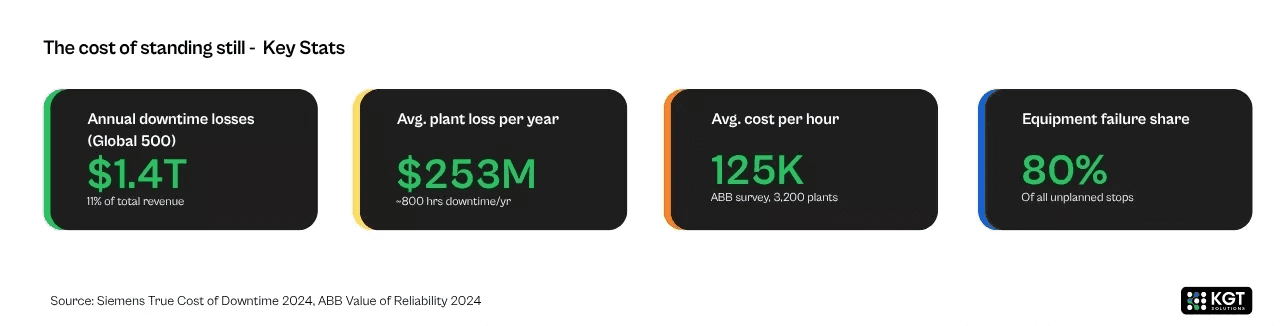
The world's 500 largest companies lose roughly $1.4 trillion a year to unplanned downtime, about 11% of total revenues, according to Siemens' True Cost of Downtime 2024 report. The average large plant loses $253 million annually. Equipment failure alone causes 80% of those unplanned stops.
Automation prevents this bleeding by replacing reactive, human-dependent processes with systems that monitor, adjust, and respond continuously. A PLC doesn't forget to check a pressure reading. An industrial control system doesn't lose focus during hour nine of a twelve-hour shift. Production monitoring systems catch deviations the moment they happen, not after a batch is ruined.
The safety math is just as blunt. OSHA data shows manufacturing accounts for 15% of all workplace injuries despite employing only 8% of the workforce. Automating 30% of manufacturing tasks by 2030 is predicted to prevent over 18,000 injuries annually in the sector, a 5.5% reduction (Lamber Goodnow / World Economic Forum).
How industrial IoT development services keep factories running
Industrial IoT solutions connect machines, sensors, and control systems into a single data layer, giving operators live visibility into equipment health, throughput, and energy consumption. According to IDC, 71% of organizations now use AIoT for predictive maintenance, the most widely adopted use case across industrial sectors.
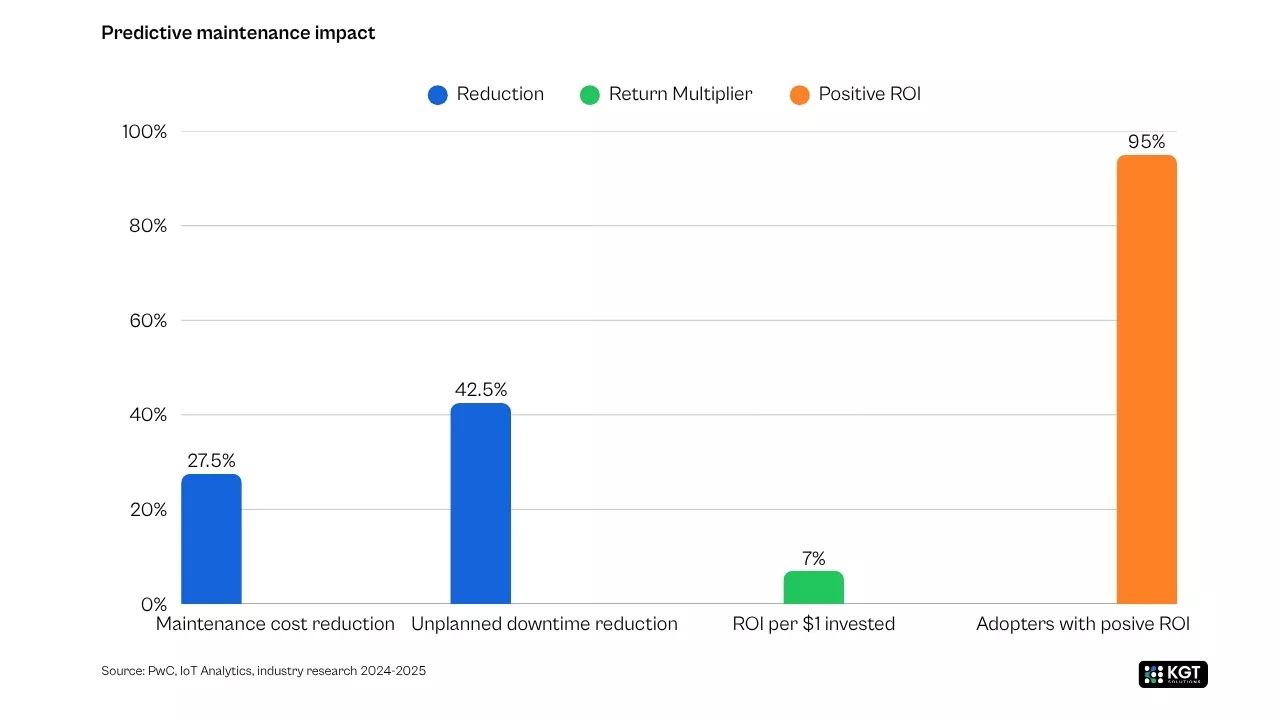
The returns are hard to argue with. IoT-driven predictive maintenance cuts maintenance costs by 25 to 30% and reduces unplanned downtime by 35 to 50%, per industry research. PwC found that every $1 invested in IoT-based predictive maintenance returns $7. The predictive maintenance market hit $14.29 billion in 2025 and is growing at 28% annually.
These services build the sensor networks, edge computing infrastructure, and data pipelines that feed AI models. Without that plumbing, you're guessing. With it, you catch a failing bearing 30 to 90 days before it seizes replacing a $2,000 part instead of dealing with $25,000 in cascading damage.

What industrial AI solutions do on the floor
These AI platforms analyze sensor data, production metrics, and historical patterns to predict failures, optimize throughput, and reduce waste before problems reach the shop floor. Ford and other major manufacturers have documented millions in savings through these models.
Companies that deeply employ AI in IoT are twice as likely to report benefits exceeding expectations, with 63% citing productivity and competitiveness gains (IDC). Digital twin software takes it further, creating virtual replicas of physical equipment so operators can simulate changes without touching the real machine. Organizations report 50% operational improvements through digital twin deployment.
The automation PLC remains the backbone of most factory floors, handling real-time control logic for conveyor speed, temperature regulation, and sequencing. But when AI sits on top of PLC industrial automation, the system stops just following instructions. It starts learning which conditions precede failures and adjusts before they arrive.
Where automated warehousing and monitoring systems fit
Automated warehousing uses robotics, conveyor systems, and software-driven picking to move goods faster and more accurately than manual labor. It's one of the fastest-growing automation product categories, pushed forward by e-commerce demand and persistent labor shortages.
Data warehouse automation tools handle the information side, structuring the massive datasets generated by floor-level sensors, tyre pressure monitoring systems, surveillance system wireless networks, and other arrays. A 5 monitor setup in a control room means nothing if the data feeding those screens is fragmented or stale.
Monitoring technology also extends beyond the factory. A monitoring system for elderly care, for instance, uses the same sensor-and-alert architecture found in industrial settings, adapted for different stakes but built on identical IIoT principles. Industrial PLC programming enables these crossover applications because the control logic transfers cleanly between domains.
IT OT Convergence in Manufacturing Explained
The cost of standing still
Two-thirds of companies experience unplanned downtime at least once a month, at an average cost of $125,000 per hour (ABB). The average manufacturer faces 800 hours of downtime per year more than 15 hours every week. Workplace injuries in manufacturing cost the industry over $170 billion annually in direct and indirect expenses.
95% of predictive maintenance adopters report positive ROI, with 27% achieving full payback within the first year (IoT Analytics). That's not a bet. That's a life jacket you can measure.
Frequently Asked Questions
What does industrial automation actually protect a factory from?
How does automation help factories survive during economic downturns?
What is the typical payback period for industrial automation investments?
Can small manufacturers afford industrial automation?
What happens to factory workers when automation is introduced?
Sources:
DataM Intelligence, "Industrial Automation Market Size," 2026
Siemens, "The True Cost of Downtime," 2024
Lamber Goodnow / World Economic Forum, Workplace Injury Automation Forecast, 2025
IDC, AIoT Predictive Maintenance Adoption Research, 2025
PwC, IoT Predictive Maintenance ROI Study
IoT Analytics, "Predictive Maintenance Market Highlights," 2024
ABB, "Value of Reliability Report," 2024
OSHA / Bureau of Labor Statistics, Workplace Injury Data, 2023
Liberty Mutual, "2025 Workplace Safety Index"
OxMaint / Siemens, Manufacturing Downtime Cost Analysis, 2025
Industrial Autonomous Floor
Newsletter
Actionable insights on industrial AI, automation, and smart operations built for safe, secure, and compliant real-world environments.