PLC Software for Modern Manufacturing: Integration, Control & ROI

PLC software controls every timed sequence, motor start, and safety interlock on a production line - replacing manual relay logic with programmable routines that cut changeover time by 30-50% and reduce wiring costs by up to 60%, according to Rockwell Automation's 2025 benchmarks.
Key Takeaways
The global PLC market hit $14.5 billion in 2025 and is projected to reach $19.8 billion by 2030, driven by manufacturers replacing aging relay panels with software-driven controllers (Fortune Business Insights)
Plants running modern PLC software report 25-40% fewer unplanned stops because ladder logic diagnostics flag faults before they cascade into full-line shutdowns (Siemens Digital Industries)
PLC control panel upgrades pay back in 8-14 months when paired with SCADA integration, cutting manual data entry by 85% and freeing operators to manage exceptions instead of routine inputs (Omron Industrial Automation)
Your assembly line runs 16 hours a day. Half the control panels date back to 2011. The relays work - until they don't. And when they don't, you're scrambling through binder-clipped wiring diagrams at 2 AM while production bleeds $5,000 an hour.
This guide breaks down what PLC software actually does on a modern factory floor, how to evaluate integration with your existing equipment, and where the ROI shows up on a P&L.
What is PLC software and why does it matter for manufacturing?
PLC software is the programming environment used to write, test, and deploy control logic on programmable logic controllers - the industrial computers that automate machine sequences, safety interlocks, conveyor timing, and I/O management across a production facility.
Think of it this way. Every time a robotic arm picks a part, a conveyor indexes forward, or a press closes at exactly the right pressure - a PLC is executing a software routine behind it. The software is where you build that logic.
The industry still runs heavily on ladder logic, the visual programming language that looks like electrical schematics. But newer PLC platforms from Siemens (TIA Portal), Rockwell (Studio 5000), and Beckhoff (TwinCAT 3) now support structured text, function block diagrams, and even Python-based scripting for complex math operations.
According to a 2025 survey by Control Engineering, 67% of manufacturers still use PLCs older than 10 years. That's a problem. Legacy PLC control panels can't communicate with MES or ERP systems, which means operators manually key in production counts, batch data, and downtime codes. A plant running 3 shifts burns roughly 45 minutes per shift on manual data entry alone.
How PLC control panels integrate with existing factory systems
PLC control panel integration connects your programmable controllers to SCADA, MES, HMI displays, and ERP platforms through industrial protocols like EtherNet/IP, PROFINET, or OPC UA - giving operators a single-pane view of every machine state, alarm, and production metric in real time.
Here's where most integration projects go sideways: the PLC talks one protocol, the SCADA speaks another, and the MES expects data in a format neither of them outputs. You end up with middleware duct tape that breaks every firmware update.
The fix is standardizing on OPC UA as the data layer. It's vendor-neutral, encrypted, and supported by every major PLC manufacturer since 2019. A food and beverage plant in Ohio cut their integration timeline from 14 weeks to 6 weeks after switching from proprietary protocols to OPC UA across all industrial automation systems.
Choosing the right industrial PLC controllers for your plant
Industrial PLC controllers range from compact micro-PLCs handling 16 I/O points on a packaging machine to rack-mounted systems managing 10,000+ I/O across an entire production facility - and picking the wrong size wastes budget on capacity you'll never use or forces a costly upgrade within 18 months.
Three questions to answer before you spec a controller:
I/O count today vs. 3 years out. If you're running 200 I/O points now but plan to add a second line, buy a controller rated for 400+. Retrofitting a bigger PLC mid-production costs 3x what it costs to overspec upfront (ABB Industrial Automation)
Scan cycle speed. High-speed packaging needs sub-1ms scan times. Batch processing and HVAC can run at 10-20ms without issues. Don't pay for microsecond performance on a process that updates every 5 seconds
Communication backplane. If your plant runs PROFINET, don't buy an EtherNet/IP-only controller and bridge it. Protocol translation adds latency and a failure point
Beckhoff's CX series runs TwinCAT 3 on a Windows-based runtime and handles PLC + motion + vision in one controller. Siemens' S7-1500 dominates the European market with integrated safety and motion control. Rockwell's CompactLogix 5380 is the go-to in North America for mid-range applications.
The ROI math on PLC software upgrades
PLC software upgrades deliver measurable returns through three channels: reduced downtime from predictive fault detection, faster changeovers from recipe-based programming, and labor savings from automated data collection - with most plants seeing full payback in 8-14 months on a $50,000-150,000 investment.
Let's run the numbers on a mid-size plant running 2 shifts:
Downtime reduction: Modern PLC diagnostics catch sensor drift and motor overload trends before they trip a fault. Plants using predictive fault logic report 25-40% fewer unplanned stops (Siemens). At $5,000/hour downtime cost and 100 hours/year of unplanned downtime, a 30% reduction saves $150,000 annually
Changeover speed: Recipe-based PLC programming cuts mechanical changeover from 45 minutes to 12 minutes on average. On a line running 4 changeovers per day, that's 2.2 hours of recovered production daily
Labor reallocation: Automated process automation for data collection eliminates 2.25 hours of manual entry per day across 3 shifts. That's not headcount reduction - it's operators spending time on quality checks and exception handling instead of typing numbers into spreadsheets
The automation controller market reflects this ROI story. MarketsandMarkets projects 7.2% CAGR through 2030, driven by manufacturers who've run the payback math and can't justify keeping legacy systems online.
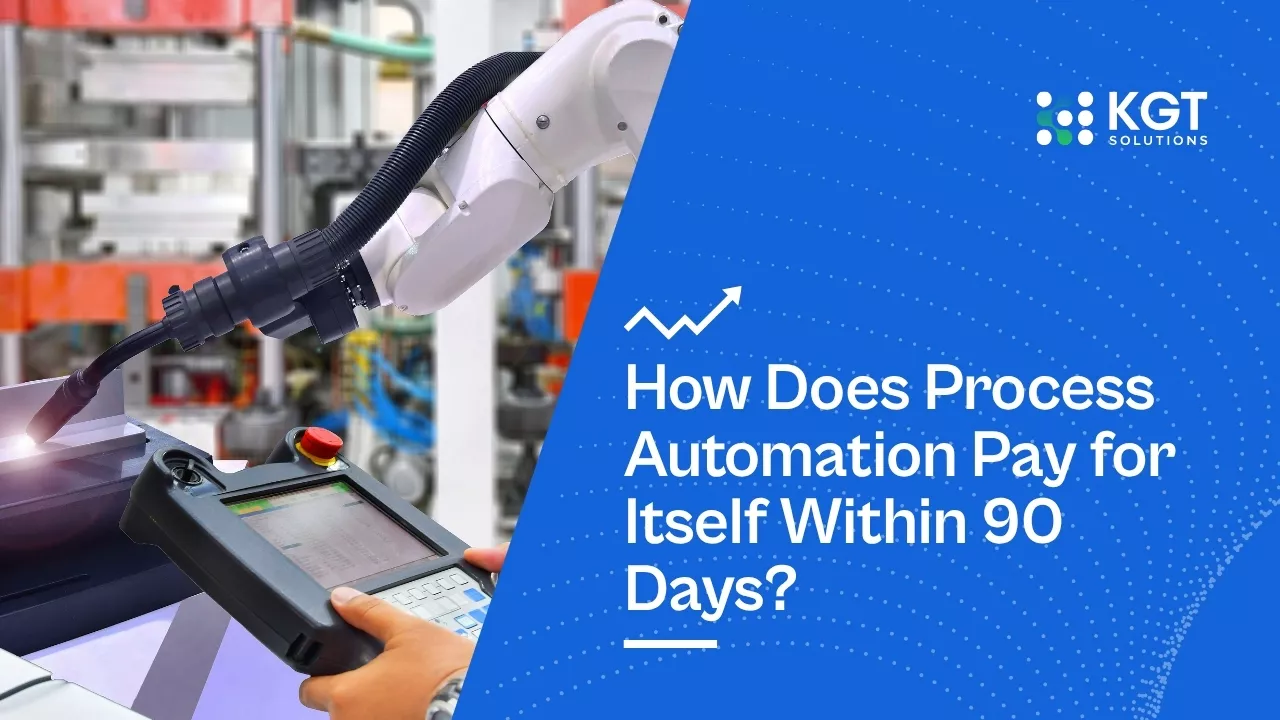
How Does Process Automation Pay for Itself Within 90 Days?
What happens when you delay a PLC upgrade
Delaying a PLC software upgrade doesn't save money - it compounds risk through rising maintenance costs on discontinued parts, growing cybersecurity exposure on unpatched firmware, and widening efficiency gaps versus competitors who've already automated their industrial automation ROI calculations.
Spare parts for Allen-Bradley PLC-5 and SLC 500 controllers now sell at 300-500% markup on the secondary market because Rockwell discontinued them. A single I/O card that cost $200 in 2015 goes for $800-1,200 on eBay today. And when that card fails at 11 PM on a Thursday, you're not buying it at list price.
The cybersecurity angle is worse. The Cybersecurity and Infrastructure Security Agency (CISA) issued 94 ICS advisories in 2025 alone, with PLC firmware vulnerabilities making up 23% of them. An air-gapped PLC from 2012 isn't safe - it's just unmonitored.
Your PLC infrastructure is either giving you data or costing you money. There's no middle ground in 2026. Book a PLC integration assessment with KGT to map your current control architecture, identify quick wins, and build a phased upgrade plan that pays for itself.
Sources:
Rockwell Automation - 2025 PlantPAx System Performance Benchmarks
Fortune Business Insights - Programmable Logic Controller Market Size 2025-2030
Siemens Digital Industries - Industrial Automation Performance Report 2025
Control Engineering - 2025 PLC and PAC Market Study
MarketsandMarkets - Automation Controller Market Global Forecast to 2030
ABB Industrial Automation - PLC Sizing and Lifecycle Cost Guide
Omron Industrial Automation - SCADA-PLC Integration ROI Whitepaper
CISA - ICS Advisory Summary Report 2025
Industrial Autonomous Floor
Newsletter
Actionable insights on industrial AI, automation, and smart operations built for safe, secure, and compliant real-world environments.