Securing industrial automation from cyber risks

Industrial automation runs on systems that were never designed to be connected to the internet. PLCs, SCADA networks, HMIs, sensors, most of this equipment was built for reliability and uptime, not for fending off ransomware. But the equipment is online now, and attackers have noticed.
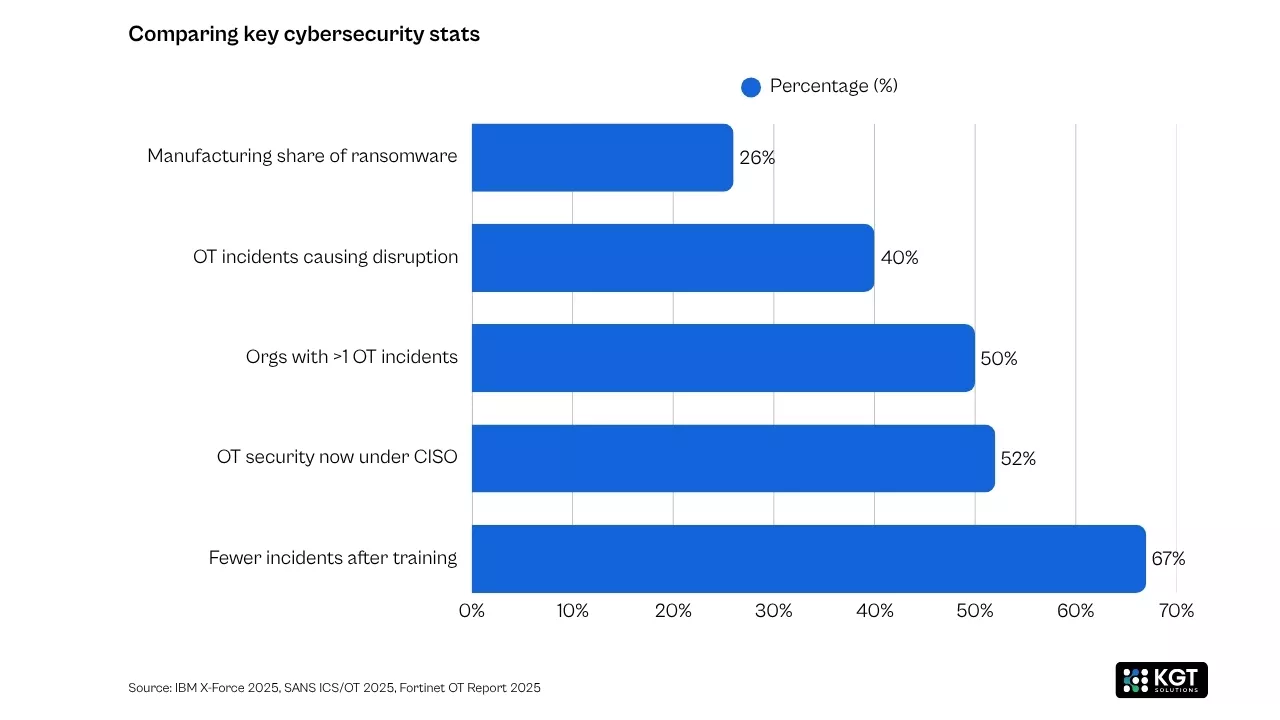
Securing industrial automation means applying layered defenses across operational technology (OT) and IT networks, using standards like IEC 62443 to segment zones, control access, and monitor threats in real time. According to IBM's 2025 X-Force Threat Intelligence Index, manufacturing has been the most targeted industry for cyberattacks four years running, accounting for 26% of all documented ransomware incidents across critical sectors.
That number is hard to ignore. Any operation running connected OT equipment, whether in energy, water treatment, or logistics, faces the same exposure.
Why industrial automation is a soft target
Most industrial environments still run equipment with 15- to 20-year lifecycles. A PLC installed in 2008 wasn't built with cybersecurity in mind, and patching it can mean shutting down an entire production line. Attackers know this.
Industrial control systems are vulnerable because they prioritize uptime over security, run outdated firmware, and increasingly connect to enterprise IT networks without adequate segmentation. The SANS Institute's 2025 ICS/OT survey found that over 22% of organizations reported a cybersecurity incident affecting OT systems in the past year, with 40% of those incidents causing operational disruption, four times higher than the industry target.
Fortinet's 2025 State of OT and Cybersecurity Report paints a similar picture. Half of surveyed organizations reported at least one cybersecurity incident, and both nation-state actors and ransomware-as-a-service operators target manufacturing because production delays can be monetized quickly.
How IEC 62443 structures defense in depth for industrial environments
IEC 62443 is the go-to framework for this. It treats a plant or facility as a collection of security zones connected by conduits, each with its own risk profile and protection level.
Defense in depth under IEC 62443 means layering multiple security controls, including network segmentation, access restrictions, system integrity checks, and continuous monitoring, so that a single breach cannot take down an entire operation. The framework defines four security levels, from basic protection against accidental misuse (SL 1) up to defenses against highly motivated, well-resourced attackers (SL 4).
This matters for organizations adopting industrial IoT development services or connecting automation PLCs to cloud-based analytics platforms. Every new connection widens the attack surface. IEC 62443 forces teams to map those connections and assign controls accordingly, rather than bolting security on after deployment.
The ICS security market reflects this urgency, growing from $18.35 billion in 2025 to a projected $29.21 billion by 2030 (The Business Research Company, March 2026).

What a practical OT security program looks like
Theory is one thing. Actually securing a plant floor with a mix of legacy PLCs, modern sensors, and warehouse automation equipment is another.
A practical OT security program combines network segmentation, strict access control, continuous monitoring through production monitoring systems, and regular employee training to reduce both technical and human vulnerabilities. Here is what that looks like in practice:
Start with an asset inventory. You cannot protect what you cannot see, and most plants have equipment nobody has catalogued in years. Industrial IoT solutions with automated asset discovery can map devices, firmware versions, and communication patterns across the network.
Then segment aggressively. Separate IT networks from OT networks. Isolate safety-critical systems from general production monitoring systems. Use firewalls and data diodes between zones. Fortinet's 2025 report found that organizations at Level 4 maturity, those using automation, orchestration, and threat intelligence, reported zero intrusions at a rate of 65%, compared to just 46% at Levels 0 through 2.
Access control is the third layer. Limit who can program an automation PLC, who can access the SCADA interface, and who can modify setpoints on industrial control systems. Role-based access, multi-factor authentication, and strict credential management become table stakes once IT and OT converge.
Where industrial AI solutions and digital twin software fit in
Industrial AI solutions are changing the detection side of OT security. Rather than relying on signature-based detection alone, AI models learn what normal network traffic looks like on a plant floor and flag deviations. OT device communications tend to be repetitive and predictable, which makes anomaly detection particularly effective in these environments.
AI-powered monitoring can detect anomalies in OT network traffic with fewer false positives than traditional methods because industrial device communications follow highly predictable patterns. Kaspersky's ICS CERT reported that in Q4 2025, malware from 10,142 different families was blocked on ICS computers globally, with 19.7% encountering malicious objects during the quarter.
Digital twin software adds another dimension. By simulating a plant's network digitally, security teams can test attack scenarios and validate segmentation without risking live production.
IT OT Convergence in Manufacturing Explained
What happens when organizations invest in maturity
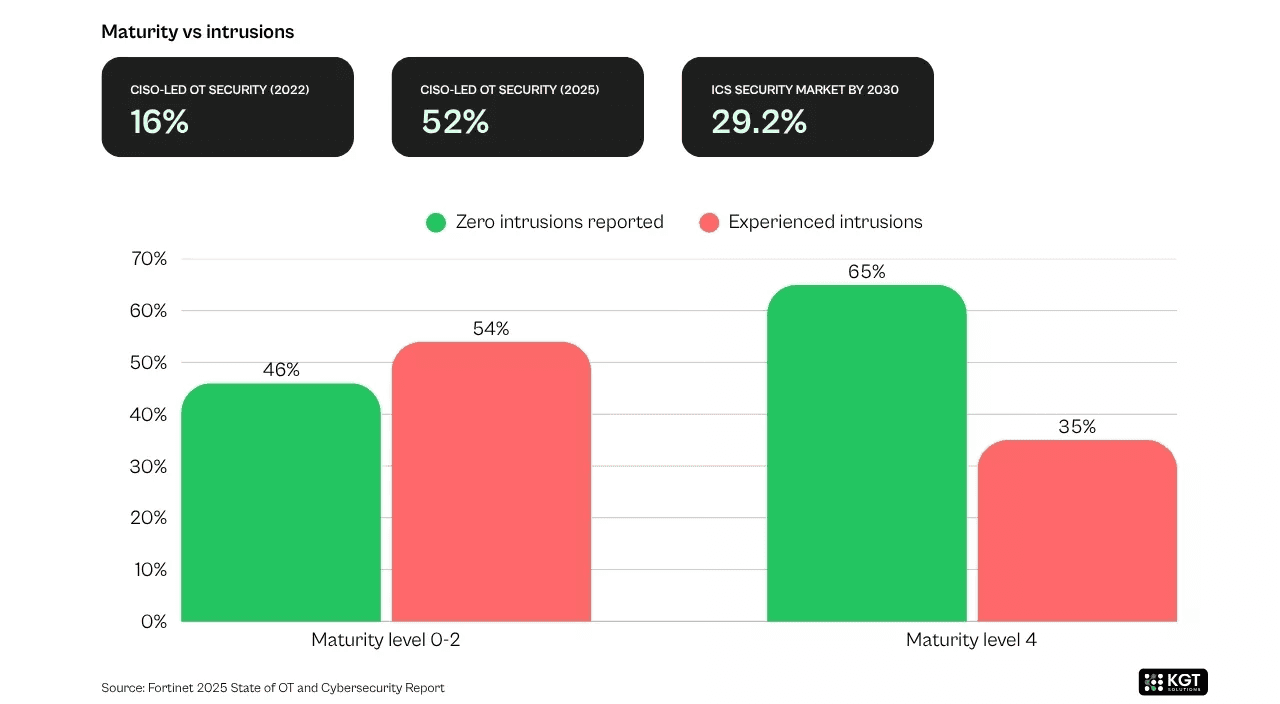
The data on security maturity tells the story. Fortinet found that 52% of organizations now place OT security under the CISO, up from 16% in 2022. That shift shows up in outcomes: organizations went from 6% reporting no intrusions in 2022 to 52% in 2025.
Organizations that elevate OT security to the CISO level and invest in segmentation and threat intelligence see measurably fewer intrusions. The companies still treating OT as somebody else's problem are the ones getting hit.
Employee training matters too. Phishing remains the top initial access vector in OT breaches. A production operator clicking a malicious link on a workstation connected to both the corporate network and the plant floor hands attackers a path to the control layer. Fortinet noted that 67% of organizations reported fewer incidents after implementing security awareness training.
The bottom line: securing industrial automation is not a single technology purchase. It is a layered program covering network architecture, access control, monitoring, and incident response. IEC 62443 provides the structure. The data confirms that following it works.
Frequently Asked Questions
What are the biggest cybersecurity threats to industrial automation systems?
How is OT cybersecurity different from IT cybersecurity?
What cybersecurity frameworks apply to industrial automation?
How much does an industrial cybersecurity breach typically cost?
What are the first steps to secure an existing industrial automation system?
Sources:
IBM, "X-Force Threat Intelligence Index 2025"
SANS Institute, "ICS/OT Cybersecurity Report 2025"
Fortinet, "2025 State of Operational Technology and Cybersecurity Report"
Kaspersky ICS CERT, "Threat Landscape for Industrial Automation Systems, Q4 2025" (April 2026)
The Business Research Company, "ICS Security Market 2026 Report" (March 2026)
Fortinet, "2025 Global Threat Landscape Report"
IEC/ISA, "IEC 62443 Series of Standards for Industrial Automation and Control Systems"
Industrial Autonomous Floor
Newsletter
Actionable insights on industrial AI, automation, and smart operations built for safe, secure, and compliant real-world environments.