

Tata Steel's Jamshedpur facility is one of India's oldest and largest integrated steel plants, running continuous conveyor belt systems around the clock across multiple production lines. These belts carry raw materials and in-process steel across the plant floor and are critical to uninterrupted production. Any unplanned belt stoppage directly hits output, and damage to a belt itself requires hours of repair and replacement.
Prior to the Online Big Scrap Detection System, the plant relied on periodic manual inspections and operator vigilance to catch foreign objects - metal scrap, debris, tools - that occasionally fell onto moving belts. The inspection process was reactive: by the time an object was noticed, the damage was often already done. There was no automated detection, no automatic conveyor stop, and no structured logging of incidents.
Foreign objects on conveyor belts - metal scrap, fallen tools, loose structural pieces - are an occupational hazard in steel plant environments. At Tata Steel Jamshedpur, the consequences of an undetected object were severe: belt tears, conveyor shutdowns, and substantial production losses.
The cost of inaction was already on the books. In the month preceding the engagement, a single belt damage event had cost the plant over $86,000 in lost production and repair costs (converted from INR at the time of reporting). Unplanned downtime events were running at 3-4 per month.
The core failure was detection lag. Without any automated system watching the belt continuously, foreign objects were only discovered after the damage had already escalated - either by an operator doing a manual walkthrough or after the belt showed visible signs of tearing. By that point, the conveyor was down and the damage was done.
The secondary problem was traceability. Incident logs were maintained manually on paper - recording what appeared, which shift it occurred in, and how long the conveyor was stopped. Paper-based records made it nearly impossible to aggregate data, spot recurring patterns, or quantify the cumulative cost of these events. Without that analysis, the operations team had no structured way to build a case for investing in prevention.
The trigger: A significant belt tear event caused serious production loss at the Jamshedpur facility. The scale of that single incident made the case for an automated prevention system undeniable.
Tata Steel selected KGT Solutions based on two areas of demonstrated capability that the project specifically demanded: deep expertise in industrial computer vision - building and deploying real-time detection models in harsh, variable production environments - and hands-on experience with PLC and SCADA integration, which was essential to closing the loop between detection and automatic conveyor control. This combination meant KGT could own the full pipeline from camera to PLC stop command, without requiring Tata Steel to coordinate between separate vision and automation vendors.
KGT designed and deployed the Online Big Scrap Detection System - a real-time AI vision system that continuously monitors the conveyor belt through a fixed industrial camera, automatically detects any foreign object on the belt surface, triggers an immediate conveyor stop via PLC integration, and simultaneously sends multi-channel alerts to designated plant personnel. The system operates fully autonomously - no operator action is required to trigger detection or initiate a belt stop.
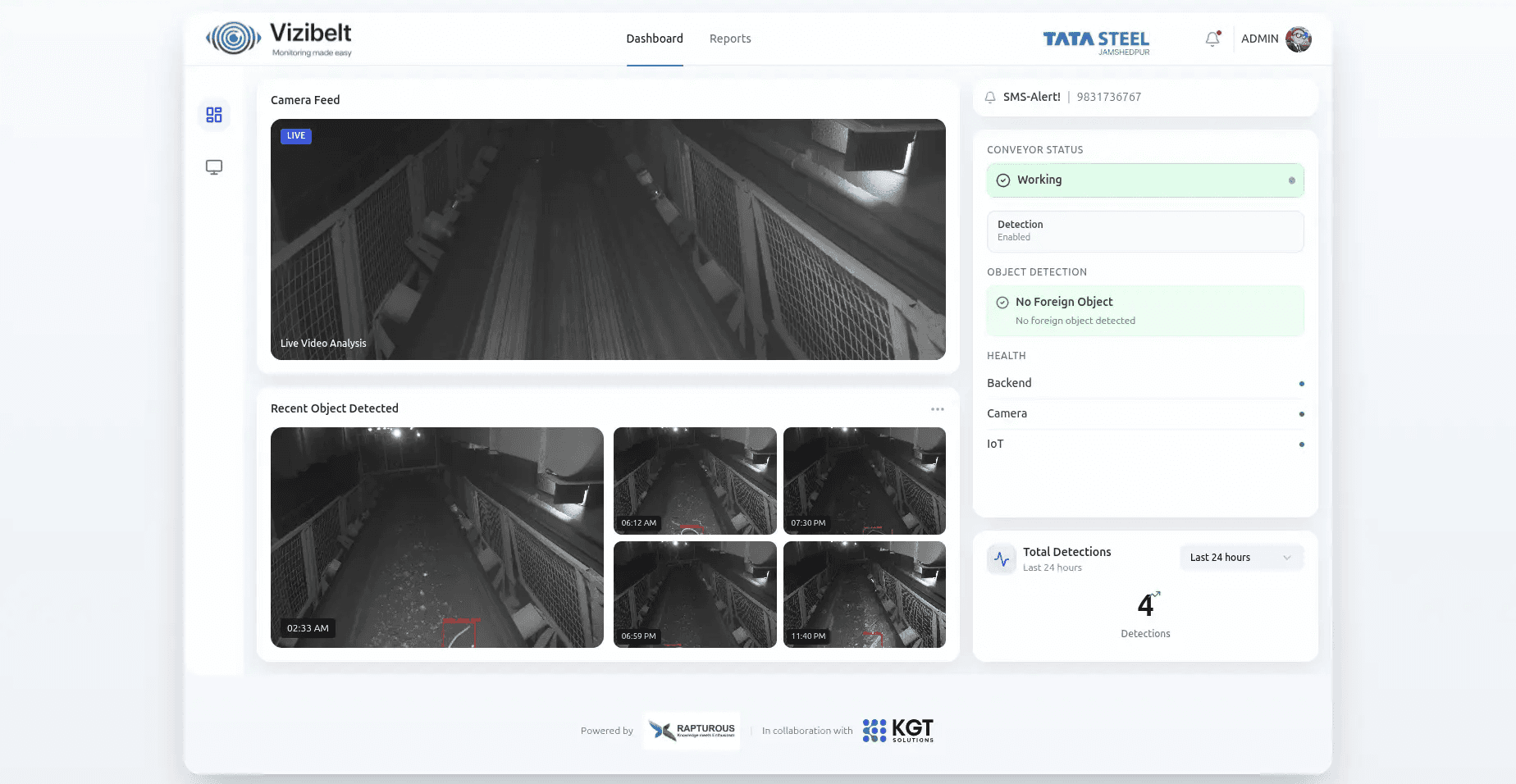
Camera & Vision Pipeline: Mounted a high-resolution industrial camera above the active conveyor belt, configured to stream a continuous live feed of the belt surface into the AI detection pipeline. Built and trained a custom computer vision model to identify foreign objects in real time against the steel plant's specific visual environment - accounting for variable lighting, belt texture, and the range of object types likely to appear.
PLC Integration & Automatic Stop: Integrated detection output with the plant's existing PLC system via Modbus Protocol, enabling automatic conveyor stop the moment a confirmed detection is made - without requiring operator intervention.
IIoT Health Monitoring: Deployed an IIoT sensor layer providing live health telemetry (system, camera, and sensor status) with automatic red-flag alerts if any component goes offline.
Vizibelt Dashboard: Built the Vizibelt web application, a control room dashboard deployed on the plant's secure internal network, accessible from any terminal on the floor. Operators get a live camera feed, detection snapshots, shift-based reports, and one-click Excel/PDF export.
Multi-Channel Alerting: Configured automated WhatsApp and SMS alerts sent instantly to designated contacts upon each detection event, plus a daily email summary of all detections from the past 24 hours.
What was hard: Installing the camera hardware on a live, continuously running conveyor line was the most operationally sensitive phase of the project. Every minute of belt downtime carries a direct production cost - the same cost the system was being built to prevent. KGT's installation team coordinated tightly with Tata Steel's operations and safety teams to mount and calibrate the camera above the active belt within narrow maintenance windows, ensuring zero unplanned disruption to ongoing production.
Tech Stack:
Computer Vision (custom-trained model)
IIoT
Modbus Protocol
PLC Integration
Python
Web Dashboard
WhatsApp Business API
SMS Gateway
Excel / PDF Export
Timeline: 9–10 weeks from kickoff to live deployment. The timeline reflected approval and coordination requirements across safety, IT, and operations departments, as well as scheduled access to the active production floor for hardware installation.
The following data covers 3+ months of live operation since deployment at Tata Steel Jamshedpur on 20 February 2026.
Metric | Before | After Deployment |
|---|---|---|
Unplanned Downtime Events | 3-4 per month | 0 since Feb 2026 |
Belt Damage Cost | $86K+ in a single month | $0 since Feb 2026 |
Foreign Object Incidents Detected | 0 (found after damage) | 57+ auto-detected |
Reduction in Conveyor Downtime | - | 38% reduction |
Increase in Productivity | - | +18% improvement |
Alert Response Time | Manual inspection, hours | Automatic stop in seconds |
ROI: The system achieved full payback within the first 90 days of operation. The 57+ foreign objects detected since go-live represent 57+ potential belt damage events that were stopped before they could escalate. At the pre-deployment damage cost rate of $86K+ per incident month, the cumulative production loss exposure prevented far exceeds the total project investment.
Beyond the numbers, the operational shift has been fundamental. Plant operators now have a continuous, always-on eye on the belt - replacing what were previously periodic manual walkthroughs. Every detection event is automatically logged with a timestamped snapshot, conveyor stop duration, and shift information, giving plant management a full audit trail that did not previously exist.
Results verified by the client. Measurement period: 20 February 2026 - present.

The next phase at Tata Steel Jamshedpur will extend coverage to additional conveyor belts across the facility. More significantly, KGT is developing a robotic intervention layer to complement the detection system: when a foreign object is identified on the belt, a robotic arm will automatically remove it and set it aside - eliminating the need for a floor operator to physically clear the belt before the conveyor can restart. This closes the last remaining manual step in the response loop and moves the system toward fully autonomous foreign object management.