AI Is Not Expensive. Bad Implementation Is.

Let me tell you something I've watched happen to smart companies, more times than I can count.
A CEO reads the headlines, hears the board ask about AI strategy, sits through three vendor demos, and signs a contract. Six months later, the project is quietly shelved. The team is demoralised. The budget is gone. And the conclusion drawn in the post-mortem? "AI didn't work for us."
But AI didn't fail. The approach did.
This distinction matters enormously because the wrong conclusion leads to one of two equally damaging outcomes: abandoning the technology entirely, or doubling down with the same broken approach. Neither one serves the business.
The Numbers Tell a Sobering Story
We are living through one of the most expensive misunderstandings in the history of enterprise technology.
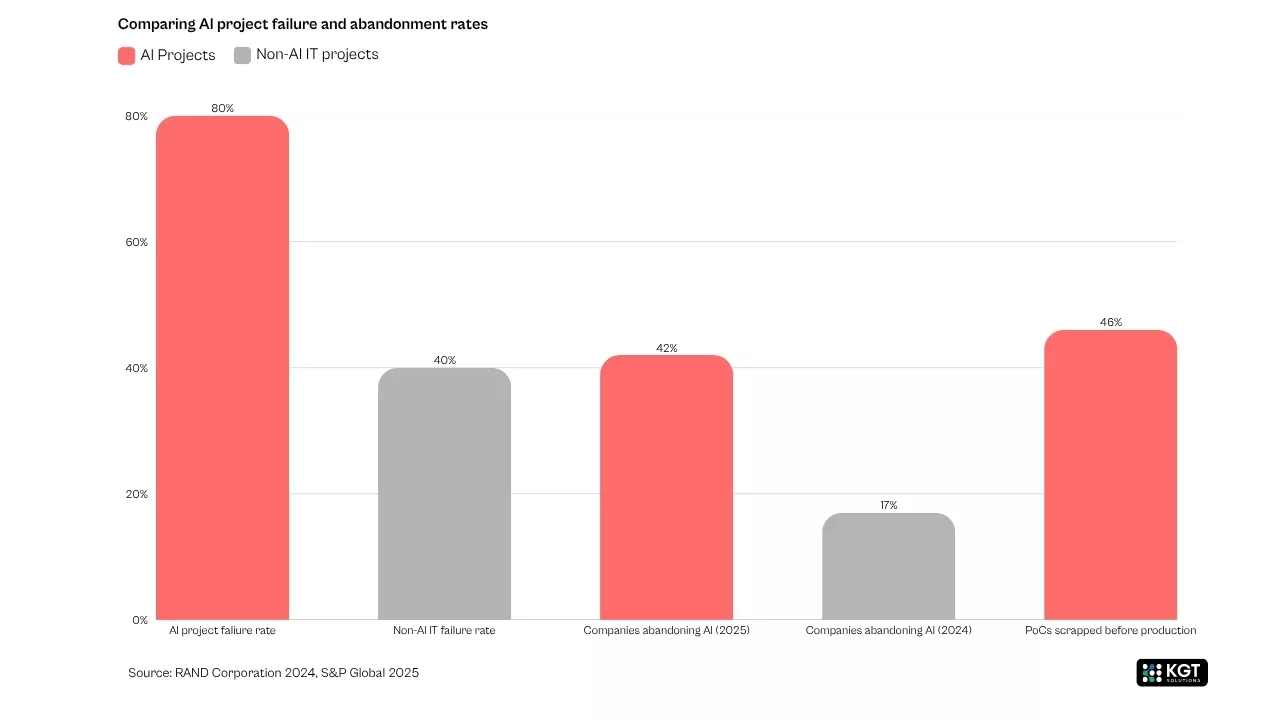
According to RAND Corporation's 2024 research, more than 80% of AI projects fail to reach meaningful production deployment = exactly twice the failure rate of non-AI IT projects. S&P Global's 2025 survey of over 1,000 enterprises found that 42% of companies abandoned most of their AI initiatives in 2025, up sharply from just 17% the year prior. The average organization scrapped 46% of its AI proof-of-concepts before they ever reached production.
And yet, in that same period, global enterprise AI investment ran into the hundreds of billions of dollars.
This is not a technology problem. These organizations had access to the same tools, the same models, the same infrastructure as the companies generating real returns. The gap is not technological. It is methodological.
The Four Ways Implementations Go Wrong
1) Starting with the technology instead of the problem
The most common and most costly mistake. A company feels competitive pressure, selects an AI platform, and then goes looking for problems to apply it to. That is the wrong sequence, and it almost always produces the same outcome: a tool in search of a purpose, burning budget while stakeholders lose patience.
The MIT State of AI in Business 2025 report made headlines for one specific finding: 95% of generative AI pilots fail to deliver measurable P&L impact. Nearly half of all GenAI investment, the report found, went into sales and marketing initiatives not because the ROI was strongest there, but because the metrics were easiest to attribute. Back-office automation consistently delivers stronger returns. But it requires more discipline to define, so it gets overlooked.
The companies generating real value from AI did not start with a technology. They started with a question: where is our most expensive, repeatable problem? The technology followed the answer.
2) Overengineering solutions to straightforward problems
Not every business challenge requires a custom-built model, a dedicated data science team, or a multi-year implementation. A significant portion of AI project budgets are consumed by engineering complexity that the actual use case simply does not require.
Many operational problems that organizations try to solve with sophisticated AI can be addressed with structured automation, rule-based workflows, or off-the-shelf tools - faster, cheaper, and with more predictable outcomes. The drive to build impressive systems rather than effective ones is partly a vendor dynamic and partly an internal one. Both deserve scrutiny.
Winning AI programmes, as McKinsey's 2025 analysis consistently confirms, focus on a small number of high-impact use cases rather than attempting broad transformation simultaneously. Focused approaches deliver three times higher ROI compared to launching multiple initiatives at once.
Agentic Orchestration Explained for Enterprise CTOs

3) Ignoring the data foundation
This is the one most organizations do not discover until it is too late.
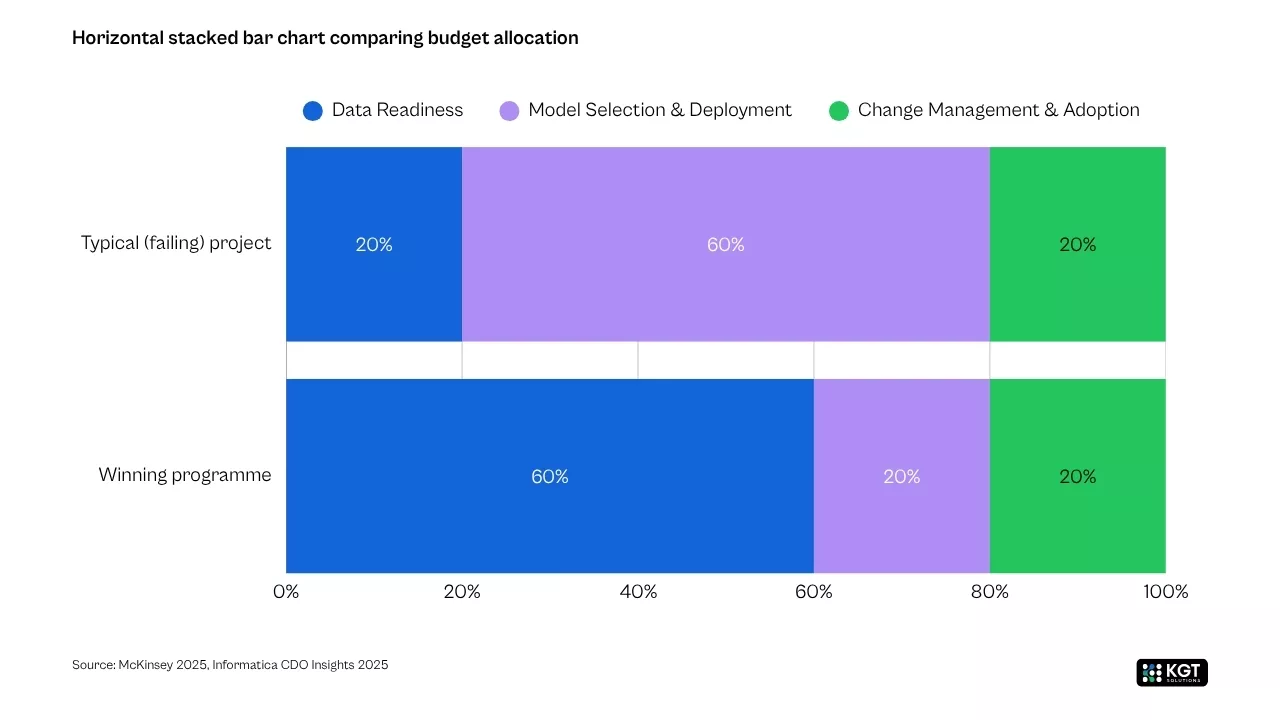
Informatica's 2025 CDO Insights survey identified data quality and readiness as the top obstacle to AI success, cited by 43% of respondents. A McKinsey study puts it even more starkly: 70% of AI projects fail due to data quality issues rather than any limitation of the models themselves. AI does not create value from poor data. It amplifies the problems already embedded in it.
Winning programmes invert the typical spending logic. Instead of allocating the majority of the budget to model selection and deployment, they earmark 50–70% of timeline and budget to data readiness extraction, normalization, governance, and quality infrastructure before a model is ever trained or configured.
It is not glamorous work. It does not generate slides that impress a board. But it is the work that determines whether the implementation succeeds or fails.
4) Treating deployment as the finish line
Go-live is not the end of an AI implementation. In many ways, it is the beginning of the harder part.
If the people expected to use the system have not been trained, if the tool has not been embedded into the daily workflow, or if there is no visible executive sponsorship signalling that this is how work is done now adoption drops. And when adoption drops, ROI follows.
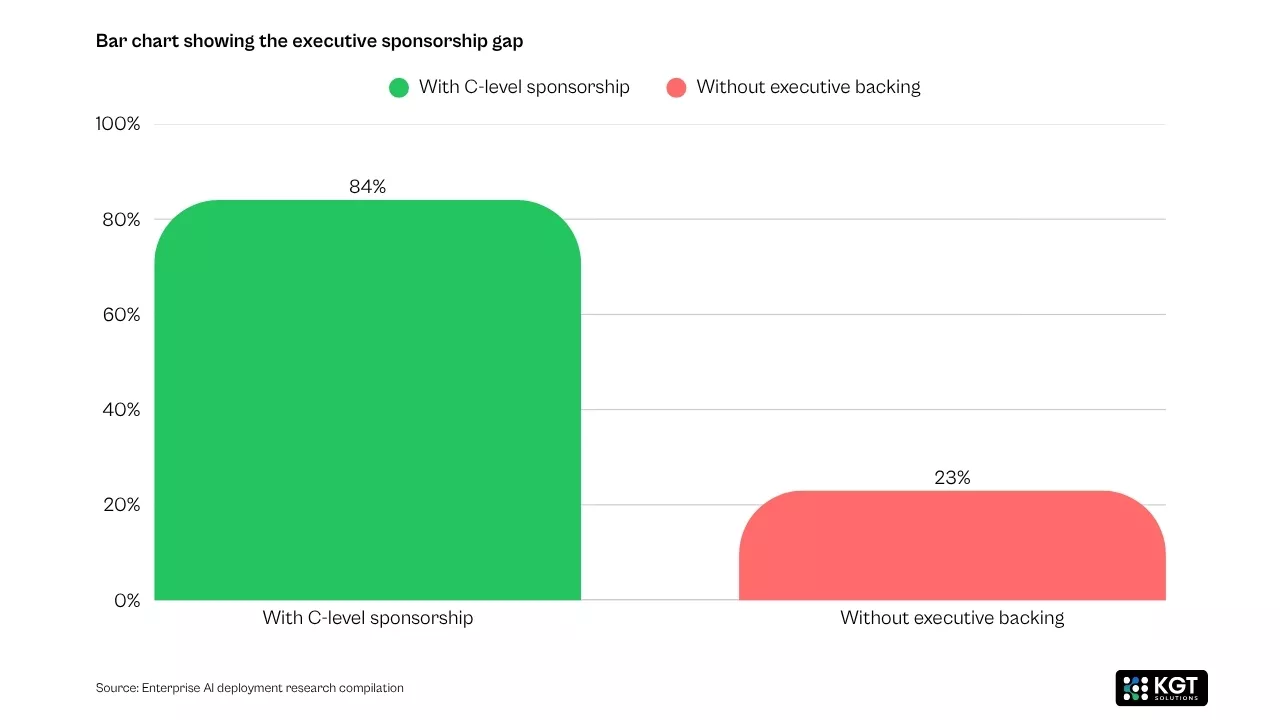
Research across enterprise AI deployments shows that 84% of AI initiatives with active C-level sponsorship achieve positive ROI, compared to just 23% of those without executive backing. That gap is not about the technology. It is about the organizational signal sent by leadership and whether people believe the change is real and lasting.
What Successful Implementation Actually Looks Like
The companies consistently generating returns from AI are not the ones with the largest budgets or the most sophisticated models. They share four characteristics that have nothing to do with technology at all.
They define the problem before selecting the tool. Every initiative begins with a specific, measurable business outcome. Not "we want to use AI in customer service" but "we want to reduce first-response resolution time by 30% within six months." The precision of the problem statement determines the quality of the solution.
They start small, on purpose. Not because they lack ambition, but because they understand that a focused success builds organizational confidence and generates the internal evidence needed to scale. Deloitte's 2025 AI survey found that AI ROI Leaders focus on a few high-impact opportunities rather than spreading investment across many simultaneous pilots and expect twice the ROI of their less disciplined peers as a result.
They invest in data before they invest in models. Data infrastructure is unglamorous and expensive. It is also non-negotiable. Organizations that factor data remediation into their planning project 29% higher ROI than those that treat it as an afterthought.
They measure what matters from day one. Not vanity metrics - real operational indicators tied directly to the business problem they set out to solve. McKinsey's research confirms that organizations tracking well-defined KPIs for AI initiatives are significantly more likely to realize value and contain risk.
The Real Cost Conversation
Here is what I would tell any CEO sitting across from a vendor who just quoted them a seven-figure implementation:
The number on that proposal is not your AI cost. Your AI cost is the sum of every resource consumed by a project that lacks a clear problem statement, was built on poor data, deployed without change management, and measured against the wrong outcomes. That is where the money disappears.
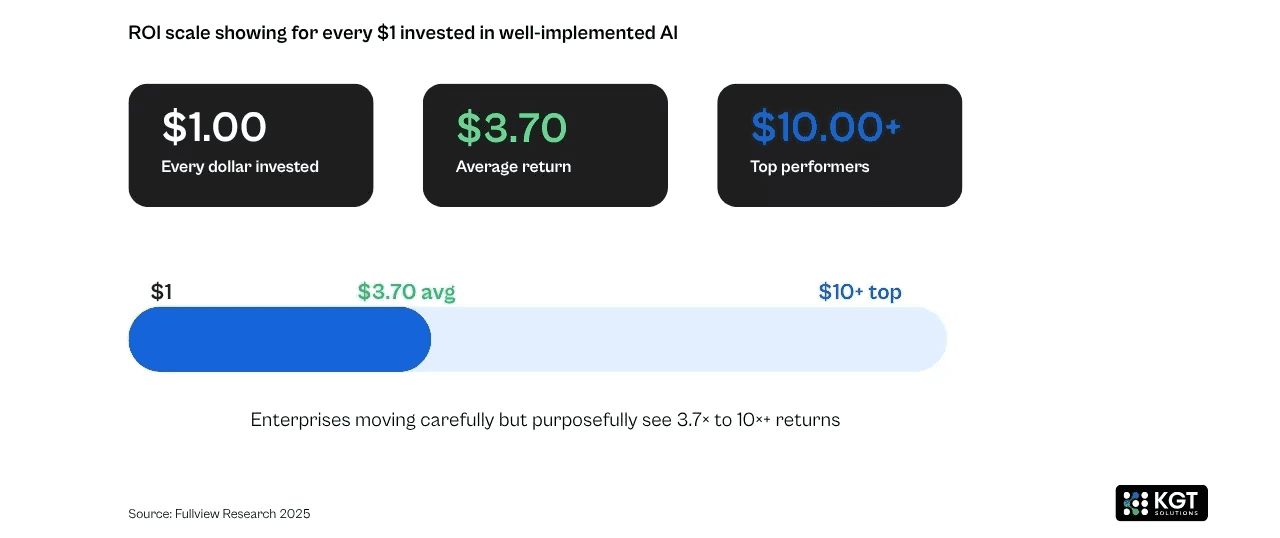
Done right, AI is not a budget line. It is a return. Enterprises that move carefully but purposefully - starting with the right use case, building the data foundation, investing in adoption are seeing $3.70 in value for every dollar invested, with top performers exceeding $10 per dollar (Fullview Research, 2025).
The technology is not expensive. The lack of clarity is.
A Framework Before You Commit a Single Rupee
Before any AI investment - regardless of scale - these four questions deserve honest answers:
What is the specific problem we are solving, and how will we measure success? If the answer is vague, the investment is not ready.
What does our data actually look like? Not what we assume it looks like - what a data audit reveals it looks like.
Who will use this, and how will their workflows change? If there is no change management plan, there is no adoption plan.
Who in leadership owns this? A project without a named executive owner has no accountability structure, and no accountability structure means the first sign of friction becomes a reason to deprioritize.
These are not technical questions. They are leadership questions. And they are the ones that separate implementations that deliver from implementations that become case studies in what not to do.
Frequently Asked Questions
Why do AI projects fail despite large budgets?
What does bad AI implementation actually look like?
How can companies reduce the cost of AI adoption?
Is custom AI development always more expensive than off-the-shelf solutions?
What is the first step to implementing AI the right way?
Sources:
RAND Corporation, The Root Causes of Failure for Artificial Intelligence Projects and How They Can Succeed, 2024
S&P Global Market Intelligence, Enterprise AI Initiative Survey, 2025
MIT NANDA, The GenAI Divide: State of AI in Business 2025
McKinsey & Company, The State of AI 2025
Informatica, CDO Insights Survey, 2025
Deloitte, Turning AI into ROI, 2025
Fullview Research, 200+ AI Statistics & Trends for 2025
Nexos.ai, AI ROI Research Compilation, 2025
Protocol AI Newsletter
Practical insights on AI, automation, and intelligent systems focused on real-world applications, not hype.