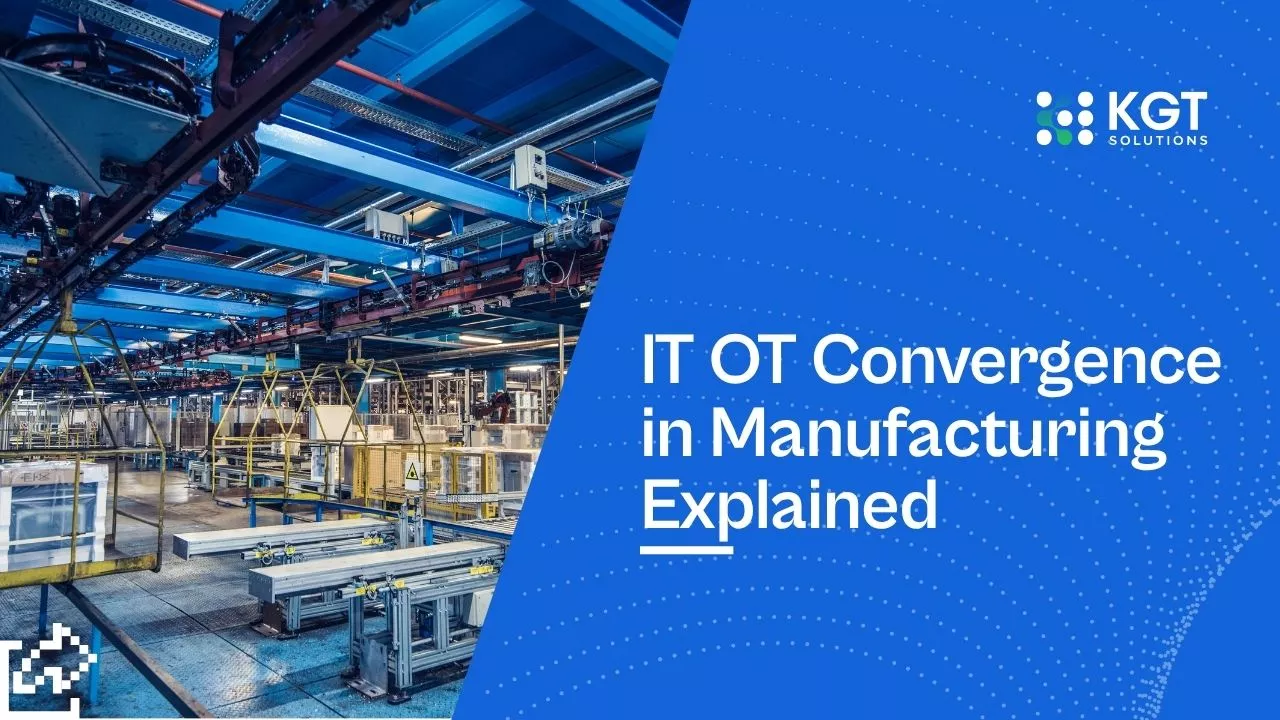
IT OT Convergence in Manufacturing Explained

IT OT convergence is the integration of information technology systems (ERP, cloud, databases) with operational technology systems (SCADA, PLCs, sensors) into a unified architecture that shares data, protocols, and governance across factory and enterprise networks.
Manufacturing runs on two parallel nervous systems. IT handles business data - orders, financials, supply chain logistics. OT controls the physical world - machine speeds, temperature setpoints, conveyor timing. For decades, these systems operated in isolation. That separation was intentional. OT networks prioritized uptime and safety. IT networks prioritized speed and flexibility. But that air gap is closing fast, and the $50 billion it ot convergence market is projected to reach $101.9 billion by 2030. If you’re a VP of Operations or plant manager evaluating convergence, this guide explains what’s actually changing, what risks come with it, and how to architect the transition without exposing your production floor.
Key Takeaways
IT OT convergence connects business systems (ERP, cloud) with production systems (SCADA, PLCs, sensors) for real-time visibility across the entire operation
The convergence market hit $50 billion in 2024 and is growing at 12.6% CAGR through 2030
Manufacturing is the most ransomware-targeted sector for the fourth consecutive year, with attacks up 61% in 2025
Legacy OT assets over 15 years old exist in roughly half of manufacturing organizations, creating major security gaps
Convergence should be phased: start with monitoring visibility, then add bidirectional data flows, then unified governance
Security architecture must treat OT and IT as separate trust zones even after network convergence
What Is IT/OT Convergence
IT/OT convergence merges enterprise information technology and operational technology into a single connected architecture where data flows between business and production systems in real time.
Understanding what is it/ot convergence starts with understanding what is it/ot in the first place. IT systems manage data - databases, email servers, ERP platforms, cloud infrastructure. OT systems manage physical processes - programmable logic controllers run assembly lines, SCADA systems monitor pressure and flow, distributed control systems coordinate plant-wide operations. Each evolved independently with different priorities. IT prioritizes confidentiality and data integrity. OT prioritizes availability and safety. A server reboot is routine in IT. An unplanned controller restart on a production line costs real money and potentially endangers workers.
Convergence doesn’t mean merging these into one system. It means building a shared data layer and communication framework so that production data reaches business systems in real time, and business logic can inform production decisions without manual handoffs.
Why IT OT Convergence Matters for Manufacturing
IT OT convergence in manufacturing enables real-time production visibility, predictive maintenance, and data-driven optimization that isolated systems cannot deliver.
The business case is straightforward. When your MES can’t talk to your ERP in real time, you’re making scheduling decisions on stale data. When sensor readings from the ot network stay trapped in local historian databases, your maintenance team can’t build predictive maintenance systems that reduce unplanned downtime. When quality data lives in OT while customer complaints live in IT, root cause analysis takes weeks instead of hours.
Connected industrial IoT devices are expected to surpass 29 billion globally by 2030. Each of those devices generates data that only creates value when it reaches the systems that can act on it. Ot and it convergence is the infrastructure layer that makes that data flow possible.
The manufacturing leaders who’ve converged their IT and OT stacks report 15-25% reductions in unplanned downtime and 10-20% improvements in overall equipment effectiveness. Those aren’t theoretical gains - they come from having the right data in the right system at the right time.


IT vs OT Network - Understanding the Fundamental Differences
IT networks prioritize data confidentiality and rapid change cycles, while OT networks prioritize continuous availability and physical safety, creating fundamental architectural tension during convergence.
The it vs ot network distinction goes deeper than protocols. IT networks run on standard TCP/IP, get patched regularly, and tolerate brief outages for updates. OT networks often run proprietary industrial protocols (Modbus, Profinet, EtherNet/IP), can’t be patched without production shutdowns, and measure uptime in years, not nines.
When comparing ot vs it, the lifecycle differences matter most. An IT server lives 3-5 years. A PLC or SCADA system runs 15-25 years. An IDC study found that legacy OT assets are 15 or more years old in roughly half of manufacturing organizations. These systems were designed before cybersecurity was a concern and can’t run modern security agents without performance degradation.
The ot vs it network architecture also differs in failure consequences. An IT outage loses data or disrupts email. An OT failure can damage equipment worth millions, release hazardous materials, or injure workers. This asymmetry means convergence architects must maintain separate safety domains even while enabling data integration.
The Security Challenge - OT vs IT Security
OT vs IT security requires fundamentally different approaches because OT systems cannot be patched on schedule, run legacy protocols without encryption, and control physical processes where failure has safety consequences.
This is where convergence gets dangerous. Manufacturing is the most ransomware-targeted sector for the fourth consecutive year, with attacks rising 61% in 2025 and costing an average of $1.9 million per day in downtime. Every new connection between IT and OT creates a potential path for attackers to reach equipment that was never designed to be network-accessible.
The ot vs it security gap is real. Only 15% of manufacturing organizations have robust cybersecurity practices in place, according to IDC. Fortinet’s 2025 State of Operational Technology and Cybersecurity Report found that half of organizations experienced at least one cybersecurity incident over the year.
The attack pattern is consistent: attackers compromise IT systems through phishing or credential theft, then pivot laterally into OT networks that lack segmentation. Once inside the OT environment, they can halt production lines, manipulate process parameters, or deploy ransomware that encrypts both IT databases and OT historian servers simultaneously.
Your convergence architecture needs defense-in-depth: network segmentation between IT and OT zones, industrial demilitarized zones (DMZs), protocol-aware firewalls, and governance frameworks that cover AI and automation systems operating across both environments.
Predictive Maintenance in Manufacturing Explained

Five Layers of a Converged IT/OT Architecture
A converged IT/OT architecture uses five layers - edge devices, plant network, DMZ, enterprise network, and cloud with security controls at every boundary.
Layer 1 is the edge - sensors, actuators, PLCs, and field devices that interact with physical processes. These stay on isolated OT networks with deterministic communication protocols.
Layer 2 is the plant network - switches, industrial Ethernet, and local servers running SCADA, HMI, and MES applications. This is where production data aggregates before crossing any boundary.
Layer 3 is the industrial DMZ - the critical security boundary between OT and IT. Data passes through here via one-way data diodes, jump servers, or protocol-breaking proxies. Nothing from IT should directly address OT devices through this layer.
Layer 4 is the enterprise network - ERP, business intelligence, cloud platforms, and the systems that stop you from guessing with industrial automation by providing data-driven decision support.
Layer 5 is the cloud and external connectivity - remote monitoring, vendor access, supply chain integration. This layer requires the strongest identity and access management controls.
Cybersecurity integration in IT/OT platforms has grown 25% annually because manufacturers are learning that flat networks with OT devices reachable from the internet aren’t convergence they’re negligence.
How to Phase Your IT OT Convergence Roadmap
Phase IT OT convergence in three stages - monitor first, then integrate data flows, then unify governance to reduce risk while building organizational capability.
Phase 1 is read-only visibility (3-6 months). Deploy passive monitoring on OT networks. Mirror traffic to analytics platforms without changing any OT configurations. Build your asset inventory. Identify what’s running, what protocols it uses, and what data it generates. This phase carries near-zero production risk and delivers immediate value by showing you what you actually have.
Phase 2 is bidirectional data integration (6-12 months). Establish the industrial DMZ. Deploy OPC UA or MQTT brokers to normalize OT data for IT consumption. Connect MES to ERP. Enable AI-driven insights from your industrial automation data. This phase requires careful change management because you’re now creating dependencies between IT and OT systems.
Phase 3 is unified governance and optimization (ongoing). Implement cross-domain security monitoring. Build unified dashboards for operations and IT. Establish joint incident response procedures. Optimize based on the integrated data you’re now collecting. This phase is where the ROI compounds because you can make decisions that span the entire operation.
Common IT OT Convergence Challenges
The biggest IT OT convergence challenges are organizational - IT and OT teams have different cultures, vendors, skill sets, and risk tolerances that resist integration more than the technology does.
Technology convergence is the easy part. Organizational convergence is where projects stall. IT teams push for standardization and rapid patching. OT teams resist changes to running systems because a bad patch can halt a $500,000-per-hour production line. IT procurement evaluates vendors on features and cost. OT procurement evaluates vendors on reliability and support longevity.
Staffing is another barrier. IT professionals rarely understand Ladder Logic or PID control loops. OT engineers rarely understand Active Directory or cloud IAM. Convergence requires cross-training or hiring hybrid professionals who understand both domains and those people are scarce.
The third challenge is vendor lock-in. OT vendors have traditionally shipped proprietary systems that resist integration. The push toward open standards like OPC UA and MQTT helps, but legacy brownfield installations still run protocols from the 1990s that require translation layers to participate in a converged architecture.
How KGT Architects Converged Industrial Systems
KGT designs converged IT/OT architectures that maintain OT safety boundaries while enabling enterprise-grade data visibility and AI-driven optimization.
We build convergence architectures for manufacturers who can’t afford to learn from their own mistakes. Our approach starts with a full OT asset discovery and network mapping - because you can’t secure what you can’t see. We then design the industrial DMZ, deploy protocol-normalizing middleware, and connect production data to your business intelligence stack.
For organizations already running converged networks, we harden the architecture - adding segmentation, deploying industrial intrusion detection, and building the monitoring layer that catches anomalies before they become incidents. Every KGT convergence project includes a security assessment that covers both the IT and OT domains.
Frequently Asked Questions
What is IT/OT convergence?
What is the difference between IT and OT networks?
Why is IT OT convergence important for manufacturing?
What are the biggest security risks of IT OT convergence?
How long does IT OT convergence take?
What protocols are used in IT OT convergence?
Who should lead IT OT convergence projects?
How do you secure a converged IT OT environment?
IT OT convergence is not optional for manufacturers who want to compete on data. The production floor generates the richest data in your organization, and keeping it locked in isolated OT systems means making business decisions with half the picture. But convergence done wrong - flat networks, no segmentation, no DMZ - is worse than no convergence at all. Start with visibility. Build the security architecture before you build the data integrations. Phase the rollout so your OT team trusts the process. And architect for the reality that IT and OT will always have different priorities, even when they share the same network.
Sources
Virtue Market Research - Global IT/OT Convergence Market Report 2025-2030
Fortinet - 2025 State of Operational Technology and Cybersecurity Report
IDC - Legacy OT Infrastructure and Cybersecurity Readiness Study
IoT Analytics - IT/OT Convergence: 27 Themes Defining Industrial Integration
BizTech Magazine - Navigating IT/OT Convergence in Modern Manufacturing
Protiviti - Manufacturing’s OT Security Challenges 2026
The Business Research Company - IT/OT Convergence Global Market Report 2026
Dassault Systèmes - What Are IT and OT in Manufacturing
Industrial Autonomous Floor
Newsletter
Actionable insights on industrial AI, automation, and smart operations built for safe, secure, and compliant real-world environments.