Predictive Maintenance ROI: 35-50% Less Downtime [2026 Data]

Plants using predictive maintenance cut unplanned downtime 35-50% within the first year, pulling 10:1 to 30:1 ROI across a $14.29B global market.
Predictive maintenance reduces unplanned downtime by deploying IoT vibration sensors, thermal cameras, and AI-driven anomaly detection models that identify equipment degradation 30 to 90 days before failure occurs - cutting unexpected breakdowns by 35-50% and recovering an average $2.3 million per avoided hour of production stoppage in automotive manufacturing alone.
Key Takeaways
35-50% less unplanned downtime in 12 months, 10:1 to 30:1 ROI, in a $14.29B market growing 28% yearly.
These programs reduce unplanned stoppage events by 35-50% within 12 months of deployment, with top-performing plants reporting 71% reductions after full-scale implementation.
Manufacturers running these monitoring loops see 10:1 to 30:1 ROI within 12-18 months, with cost reductions of 25-40% compared to reactive or calendar-based approaches.
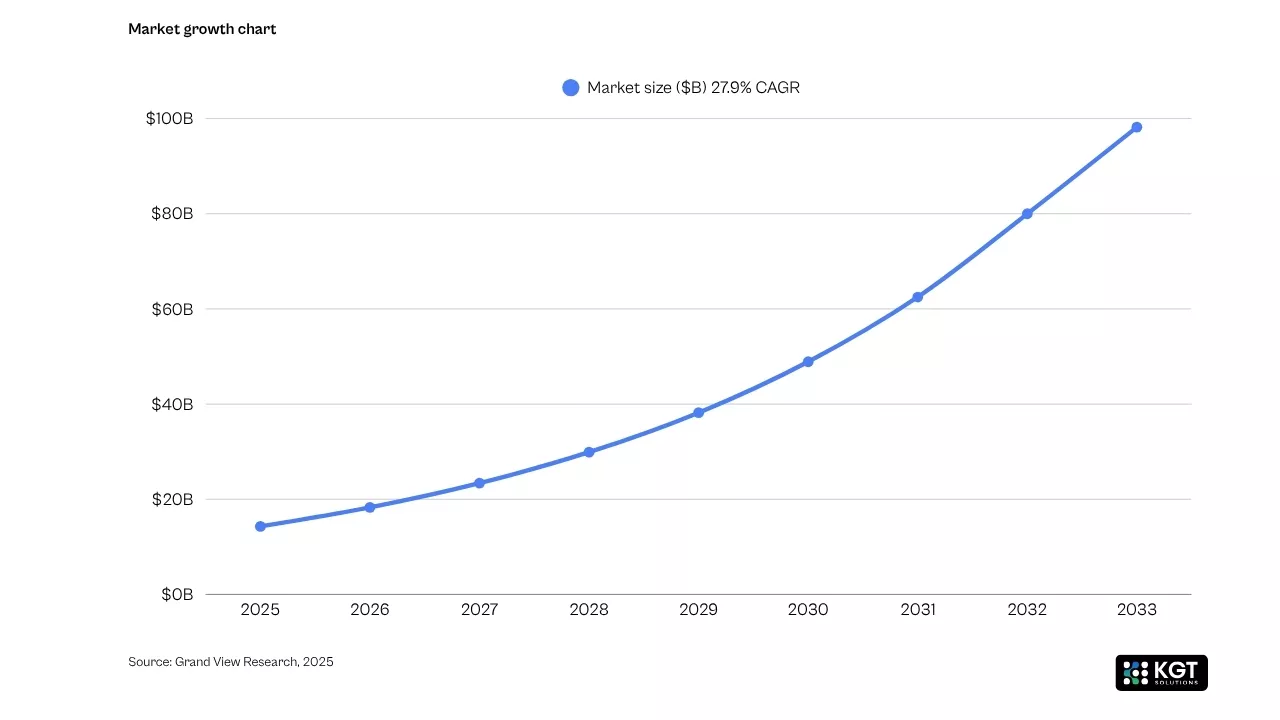
The market hit $14.29 billion in 2025 and grows at 28% CAGR, driven by sensor costs dropping below $1 per unit and AI model accuracy reaching 97%.
How Do IoT Sensors and AI Detect Failures Before They Happen?
Vibration, temperature, and acoustic sensors feed data into neural networks that catch wear patterns up to 90 days before something actually breaks.
Industrial sensors - including accelerometers, infrared thermography units, and ultrasonic detectors - feed continuous vibration, temperature, and acoustic data into trained neural networks that recognize degradation patterns with up to 97% accuracy, flagging anomalies 30-90 days before catastrophic failure.
The detection stack works in three layers. Physical sensors capture raw signals from rotating equipment, hydraulic systems, and electrical panels at millisecond intervals. Edge processors filter noise and extract frequency-domain features before pushing compressed data upstream.
Cloud-hosted or on-prem AI models trained on historical failure data then classify the incoming signals against known degradation curves. When a bearing's vibration signature shifts outside normal operating bands, the system calculates remaining useful life in hours - not guesses, not averages - specific to that asset under its actual load conditions.
Why Calendar-Based Maintenance Fails
Calendar-based preventive maintenance catches roughly 30-40% of failures because it replaces components on fixed time intervals regardless of actual wear state, wasting budget on healthy parts while missing the 60-70% of degradation that occurs between scheduled checks.
A motor scheduled for bearing replacement every 6 months might fail at month 4 under heavy load. Or it might run perfectly for 14 months under lighter conditions. Fixed schedules cannot adapt to real operating context.
Sensor-based approaches solve this by monitoring the actual physical state of the component. The accelerometer does not care what the calendar says. It measures what is actually happening inside the machine right now.
The Three-Layer Detection Architecture
The three-layer detection architecture combines physical IoT sensors at the machine level, edge computing for real-time signal processing, and cloud AI models for failure probability scoring - creating a system that scales from 10 pilot assets to plant-wide deployment without rearchitecting existing automation infrastructure.
Layer 1: Wireless accelerometers, current transducers, and infrared sensors attach to equipment with magnetic mounts in under 30 minutes per asset. No rewiring. No control system modifications.
Layer 2: Edge gateways preprocess raw sensor streams, reducing bandwidth by 60-80% while keeping alert latency under 200 milliseconds for time-critical assets.
Layer 3: AI classification models (random forest, LSTM networks, or transformer architectures) score each asset's health state against plant-specific failure libraries built from CMMS history.
How competitors are using these same systems to win.

What Financial Returns Does Condition-Based Monitoring Deliver?
The U.S. Department of Energy found condition-based monitoring returns 10x investment while cutting breakdowns 70-75% and downtime 35-45%.
Sensor-driven monitoring delivers measurable financial returns by converting catastrophic emergency repairs into planned, budgeted interventions - with the U.S. Department of Energy confirming a tenfold ROI increase, 70-75% fewer breakdowns, and 35-45% downtime reduction compared to no structured program.
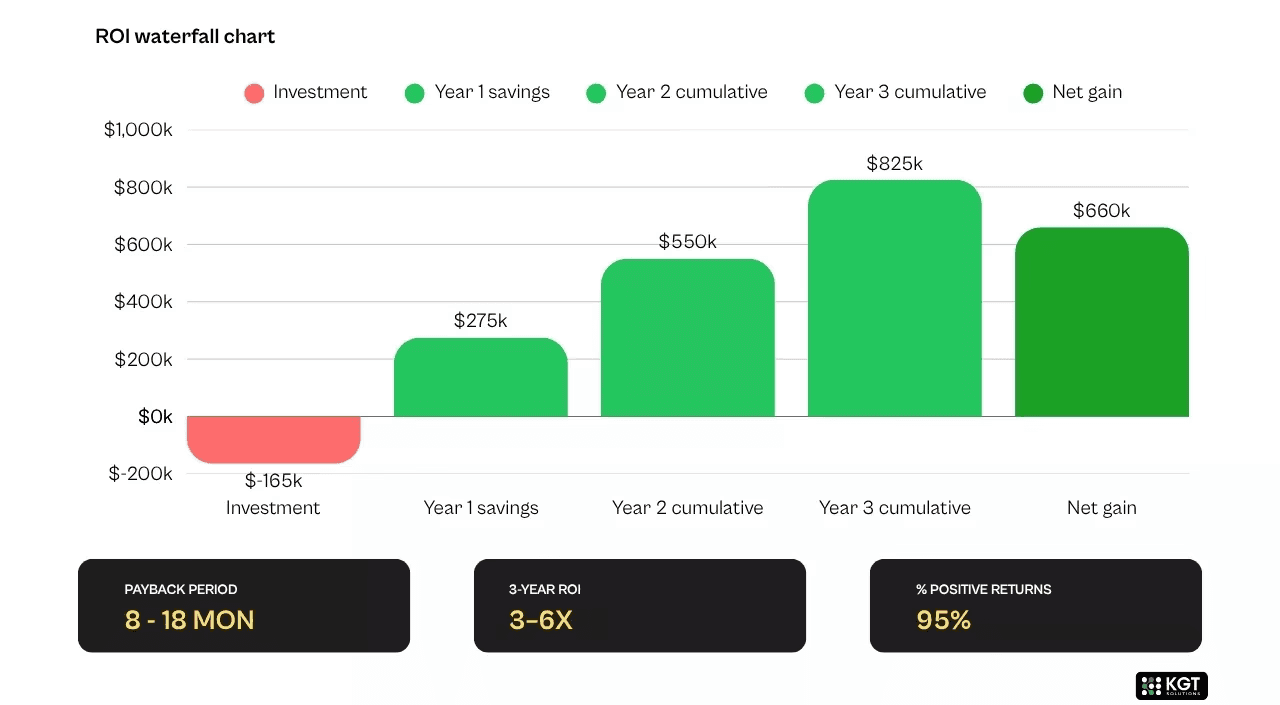
The math is blunt. A mid-market plant running 10 to 30 critical assets can deploy a full sensor-and-analytics stack for $80,000 to $250,000, including hardware, platform licensing, and integration. The typical combined annual benefit runs $150,000 to $400,000, with payback in 8 to 18 months and a 3-year ROI of 3 to 6x.
Automotive plants face downtime costs exceeding $2.3 million per hour, making even a 30 percent reduction in unplanned stops worth tens of millions annually. The investment-to-return ratio explains why 28% CAGR growth is happening across the sector.
Metric | Reactive Maintenance | Predictive Maintenance | Delta |
|---|---|---|---|
Breakdown frequency | Baseline | 70-75% fewer (DOE) | Massive |
Downtime reduction | 0% | 35-50% in year one | Immediate |
Maintenance cost | Baseline | 25-40% lower | $150K-$400K/yr |
ROI timeline | Never | 8-18 months payback | 3-6x over 3 years |
OEE improvement | Flat | +5 to 15 points | Revenue gain |
One food and beverage manufacturer cut downtime by 50 percent and boosted OEE by 25 percentage points on its bottling lines - the kind of gain that makes the hidden costs of skipping automation painfully obvious in hindsight.
OEE Gains That Justify CapEx in 90 Days
Plants routinely gain 5 to 15 OEE percentage points within the first year of deployment, directly translating sensor investment into throughput gains that fund further CapEx justification without additional capital requests.
A plant running at 65% OEE that reaches 75% is producing 15% more sellable product on the same equipment and labor base. That throughput gain compounds monthly. Most finance teams approve expansion requests on far weaker numbers.
Top-performing plants reporting 71% reductions after full-scale implementation are not outliers. They are what happens when sensor coverage reaches 80%+ of critical assets and the model has ingested 12+ months of plant-specific failure data.
How Do You Implement Without Disrupting Production?
Start with 5-10 of your worst offenders, add wireless sensors alongside what you already run, and expect payback in 8-18 months.
Implementation follows a phased rollout - starting with 5 to 10 critical assets selected by downtime cost and failure frequency - deploying wireless sensors and edge gateways that run parallel to existing maintenance programs until confidence builds and the system takes over scheduling authority.
Phase 1 (Months 1-3): Criticality analysis. Rank every asset by hourly stoppage cost multiplied by annual failure probability. Top 10 become the pilot group.
Deploy wireless sensors - no production shutdown required.
Phase 2 (Months 4-6): Model training. The AI ingests 3-6 months of sensor data alongside CMMS work order history. First alerts begin flowing to maintenance teams for validation, not action.
Phase 3 (Months 7-12): Full authority. Validated models drive automated work orders, spare parts procurement triggers, and maintenance window scheduling aligned to production demand. This is where the 35-50% downtime reduction materializes.
The entire deployment runs parallel to existing programs. There is no rip-and-replace moment. Teams that understand why their current software predicts nothing adopt faster because they have already felt the pain of false promises from under engineered systems.
Use our ROI calculator to justify your CapEx in 90 days
IT OT Convergence in Manufacturing Explained

Frequently Asked Questions
How much does predictive maintenance reduce unplanned downtime?
What is the realistic ROI for a mid-market manufacturing plant?
Does predictive maintenance replace preventive maintenance entirely?
What sensors are needed for predictive maintenance?
How long does it take to see ROI from predictive maintenance?
Conclusion
Audit your critical assets by stoppage cost, deploy wireless sensors on the top 10, and let 3-6 months of data train your failure models. KGT Solutions builds these AI-powered industrial systems end to end - talk to our engineering team to scope your pilot.
Why most predictive maintenance software fails to deliver.
Sources:
U.S. Department of Energy - Predictive Maintenance
MarketsandMarkets - Predictive Maintenance Market 2026-2031
Fortune Business Insights - Predictive Maintenance Market Size 2034
Guidewheel - The Real ROI of Real-Time Downtime Tracking
Mitsubishi Manufacturing - Predictive Maintenance Guide 2026
Industrial Autonomous Floor
Newsletter
Actionable insights on industrial AI, automation, and smart operations built for safe, secure, and compliant real-world environments.