Industrial Automation ROI: 330% in 3 Years [Hidden Gains]

Companies report 330% returns over three years from intelligent automation, with payback inside 12 months. Most ROI models miss half the real gains.
Most conversations about industrial automation ROI go like this: someone pulls out a spreadsheet, points to labor savings, and declares the project justified. That math isn't wrong, but it's incomplete. The returns that actually change a company's trajectory, things like fewer production errors, smarter resource allocation, and the ability to absorb supply chain shocks, rarely show up in the initial business case.
The global industrial automation market crossed $215 billion in 2025 and is growing at roughly 9.5% annually, according to Research Nester. Yet a 2025 manufacturing survey by Vention found that nearly one third of automation projects don't perform as expected. The gap between investment and outcome usually comes down to measuring the wrong things.
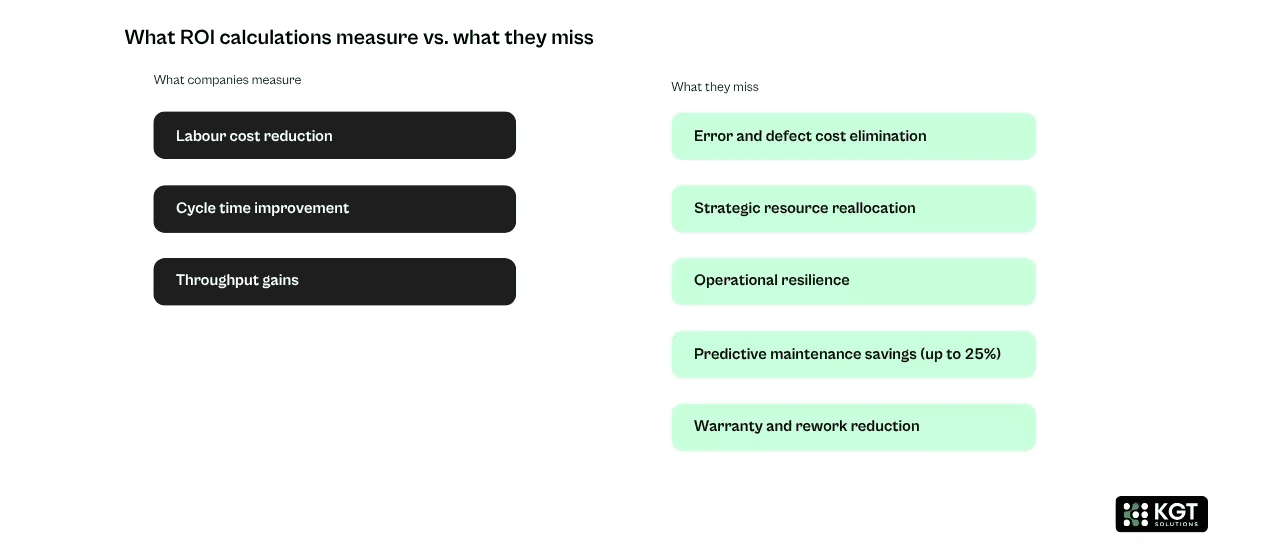
Where the standard industrial automation ROI calculation falls short
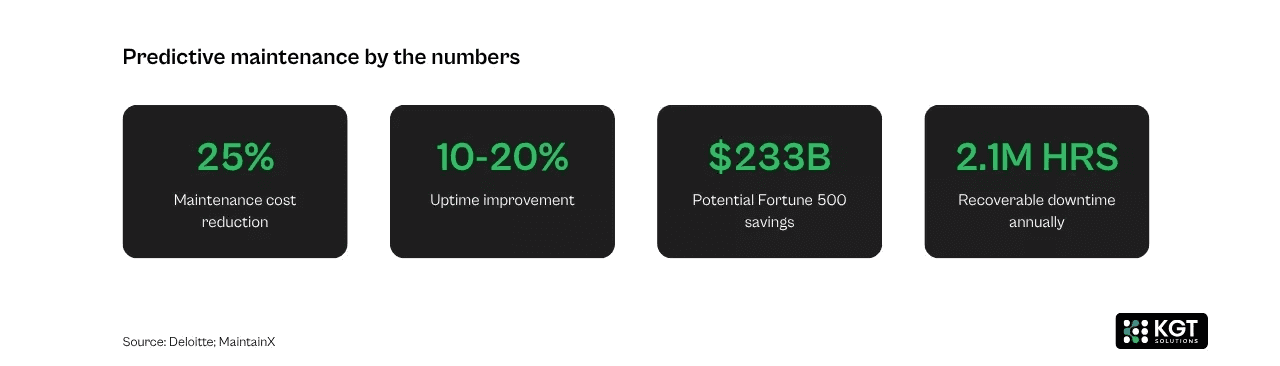
Predictive maintenance alone cuts costs 25% and adds 10% uptime. Most ROI models completely ignore these second-order gains.
Traditional ROI focuses on what's easy to count: headcount reduction, cycle time improvement, throughput gains. These are real, but they're also the most commoditized benefits. Every competitor running the same automation PLC configuration gets them too.
What separates companies that see 2x returns from those that break even is whether they capture the second and third order effects. According to Deloitte, predictive maintenance alone can cut maintenance costs by up to 25% and raise uptime by 10 to 20%. That's not labor savings. That's an entirely different category of value that most project proposals ignore.
Error elimination changes the economics of quality
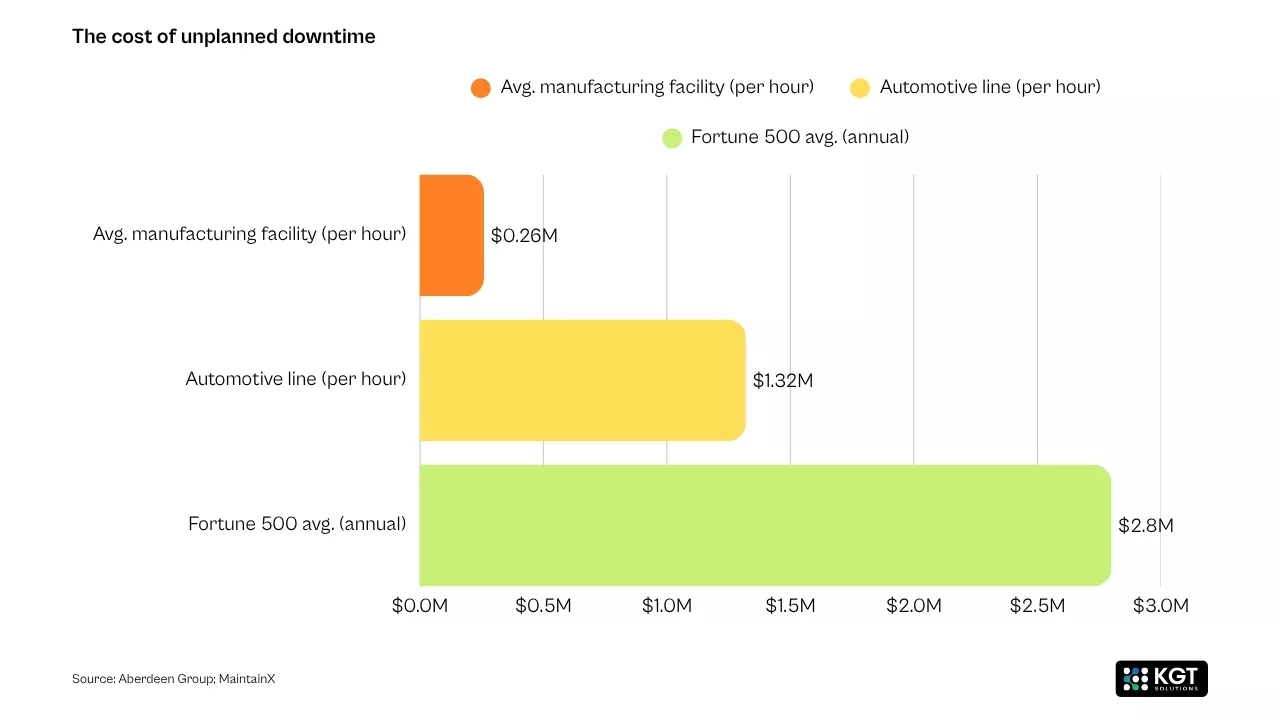
Unplanned downtime costs $260,000 per hour on average. Automation removes the human variability that causes most quality failures.
Here's a number worth sitting with: manufacturing facilities lose an average of $260,000 per hour during unplanned downtime, according to Aberdeen Group. In automotive plants, that figure can hit $22,000 per minute.
Industrial automation eliminates the human variability that causes most quality failures. When industrial control systems and production monitoring systems run consistently, defect rates drop. When defect rates drop, rework costs disappear, warranty claims shrink, and customer trust compounds over years. None of that shows up in month one of a payback calculation.
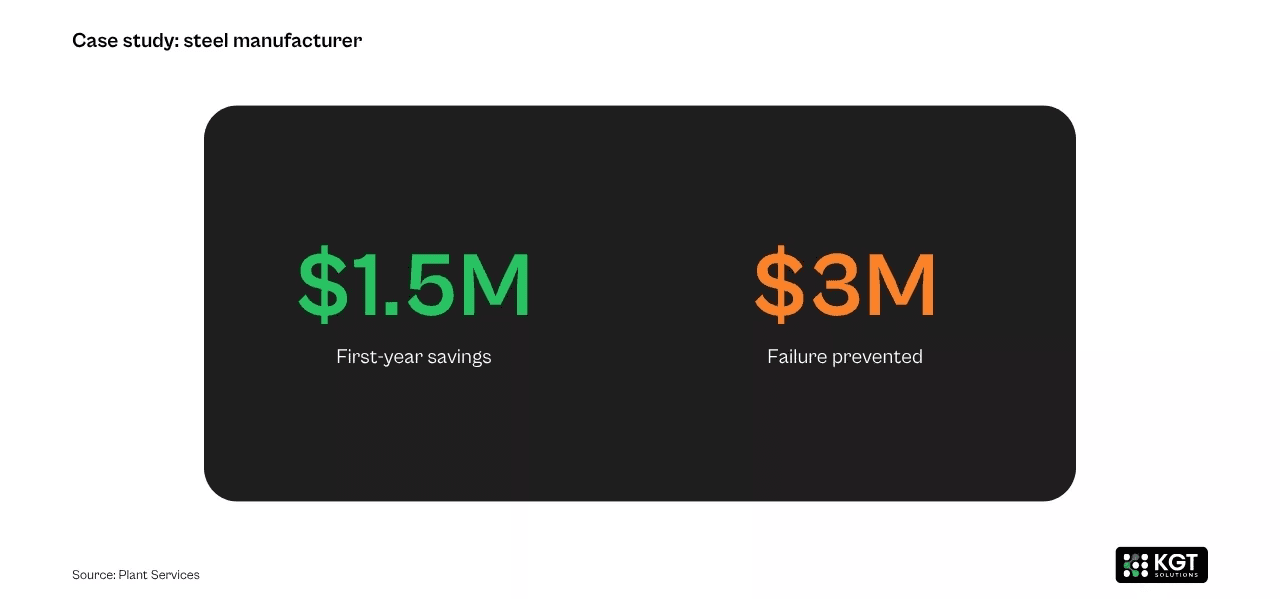
IoT solutions make this even more precise. Sensors feeding data into monitoring systems can catch deviations in temperature, pressure, or vibration long before they cause a rejected batch. A steel manufacturer using this approach saved $1.5 million in its first year and prevented a $3 million transformer failure, according to Plant Services.

Strategic resource reallocation is the real multiplier
88% of organizations use AI somewhere. But the bigger ROI comes from moving freed-up workers into roles that actually grow revenue.
When people talk about automation replacing workers, they miss the more interesting story. A 2025 McKinsey report found that 88% of organizations use AI in at least one business function, but only a third have scaled it across the enterprise. The companies getting outsized returns aren't just cutting headcount. They're moving experienced operators into roles where human judgment actually matters.
Robotic process automation RPA services handle repetitive data entry and reporting tasks so that engineers can focus on process improvement. One consumer packaged goods company saved $5 million annually by deploying sensors and predictive analytics across its production lines, freeing maintenance teams to work on reliability engineering rather than emergency repairs.
Industrial IoT development services amplify this effect. When warehouse automation handles material movement and digital twin software models process changes before they hit the floor, the humans in the loop shift from execution to optimization. That shift is where the compound returns live.
Operational resilience: the ROI you only appreciate during a crisis
Automated plants absorb supply chain hits and demand spikes without losing capacity. You do not appreciate this until a crisis actually happens.
Operational resilience means absorbing disruptions, from supply chain failures to equipment breakdowns to demand spikes, without losing production capacity. The past few years made this painfully concrete for manufacturers worldwide.
Industrial AI solutions and PLC industrial automation give plants the flexibility to reroute production, adjust parameters on the fly, and maintain output when something goes sideways. A 2025 Vention survey found that 73% of manufacturers plan to increase automation investments over the next three years, and the primary driver isn't cost cutting. It's resilience.
Consider how industrial PLC programming enables rapid changeovers. A production line controlled by modern PLC hardware can switch between product variants in minutes rather than hours. When demand shifts or a supplier drops out, that flexibility is worth more than the entire capital cost of the system.
IT OT Convergence in Manufacturing Explained
What the data actually says about payback
Companies are getting 330% returns over three years from intelligent automation. Most see payback inside the first 12 months.
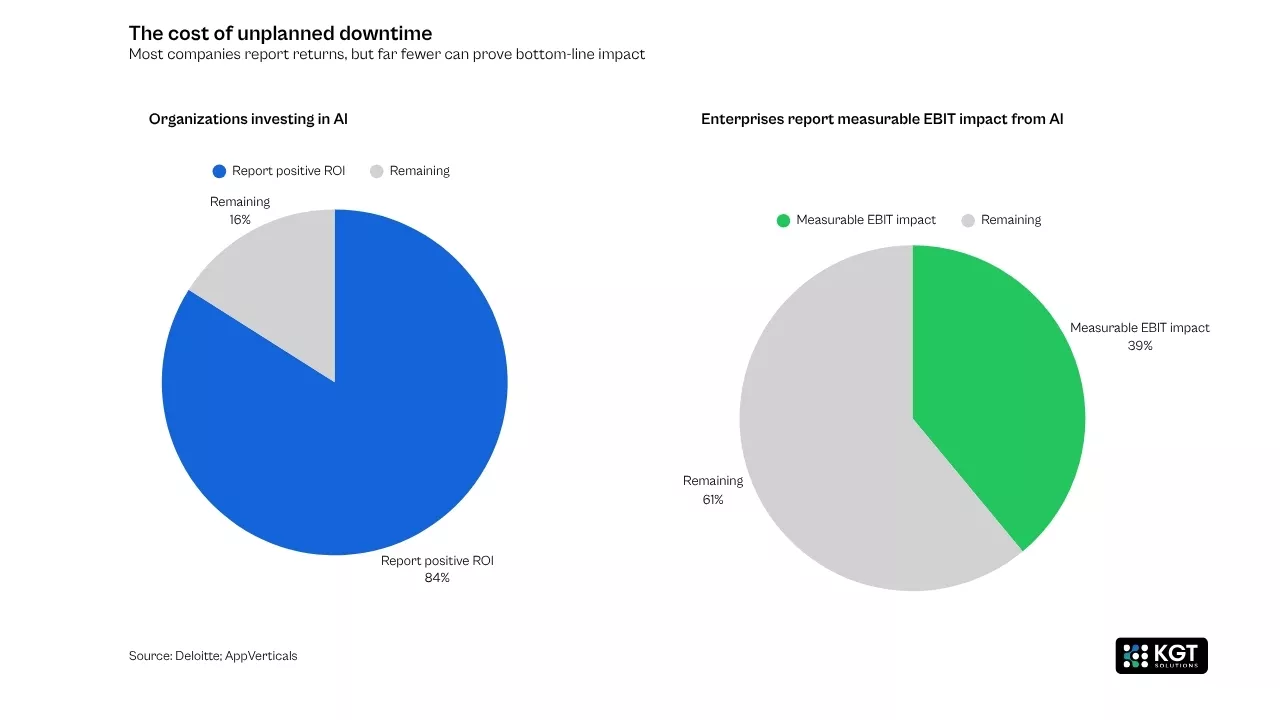
The payback data is more interesting than most vendor pitches suggest. According to SS&C Blue Prism, companies see a 330% return over three years from intelligent automation, with payback often within six months. A separate study found that 84% of organizations investing in AI report positive ROI, per Deloitte.
But there's a catch: only 39% of enterprises report measurable EBIT impact from AI, and most say the contribution is still below 5%. The gap isn't the technology. It's that most companies are still measuring labor savings and speed while ignoring error reduction, resource reallocation, and resilience.
Fortune 500 companies lose an estimated $2.8 billion annually from unplanned downtime alone, roughly 11% of revenue. Full adoption of condition monitoring and predictive maintenance could save those companies $233 billion in maintenance costs and recover 2.1 million hours of downtime each year.
How to measure what actually matters
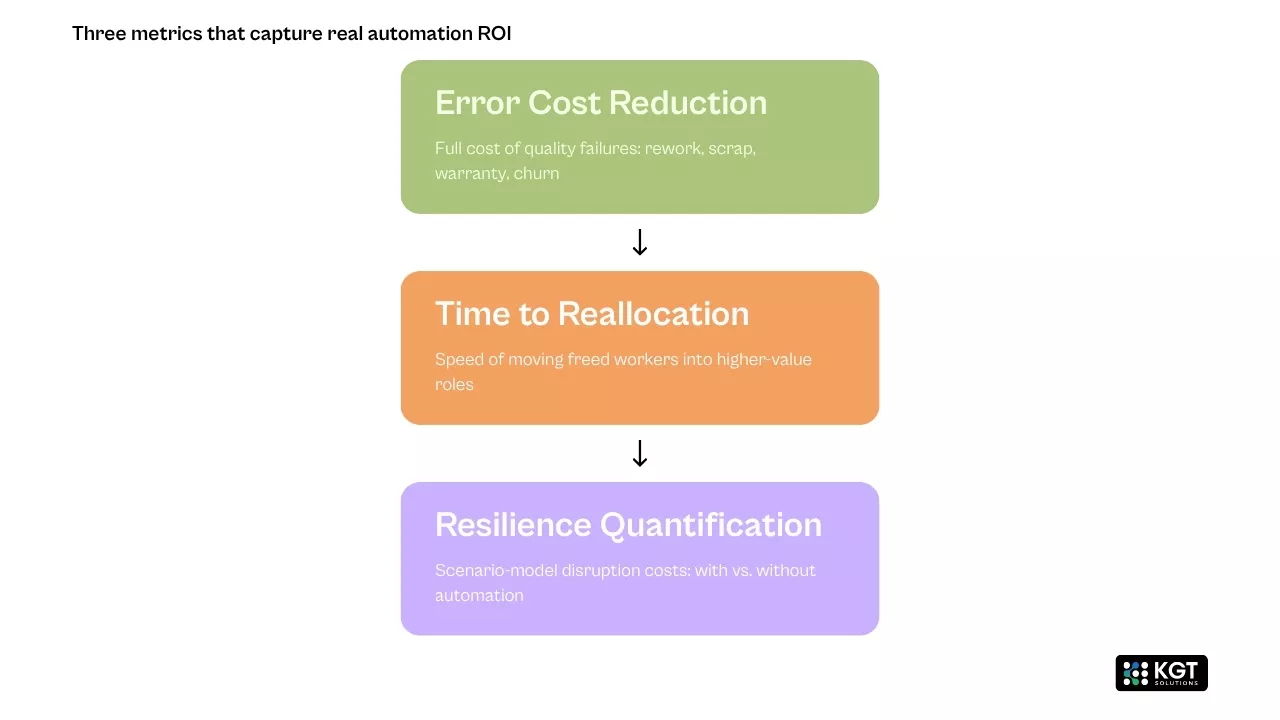
Stop measuring just cycle time and headcount. Track error cost reduction, the value of redeployed workers, and resilience gains instead.
If you're building a business case for industrial automation, here's what I'd suggest measuring beyond the obvious:
First, track error cost reduction. Not just defect rates, but the full cost of quality failures including rework, scrap, warranty claims, and customer churn. Your existing control and monitoring infrastructure already generates the data for this. You just need to connect it to finance.
Second, measure time to reallocation. How quickly can freed up workers move into higher value roles? The ROI of industrial automation scales with how effectively you redeploy talent, not how many positions you eliminate.
Third, quantify resilience. Run scenario models using digital twin software. What does a 48 hour supplier disruption cost with your current setup versus with automated failover? The difference is real money, even if it hasn't happened yet.
The bottom line
The market is heading toward $400 billion by 2030, with growth accelerating across every region. But the companies capturing the most value aren't the ones with the biggest automation budgets. They're the ones measuring the returns that nobody puts in the PowerPoint.
Error elimination, strategic resource reallocation, and operational resilience are where the compound returns hide. If your ROI model only counts labor savings and speed, you're probably undervaluing your automation investments by half or more.
Frequently Asked Questions
What does 330% ROI from industrial automation actually mean?
What are the hidden gains in industrial automation that most companies overlook?
How long does it take to see ROI from industrial automation?
Is industrial automation ROI realistic for small and mid-size manufacturers?
What metrics should manufacturers track to measure automation ROI accurately?
Sources:
Research Nester, ""Industrial Automation Market Size, Share & Trends Forecast 2026-2035,"" September 2025.
Vention, ""2025 Manufacturing Automation Survey Findings and Insights,"" December 2025.
Deloitte, ""Advanced Analytics and Machine Learning for Predictive Maintenance,"" 2021.
Aberdeen Group, unplanned downtime cost data, cited in WorkTrek, September 2025.
Plant Services, ""Steel Manufacturing Case Study: Preventing Transformer Failures.""
McKinsey, ""State of AI 2025"" report.
SS&C Blue Prism, intelligent automation ROI data, cited in Ringly.io, April 2026.
MaintainX, ""25 Maintenance Stats, Trends, and Insights for 2026,"" October 2025.
AlixPartners, ""Industrial Automation: A Rich Hunting Ground for Corporates and Private Equity,"" January 2025.
Industrial Autonomous Floor
Newsletter
Actionable insights on industrial AI, automation, and smart operations built for safe, secure, and compliant real-world environments.