How to Choose an Enterprise AI Platform in 2026

An enterprise AI platform is the software layer that builds, runs, and governs AI across your business. Pick it on data fit, not demos.
Key Takeaways
Most CTOs evaluate 6-10 vendors before shortlisting; a scoring rubric cuts that decision time roughly in half.
An enterprise AI platform should be judged on data integration, governance, and total cost over 3 years, not feature checklists.
Build vs buy is rarely all-or-nothing. Around 70% of mature teams run a hybrid: buy the platform, build the custom models.
Hidden costs (integration, retraining, compliance) often add 40-60% on top of the sticker license price.
What Is an Enterprise AI Platform?
An enterprise AI platform is the software stack that lets a company build, deploy, govern, and monitor models across many teams from one place.
Think of it like the electrical panel in a building. You don't wire each appliance straight to the street. You run everything through one panel that controls power, safety, and metering. This software does the same job for models, data pipelines, and access. It sits between your raw data and the apps your teams ship.
The category is crowded. You'll see the term used for three different things: managed cloud AI services, MLOps tooling, and full enterprise artificial intelligence suites. Knowing which one you actually need is half the battle. A retail founder wanting a recommendation engine has very different needs than a bank automating loan decisions, even though both shop in the same market.
For a deeper look at the make-or-buy question before you shortlist vendors, our guide on build vs buy AI software breaks down the trade-offs by team size and risk.
Why Do CTOs Struggle to Choose an Enterprise AI Platform?
CTOs struggle because vendor demos all look identical, and the real differences only show up after data integration starts.
The market hands you analysis paralysis on purpose. There are dozens of enterprise AI solutions, and almost every vendor claims to do everything. Gartner has noted that a large share of AI projects stall before production, and platform mismatch is a common reason. You buy for the demo, then discover your data doesn't fit.
Three things make the choice hard:
Feature parity is fake. On a slide, every platform supports "custom models" and "real-time inference." In practice, the depth varies wildly.
Lock-in is invisible at signing. Switching costs hide in proprietary formats and retrained staff.
Pricing is opaque. License is the small number. Integration and compute are the big ones.
And here's the trap most teams fall into: they let the loudest vendor set the evaluation criteria. If a salesperson tells you to score on "model marketplace size," you're now playing their game, not yours.
How Do You Evaluate Enterprise AI Platforms?
| Criterion | Weight | What to actually test |
|---|---|---|
| Data integration fit | 25% | Reads your real data sources without a 6-month pipeline rebuild |
| Governance & compliance | 20% | Audit logs, access controls, model lineage, region rules |
| Total 3-year cost | 20% | License + compute + integration + retraining |
| Scalability & latency | 15% | Cost and speed at 10x today's volume |
| Vendor support & roadmap | 10% | Real response times, not the logo on the contract |
| Exit & portability risk | 10% | Export formats and model ownership if you leave |

Score every platform on six weighted criteria: data fit, governance, scalability, cost, support, and exit risk.
Don't start with features. Start with a rubric. Assign weights based on your situation, then score each vendor 1-5. The math forces honesty when a demo tries to dazzle you.
Criterion | Weight | What to actually test |
|---|---|---|
Data integration fit | 25% | Can it read your real data sources without a 6-month pipeline rebuild? |
Governance & compliance | 20% | Audit logs, access controls, model lineage, region-specific rules |
Scalability & latency | 15% | Cost and speed at 10x your current volume, not today's |
Total 3-year cost | 20% | License + compute + integration + retraining, not sticker price |
Vendor support & roadmap | 10% | Response times, not the logo on the contract |
Exit & portability risk | 10% | How hard is it to leave? Export formats, model ownership |
Run a paid proof-of-concept on your two finalists with your own data. A demo proves the platform works on the vendor's data. A POC proves it works on yours. That difference is where most regret lives.
What Data Integration Questions Should You Ask?
Data integration is the single biggest predictor of success; ask how the platform connects to your messiest data source first.
Most platforms demo beautifully on clean, structured data. Your business doesn't run on clean data. It runs on legacy databases, half-documented APIs, and a warehouse three acquisitions deep.
Ask these before you sign:
Does it connect natively to our existing data warehouse, or do we build adapters?
How does it handle unstructured data (PDFs, images, logs)?
What happens to latency when our data volume triples?
Can our existing team maintain the pipelines, or do we need new hires?
One mid-market logistics firm we know picked a platform on model quality, then spent four months and a six-figure budget just getting their data in. The model was never the problem. If you also build IoT or sensor-heavy products, vetting the vendor's data layer the way you'd vet an IoT software development company saves that pain.
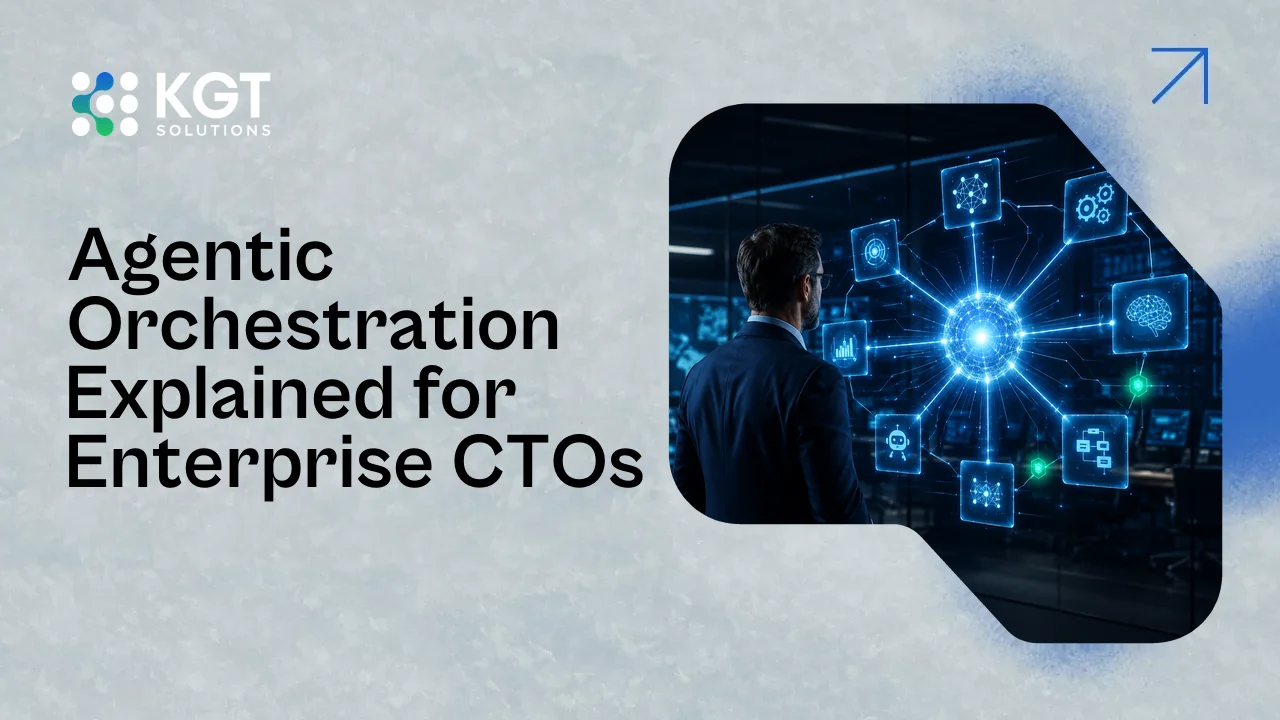
Agentic Orchestration Explained for Enterprise CTOs
How Important Is AI Governance and Compliance?
Governance is non-negotiable for any platform handling regulated data; missing audit trails can void compliance overnight.
If you operate in finance, healthcare, or anywhere with regulators, governance isn't a nice-to-have. It's the thing that keeps you out of trouble. You need model lineage (who trained what, on which data), access controls, and audit logs that satisfy an external reviewer.
The EU AI Act and similar rules are pushing this hard. A platform without built-in governance forces you to bolt it on later, which costs more and breaks more. Ask to see the audit log on a live model, not a slide about it.
Build vs Buy: When Should You Build Your Own AI Platform?
Build your own platform only when AI is your core product or your data is so unique that no vendor fits; otherwise, buy.
This is the question that keeps CTOs up at night. The honest answer is that most companies should buy the platform and build the models on top. Around 70% of mature AI teams run this hybrid setup. They get the plumbing from a vendor and spend their engineering budget where it differentiates them.
Factor | Lean Buy | Lean Build |
|---|---|---|
AI is your core product | No | Yes |
Data is industry-standard | Yes | No |
Team has senior ML engineers | No | Yes |
Time to market matters most | Yes | No |
Compliance needs are extreme & unique | Maybe | Yes |
Building gives you control and zero license fees. It also gives you a permanent maintenance bill and a hiring problem. Most ai software companies that started by building their own stack eventually wished they'd bought the boring parts. Build the 10% that makes you special. Buy the 90% that everyone needs.
What Are the Hidden Costs of an Enterprise AI Platform?
Hidden costs add 40-60% to the license price; integration, compute, and staff retraining are the three biggest surprises.
The license fee is the part vendors put on the quote for your enterprise AI platform. It's also the smallest part of what you'll actually spend. Budget for the rest or get blindsided at renewal.
The costs that ambush teams:
Integration: Connecting your data and apps. Often the single largest line item in year one.
Compute: Inference and training bills scale with usage and can dwarf the license.
Retraining staff: Your team needs weeks to get productive on a new platform.
Compliance overhead: Meeting audit and governance requirements takes real hours.
A useful gut check: take the quoted annual license and multiply by 1.5 for your realistic year-one total. If that number breaks your budget, you found out cheap. Plenty of leading ai companies publish reference architectures that help you estimate compute before you commit.
How Do You Shortlist the Right Vendor?
Shortlist by matching platform strengths to your top two weighted criteria, then run paid POCs on the final two vendors.
Don't try to find the "best" tool. There isn't one. Among the dozens of enterprise AI solutions on the market, there's only the best fit for your data, your team, and your compliance reality. A platform that's perfect for a 5,000-person bank may be wrong for a 40-person startup.
Your shortlist process:
Write your weighted rubric before you take a single demo.
Score 5-8 vendors on public info and a guided demo.
Cut to two finalists.
Run a paid POC on each with your real data and a real use case.
Score the POC results, factor in 3-year cost, and decide.
This is slower than picking the vendor with the slickest pitch. It's also how you avoid the platform migration nobody budgets for. When you need an enterprise AI platform that actually ships, the rubric is your protection against a good salesperson.
Frequently Asked Questions
What is the biggest mistake companies make when choosing an enterprise AI platform?
How long does it take to implement an enterprise AI platform?
What security and compliance features should an enterprise AI platform include?
How do you measure ROI from an enterprise AI platform investment?
Should enterprises build their own AI platform or buy a commercial solution?
Conclusion
Choosing an enterprise AI platform comes down to one habit: score on your data and your costs, not the vendor's demo. Write your weighted rubric, run a paid POC on two finalists, and budget 1.5x the license. If you want a second set of eyes on your shortlist or POC plan, talk to the KGT Solutions team before you sign anything.
Sources:
Gartner - Predicts AI Project Implementation and Failure Rates
McKinsey & Company - The State of AI 2025
European Commission - EU AI Act Compliance Guidance
Deloitte - State of Generative AI in the Enterprise 2025
IDC - Worldwide Artificial Intelligence Platforms Forecast
Protocol AI Newsletter
Practical insights on AI, automation, and intelligent systems focused on real-world applications, not hype.