Stop Guessing With Your Industrial Automation

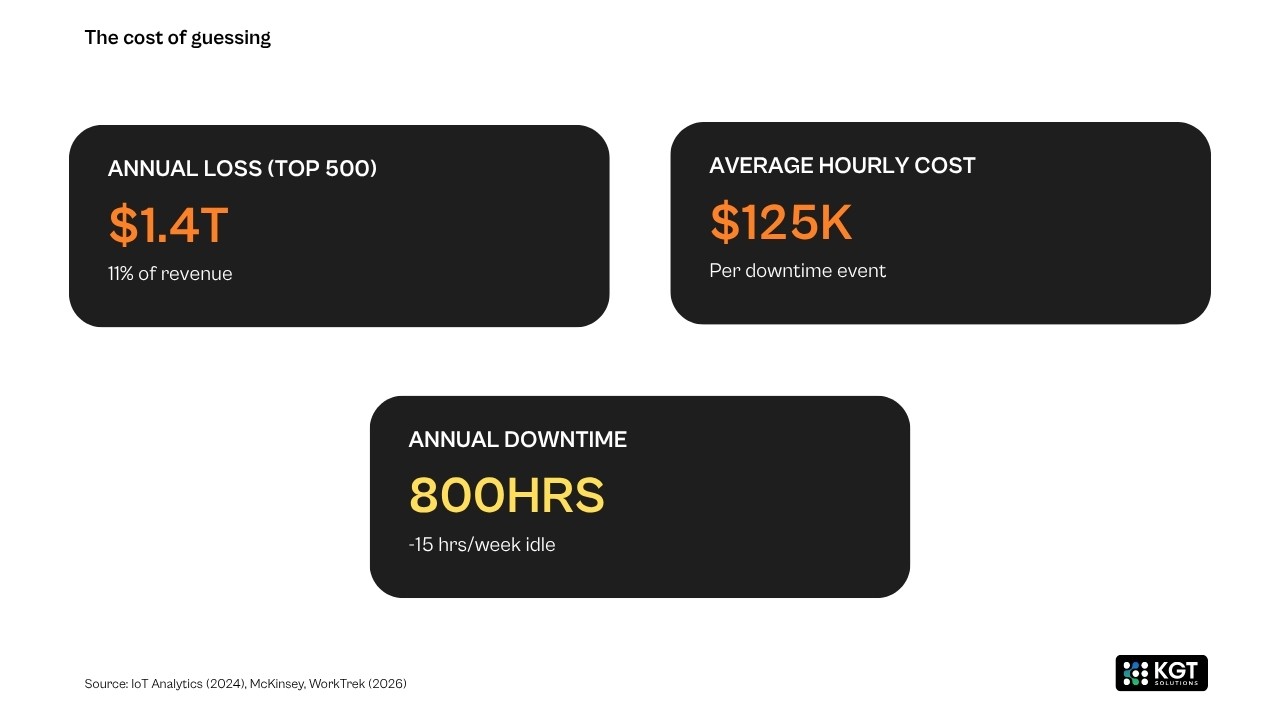
Most factories still run on gut instinct. An operator hears a strange noise from a motor, calls in a technician, and the team spends two hours chasing a problem that could have been flagged automatically three weeks ago. According to Siemens' True Cost of Downtime 2024 report, unplanned stoppages drain $1.4 trillion a year from the world's 500 biggest companies, roughly 11% of their total revenue. That number should bother anyone still relying on guesswork in their industrial automation setup.
The gap between "automated" and "intelligent" is where most of that money disappears.
Why Guesswork Persists in Industrial Automation
In its most basic form, industrial automation means replacing manual tasks with machines and control systems. PLCs execute logic, SCADA interfaces show dashboards, and motors spin on schedule. But installing an automation PLC and connecting sensors does not, by itself, eliminate uncertainty.
A 2024 ABB survey of 3,200 plant maintenance leaders found that two-thirds of companies deal with unplanned downtime at least once a month, costing an average of $125,000 per hour. The equipment is automated. The decision-making around it often is not. Operators eyeball temperature gauges, maintenance teams follow calendar-based schedules that ignore actual wear, and production managers adjust parameters based on what worked last quarter.
This is the guessing that needs to stop.
What Data-Driven Industrial Automation Actually Looks Like
Moving past guesswork requires layering intelligence on top of existing industrial control systems. The building blocks:
Real-time production monitoring systems that capture data from every PLC, sensor, and actuator on the floor. Not monthly reports. Continuous streams that surface anomalies within seconds. The average manufacturer faces roughly 800 hours of unplanned downtime per year. These monitoring systems cut into that figure by catching deviations before they become full stoppages.
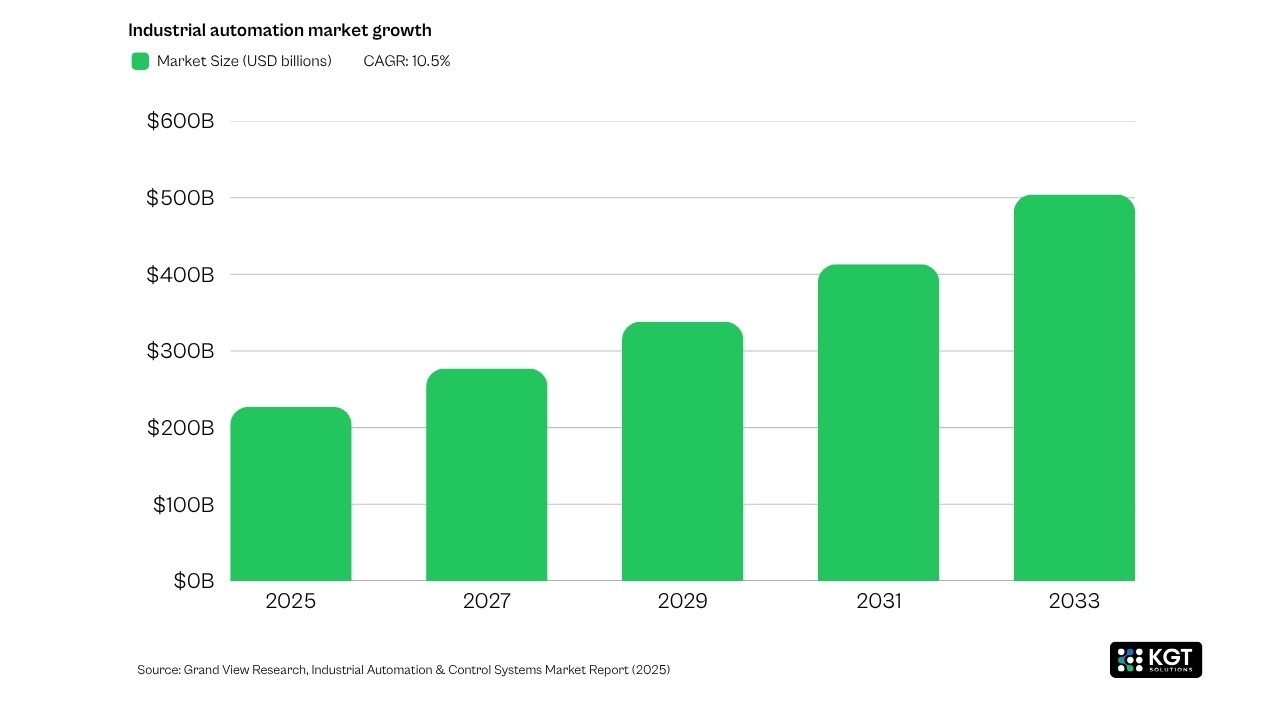
Industrial IoT solutions that connect previously siloed equipment into a single data layer. When a conveyor motor in packaging can talk to the upstream filling station, you catch bottlenecks in real time instead of discovering them in the scrap bin. The global market for these technologies is projected to grow from $226 billion in 2025 to over $500 billion by 2033, at roughly 10.5% CAGR, according to Grand View Research.
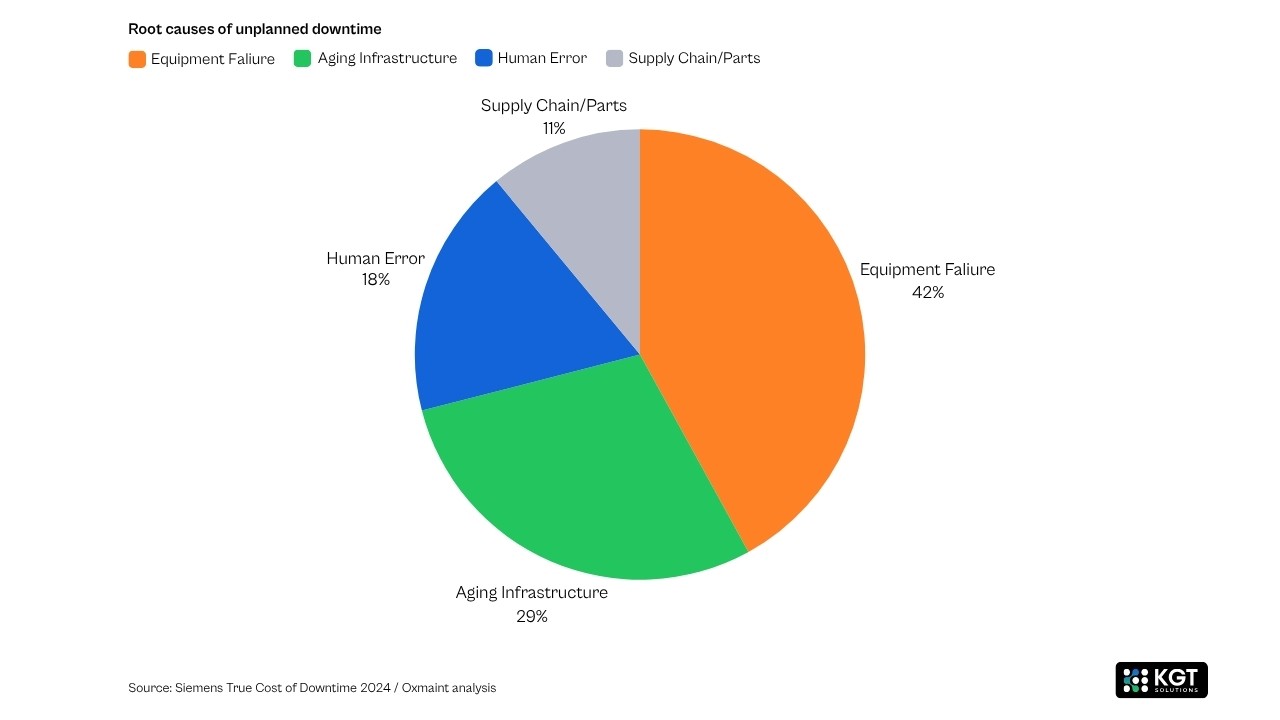
Predictive maintenance powered by industrial AI solutions. Calendar-based maintenance replaces parts on a fixed schedule regardless of condition. Predictive maintenance replaces parts when sensor data and machine-learning models indicate actual degradation. IDS-INDATA research shows that predictive tools have reduced downtime by up to 50% in facilities that have adopted them. Equipment failure alone accounts for 42% of all unplanned downtime, and most of it is preventable.

The Role of PLCs and Control Systems
PLC programming remains the backbone of factory-floor logic. A well-programmed PLC handles sequencing, interlocking, and safety shutdowns with millisecond-level reliability. But a PLC alone does not know whether the motor it controls is three weeks from bearing failure.
That's where integration matters. Modern PLC platforms feed operational data into edge computing devices or cloud analytics layers. The PLC executes control logic. The analytics layer spots patterns across thousands of data points to predict failures, optimize energy use, and adjust process parameters dynamically.
This combination is what separates automation products that merely execute from systems that actually think.
Digital Twins and Warehouse Automation: Seeing Before Doing
Digital twin software creates a virtual replica of a physical system, letting engineers test changes before implementing them on the floor. Instead of guessing whether a new conveyor speed will cause jams downstream, you simulate it. Instead of hoping a revised PLC program handles edge cases, you run it against a digital model first.
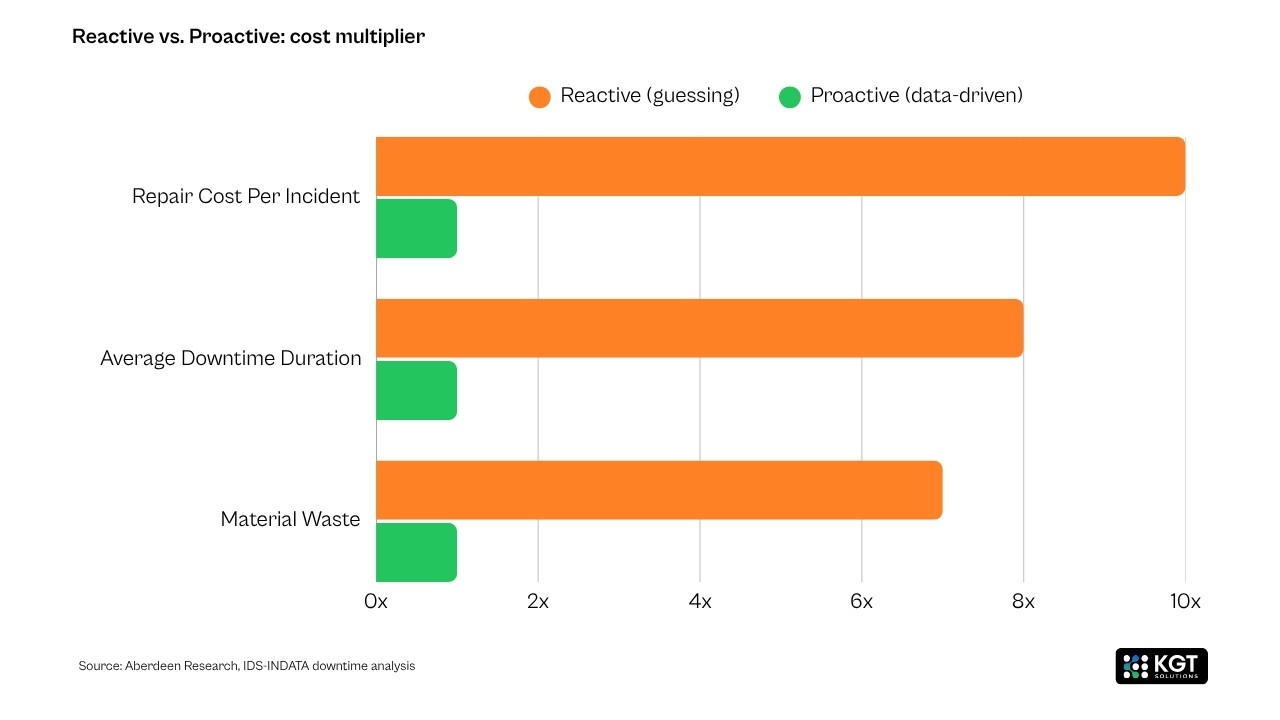
In warehouse settings, these virtual models simulate pick-and-place sequences, robotic path planning, and throughput under varying order volumes. Considering that unplanned repairs cost 3 to 10 times more than scheduled work, testing in simulation first is an obvious financial decision
IT OT Convergence in Manufacturing Explained
Monitoring Systems Beyond the Factory Floor
The same principle applies outside traditional manufacturing. A tyre pressure monitoring system on fleet vehicles uses sensor data instead of manual checks to prevent blowouts. Surveillance system wireless setups use edge processing to flag anomalies without a human watching every feed. A monitoring system for elderly care replaces periodic manual check-ins with continuous sensor networks.
The common thread: replacing observation with continuous, automated data collection and intelligent alerting.
How to Start: Practical Steps
If you are running legacy PLCs and standalone SCADA, you do not need to rip everything out. Start with these:
Instrument the biggest pain points first. If bearing failures on a specific motor cause 40% of your line stoppages, put vibration and temperature sensors on that motor. Connect them to an analytics platform. You will likely see patterns within weeks.
Connect your data silos. Most factories have production data in one system, maintenance records in another, and quality data in a third. IIoT platforms that unify these streams give you visibility that no single system can provide on its own.
Set up a 5 monitor setup in your control room that displays real-time OEE, maintenance alerts, quality metrics, energy consumption, and production schedule adherence. Visibility changes behavior. When the whole team can see that a line is trending toward a stoppage, someone acts on it faster.
Adopt robotic process automation RPA services for back-office processes that feed into production: purchase order processing, quality documentation, compliance reporting. Manual data-entry errors in these areas cascade into production issues more often than most teams realize.
The Bottom Line
The global market for these technologies is heading past $500 billion for a reason: companies that use data outperform those that guess. Unplanned downtime costs U.S. manufacturers around $50 billion annually, with equipment failures accounting for 42% of the total. Over 80% of manufacturers cannot accurately calculate their own downtime costs.
Stop guessing. Instrument your equipment, connect your systems, and let the data tell you what is actually happening. The technology exists. The question is whether you will use it or keep relying on the operator who says the motor "sounds fine."
Frequently Asked Questions
What are the signs that your industrial automation relies too heavily on guesswork?
How does data-driven automation reduce unplanned downtime?
What types of sensors are essential for eliminating guesswork in factory operations?
How long does it take to transition from reactive to predictive industrial automation?
What ROI can factories expect from replacing guesswork with automated monitoring?
Sources:
Siemens, "The True Cost of Downtime 2024" - Senseye Predictive Maintenance Report
ABB, "Value of Reliability Report" (2023) - Survey of 3,200 global plant maintenance leaders
Grand View Research, "Industrial Automation & Control Systems Market Report" (2025)
IDS-INDATA, "The Real Cost of Downtime in Manufacturing" (2025)
Aberdeen Research = Manufacturing downtime cost analysis
Forbes - U.S. manufacturing unplanned downtime estimates
Industrial Autonomous Floor
Newsletter
Actionable insights on industrial AI, automation, and smart operations built for safe, secure, and compliant real-world environments.