AR in Manufacturing: 5 Use Cases with Proven ROI (2026)

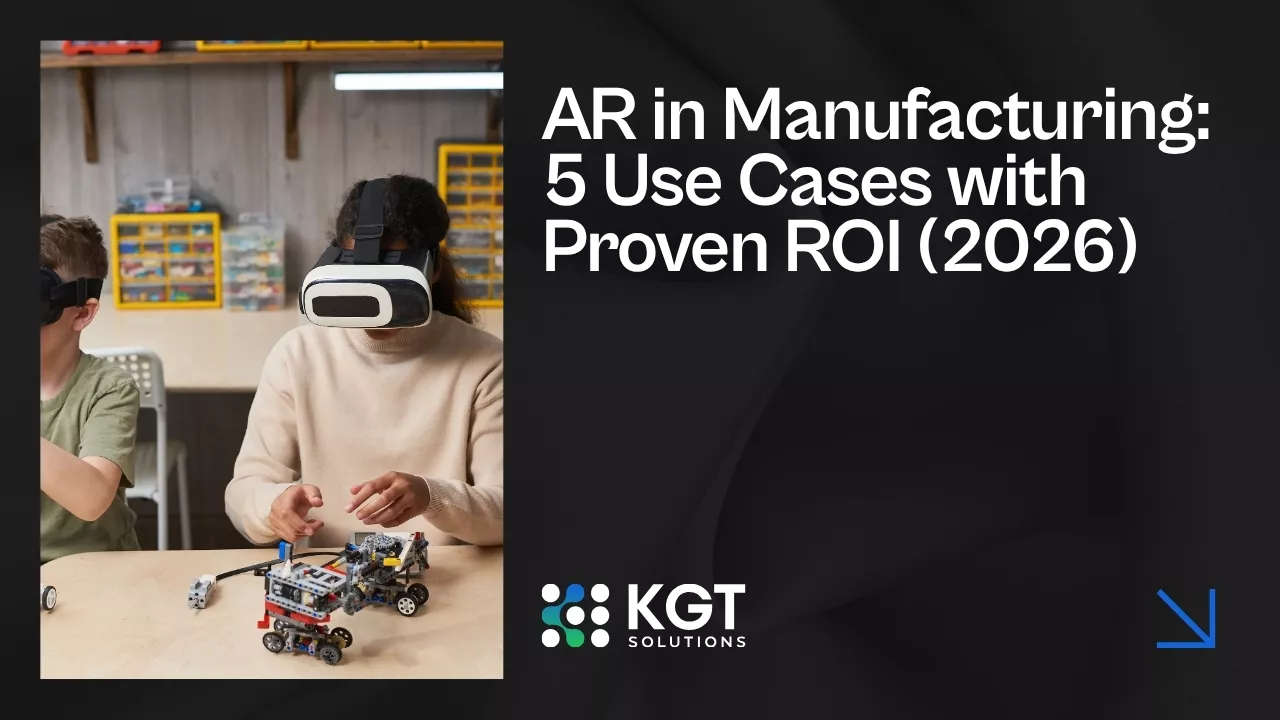
Augmented reality in manufacturing cuts training time 40-50% and reduces assembly errors by up to 90% across automotive, aerospace, and electronics plants.
Key Takeaways
AR-guided assembly reduces error rates by up to 90% and speeds up complex tasks by 25-30%, according to Boeing and Lockheed Martin production data
The industrial augmented reality market is projected to hit $18.8 billion by 2028, growing at 25.1% CAGR from a $5.7 billion base in 2023
Virtual reality in manufacturing training programs cut onboarding time from weeks to days, with companies reporting 75% faster skill acquisition and 43% fewer on-the-job incidents
AR remote assistance saves $1,200-$3,500 per service call by eliminating travel costs and reducing mean time to repair by 30-50%
What Is Augmented Reality in Manufacturing?
Augmented reality in manufacturing overlays digital instructions, 3D models, and real-time data onto physical equipment through headsets, tablets, or smart glasses.
Think of it as giving your operators X-ray vision. Instead of flipping through a 200-page paper manual to find a torque spec, a technician wearing AR glasses sees the exact bolt highlighted in their field of view - with the correct torque value floating right next to it.
AR in manufacturing isn't a futuristic concept anymore. It's running on shop floors at Boeing, Porsche, Toyota, and hundreds of mid-market manufacturers right now.
The technology pulls from three sources: computer vision to understand what the camera sees, spatial mapping to anchor digital objects to real-world surfaces, and IoT sensor feeds to display live machine data in context.
What makes this different from watching a YouTube tutorial? Context. AR instructions move with the operator and adapt to what the worker is looking at. And they're connected to your MES, ERP, and quality systems - so the digital overlay shows the right data for the right work order at the right time.
How Does AR Differ from Virtual Reality in Manufacturing?
AR adds digital information to the real world while virtual reality in manufacturing replaces it entirely with a simulated environment.
This distinction matters for every manufacturer evaluating these technologies. Here's the practical breakdown:
Feature | Augmented Reality (AR) | Virtual Reality (VR) |
|---|---|---|
Environment | Real world + digital overlay | Fully simulated |
Hardware | Smart glasses, tablets, phones | VR headsets (Oculus, HTC Vive) |
Best for | On-the-job guidance, maintenance, QC | Training, design review, simulation |
Operator mobility | Full movement on shop floor | Stationary or limited area |
Setup cost (per station) | $2,000-$8,000 | $3,500-$12,000 |
Safety risk during use | Low (can see real environment) | Moderate (fully immersed) |
Most manufacturers don't pick one or the other. They use virtual reality in manufacturing to train new hires in a risk-free simulated environment, then switch to AR for real-time guidance once those workers hit the production floor.
Their defect rate dropped 50% on AR-guided tasks. That's the real argument for using both - VR builds muscle memory before workers touch real equipment, and augmented reality in manufacturing keeps them accurate once they do.
What Are the Top AR Use Cases on the Factory Floor?
AR use cases in manufacturing span assembly guidance, remote expert assistance, quality inspection, and maintenance - each cutting costs 20-50% in its category.
The use cases for augmented reality in manufacturing break into four buckets. Each one solves a different pain point.
1. Assembly Guidance and Work Instructions
Boeing's wire harness assembly used to take technicians 45 days to complete using paper schematics. With AR overlays from Skylight smart glasses, the same job takes 25 days. That's a 45% time reduction with zero increase in errors.
The value here isn't just speed. AR-guided assembly catches mistakes in real time - if a technician reaches for the wrong connector, the system flags it before the part gets installed. GE Aviation reported a 90% reduction in errors on AR-guided engine assembly tasks.
2. Remote Expert Assistance
When a $400,000 CNC machine goes down at 2 AM and your best technician is 600 miles away, AR remote assistance closes that gap. The on-site operator wears AR glasses. The remote expert sees exactly what the operator sees, draws annotations in the operator's field of view, and walks them through the fix step by step.
Cisco found that AR-assisted remote repairs cut mean time to repair (MTTR) by 32%. Travel costs drop to zero. One automotive parts manufacturer reported saving $1.2 million annually by replacing 80% of on-site service visits with AR remote sessions.
3. Quality Inspection
AR overlays compare the physical product against the CAD model in real time. Deviations as small as 0.5mm get flagged instantly. Airbus uses AR inspection on A350 fuselage sections - a process that used to take 3 weeks with manual measurement now takes 3 days.
This connects directly to machine vision inspection systems. AR adds the human judgment layer on top of automated vision, catching the contextual defects that cameras miss.
4. Maintenance and Repair
Predictive maintenance systems tell you something is about to break. AR tells the technician exactly how to fix it. Thyssenkrupp's elevator technicians use Microsoft HoloLens to see maintenance history, part diagrams, and step-by-step repair instructions overlaid on the actual equipment.
Their job completion time dropped 4x. That's the difference between a 2-hour guessing game and a 30-minute guided fix using augmented reality solutions on the actual equipment.
Caterpillar uses AR to guide field technicians through complex hydraulic system repairs. Without AR, a typical hydraulic valve rebuild required a Level 3 technician. With AR guidance, Level 1 technicians complete the same repair at 95% first-time-fix rates.

What ROI Should You Expect from AR in Manufacturing?
AR deployments show 100-300% ROI within 18-24 months, with payback driven by error reduction, training savings, and eliminated travel costs.
The ROI equation for augmented reality in manufacturing depends on where you deploy first.
Entry Point | Typical Savings | Payback Period |
|---|---|---|
Assembly guidance | 25-45% faster task completion | 8-14 months |
Remote assistance | $1,200-$3,500 saved per service call | 6-10 months |
Training (VR + AR combined) | 40-50% reduced onboarding time | 10-16 months |
Quality inspection | 30-90% fewer defects escaping | 12-18 months |
Maintenance | 25-40% faster MTTR | 8-12 months |
PTC's 2025 State of Industrial AR report found that 72% of manufacturers who deployed AR solutions reported positive ROI within the first year. But here's the catch most vendors won't tell you - the companies that hit ROI fastest started small.
The failures almost always come from trying to roll AR out across the entire plant on day one. Augmented reality solutions work best when you match the right use case to the right pain point first, then scale.
MVP Development Company: How Founders Choose Right
Which AR Hardware and Platforms Lead in 2026?
Microsoft HoloLens 2, RealWear Navigator, and Apple Vision Pro dominate industrial AR - each built for different environments and budgets.
The AR in manufacturing hardware landscape has matured significantly. Here's what's worth evaluating:
Microsoft HoloLens 2 ($3,500): The enterprise workhorse. Hands-free, mixed reality, integrates with Dynamics 365 Guides. Best for assembly and maintenance workflows.
RealWear Navigator 520 ($2,500): Purpose-built for harsh industrial environments. Voice-controlled, intrinsically safe for hazardous zones.
Apple Vision Pro ($3,499): The newest entrant in augmented reality solutions for industry. Superior visual quality and spatial computing.
Magic Leap 2 ($3,299): Lighter than HoloLens, dimmer in bright environments. Some aerospace firms use it for overlay-heavy inspection tasks.
On the platform side, PTC Vuforia, Teamviewer Frontline, and Scope AR lead the augmented reality solutions market for manufacturing.
One thing many CEOs and founders underestimate about AR/VR adoption is the integration work. Connecting AR to your ERP, MES, and IoT data layer is where 60% of the deployment timeline goes.
What 2026 Trends Are Shaping AR in Manufacturing?
AI-powered AR, 5G-enabled remote rendering, and AR cloud persistence are turning augmented reality from a tool into an operating layer for smart factories.
Five augmented reality in manufacturing trends to watch this year:
Generative AI + AR: AR systems now use large language models to auto-generate work instructions from CAD files and maintenance logs. This cuts content creation time from weeks to hours.
5G private networks for AR: Latency under 10ms means AR headsets can offload rendering to edge servers. Ericsson and Nokia are deploying private 5G in factories specifically for AR workloads.
AR cloud and spatial anchoring: Persistent AR layers that stay anchored to physical machines even after the headset turns off. PTC and Microsoft are leading this with Azure Spatial Anchors.
Digital twin integration: AR overlays connected to live digital twin models so operators see real-time simulation data while looking at the physical machine.
Wearable cost compression: RealWear's Navigator 520 hit $2,500 in 2025 - down from $3,200 two years earlier. This brings augmented reality in manufacturing within reach for mid-market plants.
How Do You Start an AR Pilot Without Blowing Your Budget?
Start with one pain point, one line, and 5-10 users - most successful AR pilots cost $25,000-$75,000 and run 8-12 weeks.
Here's the AR in manufacturing pilot playbook that works:
Pick the pain point with the clearest baseline. Choose a workflow where you already measure time, errors, or cost.
Choose 5-10 pilot users. Pick average workers. If AR makes them faster and more accurate, you've proven the case for everyone.
Budget for content, not just hardware. Flip that ratio closer to 50/50.
Set a 90-day decision gate. If the numbers improve by 15% or more, you have a green light to scale.
Plan the integration path early. Talk to your MES and ERP vendors in week 1, not week 10.
Most mid-market manufacturers exploring augmented reality solutions can get a pilot running for under $50,000.
Frequently Asked Questions
How much does augmented reality cost for a manufacturing plant?
Can AR work in harsh industrial environments like foundries or chemical plants?
What's the difference between AR-guided inspection and machine vision inspection?
How long does it take to train workers on AR systems?
Does AR replace workers or make them more productive?
Conclusion
Augmented reality in manufacturing is a proven tool already delivering 25-90% improvement across assembly, training, inspection, and maintenance at hundreds of plants. Start a focused pilot on your highest-pain workflow and measure the results within 90 days. Explore KGT's AR/VR deployment capabilities to plan your first AR pilot.
Sources:
Boeing - AR Wire Harness Assembly Efficiency Study
PTC - 2025 State of Industrial AR Report
Lockheed Martin - Orion Spacecraft AR Production Data
GE Aviation - AR-Guided Engine Assembly Error Reduction
Ericsson - 5G for Industrial AR and Digital Twin Integration
Airbus - A350 AR Quality Inspection Case Study
Caterpillar - AR-Guided Field Service Technician Performance Report
Stay Ahead of Systems Innovation
AI-first SaaS, Web3, and XR insights covering systems, product thinking, and technologies that move from idea to production.