The Real Cost of Bad Industrial Automation

Most manufacturers think the biggest risk in industrial automation is spending too much money upfront. They're wrong. The real cost shows up later, in ways that don't fit neatly on a purchase order: lines sitting idle, engineers patching code they didn't write, and production targets that keep slipping further into next quarter.
The global market is expected to reach $90.9 billion by 2035, growing at 6.9% CAGR (Future Market Insights, 2025). With that much capital flowing in, the gap between doing it well and doing it badly keeps getting wider.
What does bad automation actually look like?
Bad automation is any implementation that creates more problems than it solves. This includes poorly scoped PLC programming, mismatched industrial control systems, undertrained staff operating complex robotics, or architectures that lock you into a single vendor with no room to adapt.
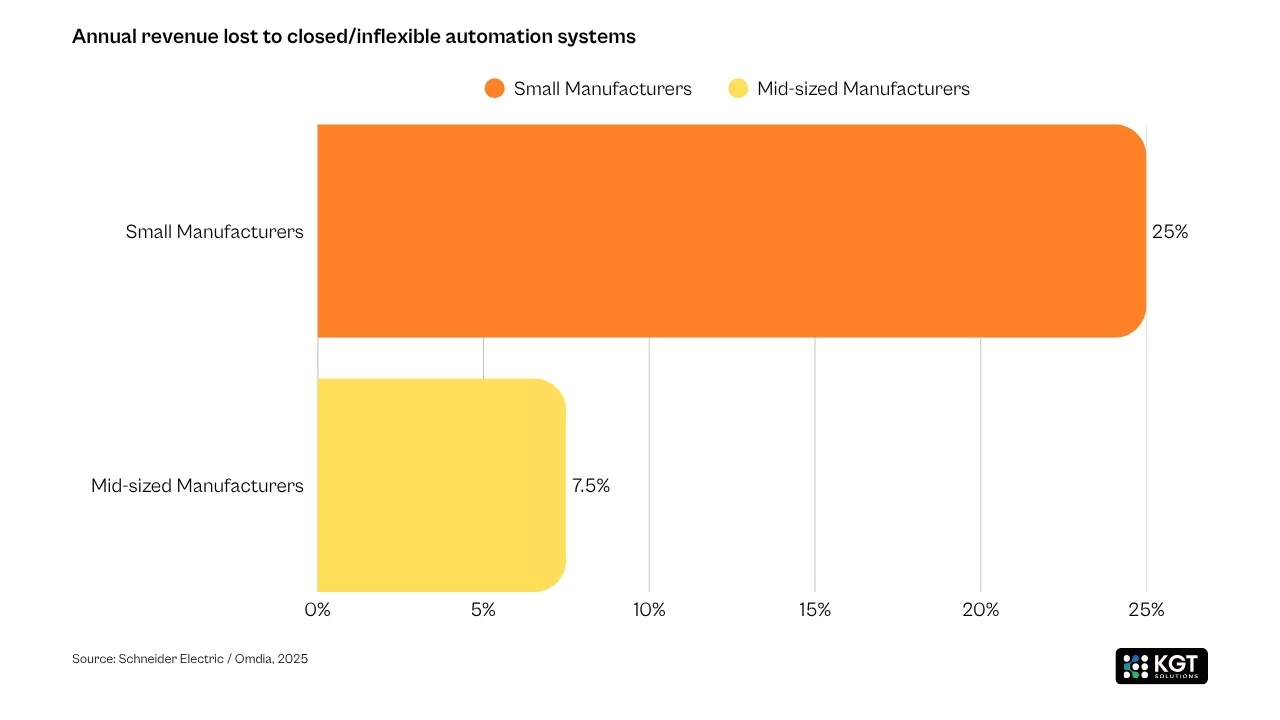
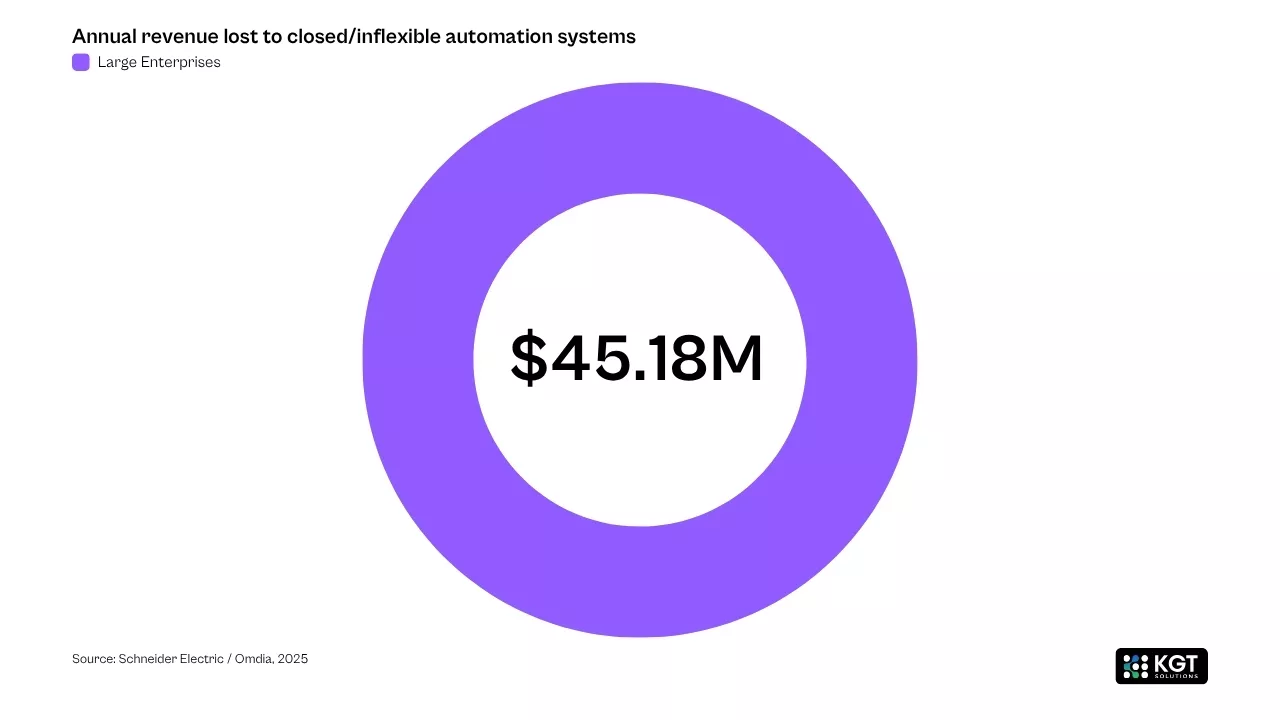
A 2025 Schneider Electric-commissioned study by Omdia found that closed, inflexible systems cost mid-sized manufacturers an average of 7.5% of their annual revenue. For larger enterprises, that figure climbs to $45.18 million per year. Smaller manufacturers can lose up to 25% of annual revenue to these inefficiencies. That's not a rounding error. That's a business viability question.
Unplanned downtime: where the money disappears
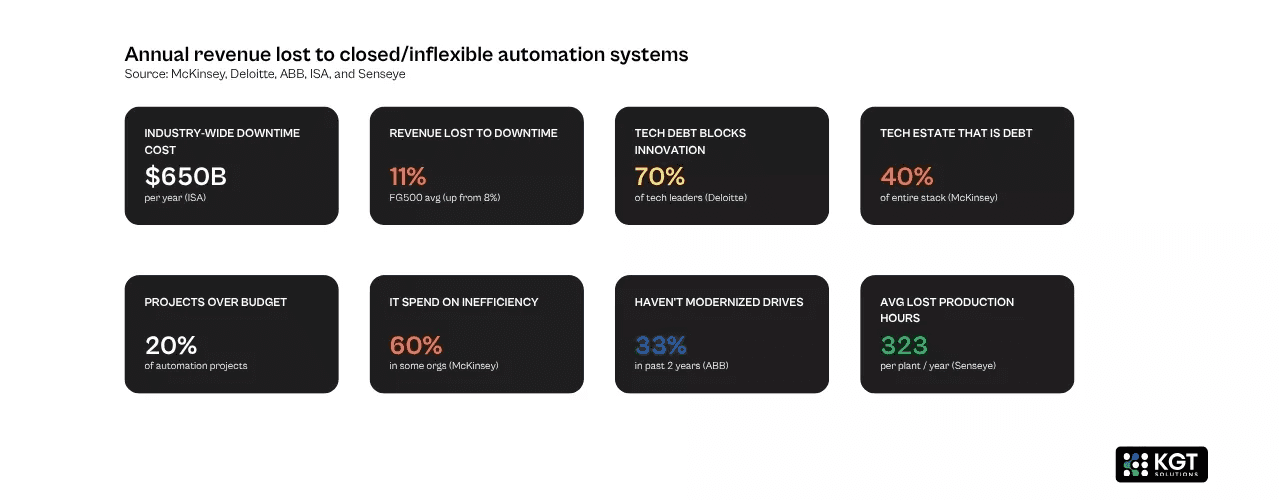
The most immediate cost of poorly implemented automation is unplanned downtime. According to Senseye's True Cost of Downtime report, large plants lose an average of 323 production hours per year, at roughly $532,000 per hour. That works out to about $172 million per plant, per year.
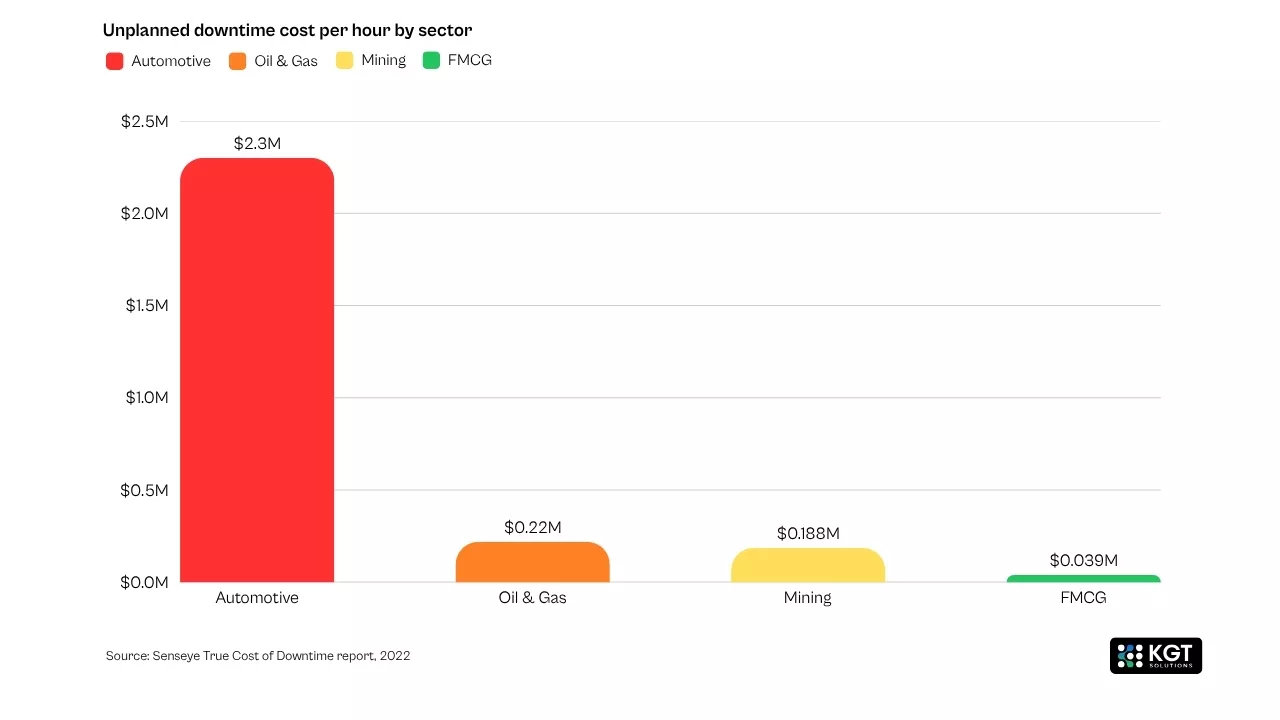
In automotive manufacturing, unplanned downtime costs approximately $2.3 million per hour, making it the most expensive sector for production stoppages. In FMCG, the figure sits around $39,000 per hour. Mining and heavy industry fall at $187,500 per hour.
When a controls engineer is underqualified, or when PLC industrial automation programming is rushed, commissioning drags. Safety sign-offs bounce. Fault-finding takes days instead of hours. According to a 2025 analysis by Kensington Additive, for Fortune Global 500 manufacturers, unplanned downtime now eats roughly 11% of annual revenue, up from around 8% in 2019-2020.
An ABB survey of 3,600 senior decision-makers confirmed the pattern: 83% agreed that downtime costs a minimum of $10,000 per hour, with 76% estimating hourly costs up to $500,000. Yet a full third hadn't modernized any motors or drives in the past two years.

Technical debt in industrial automation
Here's something that doesn't show up on the balance sheet fast enough: technical debt. In manufacturing, this usually looks like legacy PLCs running code nobody fully understands, production monitoring systems stitched together with workarounds, and industrial IoT solutions bolted on without a coherent architecture.
Technical debt in automation refers to the accumulated cost of shortcuts and outdated systems that compound over time, eventually requiring far more effort to fix than the original problem warranted.
Deloitte's Tech Trends 2024 report found that 70% of technology leaders view technical debt as a hindrance to innovation and the number one cause of productivity loss. McKinsey's research puts it differently: technical debt can account for up to 40% of an organization's entire technology estate. For manufacturers running aging automation PLCs and disconnected warehouse automation systems, that proportion can be even higher.
Why industrial IoT development services fail on a weak foundation
You can't layer sensors and dashboards on top of broken systems and expect good results. If your industrial control systems are fragmented and your production monitoring systems are siloed, adding IoT just gives you a faster view of the same problems.
Industrial IoT development services only deliver value when the underlying architecture is sound, the data pipelines are clean, and the control layer is properly integrated. Otherwise, you end up paying twice: once for the IoT layer that doesn't work, and again to fix the foundation you should have built first.
The International Society of Automation estimates that downtime costs the manufacturing sector nearly $650 billion annually. A significant share of that comes from systems that were automated badly rather than not automated at all.
IT OT Convergence in Manufacturing Explained
How to tell if your automation is costing more than it should
If your engineers spend more time troubleshooting than optimizing, that's a signal. If alerts go unactioned, the system isn't serving you. If adding a new product line requires a six-month integration project, your architecture is overdue for a rethink.
The clearest sign of bad automation is when the system requires more human intervention than the manual process it replaced. At that point, you haven't automated anything. You've added complexity.
McKinsey reports that nearly 20% of projects run over budget, and in some organizations, up to 60% of IT spend goes toward hidden inefficiencies rather than productive work.
What getting it right requires
Getting it right means starting with the process, not the technology. It means hiring controls engineers who understand your industry, investing in proper programming from the start, and building architectures that can accommodate industrial AI solutions and digital twin software without a complete rebuild later.
A single 90-minute unplanned outage on an automotive line can cost $3.45 million. Spending extra on a qualified integrator who gets commissioning right the first time is not an expense. It's insurance.
The manufacturers who get the most out of this spend are the ones who treat it as engineering, not procurement.
Frequently Asked Questions
What are the most common hidden costs of poorly implemented industrial automation?
How much revenue do manufacturers lose from bad automation annually?
What are the warning signs that industrial automation is underperforming?
Can bad automation be fixed or does it need full replacement?
How do you prevent industrial automation projects from failing?
Sources:
Future Market Insights, Industrial Automation Market Size & Forecast 2025-2035, April 2025
Schneider Electric / Omdia, Open vs. Closed: The $11.28M Question for Industrial Leaders, November 2025
Senseye, The True Cost of Downtime, 2022
Kensington Additive, The Real Cost of a Bad Automation Hire, September 2025
ABB / Sapio Research, Industrial Downtime Costs Up to $500,000 Per Hour, October 2025
Deloitte, Tech Trends 2024
McKinsey & Company, Technical Debt Study, 2022
International Society of Automation, The Dollar Value of Downtime
Industrial Autonomous Floor
Newsletter
Actionable insights on industrial AI, automation, and smart operations built for safe, secure, and compliant real-world environments.