What Is AI Orchestration and Why It Matters

Key Takeaways:
AI orchestration coordinates multiple AI models, agents, and tools into a unified workflow under a central control layer
Without orchestration, multi-agent deployments collapse under coordination failures, context loss, and unpredictable outputs
Enterprise orchestration platforms like LangGraph, Temporal, and Prefect reduce integration complexity by 40-60% compared to custom-built pipelines
CTOs deploying three or more AI models in production need an orchestration strategy before scaling - not after
The orchestrator agent is the decision layer that routes tasks, manages state, handles failures, and enforces guardrails
What Is AI Orchestration
AI orchestration is the coordination layer that directs multiple AI models, agents, and tools to complete complex, multi-step tasks as one unified system.
Think of it like a conductor managing an orchestra. Each instrument - your LLM, your retrieval system, your code executor, your API connectors - plays a distinct role. Without the conductor, you get noise. With orchestration, you get a system that produces consistent, predictable outputs even when individual components fail or produce unexpected results.
In technical terms, AI orchestration manages the sequencing of tasks, routing of inputs and outputs between agents, state persistence across sessions, and error handling when a step breaks down. It's the difference between a pipeline that works in demos and one that holds up under real enterprise load.
Gartner estimates that by 2026, over 80% of enterprise AI deployments will involve multiple models working together - which makes orchestration the prerequisite infrastructure, not an optional add-on.
What Is the Purpose of an Orchestrator Agent
The orchestrator agent is the control unit that receives a goal, breaks it into subtasks, assigns each subtask to the right specialized agent, and synthesizes the results.
Without this layer, multi-agent systems require humans to manually route every handoff - which defeats the point of automation entirely. The orchestrator decides which agent runs first, whether to run agents in parallel or sequence, and what to do when an agent returns an error or an unexpected output.
A practical example: a CTO at a financial services firm deploys three agents - one for data extraction, one for risk scoring, one for report generation. The orchestrator receives the client brief, sends the raw data to the extraction agent, passes the structured output to the risk scorer, and only triggers the report agent once both upstream results are validated. If the risk scorer times out, the orchestrator retries or escalates - without human intervention.
This is what makes agentic AI deployments operationally viable at scale.
Why AI Orchestration Matters for Enterprise CTOs
Enterprise CTOs without an orchestration strategy face model sprawl, coordination failures, and compounding debugging costs as AI deployments grow past two or three systems.
Most AI projects start simple - one model, one task, one team. But production reality is messier. You add a retrieval layer. Then a code interpreter. Then a third-party tool call. Without orchestration, each integration is a one-off build. Failures cascade silently. Context gets lost between steps. And when something breaks at 2am, there's no unified place to diagnose why.
McKinsey's 2025 State of AI report found that enterprises with centralized AI orchestration frameworks reduced time-to-debug by 47% compared to teams managing agents ad hoc. That's not a marginal gain - it's the difference between a team that ships and one that firefights.
If you're evaluating enterprise AI platforms, the presence or absence of a native orchestration layer is one of the most important differentiators to assess.
Core Components of an AI Orchestration Platform
An AI orchestration platform includes four layers: task routing, state management, tool integration, and observability - all working together under a single control interface.
Task routing determines which agent or model handles each step. State management persists context across agent handoffs so no information drops between steps. Tool integration connects agents to external APIs, databases, and execution environments. And observability gives your team real-time visibility into what each agent is doing, what it returned, and where it failed.
Platforms like LangGraph handle stateful, graph-based agent flows. Temporal handles long-running, fault-tolerant workflows with durable execution. Prefect handles data-pipeline orchestration with strong retry and scheduling primitives. Each serves a different primary use case, and many enterprises run more than one depending on the workload.
Choosing between them means being honest about your failure modes - not just your happy-path requirements.

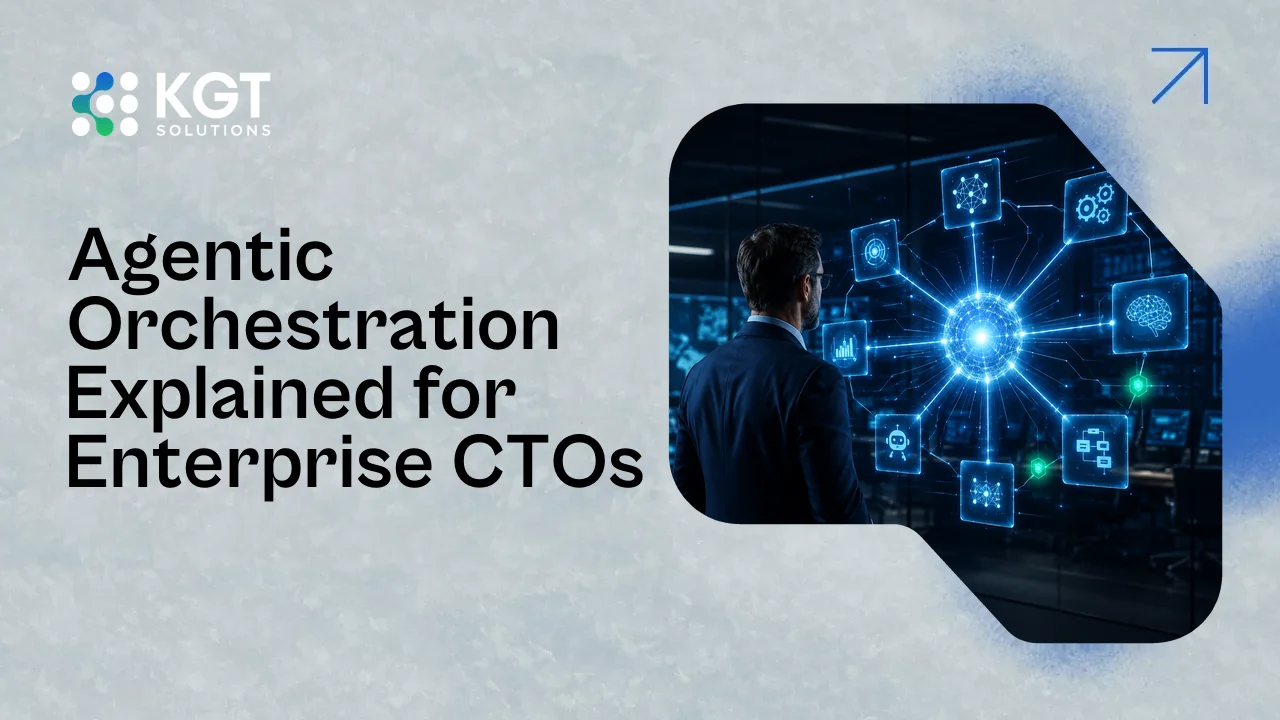
Agentic Orchestration Explained for Enterprise CTOs
Top AI Agent Frameworks and Orchestration Tools
The top AI agent frameworks for enterprise use in 2026 are LangGraph, CrewAI, AutoGen, Temporal, and Prefect - each with distinct strengths across different workflow types.
LangGraph is best suited for graph-based agent reasoning where control flow needs to be explicit and stateful. CrewAI simplifies role-based multi-agent collaboration with a more developer-friendly interface. AutoGen, from Microsoft Research, excels at conversational multi-agent tasks where agents negotiate outputs through dialogue. Temporal and Prefect are stronger for production-grade orchestration of long-running, distributed workflows.
A common mistake is choosing an orchestration framework based on popularity rather than the specific failure modes of your use case. If your workflows involve API calls that can fail, retries that need durable state, and handoffs between five or more agents - LangGraph or Temporal is a better fit than a lighter wrapper.
According to a16z's 2025 AI infrastructure survey, 63% of enterprise engineering teams reported using two or more orchestration tools in production - because no single framework handles every workflow type.
Agentic AI Orchestration vs Traditional Automation
Agentic AI orchestration differs from traditional automation because agents reason about how to complete a task, while traditional automation just executes predefined rules.
Traditional RPA and workflow automation tools like Zapier or Make handle deterministic flows well - if X happens, do Y. But they break when inputs vary, exceptions arise, or the next step depends on interpreting ambiguous output. Agents handle that ambiguity. But that flexibility introduces new coordination risks that orchestration exists to contain.
The combination of automation and orchestration tools gives you the best of both: structured execution for predictable steps, and agentic reasoning for the steps that require judgment. Separating those two layers in your architecture is one of the cleaner decisions you can make early in a deployment.
The 2026 agentic AI trends that matter most to enterprise CTOs are all downstream from this distinction.
Build vs Buy: Choosing Your Orchestration Approach
Building a custom orchestration layer costs 3-5x more than adopting an existing platform when you account for maintenance, failure handling, and observability tooling over 18 months.
Some teams reach for custom orchestration because existing frameworks don't fit their exact data model or security requirements. That's a legitimate reason - but it's rarer than most internal pitches make it sound. The more common driver is familiarity bias: the team knows Python, and building feels more controllable than adopting a new framework.
The build vs buy calculation for orchestration needs to include the cost of maintaining failure handling, durable state, retry logic, and observability from scratch - not just the initial build sprint. Most teams underestimate that tail by a factor of two.
For a detailed breakdown of how to run this analysis, the build vs buy framework for enterprise AI is a useful starting point before committing to either path.
How to Evaluate Enterprise Orchestration Platforms
Enterprise orchestration platforms should be evaluated on five criteria: state persistence, failure handling, observability depth, security controls, and integration surface area.
State persistence determines whether your workflows survive failures mid-execution without data loss. Failure handling determines whether retries, fallbacks, and escalations are first-class features or afterthoughts. Observability depth determines how quickly your team can diagnose a problem in production - logs, traces, and replay capability matter more than dashboards.
Security controls are non-negotiable in regulated industries - you need to know which agent accessed which data, when, and with what permissions. And integration surface area determines how much custom glue code you'll write to connect your orchestration layer to your existing stack.
If you're building out a team to manage this infrastructure, understanding how to hire an AI agent development company is worth working through in parallel.
Frequently Asked Questions
What is AI orchestration in simple terms?
What is the difference between AI orchestration and automation?
Which AI orchestration platform is best for enterprise?
Do I need AI orchestration if I'm only using one model?
How does an orchestrator agent work?
Conclusion
AI orchestration is the infrastructure layer that makes multi-agent systems production-ready. Without it, complexity accumulates faster than your team can manage - and what starts as three integrated models becomes a debugging nightmare inside twelve months. The good news is that the orchestration platform market has matured enough that you don't need to build from scratch. What you do need is a clear view of your failure modes, an honest assessment of your team's operational capacity, and a framework selection process anchored to those realities rather than vendor demos. If you're already running AI agents in production and haven't formalized your orchestration strategy, that's the gap worth addressing first.
Sources:
Gartner - Top Strategic Technology Trends 2026
McKinsey & Company - The State of AI in the Enterprise 2025
Andreessen Horowitz (a16z) - AI Infrastructure Survey 2025
Microsoft Research - AutoGen: Enabling Next-Gen LLM Applications via Multi-Agent Conversation
LangChain - LangGraph Production Deployment Guide 2025
Temporal Technologies - Durable Execution for AI Workflows: Enterprise Report 2025
Forrester Research - Enterprise AI Automation Platforms Wave 2025
Protocol AI Newsletter
Practical insights on AI, automation, and intelligent systems focused on real-world applications, not hype.