Are You Too Late To Adopt AI Agents?

No. You're not too late to adopt AI agents - but you're running out of room to be early.
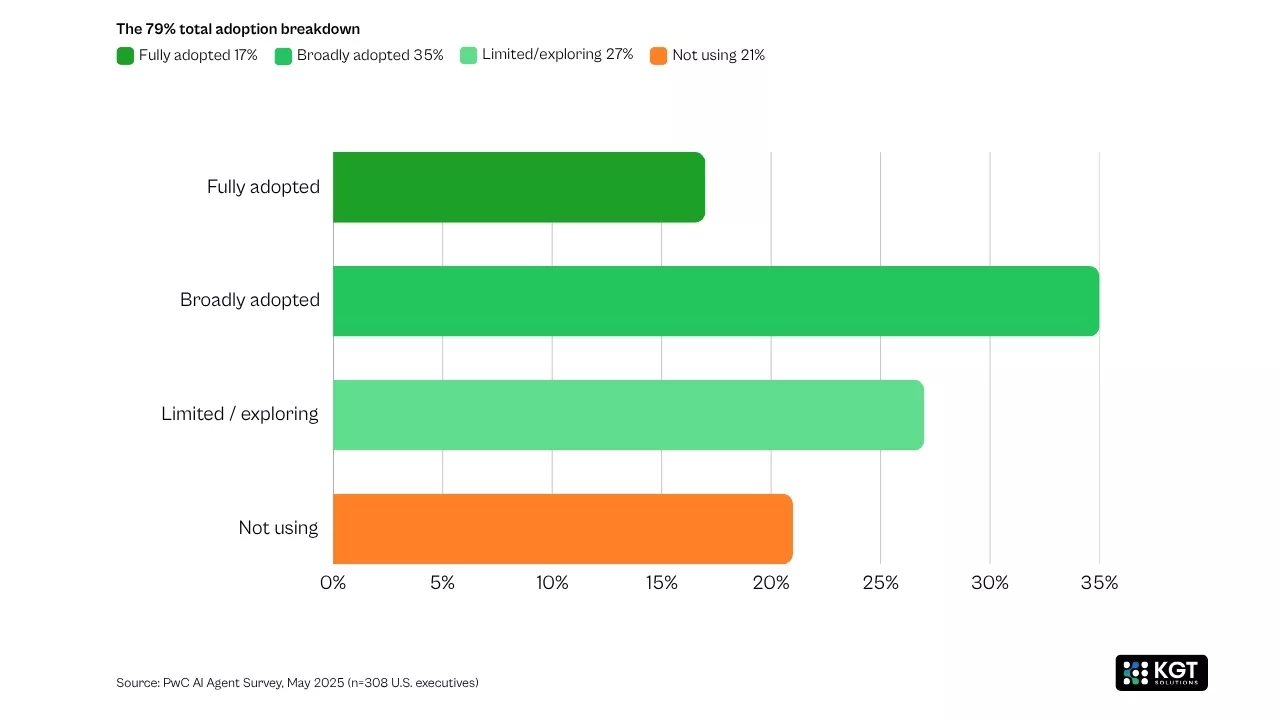
The gap between "competitive advantage" and "table stakes" is shrinking fast. According to PwC's 2025 survey of 308 U.S. executives, 79% of organizations have already adopted these systems in some capacity. That figure was nowhere near this two years ago. If you're reading this in 2026 without a plan, you're behind - but you're not out.
What Are AI Agents and Why Do They Matter Now?
AI agents are autonomous software systems that plan, reason, use external tools, and complete multi-step tasks with minimal human input. They're not the chatbots everyone experimented with in 2023. A chatbot answers your question. An agent books your meeting, updates your CRM, emails the client, and schedules a follow-up - without you lifting a finger.
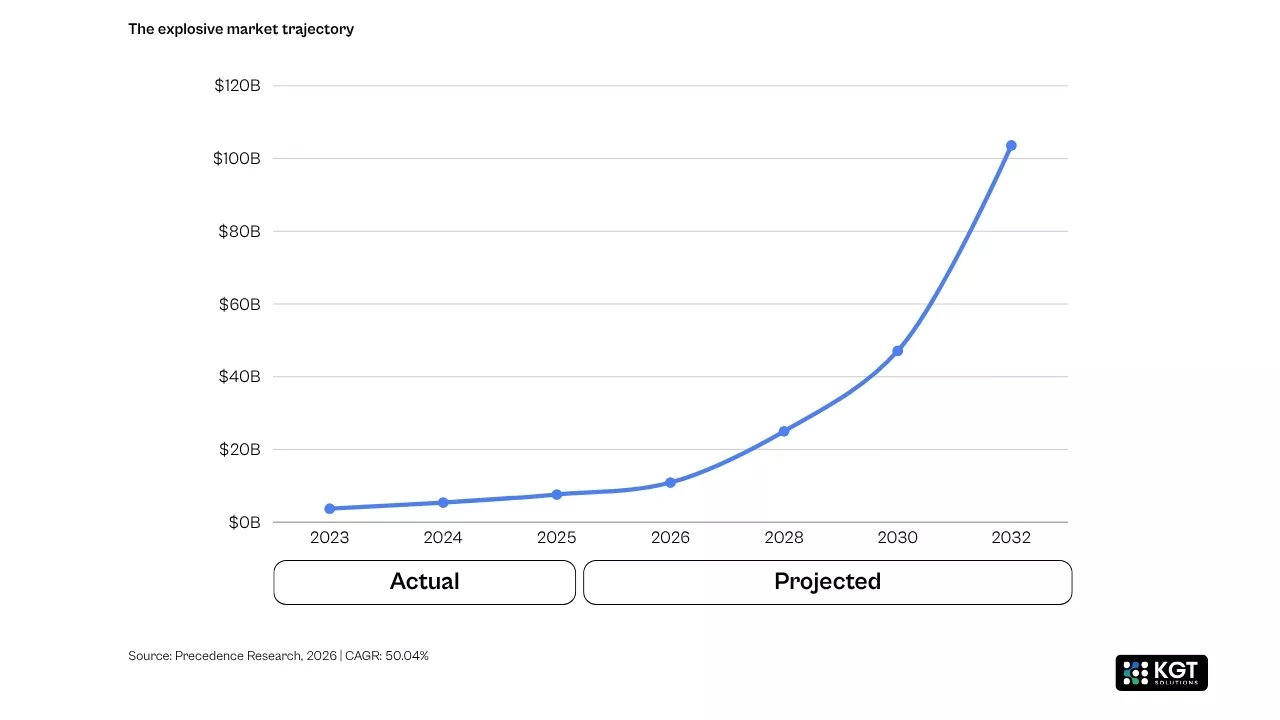
The global market hit roughly $7.6 billion in 2025 and is projected to exceed $10.9 billion this year, growing at over 45% annually (Grand View Research). Gartner forecasts that 40% of enterprise applications will embed task-specific agents by the end of 2026, up from less than 5% in 2025. This is among the steepest adoption curves in enterprise software history.
Why Most Businesses Are Still Stuck
Most companies ran a ChatGPT pilot last year, maybe tested some automation tools, and called it a strategy. That's not adoption. That's window shopping.
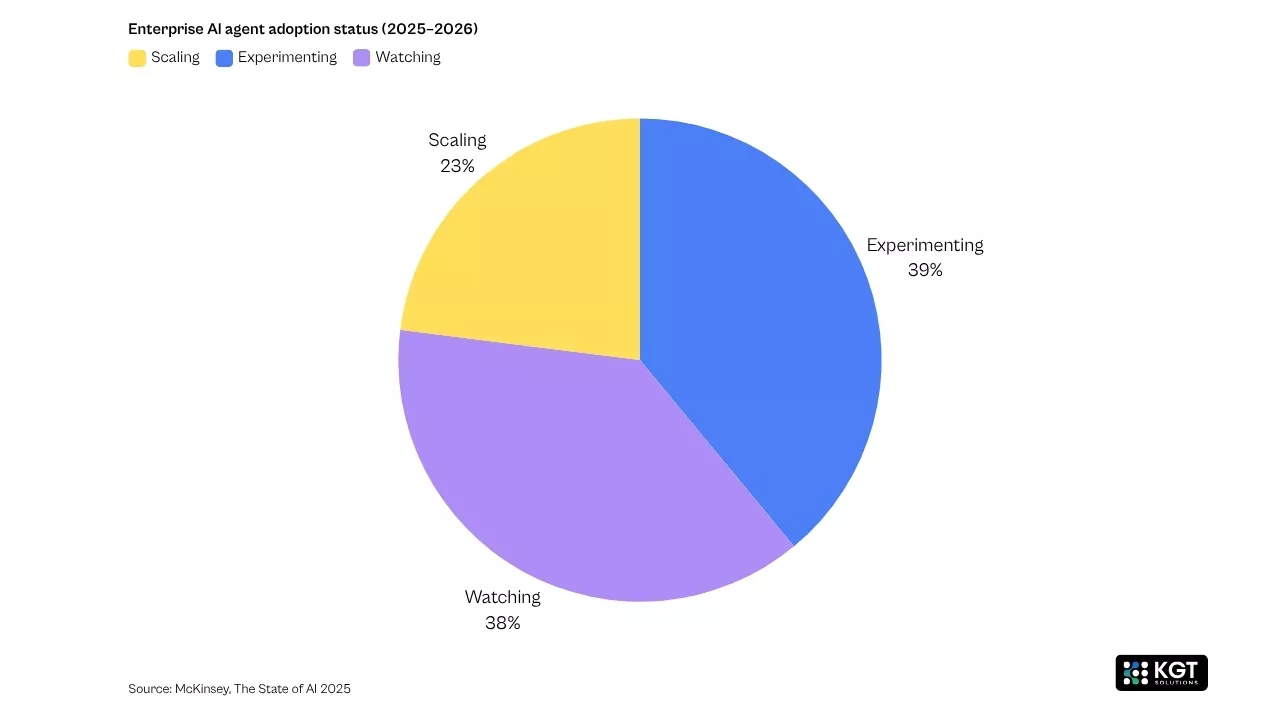
McKinsey's 2025 State of AI report found only 23% of organizations are actually scaling agentic systems, with another 39% still experimenting. The rest are watching. And AI high performers - companies seeing real financial returns - are three times more likely than their peers to be scaling deployments across multiple functions.
The hesitation usually comes down to integration headaches, unclear ROI, and talent gaps. Fair enough. But these are the same objections people made about cloud computing in 2010. The ones who waited spent years catching up.
How Industries Are Already Using AI Workflow Automation
This stopped being theoretical a while ago.
AI for insurance agents is one of the clearest examples. Claims processing that dragged on for weeks now wraps up in hours. These systems handle document intake via OCR, cross-reference policy terms, flag fraud, and escalate to humans only when judgment is needed. BCG reports that P&C insurance AI spending will triple in 2026 as a share of revenue. Property insurers already use these systems to process drone imagery post-disaster and match damage assessments to coverage clauses automatically.
Best AI for real estate agents follows a similar pattern. McKinsey estimates that automation applied to knowledge work in real estate could unlock $430 to $550 billion in annual value globally. Real estate professionals now rely on AI-driven lead qualification, CRM updates, scheduling, and predictive market analysis - tasks that used to eat half their working day.
Accounting workflow software is seeing rapid traction too. Automated invoice processing cuts costs by 60 to 80 percent in some firms, handling cost-code matching, reconciliation, and anomaly detection without manual entry.
How to Create an AI Agent Strategy Without Overcomplicating It
You don't need to build from scratch. That misconception alone has stalled more companies than any technical barrier.
Pick one workflow. Something repetitive, rule-based, and time-consuming. Customer support triage, invoice processing, appointment scheduling - these are low-risk starting points that deliver fast returns.
Choose the right workflow management software. No-code and low-code platforms now connect with existing CRMs, email, and accounting systems. You don't need a full AI team, though working with an AI business consultant helps map the right custom AI solutions to your operations.
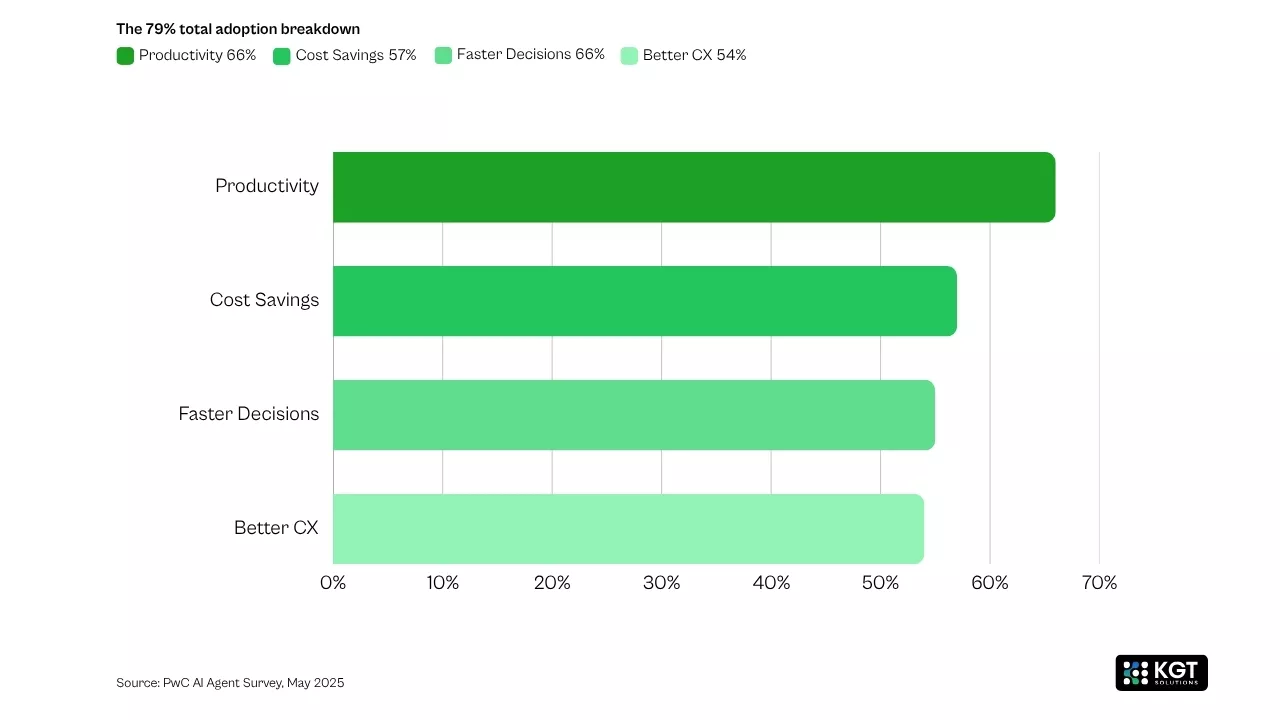
Define success before you deploy. Among companies already using these systems, 66% report measurable productivity gains, 57% report cost savings, and 55% see faster decision-making (PwC). Those numbers exist because someone picked a metric first.
Build in human oversight. The best automation solutions pair AI execution with human judgment on edge cases. Gartner warns that over 40% of agentic projects risk cancellation by 2027 without governance and observability built in.
Agentic Orchestration Explained for Enterprise CTOs
The Bigger Risk Is Adopting Too Shallow
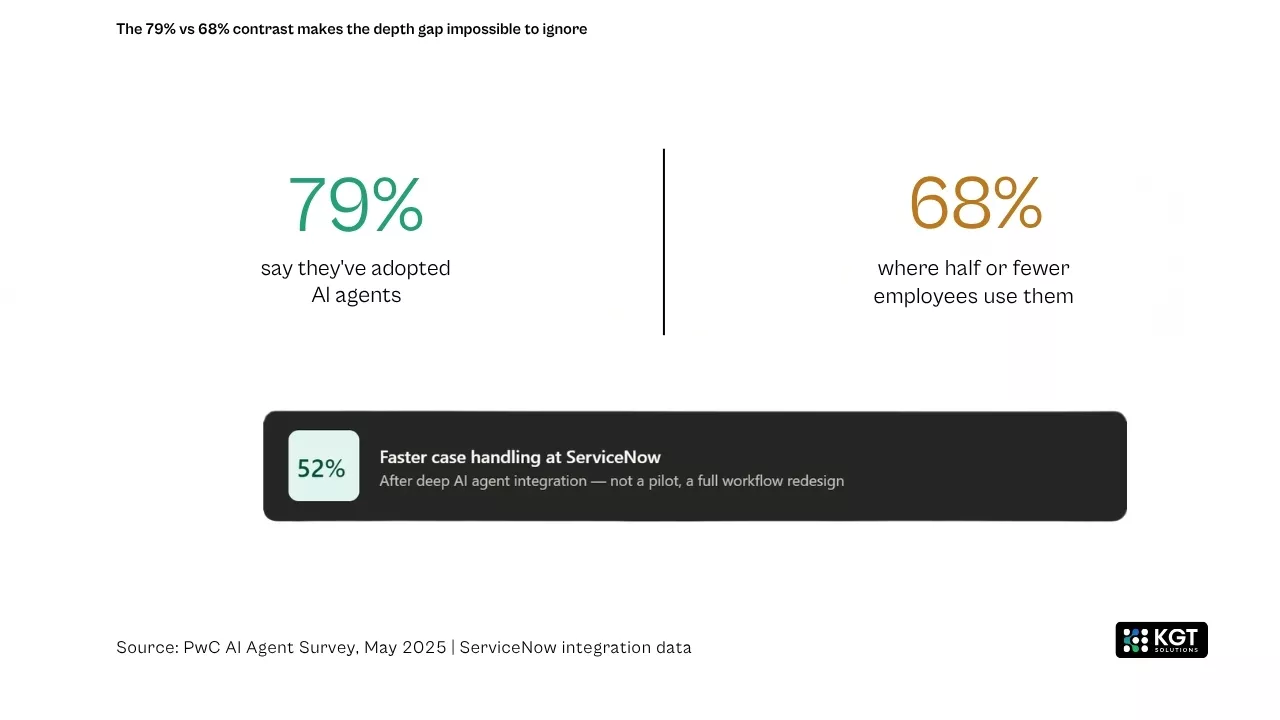
Here's what keeps getting missed. PwC found that while 79% of companies claim adoption, 68% say half or fewer of their employees actually interact with these tools daily. A lot of what passes for adoption is really just a login nobody uses.
The organizations pulling ahead are redesigning entire workflows around what these tools make possible. ServiceNow reported a 52% reduction in handling time for complex customer service cases after deep integration. That result didn't come from a pilot - it came from commitment to rethinking how work gets done.
What Happens If You Wait?
The Allganize survey of 1,000 U.S. business leaders found nearly 60% plan to adopt these systems within a year. When the majority of your competitors are on the same timeline, inaction becomes its own strategy - just not a good one.
Forty-six percent of PwC respondents said they worry about falling behind competitors. That anxiety is earned. Companies that build their adoption strategy now will have compounding advantages in cost, speed, and customer experience over the next two years.
The technology is no longer the bottleneck. The tools for intelligent automation exist. Platforms for workflow automation are mature and accessible. What's missing in most organizations is the decision to start - not the capacity to execute.
You're not too late. But "not too late" has a shelf life. Pick one process that wastes your team's time. Start there. This week.
Frequently Asked Questions
Is it too late for businesses to start adopting AI agents in 2026?
What competitive risks do businesses face by delaying AI agent adoption?
What is the fastest way to start using AI agents without a large upfront investment?
Do AI agents require a dedicated technical team to manage and maintain?
How do AI agents differ from traditional automation tools like RPA?
Sources:
PwC AI Agent Survey, May 2025
McKinsey, "The State of AI in 2025"
Grand View Research, AI Agent Market Projections 2025–2032
Gartner, Enterprise Application Forecast 2026
Allganize U.S. Business Leaders Survey, January 2026
McKinsey, "How Agentic AI Can Reshape Real Estate's Operating Model," March 2026
BCG, "The AI-First Property and Casualty Insurer," 2026
MIT Sloan, "Agentic AI, Explained," February 2026
Protocol AI Newsletter
Practical insights on AI, automation, and intelligent systems focused on real-world applications, not hype.