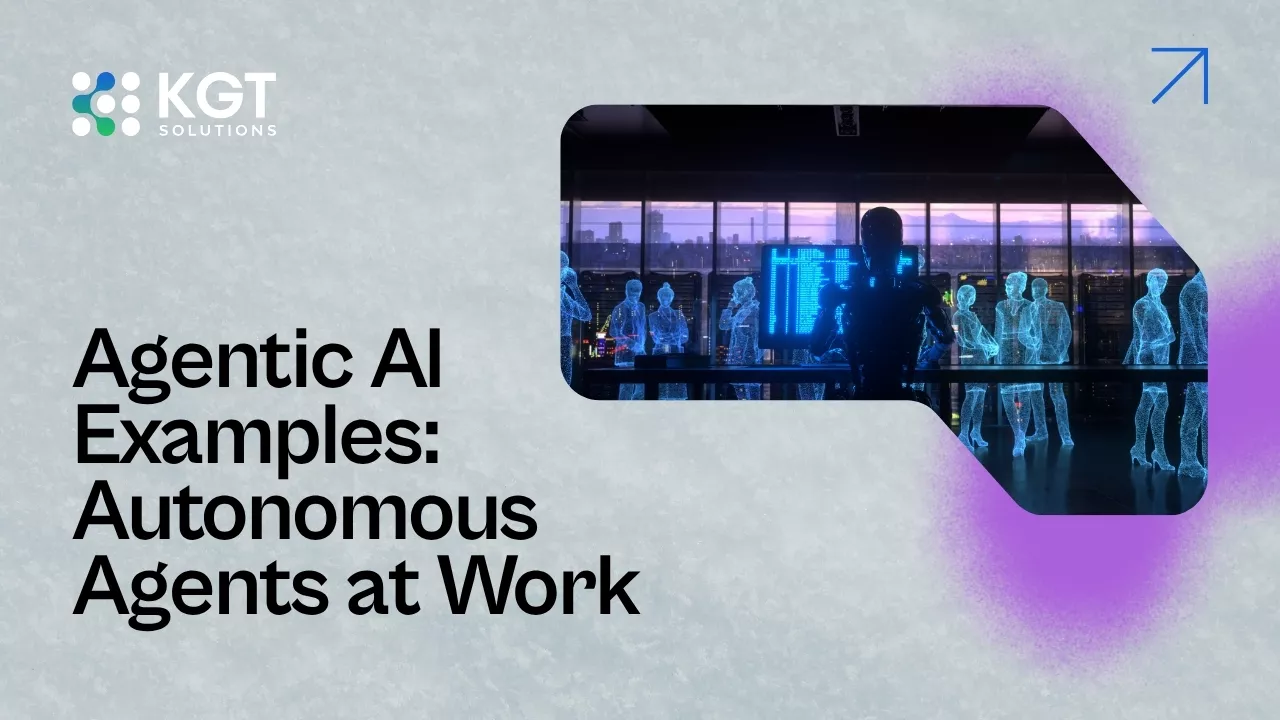
Agentic AI Examples: Autonomous Agents at Work

Autonomous AI agents cut process cycle times 40-65% across procurement, compliance, IT ops, and supply chains without human prompts.
Your ops team is already behind if they still copy-paste between systems and wait on approvals for routine decisions.
Key Takeaways
Autonomous agents deliver 40-65% faster cycle times and 171% ROI across procurement, IT ops, and compliance.
Enterprises running autonomous agents report 40-65% faster process cycle times across procurement, logistics, and compliance - with 171% average ROI on deployed systems.
The agentic AI market hit $7.6 billion in 2025 and is projected to reach $236 billion by 2034 at a 40%+ CAGR, making it the fastest-growing enterprise software category since early cloud migration.
79% of enterprises have adopted AI agents in some form, but only 11% run them in production - the gap between experimenting and deploying is where competitive advantage gets locked in.
Introduction
Enterprise teams waste 30-40% of their week on tasks autonomous agents handle in minutes - here are the real examples.
Most enterprise teams burn 30-40% of their week on predictable tasks: pull data from one system, check it against rules in another, update a third. Agentic AI was built to kill that loop. This guide breaks down real agentic ai examples running in production, what separates them from last year's chatbot, and where the money actually shows up.
What Are Agentic AI Systems and How Do They Differ from Traditional Bots?
Agentic AI systems perceive, reason, and act across multiple tools without oversight - unlike RPA bots that crash when a format changes.
The difference is adaptability. A standard RPA workflow follows path A or path B. If something falls outside those paths, it stops and creates a ticket.
An autonomous agent figures it out. Once you understand how ai agents explained in practical terms work, the gap becomes obvious.
These systems use large language models as their reasoning engine. They read unstructured data, weigh options, and pick the best action based on context. Gartner projects that by 2028, 33% of enterprise software will include agentic capabilities - up from less than 1% in 2024.
Consider procurement. A traditional bot extracts line items from one PO template it was trained on. An autonomous procurement agent reads POs from 40 different supplier formats, cross-references pricing against contract terms, and auto-approves orders under $10,000.
No one builds a rule for each format. TechBlocks documented a 20% reduction in procurement cycle time with this approach.
| Dimension | Traditional RPA | Agentic AI |
|---|---|---|
| Input Handling | Fixed templates only - breaks on format changes | Reads 40+ formats, adapts to new layouts automatically |
| Exception Handling | Stops and creates ticket for human review | Reasons through exceptions using LLM, self-corrects |
| Maintenance Cost | 40-60% of build cost annually | Near-zero - agents adapt without reconfiguration |
| Bot Count per Process | 5-8 bots per workflow (one per path) | 1 agent handles entire workflow including edge cases |
| Decision Making | Binary (if/then rules only) | Contextual - weighs options, picks best action |
| Enterprise Adoption by 2028 | Declining - Gartner projects flat growth | 33% of enterprise software will include agentic AI |

Where Are Autonomous Agents Running in Production Right Now?
Autonomous agents run production workloads across IT ops, procurement, compliance, and customer service in enterprises today.
These are not pilot programs. Here is where agents do real work today:
IT Operations: Agents monitor infrastructure logs, diagnose root causes, and auto-fix common incidents. Forrester reports a 67% reduction in manual decision-making time within six months of deployment.
Procurement and Supply Chain: Autonomous agents track supplier lead times, predict stockouts 3-6 weeks ahead, and trigger reorders. Supply chain systems using agents cut inventory carrying costs 20-35% according to McKinsey.
Financial Compliance: Agents scan regulatory updates daily, compare them against internal policies, and draft adjustment memos. One Big Four firm cut regulatory review time from 14 days to 3 using a compliance agent.
Customer Service: Beyond chatbot scripts, service agents pull customer history, check order status across fulfillment systems, process refunds, and escalate edge cases with full context. Gartner projects agentic AI will reduce customer service operational costs by 30% by 2029.
How Agentic Process Automation Replaces Fragile RPA Workflows
Agentic process automation uses LLM reasoning to handle exceptions on the fly - replacing the 5-8 separate bots a single workflow used to need.
RPA hit a wall around 2023. Maintenance costs for bot farms climbed to 40-60% of initial build costs annually because every small process change broke existing scripts.
Autonomous agents flip that equation. Instead of building a new bot for every exception, you deploy one agent with reasoning capability and connect it to your tools via APIs. A manufacturing client on SAP replaced 23 separate procurement bots with a single agent - 87% fewer failures, zero manual exception handling for routine cases.
The enterprises seeing 171% average ROI on these deployments treat agents like junior employees: capable but supervised. They set spend limits, domain restrictions, and confidence thresholds. When the agent's certainty drops below 85%, it escalates to a human.
What Should CTOs Evaluate Before Deploying Their First Agent?
CTOs should target high-volume, low-risk processes first - minimum 500 monthly instances with clear API access to core systems.
Do not start with your most complex workflow. Start with the boring one.
Pick a process eating 2-3 FTEs of time: invoice processing, onboarding ticket routing, or vendor document classification. Enterprises starting with contained, high-frequency use cases see positive ROI within 90 days. Teams that jump straight into cross-departmental orchestration take 9+ months to break even.
The 79% adoption vs 11% production gap is the defining challenge of 2026. Almost four in five enterprises experiment with agents, but fewer than one in nine have them in production. The organizations closing that gap fastest capture disproportionate competitive advantage.
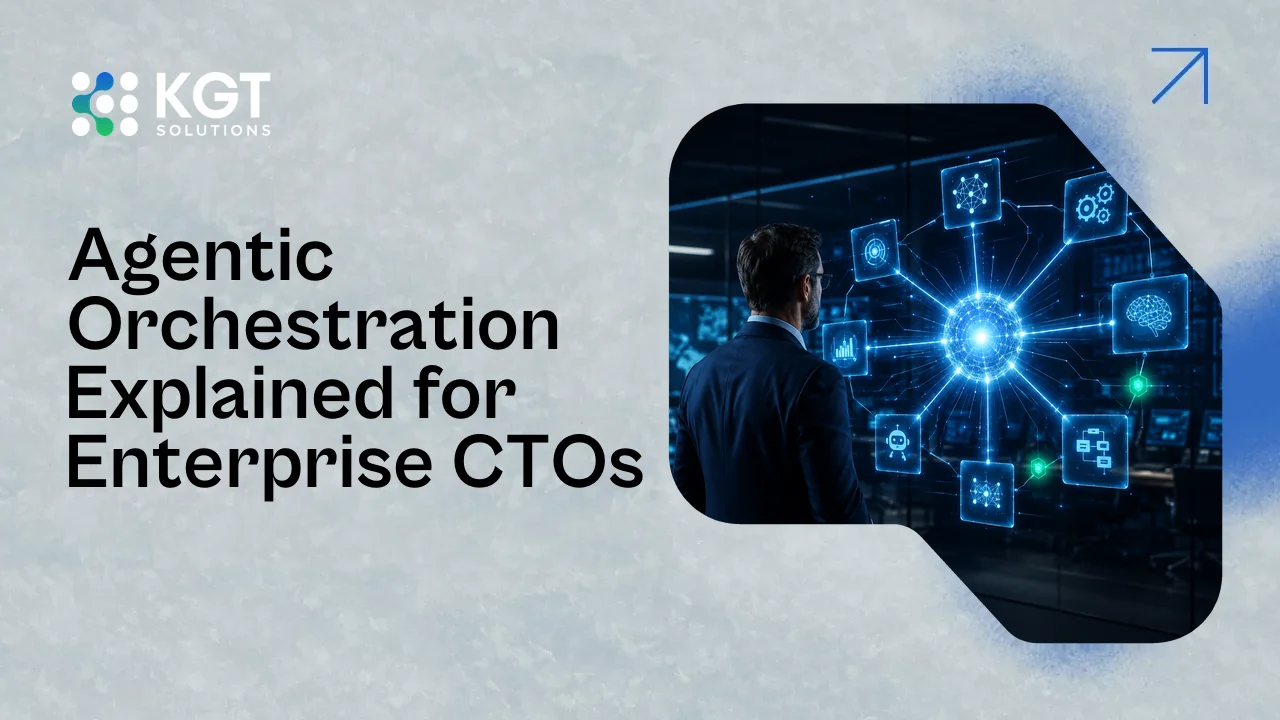
Agentic Orchestration Explained for Enterprise CTOs
Frequently Asked Questions
What metrics should enterprises track to measure AI agent performance?
What are the most common types of agentic AI in enterprise settings?
How do agentic AI systems handle errors and unexpected situations?
What infrastructure do enterprises need before deploying AI agents?
How do AI agents differ from traditional RPA bots?
Conclusion
Map your top five repetitive workflows by volume and exception rate. The one with the highest volume and fewest edge cases is your first agent candidate. Talk to KGT about scoping a pilot that pays for itself within one quarter.
Sources:
Gartner - Agentic AI Adoption and Enterprise Software Forecast 2028
Mordor Intelligence - Agentic AI Market Size and Growth Report 2026-2031
Digital Applied - Agentic AI Statistics 2026: 150+ Data Points Collection
Forrester - AI Agent Decision Automation Impact Report 2026
McKinsey - AI in Supply Chain Management 2026
Landbase - Agentic AI ROI and Performance Metrics 2026
Protocol AI Newsletter
Practical insights on AI, automation, and intelligent systems focused on real-world applications, not hype.