How Custom AI Solutions Survive the Factory Floor Chaos

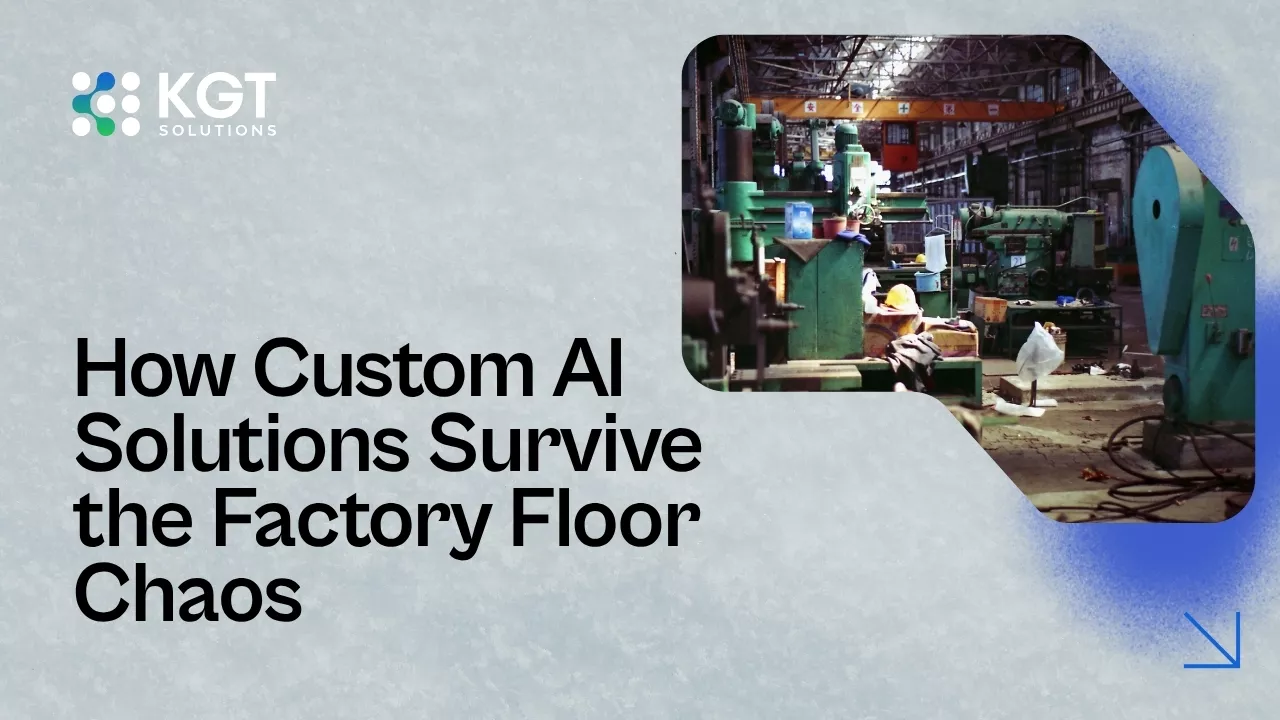
Factory floors are loud, dirty, unpredictable, and hostile to software designed in a clean office. Custom AI solutions survive this environment not because they're smarter than off-the-shelf tools, but because they're built to tolerate the mess. They process data locally, handle spotty connectivity, and plug directly into Manufacturing Execution Systems (MES) that already run the line.
Unplanned downtime costs U.S. manufacturers roughly $50 billion a year, per Siemens' True Cost of Downtime report. The average large plant loses 27 hours per month to unplanned stoppages. You don't fix those numbers with a generic dashboard.
Why Generic AI Fails on the Factory Floor
Custom AI solutions work in factory environments because they are built around the specific machines, tolerances, and failure modes of a particular production line, not generalized models that assume clean data and stable conditions.
Most commercial AI products assume consistent internet, standardized data formats, and an environment that stays roughly the same from Tuesday to Wednesday. None of that holds in manufacturing. Machines vibrate. Sensors drift. Humidity shifts between morning and afternoon. IDC's 2026 Manufacturing FutureScape found that by 2027, 60% of manufacturers will need hyperscaler ecosystems to build and deploy AI capable of handling this variability. Most haven't figured it out yet.
A custom model trained on your solder joints, your press tolerances, your conveyor speeds catches what a general purpose system skips entirely.
How Edge Deployment Keeps Custom AI Solutions Running
Edge-deployed AI processes data where it's generated, on the factory floor, eliminating cloud dependence and cutting inference latency to milliseconds.
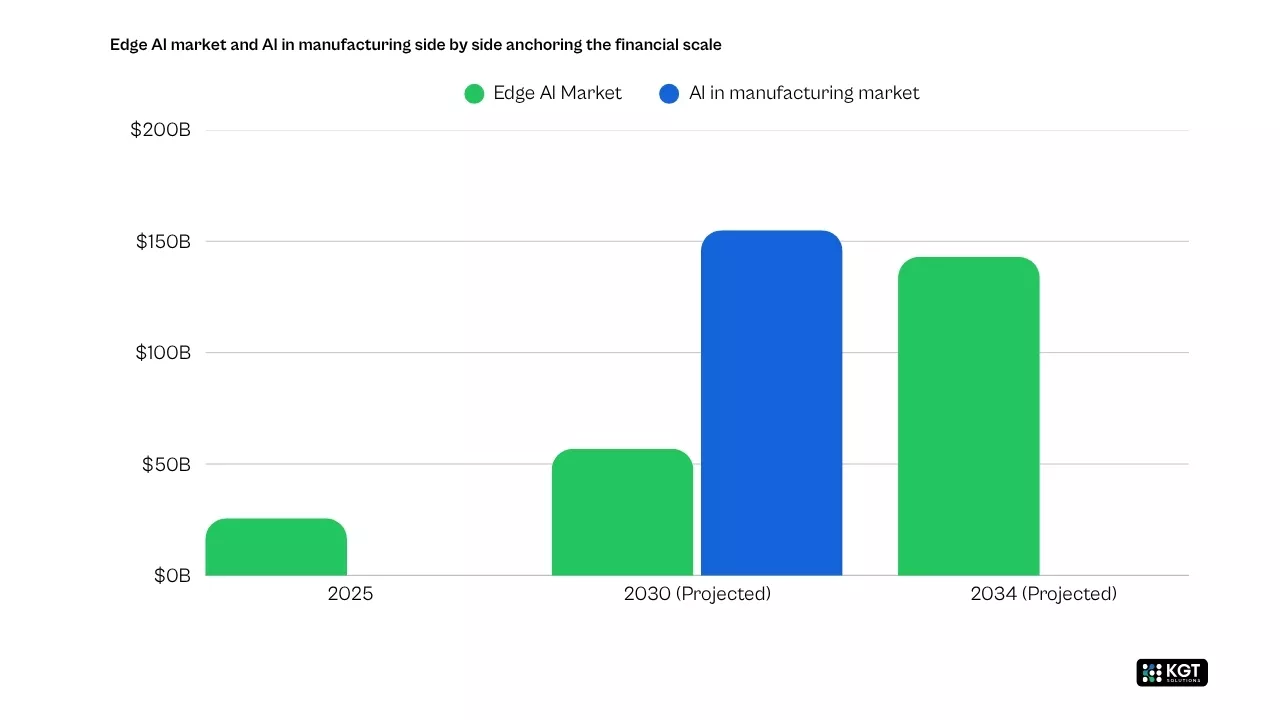
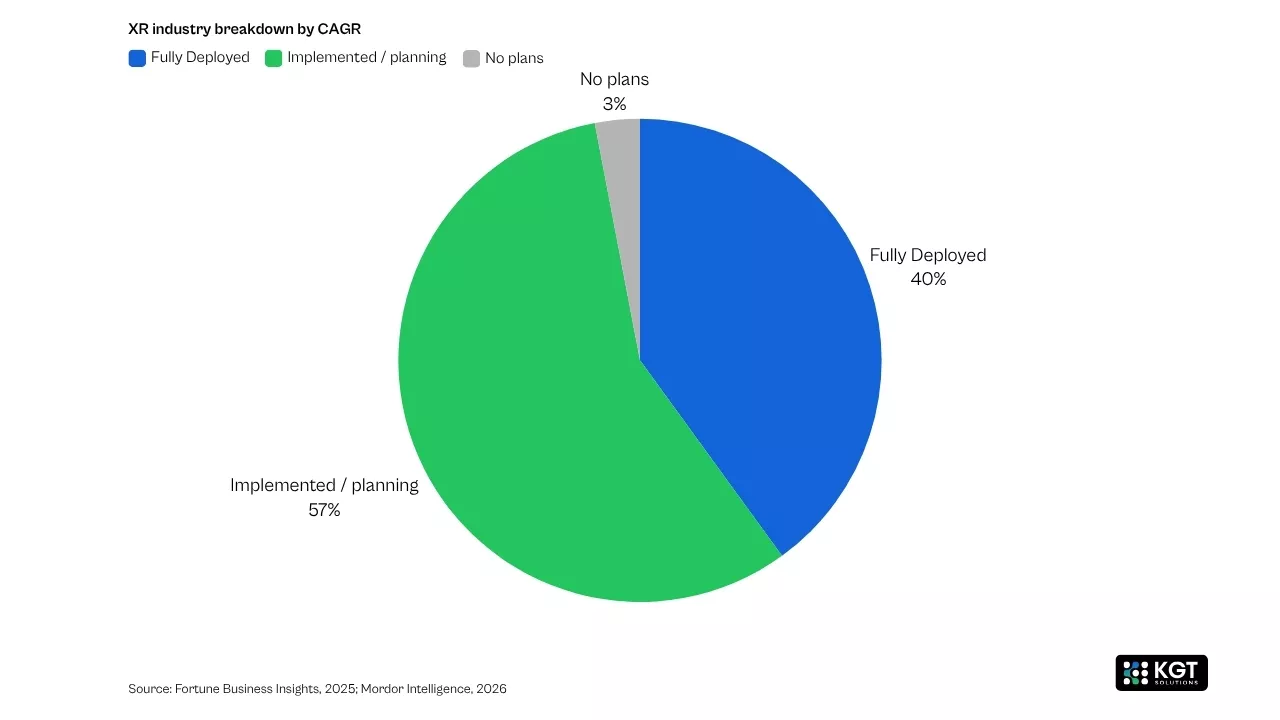
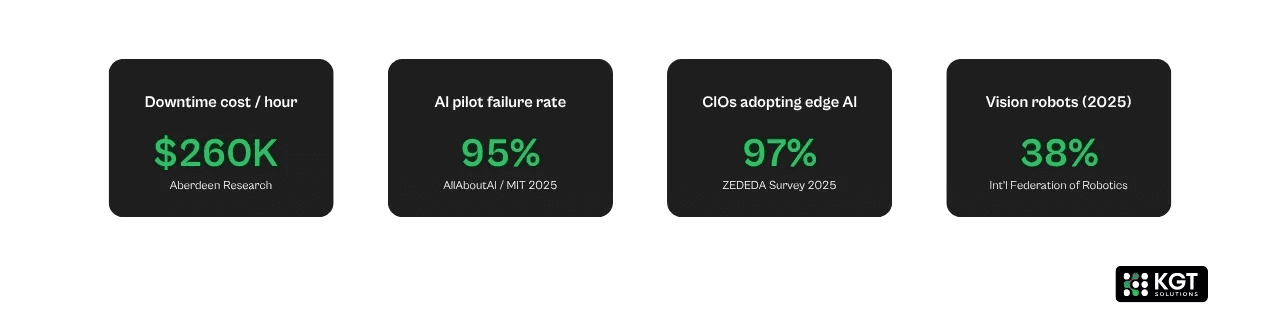
A ZEDEDA survey of 301 U.S. CIOs found that 97% have either implemented edge AI or plan to. In manufacturing, 40% of organizations report full deployment. The market for AI at the edge hit $25.65 billion in 2025 and is projected to reach $143 billion by 2034.
Factory internet is unreliable. Wi-Fi drops. Firewalls block outbound traffic. Some plants don't allow cloud connections at all. A vision system inspecting parts at 1,200 units per hour can't wait for a data center round trip. Edge inference delivers pass/fail decisions in single-digit milliseconds. Manufacturing accounts for 28% of demand for AI processing at the edge, per Future Market Insights. Factories need local processing more than almost any other environment.
What MES Integration Actually Looks Like
AI that integrates with existing execution systems acts as a real-time assistant, feeding defect predictions, scheduling adjustments, and quality data into the tools operators already use.
AI development services that skip this integration build tools nobody touches. Operators don't want another screen. They want information inside the screen they already have. MachineMetrics launched its Max AI platform in late 2025, an agentic AI layer unifying machine data, ERP, and tribal knowledge. Five manufacturers built working applications on the platform in 48 hours during a production lab. IDC projects that by 2026, over 40% of manufacturers with scheduling systems will add AI driven capabilities.
The average cost of unplanned downtime runs about $260,000 per hour across manufacturing, per Aberdeen Research. Predictive maintenance powered by models trained on your specific equipment cuts that exposure in ways generic tools can't.
Where AI Changes Inspection and Quality
AI driven development in manufacturing has moved quality control from periodic sampling to continuous automated inspection, catching defects at rates exceeding 98% accuracy.
An AI inspection system tested on laser-engraved nameplates achieved 91.33% accuracy with 100% recall, flagging every defective unit, per a 2025 arXiv study. Cognex shipped over 500,000 3D inspection systems in 2025 for electronics lines. Keyence's CV-X vision updates dropped false positives from 8% to under 2% in automotive stamping, saving one Michigan supplier $1.2 million annually (Mordor Intelligence).
Each deployment required training on the specific product being inspected. A solder joint looks nothing like a stamped metal panel. The development teams behind these systems built models around exact defect types each line produces. Vision-equipped robots made up 38% of all industrial robot installations in 2025, up from 29% in 2023, per the International Federation of Robotics.
Agentic Orchestration Explained for Enterprise CTOs

Building Resilience, Not Just Intelligence
The difference between a factory AI pilot that fails and one that survives past six months is resilience: the ability to handle dirty data, sensor drift, and connectivity drops without human intervention.
AllAboutAI analysis found that 95% of enterprise AI pilots fail to deliver measurable P&L impact. Most of those failures aren't algorithm problems. The model worked in the lab. It fell apart when the temperature spiked, the data feed stuttered, or someone bumped a camera out of alignment.
Custom solutions built for chaos account for these realities during development, not after. Fallback logic for missing sensor readings. Retraining pipelines that kick in when product specs change. ABB found that 82% of companies experienced unplanned downtime in the past three years, each incident averaging four hours. The companies shrinking that number are the ones whose AI treats disruption as the default state, not a special case.
The AI in manufacturing market is projected to reach $155 billion by 2030, growing at 35.3% annually (Standard Bots). That investment is going toward systems that survive the floor, not systems that impress in a demo room.
What Comes Next
By 2026, agentic AI systems are expected to manage 30 to 50% of routine manufacturing decisions autonomously, from replenishment to maintenance scheduling.
Agentic AI development services represent the next stage. These systems don't just detect and alert. They diagnose, order parts, schedule technicians, and execute fixes within constraints set by operators. The Customertimes market report projects 20 to 30% of manufacturers will deploy autonomous systems by 2026.
Factory floors aren't getting calmer. Machines will keep breaking. Sensors will keep drifting. The solutions that last are the ones that were designed to expect all of that from day one.
Frequently Asked Questions
Why do standard AI solutions fail on the factory floor?
What makes custom AI different from off-the-shelf industrial AI?
How long does it take to deploy a custom AI solution in a factory?
What data does a factory need to train a custom AI model?
What ROI can manufacturers expect from custom AI solutions?
Sources:
Siemens, "True Cost of Downtime" (2024)
ZEDEDA, "Edge AI Survey" (2025)
IDC, "2026 Manufacturing FutureScape"
MachineMetrics, "Production Lab 2026" (March 2026)
Aberdeen Research, via Sumitomo Drive Technologies (2025)
arXiv, "AI-Driven Multi-Stage Computer Vision System for Defect Detection" (March 2025)
Mordor Intelligence, "Computer Vision Market Competition Analysis" (March 2026)
International Federation of Robotics, via Mordor Intelligence (2025)
Standard Bots, "AI in Manufacturing" (January 2026)
Customertimes, "AI Automation in Manufacturing 2025 Report"
Future Market Insights, Edge AI in Manufacturing (2025)
AllAboutAI, "Edge AI Statistics 2025"
ABB, "Value of Reliability Report" (2025)
Protocol AI Newsletter
Practical insights on AI, automation, and intelligent systems focused on real-world applications, not hype.