Agentic AI Trends 2026: What CTOs Must Know

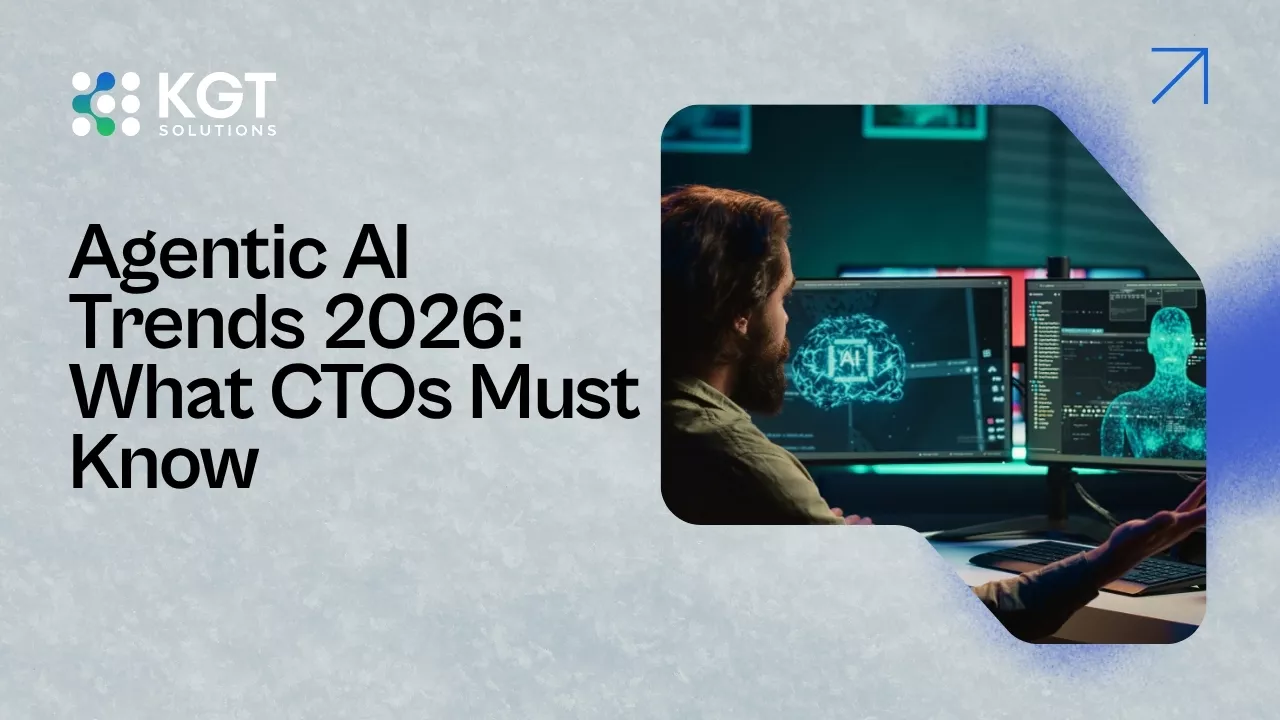
Agentic AI is moving from single-task bots to multi-agent systems that plan, execute, and self-correct across enterprise workflows.
Key Takeaways
Agentic AI spending hit $4.1 billion in 2025, with 82% of enterprises planning production deployments by Q4 2026
Multi-agent orchestration cuts manual workflow steps by 40-65%, reducing operational costs by an average of $2.3 million per year for mid-size enterprises
Companies using problem-first agentic AI approaches report 3.2x higher ROI than those chasing technology-first implementations
The shift from chatbots to autonomous agents
Agentic AI systems act independently - they set goals, make decisions, and adjust course without waiting for human prompts at every step.
A year ago, most enterprises treated AI agents like slightly smarter chatbots. You'd type a question, get an answer, and move on. That model is dead.
In 2026, agentic AI trends point toward systems that don't just respond - they initiate. They break complex tasks into subtasks, assign those subtasks to specialized agents, and coordinate results back into a single output.
Gartner projects that by 2028, 33% of enterprise software applications will include agentic AI, up from less than 1% in 2024. That's not a gentle curve. And the latest ai agents updates confirm it's already happening - Salesforce, ServiceNow, and SAP ship agent frameworks baked into their platforms.
The difference between a chatbot and an agentic AI system comes down to autonomy. Chatbots react. Agents act.
Multi-agent orchestration is the trend that matters most
Multi-agent AI systems coordinate specialized agents working in parallel - one researches, one validates, one executes - completing tasks 40-65% faster than single-agent setups.
Single agents hit a ceiling fast. They're good at narrow tasks but terrible at anything requiring coordination. That's why multi-agent orchestration has become the dominant agentic AI trend in 2026.
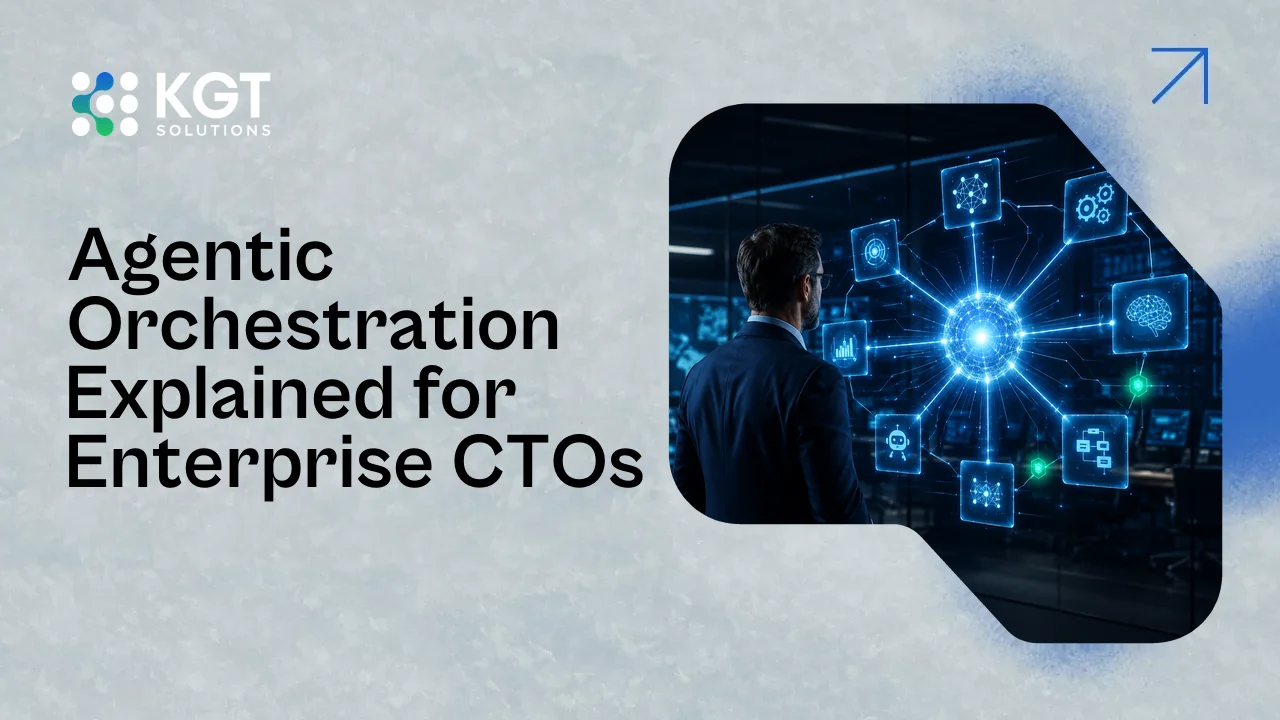
Here's how multi-agent ai orchestration works in practice. A procurement agent identifies a supply chain bottleneck. It triggers a pricing agent that pulls quotes from three vendors.
A compliance agent checks each quote against regulatory requirements. A fourth agent drafts a purchase order and routes it for approval. No human touched the process until final sign-off.
McKinsey's 2025 Global Survey on AI found that 65% of organizations now regularly use generative AI, nearly double from 10 months prior. But the companies seeing the biggest returns aren't just using generative AI. They're layering agentic AI capabilities on top.
The components of an AI agent in a multi-agent setup typically include:
Planning module - breaks goals into executable steps
Memory system - retains context across interactions and sessions
Tool access - connects to APIs, databases, and external services
Evaluation loop - checks output quality and triggers corrections
Building agentic AI applications with a problem-first approach means starting from the workflow, not the technology. What process bleeds the most time? Where do handoffs fail?
Which decisions sit in someone's inbox for 48 hours? Those are your agent candidates. Understanding the components of ai agent architecture - planning, memory, tools, evaluation - helps you scope what each agent needs before you build it.
Agentic AI examples that CTOs are actually deploying
Enterprise CTOs are deploying AI agents for IT service management, customer operations, and code generation - three use cases that account for 71% of production deployments.
The hype cycle loves to talk about AI agents that "do everything." In reality, the best ai agents in production today are specialists. They do one thing extremely well, and they do it without human babysitting.
IT Service Management: ServiceNow's AI agents now resolve 34% of IT incidents without human intervention, up from 12% in 2024. These agents diagnose issues, pull relevant knowledge articles, execute scripted fixes, and close tickets. Average resolution time dropped from 4.2 hours to 23 minutes for Tier-1 issues.
Customer Operations: Salesforce's Agentforce handled 380 million customer interactions in its first months of deployment. That's not a pilot. Wiley, the publishing company, reported a 40% increase in case resolution after deploying Agentforce agents.
Code Generation and Review: Microsoft reported that 47% of code on GitHub is now AI-generated. But the 2026 shift isn't just code generation - it's code agents that write, test, debug, and deploy. Cognition's Devin and similar agentic AI tools run full development cycles with minimal human oversight.
Three more deployment patterns gaining traction:
Supply chain agents that monitor inventory, predict stockouts, and auto-reorder from approved vendors
Financial reconciliation agents that match invoices across systems and flag discrepancies in real time
HR onboarding agents that coordinate between IT provisioning, benefits enrollment, and training scheduling

Why most agentic AI projects still fail
78% of agentic AI pilots stall before production because enterprises skip the problem-definition phase and jump straight to building agents.
Here's what nobody at the AI conferences will tell you. Most agentic AI projects fail. Not because the technology doesn't work - because the implementation approach is wrong.
The pattern looks the same every time. A CTO reads about agentic AI examples at a competitor. The team spins up a proof of concept.
The PoC works beautifully in a sandbox. Then it hits production data, edge cases, and legacy integrations - and falls apart. Even the best ai agents can't rescue a project that started without clear goals.
Deloitte's 2025 State of Generative AI report found that only 25% of companies using generative AI are seeing "significant value." The rest are stuck in pilot purgatory.
Common failure points include:
No clear success metric - "We want an AI agent" is not a business case. "We want to reduce invoice processing time from 6 days to 1 day" is
Ignoring data quality - agents are only as good as what they can access. Dirty CRM data produces dirty agent outputs
Over-automating too soon - starting with high-stakes decisions instead of high-volume, low-risk tasks
Missing guardrails - agents without boundaries will make confident mistakes at scale
The fix isn't complicated. Start small. Pick one workflow.
Define what success looks like in numbers. Build the agent. Measure. Then expand. The agentic ai companies reporting 3.2x higher ROI all follow this problem-first pattern.
Agentic Orchestration Explained for Enterprise CTOs
Agentic AI companies leading the 2026 market
Agentic AI companies in 2026 split into three tiers - platform giants, infrastructure players, and vertical specialists building industry-specific agents.
The market for agentic AI companies has exploded. Keeping track of who does what is its own full-time job.
But if you're a CTO evaluating vendors, the agentic ai trends 2026 landscape breaks down into three clear tiers.
Platform giants are embedding agents directly into enterprise software. Microsoft's Copilot Studio, Google's Vertex AI agent builder, and Salesforce's Agentforce make it possible to deploy agents without building from scratch. These tools handle orchestration, memory, and tool integration out of the box.
Infrastructure players provide the frameworks for custom agent development. LangChain, CrewAI, and AutoGen let engineering teams build multi-agent systems tailored to specific business logic. These require more technical skill but offer more flexibility.
Vertical specialists build agents for specific industries. Companies developing agents for healthcare claims processing, manufacturing quality control, or legal contract review. These tend to deliver faster ROI because they're pre-trained on domain-specific data.
The global AI agent market reached $5.29 billion in 2024 and is projected to hit $216.04 billion by 2035, growing at 40.2% annually according to Precedence Research. That growth rate tells you something important - this isn't a niche anymore.
For CTOs evaluating agentic AI companies, three questions cut through the noise:
Does this vendor's agent framework integrate with your existing tech stack, or does it require rip-and-replace?
Can you inspect and override agent decisions in real time?
What's the vendor's approach to building vs buying AI software?
| Criteria | Platform Giants | Infrastructure | Vertical Specialists |
|---|---|---|---|
| Vendors | Copilot Studio, Vertex AI, Agentforce | LangChain, CrewAI, AutoGen | Industry-specific |
| Best For | Fast deployment | Custom multi-agent systems | Domain-specific agents |
| Skill Level | Low-Medium | High | Medium |
| Time to Prod | 2-6 weeks | 2-6 months | 4-8 weeks |
| Cost | $50K-$150K | $200K-$500K+ | $75K-$250K |
| ROI | 3-4 months | 6-12 months | 4-6 months |
Agentic AI vs generative AI - what CTOs get wrong
Generative AI creates content on demand while agentic AI takes independent action - most enterprise value in 2026 comes from combining both.
The "agentic AI vs generative AI" framing is misleading. It suggests you pick one. You don't. They're layers, not competitors.
Generative AI gives you the language model - the ability to understand, generate, and reason about text, code, and data. Agentic AI wraps that model in a decision loop. It adds planning, memory, and tool use.
Think of generative AI as the brain and agentic AI as the body that puts the brain to work. The agentic ai vs generative ai distinction matters because it shapes how you budget and staff AI projects.
Here's where CTOs get tripped up. They invest heavily in generative AI capabilities - fine-tuned models, RAG pipelines, prompt engineering - but never add the agentic layer. So they end up with a system that still needs a human to press every button.
The 2026 shift is about composability. An enterprise might use GPT-4o for language understanding, Claude for analysis, and a custom model for domain tasks - all orchestrated by an agentic framework.
Google's Vertex AI agent architecture already supports this multi-model approach. So does Microsoft's Semantic Kernel. The future isn't one model to rule them all - it's specialized models coordinated by intelligent agents.
What CTOs should do in the next 90 days
CTOs should identify one high-volume, low-risk workflow, deploy a single agent with clear success metrics, and measure ROI within 90 days.
Knowing the trends means nothing if you don't act on them. Here's a 90-day playbook for CTOs who want to move from awareness to production.
Days 1-30: Audit and select.
Map your top 10 most time-consuming workflows. Score each on three criteria: volume (how often it runs), risk (what breaks if the agent makes a mistake), and data readiness (is the input data clean and accessible?). Pick the workflow that scores highest on volume and lowest on risk.
Days 31-60: Build and test.
Deploy a single agent on the selected workflow. Use a platform tool (Agentforce, Copilot Studio, or Vertex AI) if speed matters. Use a framework (LangChain, CrewAI) if customization matters. Set a clear metric: resolution time, error rate, or cost per transaction. Run parallel with the human process for 2 weeks.
Days 61-90: Measure and decide.
Compare agent performance against the human baseline. If the agent matches or beats on your key metric, plan the scale path. If it doesn't, diagnose why - data quality, edge case handling, or integration gaps are the usual suspects.
Frequently Asked Questions
What are the top agentic AI trends CTOs should watch in 2026?
How is agentic AI different from generative AI for enterprise use?
What's the biggest mistake companies make with agentic AI?
Which agentic AI companies should CTOs evaluate in 2026?
How much does agentic AI implementation cost for enterprises?
Conclusion
The CTOs who will lead in 2026 aren't the ones with the biggest AI budgets. They're the ones who pick the right first problem, solve it with agents, and prove the value.
That's the problem-first approach that separates real agentic AI results from expensive experiments. Every major agentic ai trend in 2026 points the same direction - start narrow, prove ROI, then scale.
Sources:
Gartner - Agentic AI Top Strategic Technology Trend 2025
McKinsey - Global Survey on AI, State of AI in Early 2025
Deloitte - State of Generative AI in the Enterprise Q1 2025
Salesforce - Agentforce Deployment and Customer Impact Data 2025
Precedence Research - AI Agent Market Size and Growth Forecast 2024-2035
Microsoft - GitHub Copilot AI Code Generation Metrics 2025
Fortune Business Insights - Global AI Agent Market Report 2025
Protocol AI Newsletter
Practical insights on AI, automation, and intelligent systems focused on real-world applications, not hype.