Industrial Automation: The Bridge to Smarter Operations

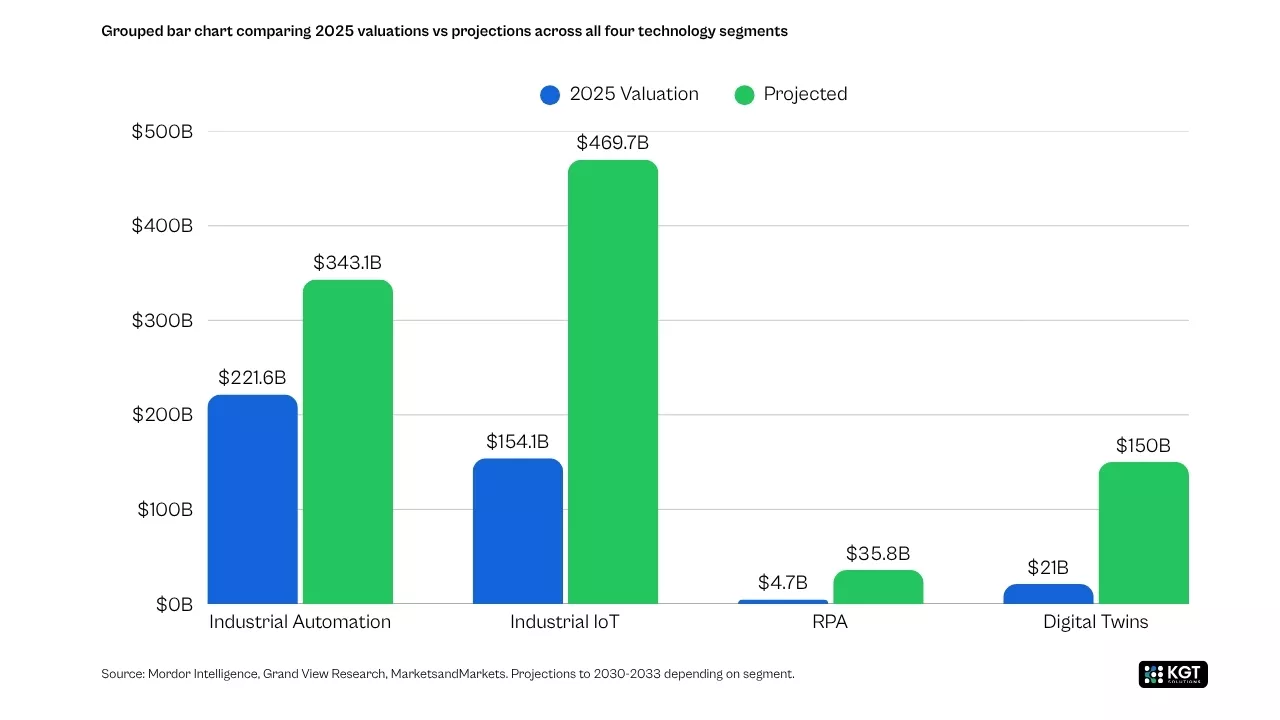
Industrial automation used to mean replacing a manual switch with a programmable one. That era is over. Today it's the connective layer between physical equipment, data systems, and decision-making software that lets operations self-correct without waiting for someone to notice the problem. The global market was valued at roughly $221.64 billion in 2025 and is forecast to reach $343.14 billion by 2031. That kind of capital doesn't move unless the payoff is measurable.
Industrial automation is the use of control systems, robotics, sensors, and software to operate production environments with minimal human intervention, enabling real-time monitoring and adaptive decision-making.
What sits at the core of modern factories
The foundation is still the programmable logic controller. It handles the logic that tells a motor when to start, a valve when to close, a conveyor when to speed up. What changed is everything layered on top.
Modern industrial control systems stack SCADA, MES, and distributed control architectures over that backbone to create a production monitoring system that flags what's about to go wrong, not just what already happened. The DCS segment held about 35% of market share in 2025. SCADA is growing at a 10.2% CAGR through 2035, driven by demand in energy, food processing, and chemicals.
How IIoT sensors changed what's possible
Connecting a sensor to a machine is simple. Building a system where thousands of sensors feed analytics platforms that inform maintenance schedules is where industrial IoT development services earn their money.
The IIoT market reached $154.14 billion in 2025 and is projected to hit $469.67 billion by 2030 at a 24.96% CAGR. Manufacturing takes the largest share. Connected sensors give plants data they never had: vibration patterns on a motor bearing, thermal drift on a heat exchanger, pressure fluctuations in a pneumatic line. With those sensors in place, you schedule maintenance proactively instead of waiting for breakdowns.
Industrial IoT solutions connect physical equipment to cloud and edge platforms through networked sensors, enabling predictive maintenance and visibility that manual monitoring cannot replicate.

Where robotic process automation fills the gaps
A controller runs a motor. It doesn't generate the work order that tells a technician to inspect that motor. That's where robotic process automation (RPA) comes in, handling purchase orders, inventory reconciliation, compliance reporting, and scheduling.
Robotic process automation handles the data entry, reconciliation, and reporting tasks that sit between physical equipment and business systems. The global market was valued at $4.68 billion in 2025 and is projected to reach $35.84 billion by 2033 at a 29% CAGR. Manufacturing captured 30.68% of revenue share in 2025. Deloitte found 53% of businesses have implemented RPA tools, with 61% meeting or exceeding cost reduction targets.
Digital twin software: testing changes before making them
Digital twin software creates a live virtual model of a physical asset or production line, allowing engineers to simulate changes and predict failures without touching active equipment.
The market was valued at $21 billion in 2025 and is projected to reach $150 billion by 2030 at a 48% CAGR. Manufacturing process planning holds the largest application share at 47.6%. Siemens partnered with NVIDIA in 2025 to bring physics-based visualization into product lifecycle management. ABB’s PickMaster Twin simulates bin-picking before deployment, cutting integration time in half.
IT OT Convergence in Manufacturing Explained
How industrial automation gets smarter with AI
Industrial AI solutions layer machine learning over existing control systems, enabling equipment to adapt its behavior based on historical process data rather than fixed rules. NVIDIA’s Rubin platform runs object detection at 240 frames per second at under 15 watts. Intel reported saving $2 million annually in scrap avoidance through AI inspection.
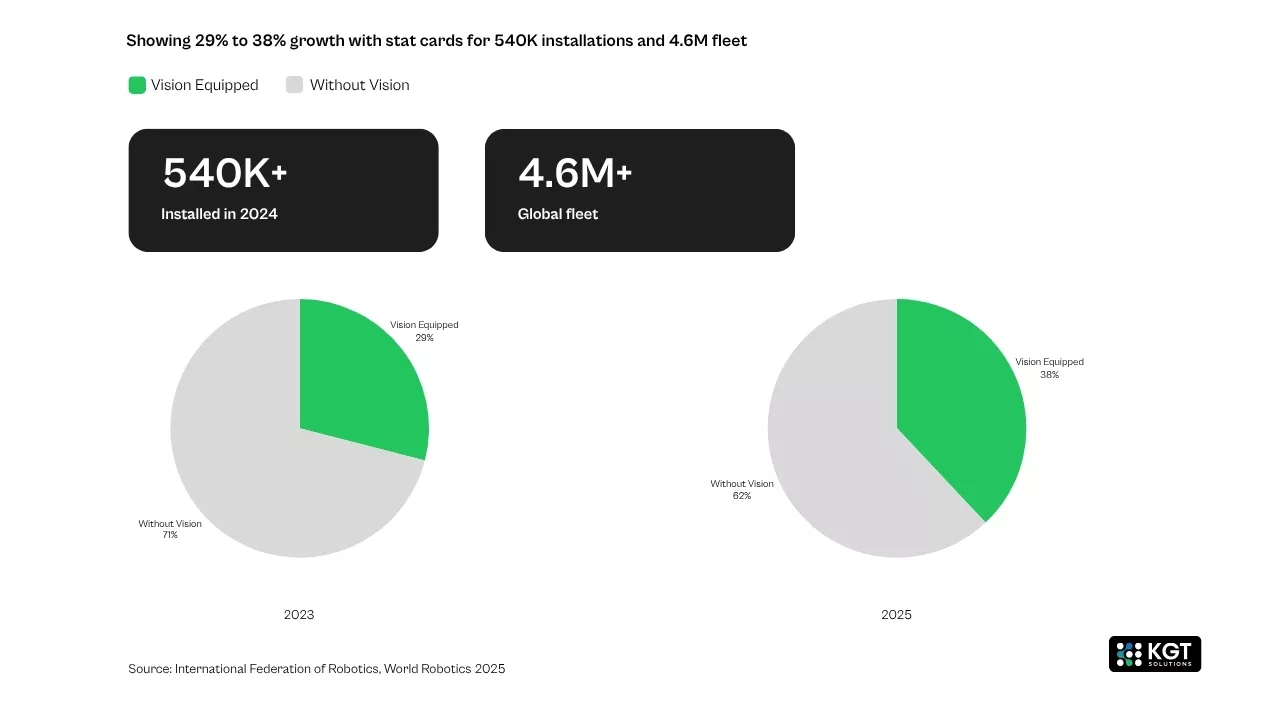
Vision-equipped robots hit 38% of all new installations in 2025, up from 29% in 2023. Over 540,000 units were installed globally in 2024, pushing the operational fleet past 4.6 million.
What actually holds adoption back
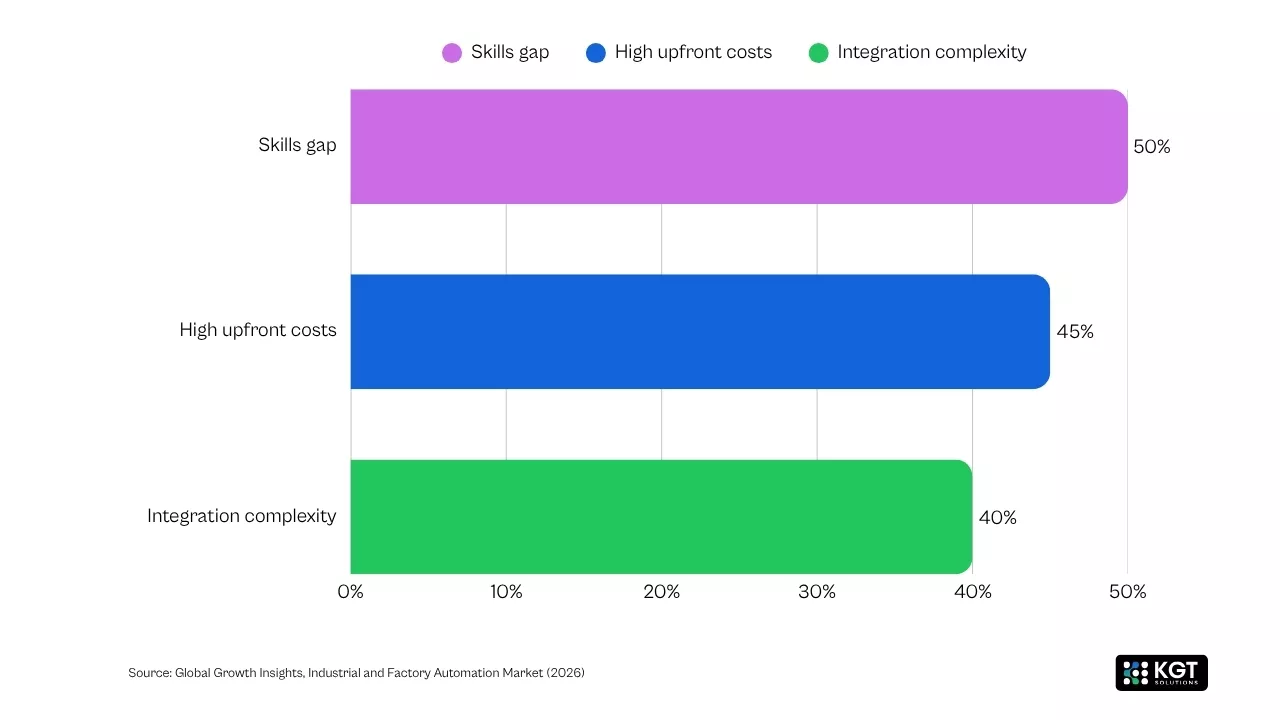
The barriers are people and process, not hardware. About 50% of organizations cite skills gaps as the primary obstacle. Another 45% point to upfront costs. Integration complexity affects 40% of deployments. A control room setup means nothing if the screens aren’t wired to the right systems.
The AI-driven segment of computer vision is projected to hit $254.51 billion by 2033 at a 32.8% CAGR. Related technologies like surveillance systems and tyre pressure monitoring borrow the same sensor and edge-AI infrastructure factories pioneered.
Frequently Asked Questions
What does smarter operations mean in the context of industrial automation?
How does industrial automation connect legacy equipment to modern systems?
What is the first step toward implementing smarter industrial operations?
How long does a typical industrial automation transformation take?
What ROI can manufacturers expect from automating their operations?
Sources:
Mordor Intelligence, Industrial Automation Market Size, Share & Growth, 2031 (Feb 2026)
Precedence Research, Industrial Automation Market Size to Hit USD 613.25 Bn by 2035 (Feb 2026)
Mordor Intelligence, Industrial Internet of Things (IIoT) Market (Mar 2026)
Grand View Research, Industrial Internet of Things Market (2025)
Grand View Research, Robotic Process Automation Market Size, Share Report, 2033 (2025)
Mordor Intelligence, Robotic Process Automation Market, Forecast 2026-2031 (Mar 2026)
MarketsandMarkets, Digital Twin Market Size, Share & Growth (2025)
Future Market Insights, Digital Twin Technology Market, 2025-2035 (Sep 2025)
Mordor Intelligence, Computer Vision Market Competition Analysis (Mar 2026)
International Federation of Robotics, via U.S. News (Apr 2026)
Global Growth Insights, Industrial and Factory Automation Market Size (Apr 2026)
Coherent Market Insights, AI in Computer Vision Market Share and Forecast, 2026-2033
Deloitte, Global Robotic Process Automation Survey
Industrial Autonomous Floor
Newsletter
Actionable insights on industrial AI, automation, and smart operations built for safe, secure, and compliant real-world environments.