Why 77% of Machine Vision Systems Miss Defects [Fix]

Machine vision systems miss defects because production environments shift faster than static inspection rules can adapt - camera calibration drifts, lighting degrades across shifts, and new material variants introduce surface patterns that rule-based algorithms were never trained to recognize, causing up to 30% of real defects to pass undetected.
Key Takeaways
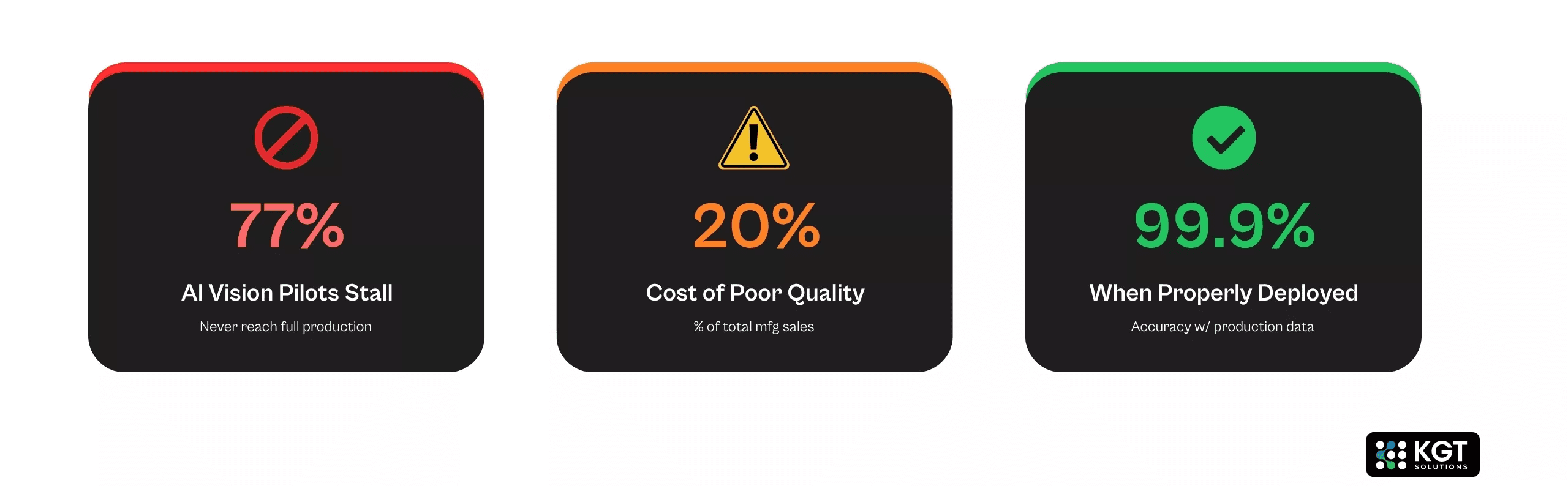
77% of AI vision implementations stall at the pilot stage and never reach full production deployment across shifts and plants.
The cost of poor quality eats roughly 20% of total manufacturing sales - for a $10M-revenue facility, that is $2M walking out the door annually.
AI-powered vision inspection systems now achieve 99.8-99.9% accuracy when properly trained on production variation data, reducing false positives by 95%.
Introduction
Your vision system passed every test on the bench. Then it hit the production floor and started missing scratches, misreads, and dimensional drift that your operators catch with the naked eye. The gap between lab accuracy and line-side reality is where most machine vision deployments quietly fail. Understanding how automation transforms quality control is the first step to fixing it.
What Causes a Machine Vision System to Fail on the Production Line?
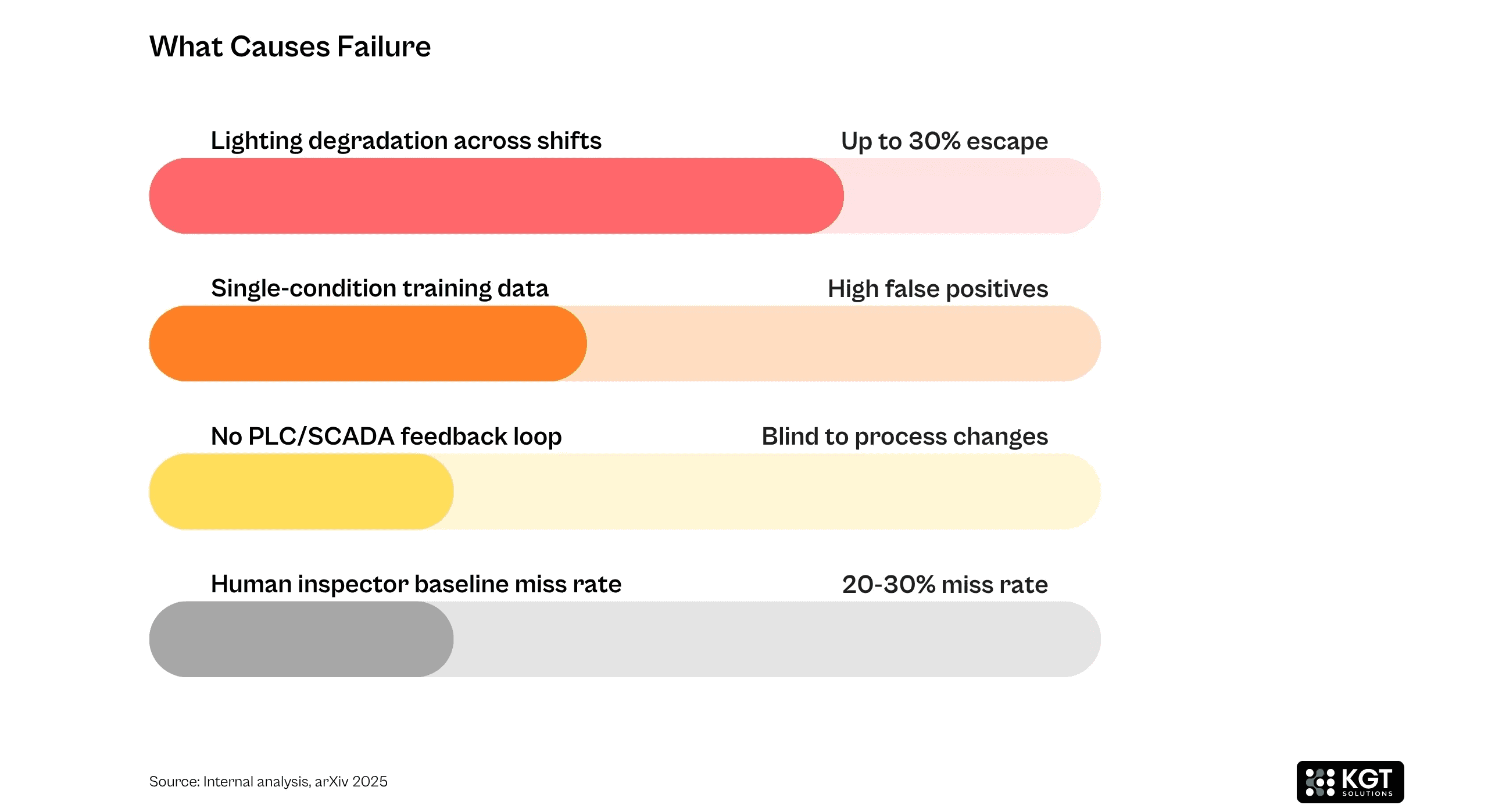
Bad lighting, training data from only one condition, and no PLC feedback loop. That combination lets up to 30% of defects slip through.
Machine vision system failures on production lines come down to environmental variability that rule-based algorithms cannot absorb, training data that does not represent real production diversity, and integration gaps between the vision hardware and the plant's existing SCADA or PLC infrastructure.
Most teams blame the camera. That is almost never the actual problem. A 50-megapixel sensor will not help if the lighting cannot produce enough contrast between a surface scratch and the material finish. Lighting is the single most underestimated variable in vision inspection system deployments.
Then there is the data problem. A vision system trained on 500 images of "good" parts from a single shift will choke when second shift runs a different material batch under fluorescent tubes that have aged 6 months. Human inspectors miss 20-30% of defects under standard conditions, but at least they adapt in real time. Static rule-based systems do not.
Failure Factor | Impact | Fix |
|---|---|---|
Lighting degradation across shifts | Up to 30% defect escape rate | Structured lighting with automatic intensity calibration |
Training data from single conditions | High false positive rates, operator distrust | Continuous learning from multi-shift, multi-material datasets |
No PLC/SCADA feedback loop | Vision runs blind to upstream process changes | Closed-loop integration with predictive maintenance protocols |

Why Do 77% of Machine Vision Pilots Never Reach Production?
Pilots work great in controlled settings. Production kills them because of multi-line variability, old MES systems, and nobody owning calibration.
Machine vision pilots fail to scale because pilot conditions are controlled and production conditions are not - shifting operators, legacy infrastructure, multi-plant variability, and the absence of a dedicated ownership model turn a successful bench test into a stalled rollout that never delivers ROI.
Here's a deeper look at why most computer vision projects fail before production.
A pilot gets one camera, one line, one engineer babysitting it for three months. Leadership greenlights the rollout, and then reality hits.
The rollout requires integrating across 4 lines with different conveyor speeds, 3 shift teams with different handling patterns, and a 12-year-old MES that nobody wants to touch. The $1.4 trillion global cost of unplanned downtime (Gartner) is not caused by technology that does not exist. It is caused by technology that was never properly deployed.
The Ownership Gap Between Pilot and Production
Ops teams inherit vision systems they were never trained on. The 28% speed gains and 32% accuracy improvements disappear fast.
The ownership gap kills more machine vision deployments than any technical limitation - pilots are owned by innovation teams with dedicated bandwidth, while production deployments land on operations teams already managing 15 other priorities without the specialist knowledge to maintain vision system calibration.
Innovation teams run pilots. Operations teams inherit production. Nobody defined who owns calibration drift, model retraining, or false positive triage between shifts. AI-powered systems improve inspection speed by 28% and detection accuracy by 32%, but only when someone is accountable for keeping the models fed with fresh production data.
IT OT Convergence in Manufacturing Explained

Training Data Decay and Model Drift
34% of defects get past vision systems running on outdated training data. The model learned one reality; production moved on to another.
Training data decay occurs when the original image dataset no longer represents current production reality - new suppliers, seasonal material variation, and tooling wear introduce surface characteristics that the machine vision model has never encountered, triggering false rejects or missed defects.
A model trained in January on brushed aluminum from Supplier A will start throwing false positives by April when Supplier B's slightly different grain pattern enters the line. Advanced vision software reduces false positives by 95%, but only with continuous retraining pipelines that ingest tagged reject images from every shift.
34% of manufacturing defects slip through because inspection systems are running on stale models. The hidden ROI of fixing your vision system goes far beyond defect rates that number drops close to zero when you close the feedback loop between reject bins and retraining queues.
How Do You Fix a Blind Machine Vision System?
Fix lighting first. Set up continuous retraining second. Integrate with PLC/SCADA third. That order gets you the fastest ROI.
Fixing a blind machine vision system requires three interventions executed in order: first, rebuild the lighting and optics for the actual production environment, second, deploy continuous learning pipelines that retrain models on live production data, and third, integrate the vision system into your plant's automation stack so upstream process changes automatically trigger inspection recalibration.
Step one is always lighting. Structured LED arrays with automatic intensity adjustment eliminate the single biggest source of false negatives. This is a hardware fix that costs a fraction of the camera investment but moves the accuracy needle further than any software upgrade.
Step two is closing the data loop. Every rejected part - whether caught by the system or flagged by an operator - gets imaged, tagged, and fed back into the training pipeline. Facilities running this closed-loop approach with IoT sensor integration report double-digit OEE improvements. When properly deployed, here's what computer vision catches that human inspectors miss.
Step three is the one most teams skip: tying the vision system into the broader automation infrastructure. When a PLC registers a tooling change or a temperature sensor flags a process deviation, the vision inspection system should automatically adjust its sensitivity thresholds. Without this, your machine vision is a standalone island reacting to problems it could have anticipated.
The market for machine vision systems in manufacturing hit $24.73 billion in 2025 and is growing at a 14.09% CAGR. The technology is not the bottleneck. The deployment methodology is.
Frequently Asked Questions
What is the most common reason a machine vision system misses defects?
How much does poor machine vision inspection cost a manufacturing plant?
Can an existing machine vision system be upgraded without full replacement?
Can machine vision work alongside human inspectors?
What lighting setup reduces false rejections in machine vision?
Conclusion
Audit your lighting first, build a closed-loop retraining pipeline second, and connect your vision system to your PLC/SCADA stack third. If your team lacks the bandwidth to execute all three, talk to an integration partner who has deployed machine vision across live production lines - not just pilot benches.
Sources:
AI Vision Finds Its Footing on the Factory Floor - Automotive Manufacturing Solutions
How Machine Vision Systems Detect Defects on the Production Line - CSSI
Machine Vision Systems in Manufacturing Market Size 2033 - Kings Research
Machine Vision Market Size & Share 2025-2030 - MarketsandMarkets
False Negatives in Machine Vision Systems 2025 - UnitX Labs
100% Accuracy AI Vision: The Real Cost of Manufacturing Defects - Overview AI
What Happens When the Inspection AI Fails - Edge AI and Vision Alliance
Machine Vision Market Size & Share - Fortune Business Insights
Industrial Autonomous Floor
Newsletter
Actionable insights on industrial AI, automation, and smart operations built for safe, secure, and compliant real-world environments.