The Real Struggle of CEOs And Founders: Adopting AI and XR in a Fast-Moving World

Every boardroom conversation eventually arrives at the same question: "We know we need to adopt AI and XR - but how do we do it without betting the house?"
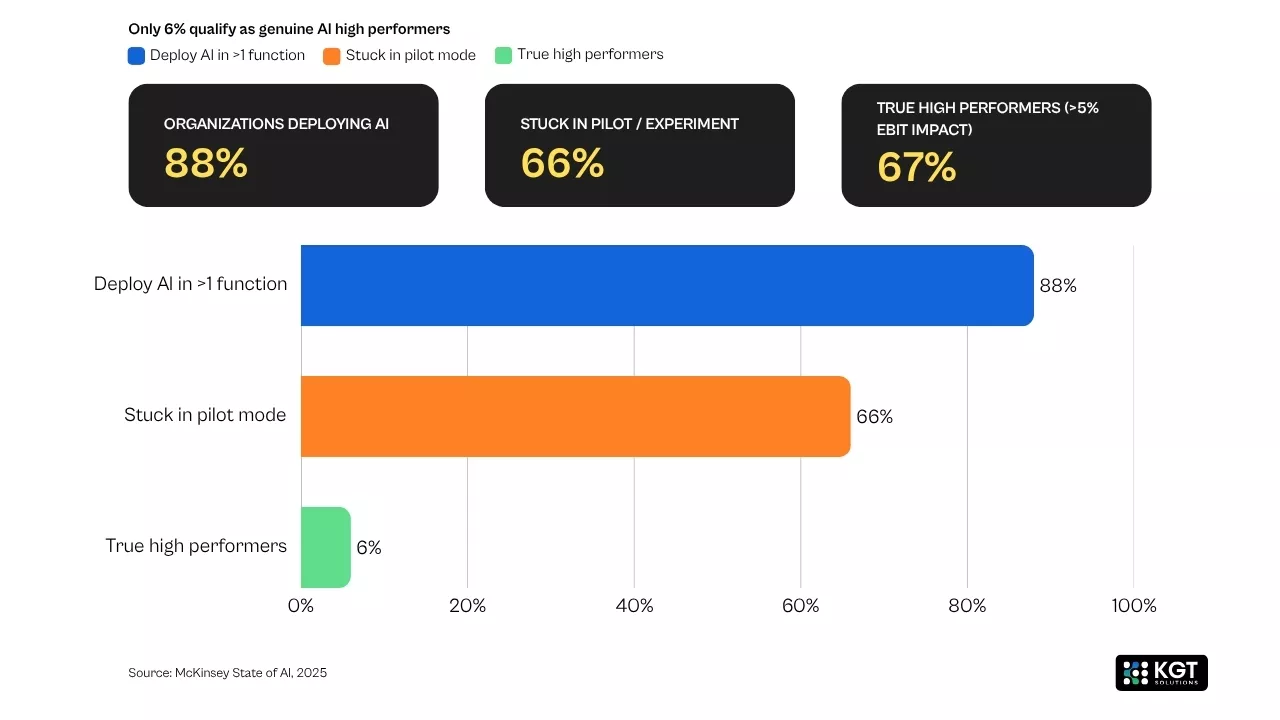
Adopting AI and XR is not a technology problem. It is an execution problem, and the gap between a vendor pitch and measurable business value is where most transformation initiatives quietly die. According to McKinsey's 2025 State of AI survey, 88% of organizations now deploy AI in at least one business function, up from 78% the previous year. But two-thirds of those organizations remain stuck in experiment or pilot mode. Only 6% qualify as genuine AI high performers, defined as achieving more than 5% EBIT impact from AI.
This piece is not another argument for why AI and XR matter. You already know they do. This is about the specific, structural barriers that prevent capable leaders from acting, and what the evidence says about how to move through them.
The Four Barriers That Actually Slow Down AI and XR Adoption
1. The Clarity Problem
The market is saturated with claims. Every platform is "AI-powered." Every vendor promises transformation. The practical result for decision-makers is paralysis, not from a lack of information, but from an overload of noise that makes prioritization nearly impossible.
The question for any CEO is not whether to adopt AI. It is which of the 200+ potential use cases McKinsey has mapped across 63 business categories is the right entry point for your specific operations, competitive position, and workforce readiness.
Adoption without clarity is just expensive experimentation.
2. The ROI Uncertainty Problem
Budget allocation without a clear return thesis is career risk for executives. That is not irrational - it is appropriate stewardship. The challenge is that AI and XR investments are often evaluated against the wrong benchmarks.
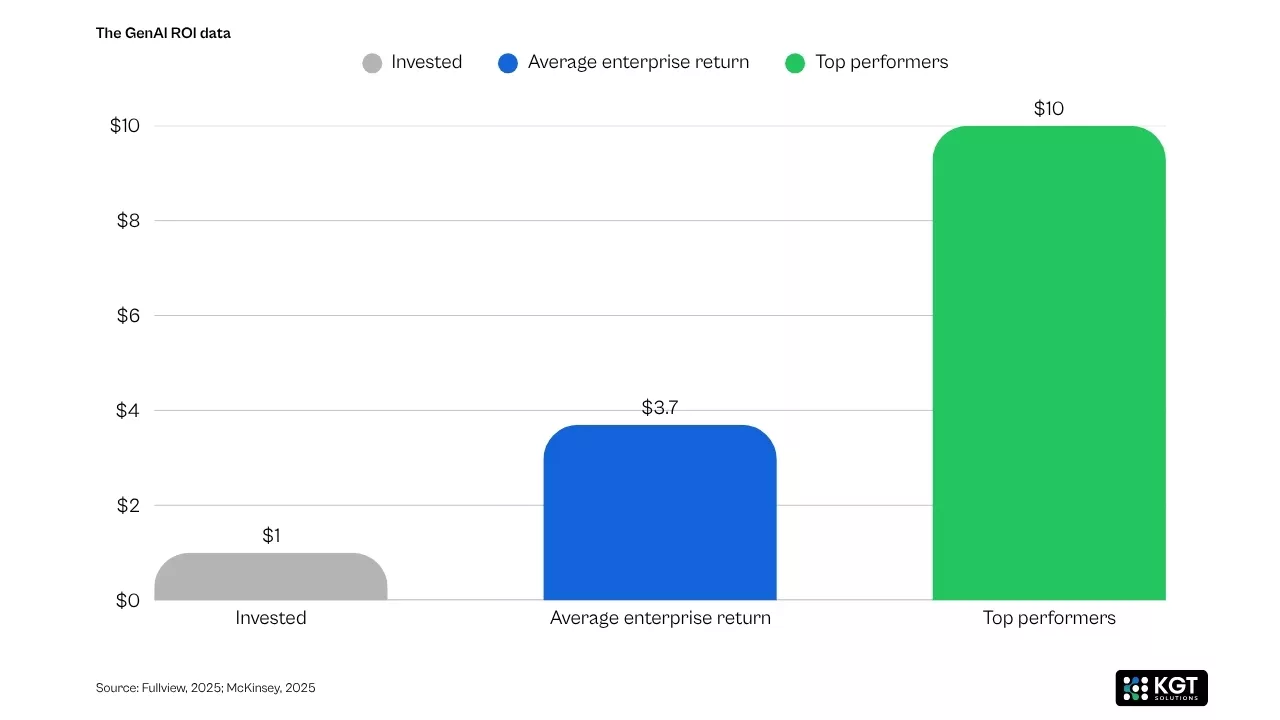
McKinsey estimates generative AI alone could unlock $2.6 to $4.4 trillion in annual value across industries, with the largest pools in customer operations, marketing and sales, software engineering, and R&D. Early enterprise movers report $3.70 in value for every dollar invested in GenAI, with top performers exceeding $10 per dollar, according to research compiled by Fullview. In manufacturing and software engineering, 10–20% cost reductions are already being documented at the function level.
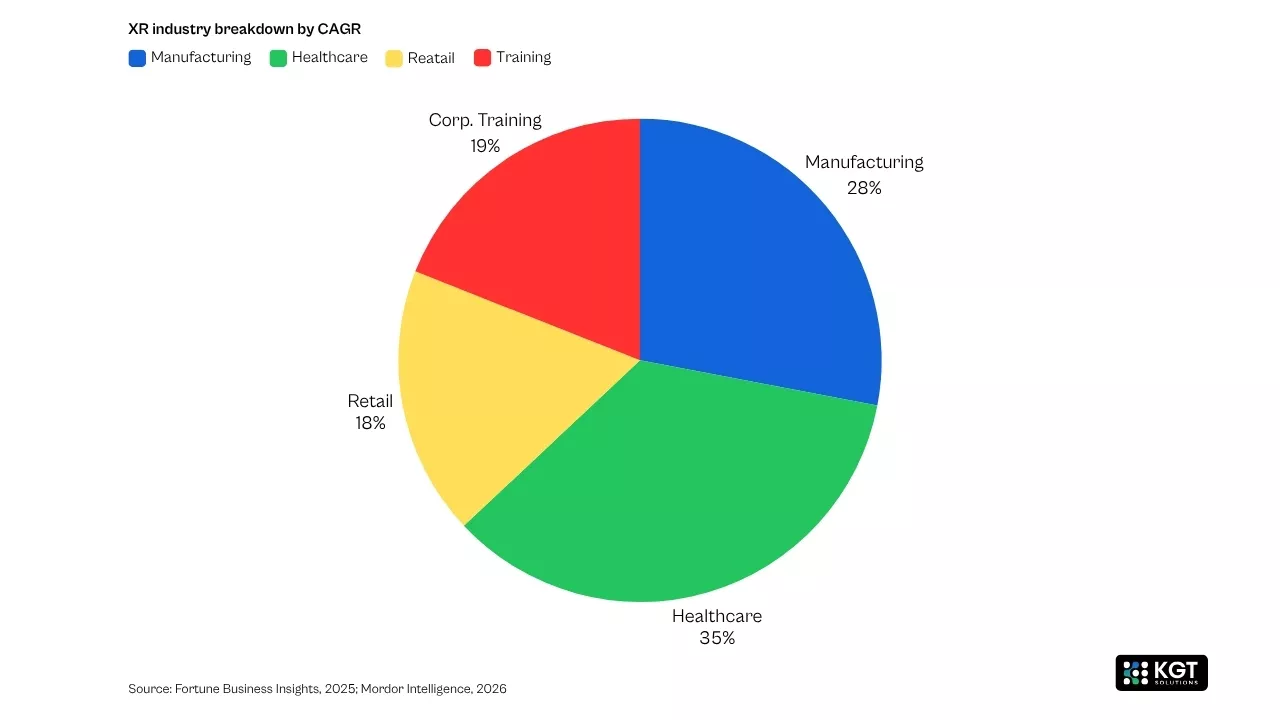
The XR market tells a parallel story. The global Extended Reality market was valued at approximately $184 billion in 2024 and is projected to grow at a compound annual rate of 30%+ through the end of the decade (Fortune Business Insights, 2025). Healthcare, manufacturing, and enterprise training are the fastest-scaling segments.
The risk is not that these technologies fail to generate returns. The risk is committing to the wrong use case before organizational readiness is established.
3. The Talent and Execution Gap
Deciding to adopt is straightforward. Executing the decision is where most organizations stall.
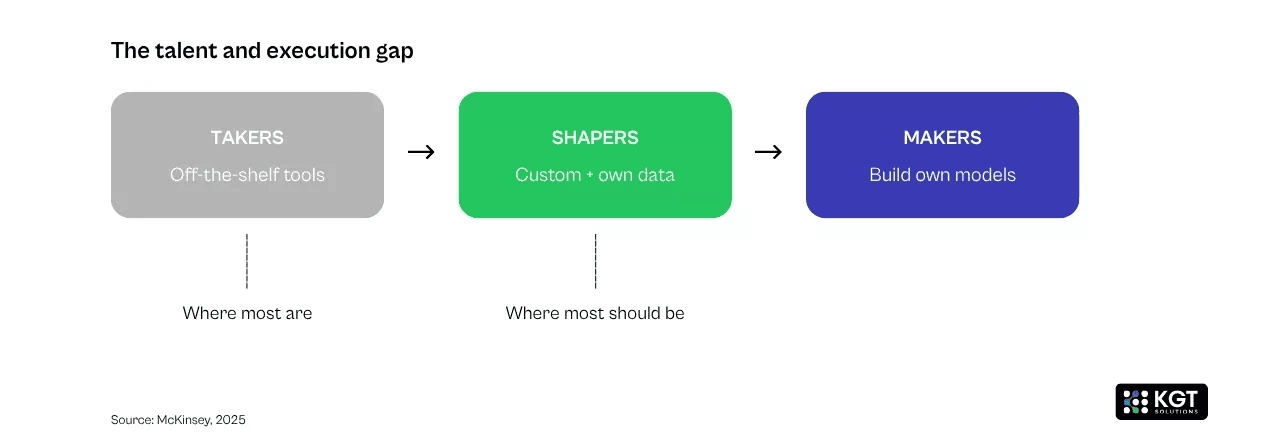
Organizations that successfully scale AI consistently outperform peers on a set of 12 practices spanning strategy, talent, operating model, and governance, per McKinsey. The gap is not technological. It is organizational. Companies fall into three implementation archetypes: takers (using off-the-shelf tools as-is), shapers (customizing platforms with proprietary data), and makers (building foundation models internally). Most enterprises should be shapers. Most are operating as takers.
The talent constraint is real and accelerating. Demand for data engineers, ML engineers, AI product owners, and AI governance specialists is outpacing supply. McKinsey notes that 32% of organizations expect AI to reduce headcount in certain functions within a year, but simultaneously, every high-performing organization is aggressively hiring for new AI-native roles.
For XR, the execution barrier is compounded by hardware costs and the need for domain-specific content development. PwC research confirms that enterprises using XR for training report a 275% increase in confidence and higher knowledge retention rates compared to traditional classroom approaches. But that outcome only materializes when the implementation is integrated into existing workflows rather than bolted on as a standalone initiative.
Agentic Orchestration Explained for Enterprise CTOs

4. The Organizational Resistance Problem
Technology is the easy part. People are the hard part.
Employees who have developed fluency in existing systems over years do not resist change because they are obstructionist. They resist because the personal cost of relearning is real, the communication around purpose is usually insufficient, and the incentive structures rarely reward early adoption. McKinsey's research identifies embedding AI into business processes and establishing role-based capability training as two of the highest-leverage practices separating high performers from everyone else.
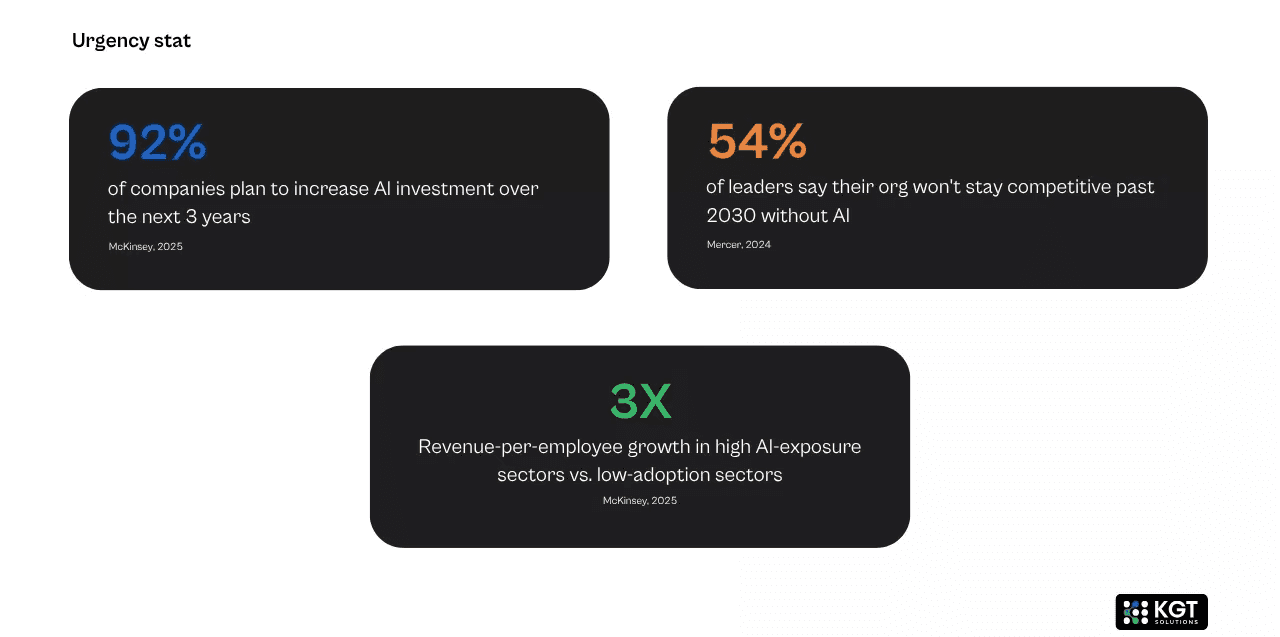
A Mercer study reinforces the urgency: 54% of business leaders believe their organizations will not remain competitive beyond 2030 without adopting AI at scale. That is not a technology forecast. It is a management challenge.
Why the Window for AI and XR Adoption Is Narrowing
Forward-thinking organizations are not waiting to see how the technology matures. They are using this period to build the organizational muscle that turns technology access into competitive advantage.
On the AI side, the gap between organizations that have embedded AI into core operations and those still running pilots is already measurable. McKinsey reports that industries embracing AI are seeing labor productivity grow faster than the global average. Revenue per employee in sectors with high AI exposure is growing at three times the rate of sectors with slower adoption.
Specific outcomes being documented across industries:
Customer operations: Predictive analytics enabling pre-emptive service interventions and hyper-personalized engagement at scale.
Operations: Automation of compliance, procurement, and back-office functions, with 37.6% of businesses now automating 51–75% of compliance tasks via AI.
Product development: AI-assisted R&D shortening development cycles and improving iteration speed.
On the XR side, enterprise applications moving beyond pilots include manufacturing (Boeing, Ford, and Siemens have integrated AR and VR platforms to upskill workers, visualize digital twins, and streamline assembly), healthcare (Johns Hopkins and Mayo Clinic have expanded VR-based platforms for surgical rehearsal and patient education, with the XR healthcare segment growing at a 42.9% CAGR), retail (virtual showrooms are quadrupling consumer confidence and cutting product return rates, per Mordor Intelligence), and corporate training (Emirates extended its immersive virtual training platform to over 23,000 cabin crew members for safety and emergency training).
Hybrid headsets are reducing prototype design time by up to 38% in automotive applications. Hospitals are documenting shorter procedure times and measurably higher retention in surgical training programs. These are not pilot-stage anecdotes.
How to Actually Start Adopting AI and XR
The companies generating real returns from AI and XR share one characteristic that has nothing to do with budget or technology access: they started with a specific problem, not a technology.
They did not ask: "How do we adopt AI?" They asked: "Where is our most expensive operational inefficiency, and what would it mean to our P&L to cut it by 20%?" The technology followed the business case, not the other way around.
McKinsey's research across more than 200 at-scale AI transformations confirms this pattern. High performers redesign workflows around AI. They do not layer AI tools onto existing processes. The value is in the process redesign, not the tool deployment.
The same logic applies to XR. The 40% training time reduction documented by PwC is not a product of the headset. It is a product of rebuilding the training curriculum around immersive simulation. The hardware is an enabler. The workflow redesign is the investment.
The Real Risk for CEOs and Founders Who Wait
There is a version of caution that is leadership. And there is a version that is postponement dressed up as prudence.
The data no longer supports a wait-and-see posture. McKinsey's 2025 findings show that 92% of companies plan to increase AI investment over the next three years. The question is not whether your competitors are moving. They are. The question is whether the gap they are opening is recoverable.
AI and XR are not future technologies. They are present-day infrastructure decisions, the same category of decision as cloud adoption in 2010 or mobile-first strategy in 2014. The companies that treated those as optional watched the ones that did not build advantages that took a decade to close.
The cost of early adoption, done with discipline, is manageable. The cost of late adoption, in a market where AI-enabled competitors are compounding their efficiency advantage every quarter, is structural.
Where to Begin
The imperative is clarity before commitment. Before budget allocation, before vendor selection, before any technology conversation:
Define the one problem worth solving - the constraint that, if removed, would generate measurable business value within 12 months.
Audit organizational readiness - not just technical infrastructure, but talent, governance capacity, and workflow flexibility.
Build for scaling, not for pilots - the majority of organizations that fail at AI adoption do so because they designed for experimentation, not production.
Measure what matters - McKinsey's data consistently shows that organizations tracking well-defined KPIs for AI initiatives are significantly more likely to realize value and manage risk.
The technology is available. The evidence is documented. The competitive signal is clear. The only remaining variable is the decision.
Frequently Asked Questions
Why do so many CEOs struggle with AI and XR adoption?
What is the biggest risk of delaying AI and XR adoption?
How should founders prioritize which AI or XR use cases to pursue first?
Do small and mid-size companies need AI and XR, or is it only for enterprises?
What mindset shift do CEOs need to successfully adopt emerging technology?
Sources:
McKinsey & Company, "The State of AI 2025: Agents, Innovation, and Transformation"
McKinsey & Company, "The State of AI in Early 2024: Gen AI Adoption Spikes and Starts to Generate Value"
PwC, Enterprise XR Training Impact Research, cited via Emergen Research Industry Report (2025)
Fortune Business Insights, "Extended Reality (XR) Market Size, Share & Statistics (2025–2032)"
Mordor Intelligence, "Extended Reality (XR) Market Size, Trends & Share Analysis, 2026–2031"
Fullview, "200+ AI Statistics & Trends for 2025: The Ultimate Roundup"
Aristek Systems, "AI 2025 Statistics: Where Companies Stand and What Comes Next"
Mercer, Business Leaders and AI Competitiveness Study (2024)
Emergen Research, "Extended Reality Market Overview: XR Industry Trend by 2034"
Protocol AI Newsletter
Practical insights on AI, automation, and intelligent systems focused on real-world applications, not hype.