What Computer Vision Catches That You Miss


Most of us trust our eyes more than we should. We glance at a product on a factory line and call it fine. We scan a retail shelf and think everything looks right. But computer vision, the branch of AI built to process and interpret visual data, picks up on things we physically cannot see, at speeds we cannot match.
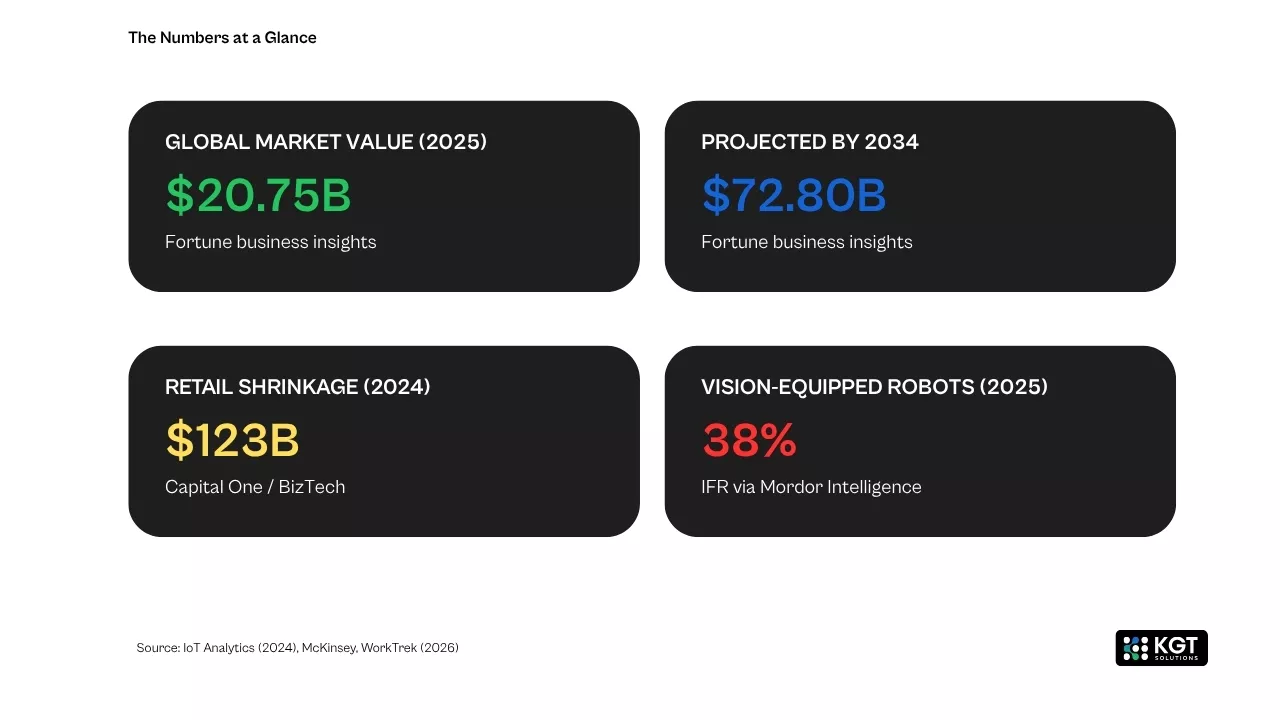
These systems analyze visual information through deep learning models, catching subtle anomalies, hidden patterns, and rapid changes that human eyes consistently miss. The global market was valued at roughly $20.75 billion in 2025, according to Fortune Business Insights, and is projected to hit $72.80 billion by 2034. That kind of investment doesn't happen unless the technology is solving real, expensive problems.
How computer vision catches defects humans can't
Computer vision defect detection uses deep learning algorithms trained on thousands of images to identify micro-cracks, surface flaws, and dimensional errors that are invisible to the naked eye, often at speeds exceeding 1,000 units per hour.
The average manufacturing company loses about 20% of total sales to poor quality costs, per Overview.ai. For a company pulling in $10 million, that's $2 million gone.
Human inspectors get tired. Their attention drifts after the 300th unit on a Monday afternoon. Automated defect detection doesn't have that problem. Deep learning algorithms trained on thousands of images identify micro-cracks, surface discoloration, dimensional errors, and material inconsistencies in real time. An AI-driven inspection system tested on laser-engraved nameplates achieved 91.33% accuracy with 100% recall, meaning it flagged every defective unit, according to a 2025 arXiv study.
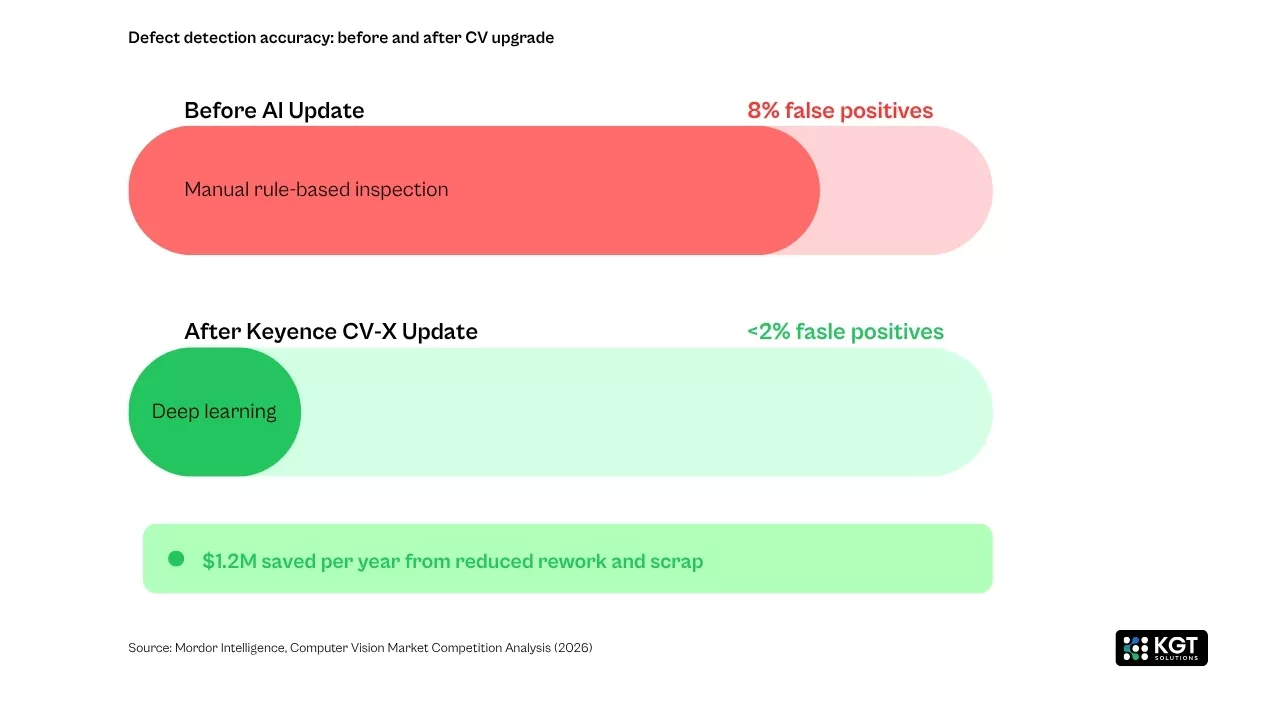
Keyence's CV-X updates brought false-positive rates from 8% to below 2% in automotive stamping, saving one Michigan supplier $1.2 million a year (Mordor Intelligence). Cognex shipped over 500,000 In-Sight 3D systems in 2025 to electronics lines inspecting solder joints at 1,200+ units per hour. No human team matches that throughput.
Computer vision defect detection isn't replacing inspectors because it's cheaper. It's covering the gaps they can't help leaving.
What retail computer vision solutions actually see
Retail shrinkage hit $132 billion globally in 2024, per a Capital One report cited by BizTech Magazine. About a third of that is shoplifting, another third employee theft. Traditional security setups miss most of it because a person watching a monitor can only focus on one feed at a time.
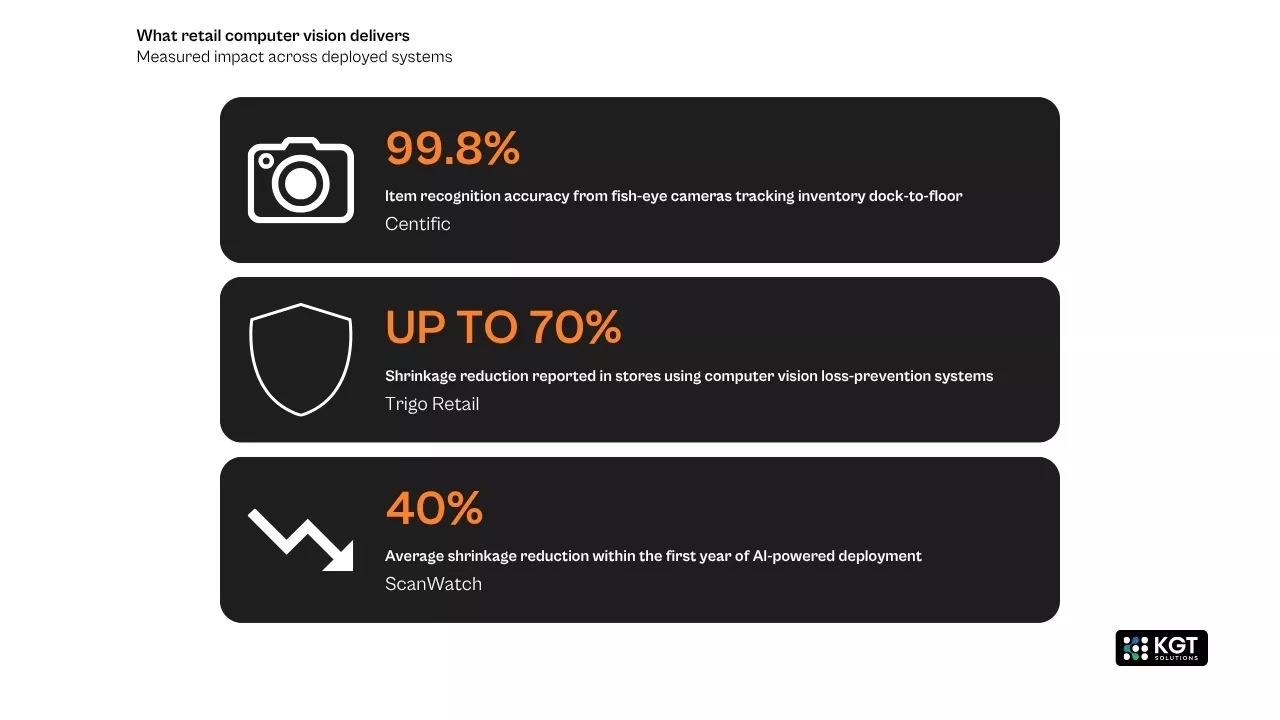
Retail computer vision solutions work by pairing AI-powered cameras with object tracking to monitor entire stores simultaneously, identifying suspicious behavior, inventory discrepancies, and checkout fraud in real time. Centific reports that fish-eye cameras with AI recognition track inventory from delivery docks to sales floors with 99.8% item accuracy. Trigo, one of the most funded companies in loss prevention tech, reports its system reduces shrinkage by up to 70% in deployed stores.
Theft detection is only part of the picture. These solutions also catch unintentional losses: items bagged without scanning, barcode swaps at self-checkout, misplaced products. The system watches the entire store simultaneously, something no security guard physically can. AI-powered detection has delivered an average 40% shrinkage reduction within the first year in some deployments (ScanWatch). The visible camera network also works as a deterrent, with known fraudsters avoiding stores after installation.
Where robotics meets vision on the factory floor
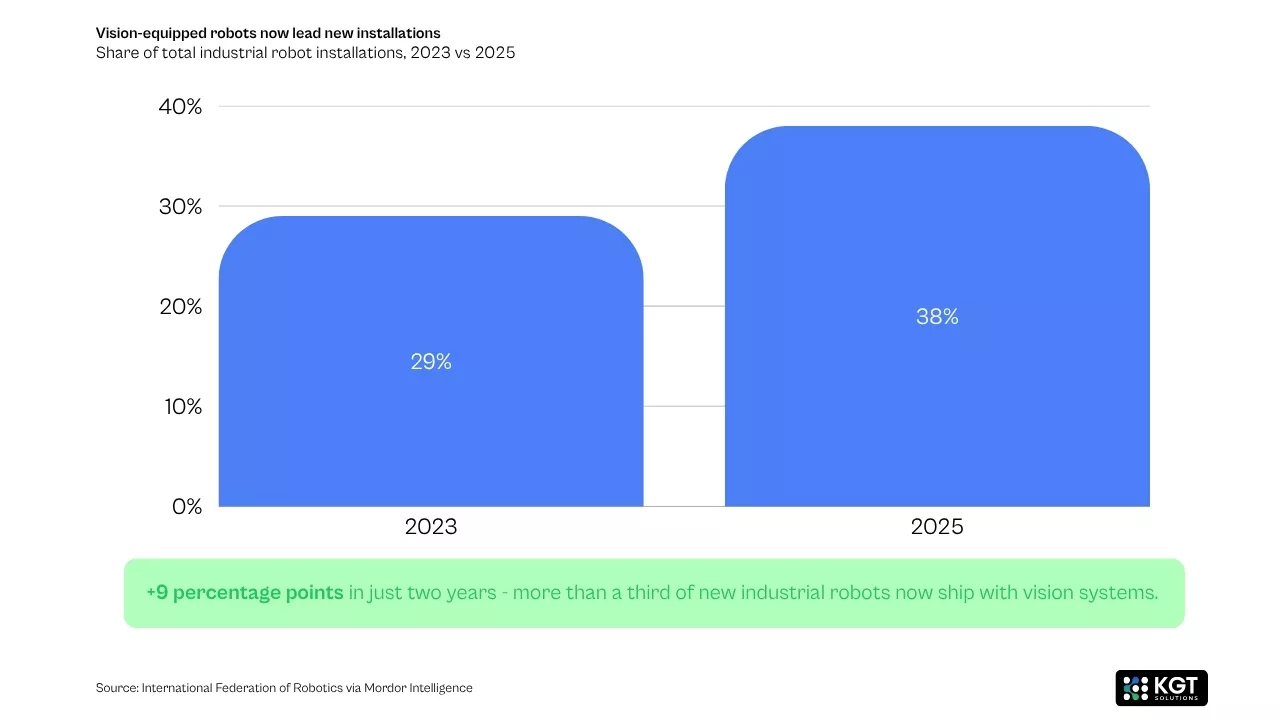
Vision-equipped robots accounted for 38% of all industrial robot installations in 2025, up from 29% in 2023, according to the International Federation of Robotics. More than a third of new industrial robots now ship with eyes.
The robotic vision market is expected to grow from $3.29 billion in 2025 to $4.99 billion by 2030 (MarketsandMarkets). These systems work together because real-world tasks aren't neatly arranged. Bin-picking, palletizing, food packaging: all involve irregular shapes and unpredictable orientations. FANUC's iRVision platform guides over 15,000 collaborative robots in food-packaging lines where fixed-motion arms fail.
A 2D vision system handles simpler tasks like barcode reading. But the industry has moved toward 3D imaging for complex inspections. ABB's PickMaster Twin cuts integration time in half by simulating bin-picking digitally before physical deployment.
Why these algorithms outperform the human eye
The difference isn't resolution. It's consistency. Automated visual inspection processes every frame without fatigue, bias, or boredom, while human accuracy drops measurably after extended shifts.
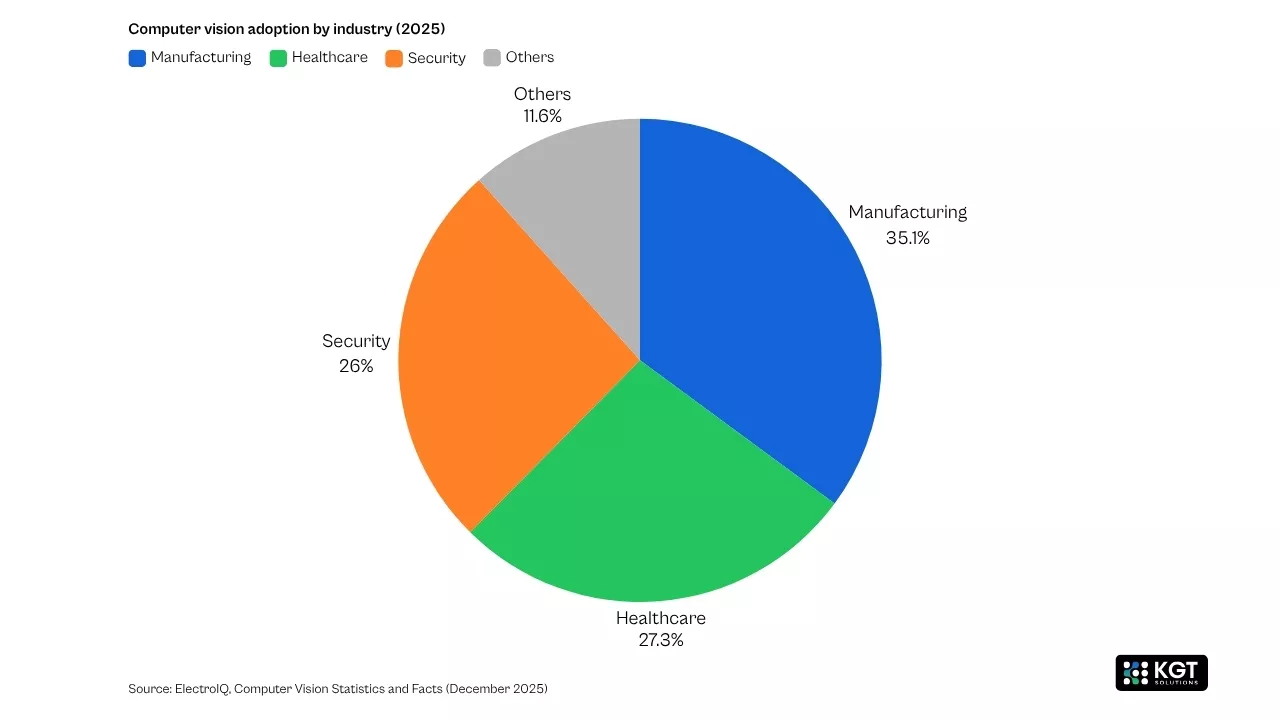
Manufacturing accounts for 35.1% of adoption, the largest industry share (ElectroIQ). Healthcare follows at 27.3%, security at 26%. These are all fields where missing one anomaly carries serious consequences, a cracked weld, a missed tumor on a scan, an undetected intruder on a perimeter.
NVIDIA's Rubin platform runs YOLOv8 object detection at 240 frames per second while drawing under 15 watts (Mordor Intelligence). Edge deployment held 47.33% of market share in 2025 and is growing at a 17.29% CAGR, meaning more processing happens right where the camera sits. Machine vision software has evolved from simple pass/fail checks to systems that learn with each cycle. Intel reported saving $2 million annually in scrap avoidance through its AI inspection system. That's not a pilot program. That's real money on a real production line.
Agentic Orchestration Explained for Enterprise CTOs

What comes next
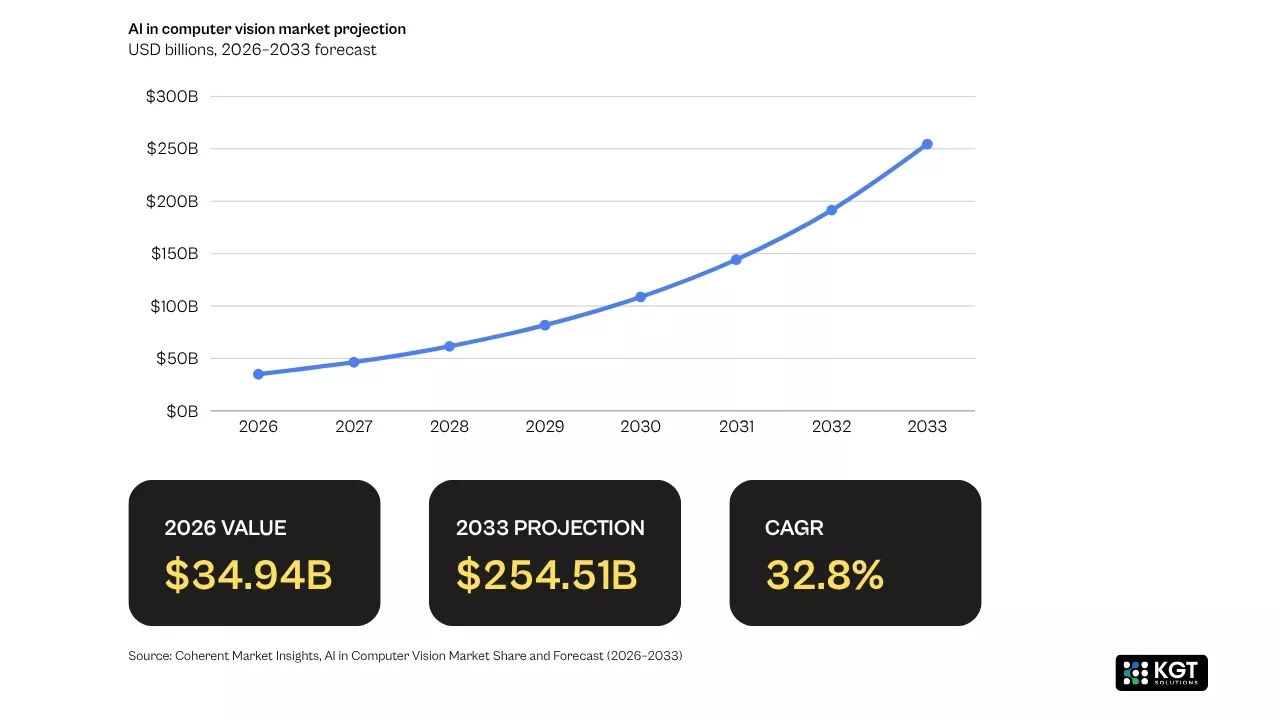
The AI-driven segment of this market is projected to reach $254.51 billion by 2033, growing at a 32.8% CAGR from 2026, per Coherent Market Insights. Wearable devices like computer vision glasses are beginning to give field workers real-time overlay data during equipment inspections, bridging the gap between fixed-camera systems and mobile field work. Autonomous vehicles are another frontier: Tesla's Full Self-Driving v13 uses eight cameras and a custom inference chip to execute lane changes across 47 U.S. states without driver confirmation.
The inspection and quality assurance application alone commanded 41.08% of total market revenue in 2025 (Mordor Intelligence), which tells you where the money is actually going.
What connects these applications is a single idea: computer vision catches what we miss because it was built to look differently than we do. It doesn't tire out, it doesn't assume, and it processes every pixel. If your operation still relies on human visual inspection alone, the question isn't whether something's slipping through. It's how much.
Frequently Asked Questions
What types of defects can computer vision detect that human inspectors typically miss?
How does computer vision improve quality control speed compared to manual inspection?
What industries benefit most from computer vision inspection systems?
Is computer vision reliable enough to replace human quality inspectors entirely?
What is the typical ROI timeline for implementing computer vision in a factory?
Sources:
Fortune Business Insights, "Computer Vision Market Size, Trends | Forecast Analysis [2034]"
Overview.ai, "100% Accuracy AI Vision: The Real Cost of Manufacturing Defects" (October 2025)
arXiv, "AI-Driven Multi-Stage Computer Vision System for Defect Detection in Laser-Engraved Industrial Nameplates" (March 2025)
Mordor Intelligence, "Computer Vision Market Competition Analysis" (March 2026)
BizTech Magazine, "IT Leaders Are Rethinking Retail Shrink With Computer Vision" (August 2025)
Centific, "Crack Down on Retail Inventory Shrinkage with Computer Vision"
Trigo Retail, "Shrink is Retail's Biggest Problem. Computer Vision is the Solution" (June 2025)
ScanWatch, "How AI And Computer Vision Enable Real-Time Shoplifting Detection" (January 2026)
MarketsandMarkets, "Robotic Vision Market Size, Share & Growth, 2025 to 2030"
International Federation of Robotics, via Mordor Intelligence (2025 data)
Coherent Market Insights, "AI in Computer Vision Market Share and Forecast, 2026-2033"
ElectroIQ, "Computer Vision Statistics and Facts" (December 2025)
Protocol AI Newsletter
Practical insights on AI, automation, and intelligent systems focused on real-world applications, not hype.