Why Your Industrial Automation Is Failing You

Industrial automation is supposed to make manufacturing faster, cheaper, and smarter. So why are so many companies spending millions on it and getting almost nothing back?
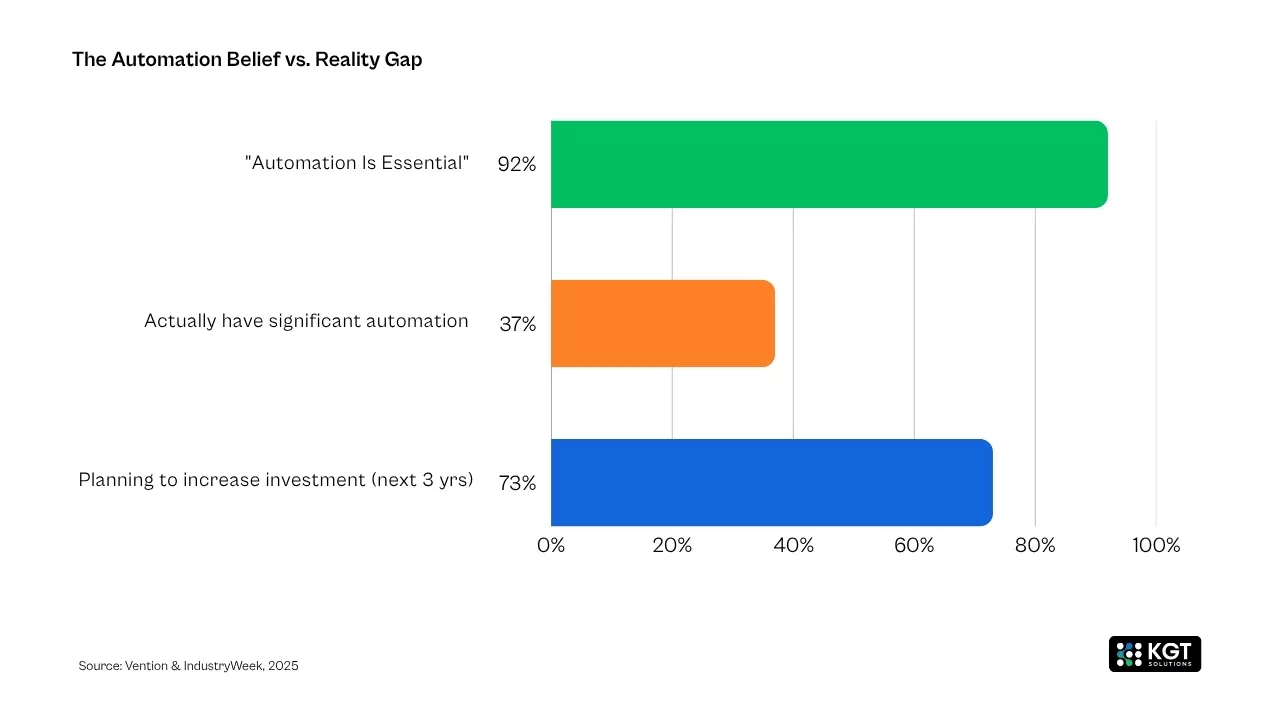
According to a 2025 Vention and IndustryWeek report, 92% of manufacturers say automation is essential for long-term competitiveness, yet only 37% report having significant or full automation in place. That gap tells you something important: the problem isn't willingness to automate. It's how companies go about it.
The Real Reason Industrial Automation Projects Fail
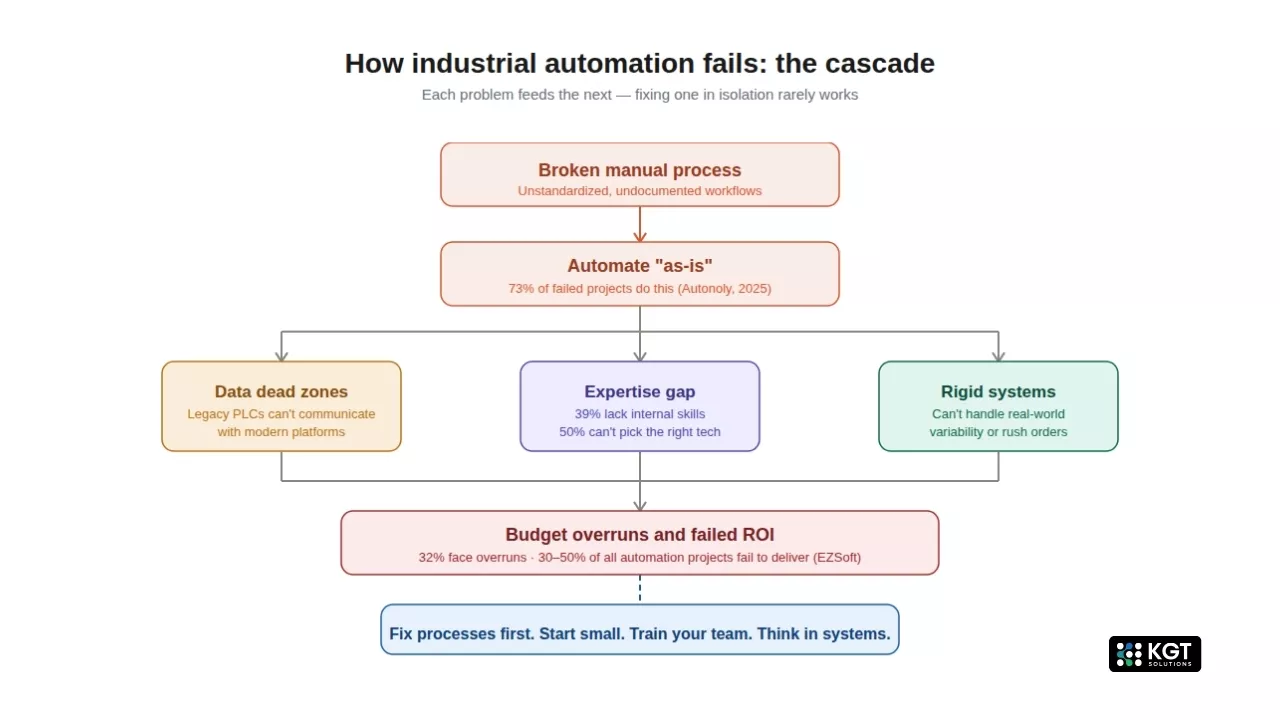
Industrial automation fails most often because companies automate broken processes instead of fixing them first. Research from Autonoly found that 73% of failed automation projects failed precisely because organizations digitized dysfunction rather than designing better workflows before adding technology. A bad manual process doesn't become a good automated one. It becomes a bad process that runs faster and breaks at scale.
Analysts at EZSoft estimate that 30 to 50% of all automation projects fail to deliver expected results. The failures typically trace back to infrastructure problems, unreliable software, and poor project management rather than faulty hardware or insufficient budgets
Why Legacy Systems and PLCs Create Data Dead Zones
Most manufacturing floors run on equipment purchased over the past two or three decades. Older PLCs, legacy industrial control systems, and siloed SCADA networks were never designed to talk to modern cloud platforms or AI-driven analytics. The result is a data dead zone: the machines generate information, but nobody can use it.
The U.S. factory automation market is expected to grow from $49.22 billion in 2025 to $88.05 billion by 2031, according to Mordor Intelligence. But a significant chunk of that spending goes toward retrofitting brownfield sites with IoT sensors, updated PLC industrial automation hardware, and middleware that bridges old and new. Companies that skip this integration work end up with expensive new software staring at machines it can't read.
Industrial PLC programming hasn't kept up with the demands of modern data infrastructure. Many plants still rely on ladder logic written a decade ago. When these systems feed into modern dashboards or logistics platforms, the data comes through incomplete or misformatted. No amount of industrial AI solutions can fix garbage input.

The Expertise Gap Is Worse Than You Think
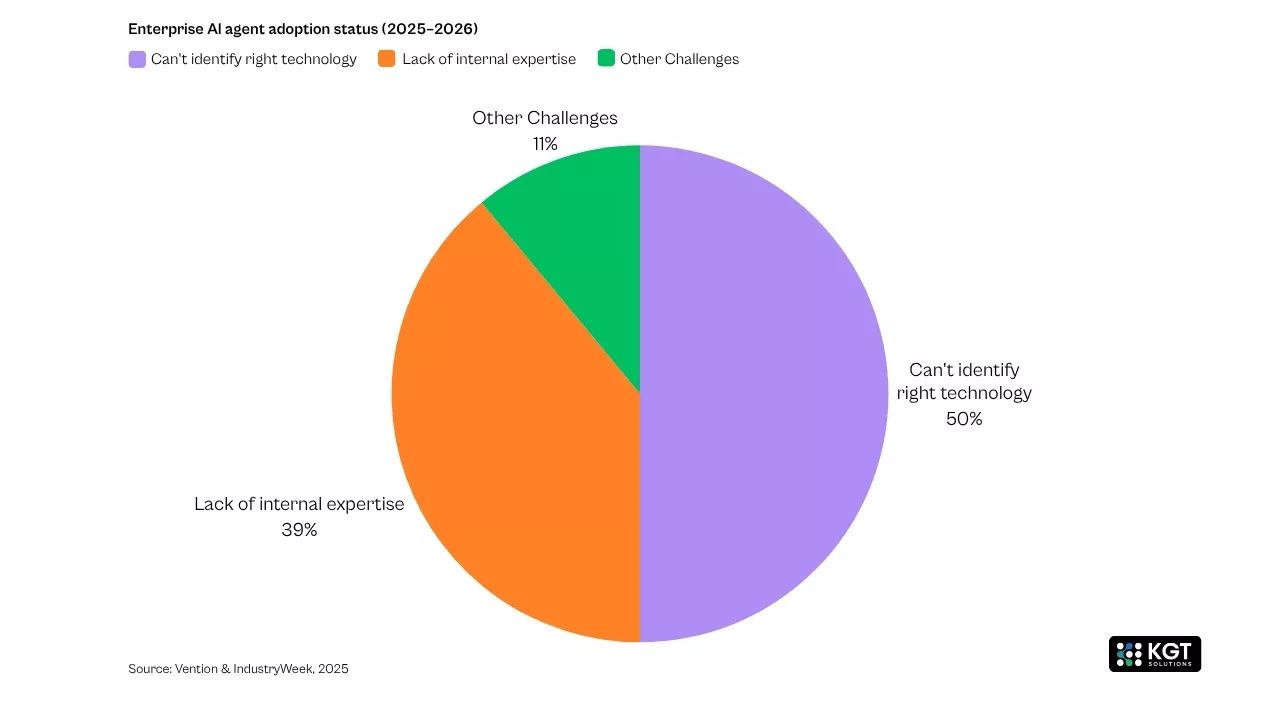
39% of manufacturers cite a lack of internal expertise as a top reason their automation projects underperform, per the Vention/IndustryWeek survey. And 50% say they struggle to even identify the right technology to deploy.
This isn't surprising. Industrial IoT solutions, robotic process automation (RPA) services, and data warehouse automation tools each require specialized knowledge. Hiring people who understand both the plant floor and the software stack is expensive and competitive. Many mid-sized manufacturers end up relying on vendors who know the technology but not the specific production environment, and that mismatch leads to systems that work in demos but fail on the line.
Industrial IoT development services can help close this gap, but only when paired with deep process understanding. Installing sensors everywhere doesn't help if nobody knows which data points actually matter for reducing downtime or improving yield.
Rigid Systems That Can't Handle Real-World Variability
Automated systems that can't adapt to daily variability on the plant floor create more bottlenecks than they eliminate. A 2025 case study documented by Wheere showed how an automotive parts manufacturer deployed autonomous mobile robots on fixed routes. The moment an urgent order required rearranging workstations, the robots failed: invalid routes, missed deliveries, production queues. The automation assumed a static world. Reality didn't cooperate.
This rigidity shows up across many categories of automation equipment: conveyor systems designed for one product size, inspection cameras calibrated for a single defect type, and scheduling software that can't handle rush orders. Digital twin software can help test scenarios before deployment, but only 15 to 20% of manufacturers use simulation tools effectively before committing to a design.
IT OT Convergence in Manufacturing Explained

Budget Overruns and Misaligned Expectations
32% of manufacturers experience budget overruns on automation projects, according to the Vention report. The overruns often happen because companies underestimate integration costs. Buying a robot is one purchase. Connecting that robot to your ERP system, your quality database, your production monitoring systems, and your supply chain platform is five more.
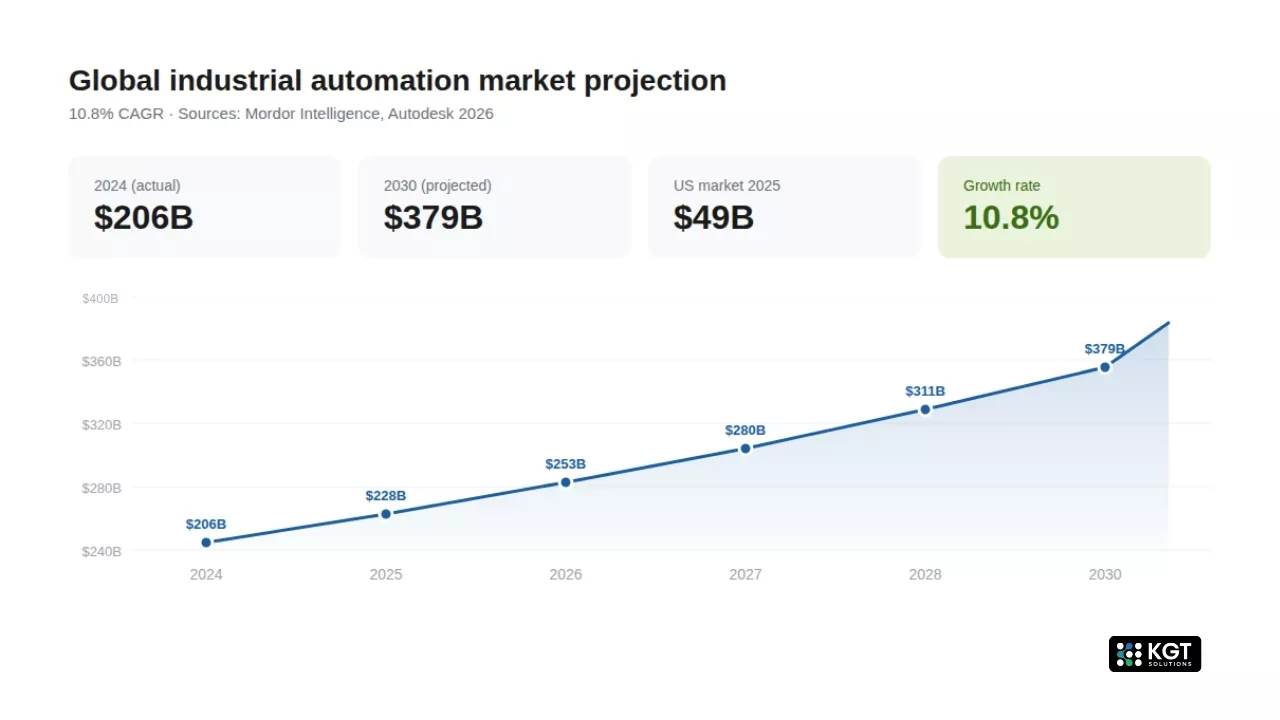
The global market for factory automation is projected to reach $378.57 billion by 2030, growing at 10.8% CAGR from $206.33 billion in 2024. Companies pouring money into this expansion need to spend at least as much on planning and integration as on equipment. The ones that don't end up with expensive islands of technology that never connect into a useful whole.
What Actually Works
Companies that get real results from their automation investments tend to follow a few patterns. They map and fix processes before automating them. They start with a focused pilot targeting a high-impact, low-complexity task and measure results against clear KPIs before scaling. They invest in training their existing workforce rather than expecting vendor-supplied systems to run themselves.
They also think in systems, not products. A PLC upgrade matters only if the data flows into analytics that someone acts on. Connected sensors matter only when the network, the storage, and the decision layer all work together.
The companies that win will be the ones who stop treating automation as a technology purchase and start treating it as an operational redesign. The market is growing fast. Growth alone doesn't mean success.
Frequently Asked Questions
What are the most common reasons industrial automation systems fail to deliver expected results?
How can you tell if your industrial automation is underperforming?
Should you replace failing automation systems or fix what you already have?
How much does poor industrial automation cost a typical manufacturing plant annually?
What role does workforce training play in industrial automation success?
Sources:
Vention & IndustryWeek, "State of the Market Report," December 2025
Autonoly, "The #1 Reason Automation Projects Fail," July 2025
EZSoft Inc., "Why Do So Many Automation Projects Fail?"
Mordor Intelligence, "US Factory Automation and Industrial Controls Market," January 2026
Autodesk, "Trends in Industrial Automation," January 2026
Wheere, "Industrial Automation: Top 5 Challenges in the Field," October 2025
Industrial Autonomous Floor
Newsletter
Actionable insights on industrial AI, automation, and smart operations built for safe, secure, and compliant real-world environments.