Agentic Orchestration Explained for Enterprise CTOs

Key Takeaways
78% of enterprises testing multi-agent systems in 2026 use an orchestration layer to let AI agents divide tasks, share context, and finish multi-step workflows
Companies using agentic orchestration report 40-60% faster process completion compared to single-agent setups, per McKinsey's 2026 AI adoption survey
The agentic ai orchestration market is projected to hit $28.6 billion by 2028, growing at 34.2% CAGR from 2025
Your AI pilot worked fine when one model handled one job. Now you have five agents, three LLMs, and a task queue that needs sequencing - without coordination, those agents trip over each other. This guide breaks down how the orchestration layer works and when your enterprise actually needs it.
What Is Agentic Orchestration?
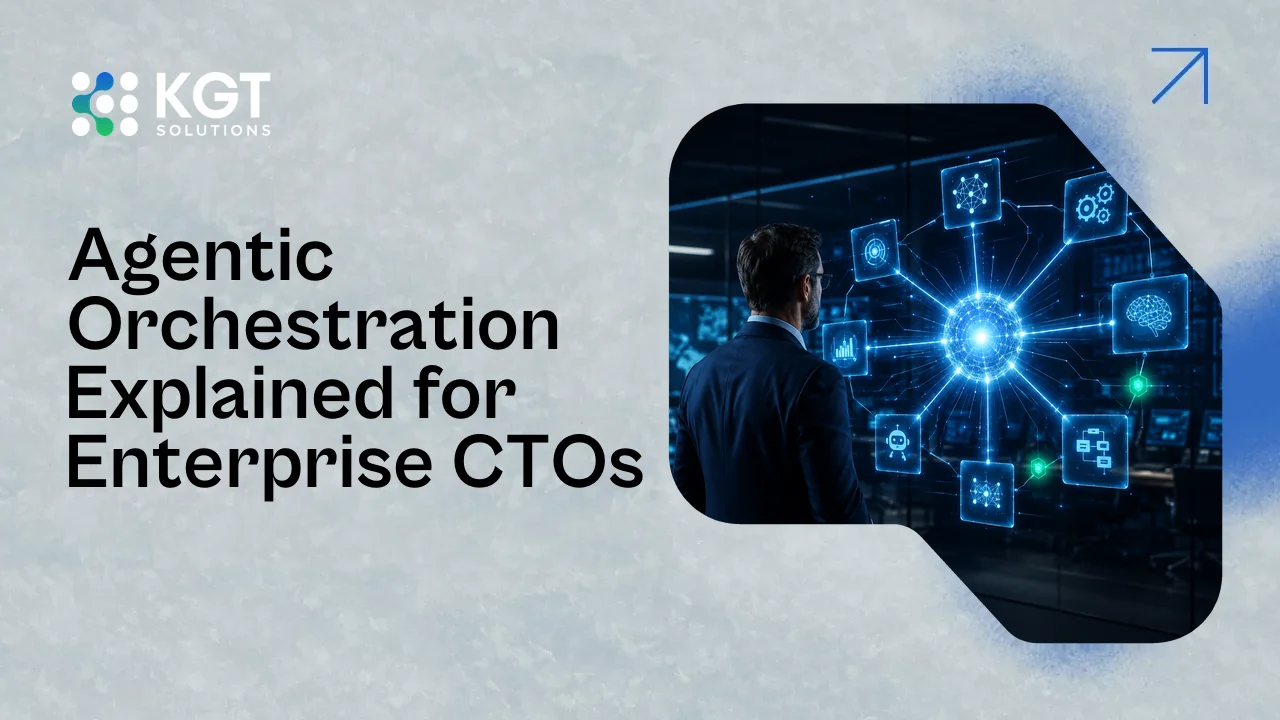
Agentic orchestration assigns, sequences, and monitors AI agent tasks across a shared workflow without requiring human input at every step.
Think of it like a factory floor supervisor - not doing the welding or painting, but making sure the right part reaches the right station at the right time. In an AI context, the orchestrator routes prompts, manages state, handles failures, and decides which agent takes which sub-task.
Traditional ai orchestration focused on chaining API calls or scheduling model inference. This approach goes further - it gives agents the ability to reason about their own task, request help from other agents, and retry when something breaks.
Gartner's 2026 AI infrastructure report found that 67% of enterprise AI deployments with more than three models now use some form of orchestration middleware. The ones that don't spend 2.3x more engineering hours on manual integration work.

How Does Agentic Orchestration Differ from Standard AI Pipelines?
Agentic orchestration uses dynamic task routing and agent-to-agent communication, while pipelines follow fixed, linear steps.
Here's the difference in plain terms:
Feature | Traditional AI Pipeline | Agentic Orchestration |
|---|---|---|
Task flow | Fixed sequence (A then B then C) | Dynamic - agent decides next step |
Error handling | Fails or retries the same step | Agent reroutes, asks another agent, or splits the task |
Context sharing | Passed as static input/output | Shared memory, agent-to-agent messages |
Human involvement | Required at decision points | Only at exception boundaries |
Scaling | Add more compute per step | Add more agents per capability |
A static pipeline works when you know every step in advance. Agentic orchestration fits when the path depends on what the first agent finds. Customer support triage, procurement approval chains, and multi-source data analysis all fall into this category.
Five Orchestration Patterns Every CTO Needs to Know
Five common patterns cover 90% of enterprise agentic ai orchestration use cases, from simple handoffs to autonomous swarms.
Sequential handoff - Agent A finishes, passes output to Agent B. Clean and predictable. Works for document processing pipelines where each stage adds a specific change.
Parallel fan-out - The orchestrator sends the same task to multiple agents at once. Used for competitive analysis where you want three agents searching different data sources simultaneously. Cuts processing time by 50-70% on parallelizable tasks.
Hierarchical delegation - A manager agent breaks a complex request into sub-tasks and assigns each to a specialist agent. This is how most enterprise ai orchestration systems actually work in production.
Consensus voting - Multiple agents independently solve the same problem, and the orchestrator picks the best answer or combines responses. Financial services firms use this for risk assessment where a single model's bias could cost millions.
Autonomous swarm - Agents self-organize around a goal with minimal central control. Still experimental for most enterprises, but MIT Technology Review found swarm-based agent systems improved complex problem-solving accuracy by 23% compared to hierarchical setups in controlled enterprise trials.
When Should You Deploy Agentic Orchestration?
Deploy agentic orchestration when your workflows involve three or more AI agents that need to share context and make routing decisions.
Not every AI project needs orchestration. If you're running a single chatbot or one classification model, adding an orchestration layer just adds cost and complexity. The break-even point is clear:
You need it when: Your workflow has conditional branching, multiple specialized models, or requires agent-to-agent communication
Skip it when: You have a single-purpose AI tool with a fixed input/output pattern
Gray zone: Two agents with simple handoffs - a lightweight task queue might be enough
Forrester's 2026 enterprise AI survey found that companies who deployed agentic AI tools with orchestration saw 42% higher task completion rates than those running agents independently. But companies that added orchestration to simple single-agent workflows saw a 15% jump in infrastructure costs with no measurable improvement.
Enterprise AI Governance: Build Your Framework

Common Mistakes CTOs Make with Agentic Orchestration
Most orchestration failures start from over-engineering the agent graph before the simplest version is validated.
Three patterns show up again and again:
Building for swarm when sequential works. Start with the simplest orchestration pattern that solves your problem. Upgrade only when the simple version hits a documented wall.
Ignoring observability. When five agents work together, debugging failures gets hard fast. Every orchestration layer needs logging at the agent level - what each agent received, what it decided, and what it passed along. Without this, your team burns hours guessing where things broke.
Skipping the human-in-the-loop exit. Agentic doesn't mean unsupervised. Deloitte's 2026 AI governance report found that 73% of production multi-agent orchestration deployments include at least one mandatory human checkpoint. The ones that don't have 3x higher error propagation rates.
Building Your First Agentic Orchestration Stack
Start with two agents, one orchestrator, and a shared memory store - a working prototype takes under two weeks.
Here's a practical starting path:
Pick one workflow that currently requires manual coordination between AI tools. Procurement approval or customer ticket escalation works well.
Define agent roles clearly. Each agent gets one job and one set of tools - Agent A reads and classifies, Agent B drafts a response, the orchestrator decides routing.
Choose your orchestration framework. Open-source options like LangGraph, CrewAI, and AutoGen handle the basics. Enterprise options from AWS, Azure, and Google add governance layers.
Build shared memory. Agents need a common place to read and write context. A simple key-value store or vector database works for most starting use cases.
Add observability from day one. Log every agent decision, every handoff, and every failure. You'll need it when something breaks at 2 AM.
For CTOs evaluating whether to build or buy their AI software stack, orchestration frameworks are typically a buy-first decision. Building custom makes sense only when you have unique routing logic no framework supports.
What Does the Agentic Orchestration Market Look Like in 2026?
The agentic orchestration market hit $12.4 billion in 2025 and grows 34% yearly as enterprises shift to multi-agent production.
Three forces are driving adoption:
LLM costs dropped 80% since 2023, making multi-agent architectures financially viable for mid-market companies
Enterprise compliance requirements now demand agent-level audit trails, which orchestration layers provide by default
The talent gap in AI engineering means companies need agents to coordinate other agents rather than hiring more ML engineers
IDC projects 58% of Fortune 500 companies will run at least one multi-agent orchestrated workflow in production by end of 2026. The agentic AI trends shaping 2026 point to orchestration as the layer separating experimental AI from production AI.
Frequently Asked Questions
What is the difference between agentic orchestration and workflow automation?
How much does agentic orchestration cost to implement?
Can small companies use agentic orchestration?
What programming languages support agent orchestration frameworks?
How do you measure ROI on agentic orchestration?
Conclusion
Map your current multi-agent workflows, pick the simplest orchestration pattern that fits, and build a two-agent prototype this quarter. If you need help designing your orchestration architecture, talk to KGT Solutions at kgt.solutions.
Sources:
Gartner - 2026 AI Infrastructure and Platform Engineering Report
McKinsey - The State of AI Adoption 2026
Forrester - Enterprise AI Agent Deployment Survey 2026
IDC - Worldwide AI and Automation Spending Guide 2026
MIT Technology Review - Multi-Agent Systems in Enterprise Settings
Deloitte - AI Governance and Risk Management 2026
Protocol AI Newsletter
Practical insights on AI, automation, and intelligent systems focused on real-world applications, not hype.