Multi-Agent AI Orchestration: A CTO's 2026 Guide

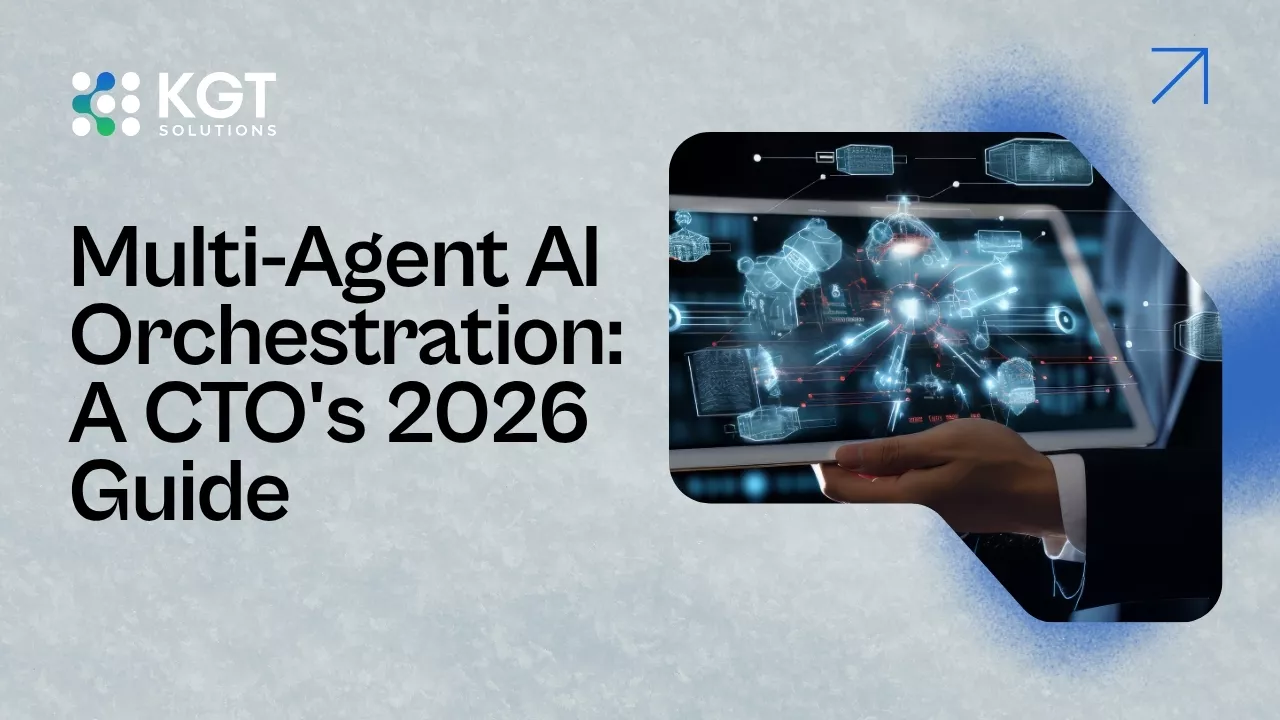
Multi-agent AI orchestration coordinates multiple specialized AI agents to complete complex enterprise workflows that no single agent can handle alone.
Most CTOs already run single-agent pilots. The question now is how to move from one agent doing one task to multiple agents collaborating on production workloads. This guide covers the architecture, frameworks, orchestration patterns, and governance layer you need before committing budget.
Key Takeaways
Multi-agent orchestration splits complex tasks across specialized agents that communicate through defined protocols
Production deployments require an orchestrator layer that handles routing, state management, error recovery, and agent lifecycle
LangGraph, CrewAI, and AWS Multi-Agent Orchestrator are the three dominant frameworks in 2026, each with different trade-offs
Governance (guardrails, observability, cost controls) matters more than framework choice for enterprise deployment
Companies running multi-agent systems report 40-60% faster task completion on complex workflows compared to single-agent setups
What Is Multi-Agent AI Orchestration?
Multi-agent AI orchestration is the architecture pattern where a central controller delegates subtasks to specialized AI agents, manages their communication, and assembles their outputs into a coherent result.
Think of it like a project manager running a team. One agent handles data retrieval. Another processes documents. A third generates reports. The orchestrator decides who works on what, in what order, and what happens when something breaks.
Single agents hit a ceiling when tasks require multiple skills, long reasoning chains, or parallel processing. A coding agent that also needs to search documentation, run tests, and deploy code will produce worse results than four agents each handling their specialty.
The shift from single-agent to multi-agent is not optional for enterprises. Gartner projects that by 2028, 33% of enterprise software applications will include agentic AI, up from less than 1% in 2024. The orchestration layer is what makes this scale.
For a foundational overview of how orchestration fits into the broader AI agent landscape, see What Is AI Orchestration and Why It Matters.
How Multi-Agent Orchestration Works in Production
Production multi-agent systems follow a hub-and-spoke model where an orchestrator routes tasks, manages state, and enforces guardrails across all connected agents.
The architecture breaks into four layers:
Orchestrator layer - Routes incoming requests to the right agent, manages conversation state, handles retries and fallbacks
Agent layer - Individual specialized agents (retrieval, reasoning, action, validation) with defined capabilities and constraints
Communication layer - Message passing between agents using structured protocols (often JSON-based event streams)
Memory layer - Shared context store that agents read from and write to, maintaining coherence across the workflow
A real example: an enterprise deploys a multi-agent system for contract review. Agent 1 extracts clauses. Agent 2 checks against compliance rules. Agent 3 flags risk. Agent 4 generates a summary. The orchestrator manages the pipeline, handles cases where Agent 2 needs clarification from Agent 1, and produces the final output.
State management is where most implementations fail. When Agent 3 flags a risk that requires re-analysis by Agent 2, the orchestrator must track what has been processed, what needs re-processing, and what context each agent needs. Without explicit state management, agents lose context and produce contradictory outputs.
Three Orchestration Patterns CTOs Should Know
The three production-proven orchestration patterns are sequential pipelines, parallel fan-out, and hierarchical delegation - each suited to different workflow complexity levels.
Pattern 1: Sequential Pipeline
Agents execute in a fixed order. Output from Agent A feeds into Agent B. Simple to implement, easy to debug. Works when tasks have clear dependencies and no branching logic.
Use for: document processing, data enrichment pipelines, content generation workflows.
Limitation: one slow agent bottlenecks the entire chain. No parallelism.
Pattern 2: Parallel Fan-Out
The orchestrator sends the same input (or different subtasks) to multiple agents simultaneously. Results are collected, merged, or compared. Faster than sequential for independent subtasks.
Use for: multi-source research, A/B comparison tasks, validation checks, ensemble reasoning.
Limitation: requires a merge strategy. Conflicting agent outputs need resolution logic.
Pattern 3: Hierarchical Delegation
A supervisor agent receives the task, breaks it into subtasks, delegates to worker agents, reviews their output, and iterates until quality meets threshold. Most flexible, most complex.
Use for: complex analysis, code generation with testing, multi-step reasoning that requires quality gates.
Limitation: higher latency, higher cost (supervisor agent runs continuously), harder to debug.
Most production systems combine patterns. A contract analysis system might use sequential for extraction, parallel for multi-jurisdictional compliance checks, and hierarchical for final review and approval routing.
Framework Comparison: LangGraph vs CrewAI vs AWS Multi-Agent Orchestrator

LangGraph offers the most control for custom workflows, CrewAI provides the fastest path to role-based agent teams, and AWS Multi-Agent Orchestrator integrates natively with AWS infrastructure.
Each framework solves orchestration differently. Your choice depends on existing infrastructure, team expertise, and workflow complexity.
LangGraph (LangChain ecosystem)
Built on a graph-based state machine model. You define nodes (agents or functions) and edges (transitions). Supports cycles, conditional routing, and human-in-the-loop checkpoints. Production-grade with persistence, streaming, and fault tolerance.
Best for: teams that need fine-grained control over agent interactions, complex conditional workflows, custom state management.
Trade-off: steeper learning curve. Requires understanding graph theory and state machine concepts.
CrewAI
Role-based framework. You define agents with roles, goals, and backstories. Agents collaborate on tasks using defined processes (sequential or hierarchical). Simpler mental model - think "AI team."
Best for: rapid prototyping, teams familiar with agent-as-persona patterns, workflows where agent specialization matters more than complex routing.
Trade-off: less control over low-level orchestration logic.
AWS Multi-Agent Orchestrator
Integrates with Bedrock, Step Functions, and Lambda. Provides built-in agent classification, context management, and routing. Native AWS infrastructure support.
Best for: enterprises already on AWS, teams that want managed infrastructure, production deployments needing enterprise-grade scaling.
Trade-off: vendor lock-in. Less flexibility than open-source alternatives.
McKinsey reports that 72% of enterprises evaluating multi-agent systems in 2025 considered framework ecosystem maturity as the top selection criterion. Framework choice is a 2-3 year commitment.
For a deeper look at how enterprise agent orchestration works at scale, see AI Orchestration for Enterprise Agent Systems.
Enterprise AI Governance: Build Your Framework

The Governance Layer CTOs Cannot Skip
The governance layer - guardrails, observability, cost controls, and access policies - determines whether a multi-agent system stays in production or gets killed after the pilot.
Framework choice gets all the attention. Governance keeps the system alive.
Guardrails and Safety
Every agent needs input validation, output filtering, and action boundaries. A research agent should not execute code. A coding agent should not access financial data. Define what each agent can and cannot do before deployment.
Implement circuit breakers. If an agent loops, consumes excessive tokens, or produces outputs that fail quality checks three times, the orchestrator must halt that agent and route to a fallback.
Observability
You need traces across the full agent chain. When the final output is wrong, you must identify which agent introduced the error. Distributed tracing tools (like LangSmith, Langfuse, or custom OpenTelemetry integrations) show each agent's input, output, latency, and token consumption.
Without observability, debugging multi-agent systems is like debugging microservices without logging.
Cost Controls
Multi-agent systems multiply LLM costs. Each agent call burns tokens. Parallel fan-outs multiply that by the number of concurrent agents. Hierarchical patterns with supervisor loops can run indefinitely without caps.
Set per-agent token budgets. Set per-request cost ceilings. Monitor cost-per-task and cost-per-outcome. Enterprise deployments that skip this step regularly see 3-5x budget overruns in the first quarter.
Access Policies
Not every agent should access every tool or data source. Implement principle of least privilege at the agent level. The summarization agent does not need database write access. The analytics agent does not need email-sending capability.
Common Failures in Multi-Agent Deployments
The top three deployment failures are agent communication breakdown, uncontrolled cost escalation, and lack of human-in-the-loop checkpoints for high-stakes decisions.
Here's what actually goes wrong:
Infinite loops - Agent A asks Agent B for clarification. Agent B asks Agent A for context. Neither can proceed. Fix: maximum iteration limits and deadlock detection
Context window exhaustion - Long-running workflows accumulate so much context that agents hit token limits. Fix: summarization agents that compress context at defined intervals
Quality degradation - Each agent introduces small errors that compound. By the fourth or fifth agent, quality drops below threshold. Fix: quality-gate agents at critical checkpoints
Cost explosion - A hierarchical supervisor re-runs the entire pipeline without cost caps. Fix: hard budget limits per orchestration run
Latency stacking - Sequential patterns where each agent adds 3-5 seconds. A 7-agent pipeline takes 21-35 seconds. Fix: parallel patterns where possible, async for non-interactive workflows
Deloitte's 2025 analysis found that 60% of enterprises that piloted multi-agent AI systems failed to move them to production, with orchestration complexity cited as the primary blocker.
For context on how the broader agentic AI trend is shaping CTO priorities, see Agentic AI Trends 2026: What CTOs Must Know.
Build vs Buy: When to Custom-Build Your Orchestrator
Build custom orchestration when your workflows are proprietary and competitive, buy when your use case matches standard patterns that frameworks already solve well.
Build when:
Your workflow logic is a competitive differentiator
You need integrations with proprietary internal systems that no framework supports
Your compliance requirements demand full code ownership and auditability
Your team has strong distributed systems engineering talent
Buy (use a framework) when:
Your use cases match common patterns (document processing, research, code generation)
Time-to-production matters more than architectural control
Your team is stronger in ML/AI than distributed systems
You want community support, regular updates, and ecosystem integrations
Most enterprises start with a framework for the first 2-3 use cases, then build custom orchestration layers for workflows that become competitive moats. The hybrid approach reduces time-to-first-value while preserving optionality.
For a broader perspective on the build vs buy decision for AI systems, see Build vs Buy AI Software: The Enterprise Decision Framework for 2026.
Getting Started: A 90-Day Roadmap
Start with a single high-value workflow, prove the pattern with 2-3 agents, then expand - never attempt enterprise-wide multi-agent deployment in the first pass.
Days 1-30: Select and Validate
Pick one workflow that currently requires multiple manual handoffs between systems or teams. Map the current process. Identify where specialized agents would replace manual steps. Choose your framework based on the comparison above.
Days 31-60: Build the Pilot
Deploy 2-3 agents on the selected workflow. Implement the orchestrator with full observability. Set cost caps. Run in shadow mode (parallel to existing process) for two weeks to validate output quality.
Days 61-90: Governance and Scale Planning
Formalize guardrails. Document failure modes discovered during shadow mode. Calculate cost-per-task vs manual-process cost. Build the business case for expanding to the next 3-5 workflows.
The key mistake to avoid: don't try to orchestrate 10 agents across 5 workflows in the first quarter. Multi-agent systems compound complexity. Start narrow, prove value, then expand.
Frequently Asked Questions
What is the difference between multi-agent orchestration and a simple agent chain?
How much does multi-agent orchestration cost compared to single-agent systems?
Can I use different LLM providers for different agents in the same system?
What skills does my team need to implement multi-agent orchestration?
How do I measure success of a multi-agent system?
Is multi-agent orchestration ready for regulated industries?
What happens when agents disagree?
Conclusion
Multi-agent AI orchestration is the architecture challenge that separates enterprises running AI demos from those running AI in production. The frameworks exist. The patterns are proven. The governance requirements are well-understood. What separates successful deployments from the 60% that fail is disciplined scope management - starting with one workflow, 2-3 agents, and full observability before expanding. Pick your framework based on your team's strengths (not hype), implement governance from day one (not after the first cost explosion), and treat orchestration as a distributed systems problem first and an AI problem second.
Sources:
Gartner - Prediction on Agentic AI in Enterprise Software Applications 2028
McKinsey - State of AI Enterprise Adoption Report 2025
Deloitte - Enterprise AI Pilot-to-Production Analysis 2025
AWS - Multi-Agent Orchestrator Framework Documentation
LangChain - LangGraph Production Architecture Guide
CrewAI - Enterprise Multi-Agent System Documentation
Protocol AI Newsletter
Practical insights on AI, automation, and intelligent systems focused on real-world applications, not hype.