Augment Code Is A Ladder, Not A Lifeboat


Every few months, someone publishes a headline about AI replacing developers. Same framing every time: the robots are coming, upskill or get left behind. But the company behind Augment Code, backed by $252 million in funding at a $977 million valuation, tells a different story. It was built to make developers better, not to make them unnecessary.
Augment Code is an AI-powered development platform that uses deep codebase indexing to help teams write, review, and manage software faster without replacing human judgment. Founded by former Microsoft and Google engineers, the company reached $20 million in revenue by late 2025. That traction didn’t come from promising full autonomy. It came from promising competence.
Why the ladder metaphor fits Augment Code
The distinction matters. A lifeboat saves you from drowning. A ladder gets you somewhere higher. This platform falls into the second category.
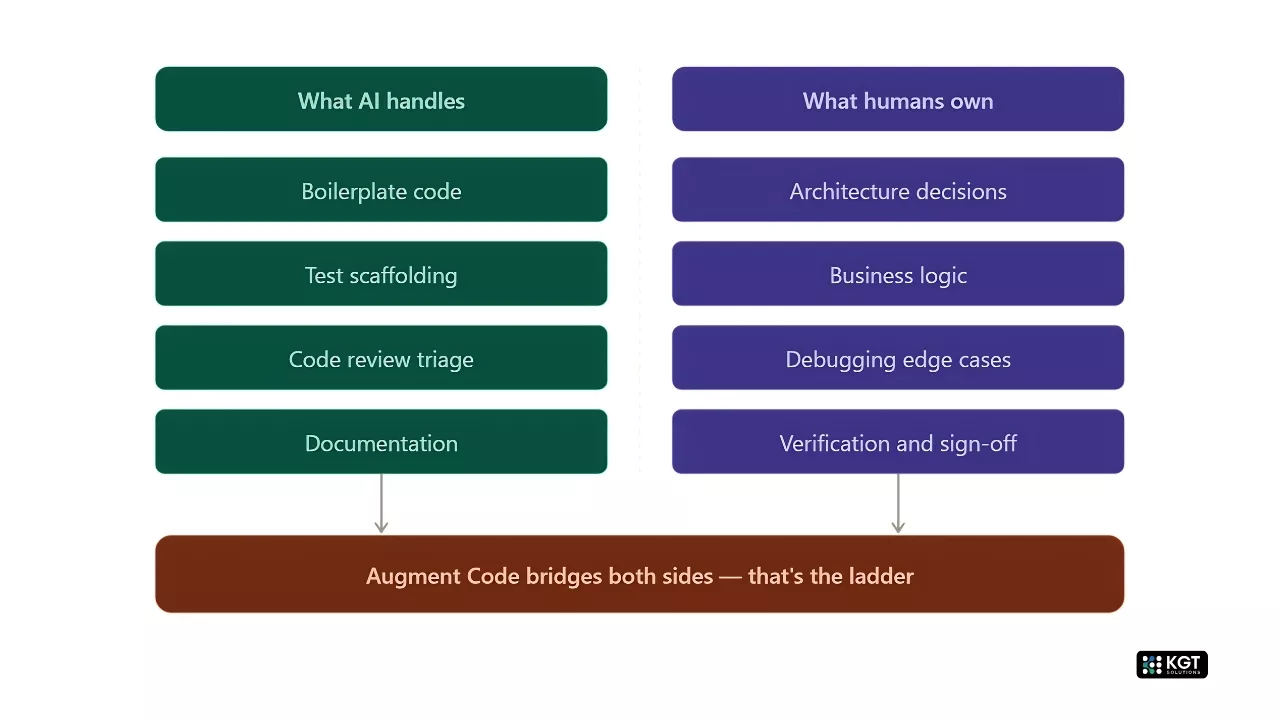
The tool handles repetitive work like boilerplate, test scaffolding, and code review while keeping humans in charge of architecture and business logic. Its Context Engine indexes up to 500,000 files across dozens of repositories, building a semantic understanding of the entire codebase. Suggestions follow existing patterns instead of fighting them. Benchmarks showed a 70% improvement in agentic coding performance across Claude Code, Cursor, and Codex.
One customer, Keeta, reported a 40% increase in developer productivity after adoption. Worth noting: the tool still expects a human to make every architectural call.
What the productivity data actually says
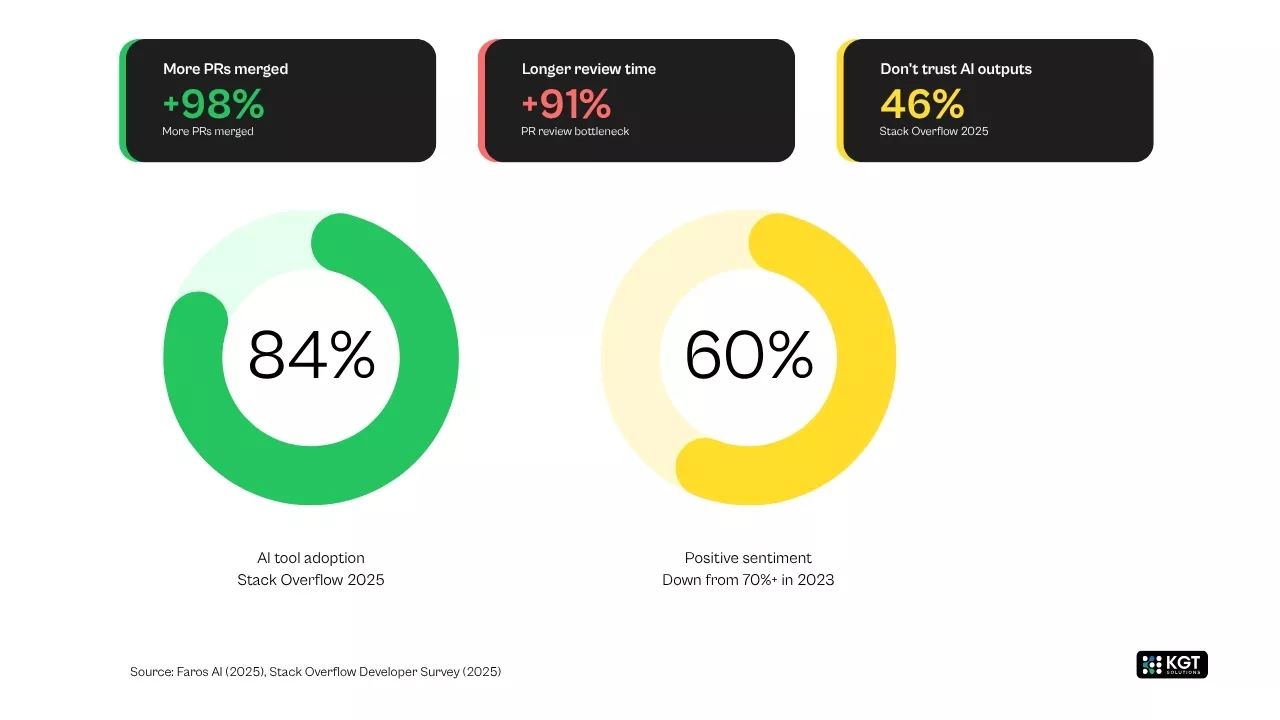
Stack Overflow’s 2025 Developer Survey found that 84% of developers use or plan to use AI tools. Positive sentiment, however, dropped from 70% in 2023 to 60% in 2025. Developers are using AI more and trusting it less.
AI coding tools save developers roughly 3.6 to 4 hours per week, though overall productivity gains plateaued at about 10%. McKinsey found AI cuts time on routine coding tasks by 46%, but only for boilerplate, test writing, and documentation not architecture or debugging.
The METR trial showed that in early 2025, experienced developers took 19% longer with AI, but by early 2026, the same group saw an 18% speedup. The tools improved, and so did developers’ instincts for when to use them. That’s what a ladder looks like.
How AI-powered development connects to the bigger picture
The broader AI market was valued at $103.58 billion in 2025, with a projected 29.3% CAGR through 2034. GitHub Copilot has 4.7 million paid subscribers and sits in 90% of Fortune 100 companies.
Generative AI development services have moved from autocomplete into agentic workflows that handle multi-file changes, reviews, and testing. Developers now use AI in about 60% of their work, but 46% still don’t trust AI outputs. Senior engineers want architectural reasoning, not speed claims.
Agentic AI vs generative AI in practice
Generative AI creates code from a prompt. Agentic AI goes further: it plans, executes, and verifies multi-step tasks.
Platforms combine generative models for writing code with agentic workflows that coordinate tasks, manage dependencies, and verify outputs. The Augment Code CLI scored 51.80% on SWE-bench Pro, the top result at testing time.
Agentic Orchestration Explained for Enterprise CTOs

Why generative AI consulting should focus on verification
High-AI-adoption teams merge 98% more pull requests, but PR review time jumps 91%. Speed without review creates debt.
AI-assisted development works when it augments review processes, not when it bypasses them. Qodo raised $70 million in March 2026 on the thesis that faster output does not equal reliable software.
The bottom line
The platform raised $252 million to build a ladder, not a lifeboat. The 85% of developers now using AI regularly aren’t being rescued. They’re climbing.
The question for any generative AI development company: are you buying speed, or competence? Ladders take effort. Lifeboats just take panic.
Frequently Asked Questions
What is Augment Code and how does it differ from other AI coding tools?
Can Augment Code replace junior developers on a team?
What programming languages and frameworks does Augment Code support?
How does Augment Code handle code security and intellectual property?
What measurable productivity gains do teams see with Augment Code?
Sources:
Augment Code, "Augment raises $227 Million to empower software teams with AI" (April 2024)
SiliconANGLE, "Augment Code makes its semantic coding capability available for any AI agent" (February 2026)
Stack Overflow, "2025 Developer Survey: AI Section"
METR, "Measuring the Impact of Early-2025 AI on Experienced Open-Source Developer Productivity" (July 2025)
METR, "We are Changing our Developer Productivity Experiment Design" (February 2026)
Fortune Business Insights, "Generative AI Market Size, Share & Growth Report, 2034"
Anthropic, "2026 Agentic Coding Trends Report"
McKinsey & Company, "State of AI 2025"
JetBrains, "State of Developer Ecosystem 2025"
Faros AI, "The AI Productivity Paradox Report" (2025)
ShiftMag, "93% of Developers Use AI. Why Is Productivity Only 10%?" (February 2026)
Augment Code, "8 Best AI Coding Assistants" (April 2026)
Getlatka, "How Augment Code hit $20M revenue" (2025)
Protocol AI Newsletter
Practical insights on AI, automation, and intelligent systems focused on real-world applications, not hype.