Does an AR VR Development Company Actually Cut Training Costs?

Companies spend a fortune training people. Travel, instructors, rented spaces, printed manuals, lost productivity while employees sit in a classroom. The bill adds up fast. So when an AR VR development company claims it can slash those costs by 30 to 50 percent, the natural response is skepticism. But the numbers from organizations that have already made the switch are hard to argue with.
An AR VR development company builds immersive simulations that replace expensive physical training setups with reusable digital environments, cutting long-term training costs by 30 to 50 percent for most organizations that scale past a few hundred learners.
How does an AR VR development company reduce training expenses?
The savings come from a few concrete places.
First, there is no travel. According to a 2026 data report from WiFi Talents, 40 percent of surveyed companies saw a measurable drop in training travel costs after adopting VR. Remove flights, hotels, and per diems, and the math shifts quickly.
Second, content is reusable. A traditional instructor-led course costs money every time it runs. A simulation built by an AR VR development company costs more upfront, but the marginal cost per additional learner approaches zero. PwC data shows VR training reaches cost parity with classroom learning at about 375 learners. Scale to 3,000 and it becomes 52 percent cheaper.
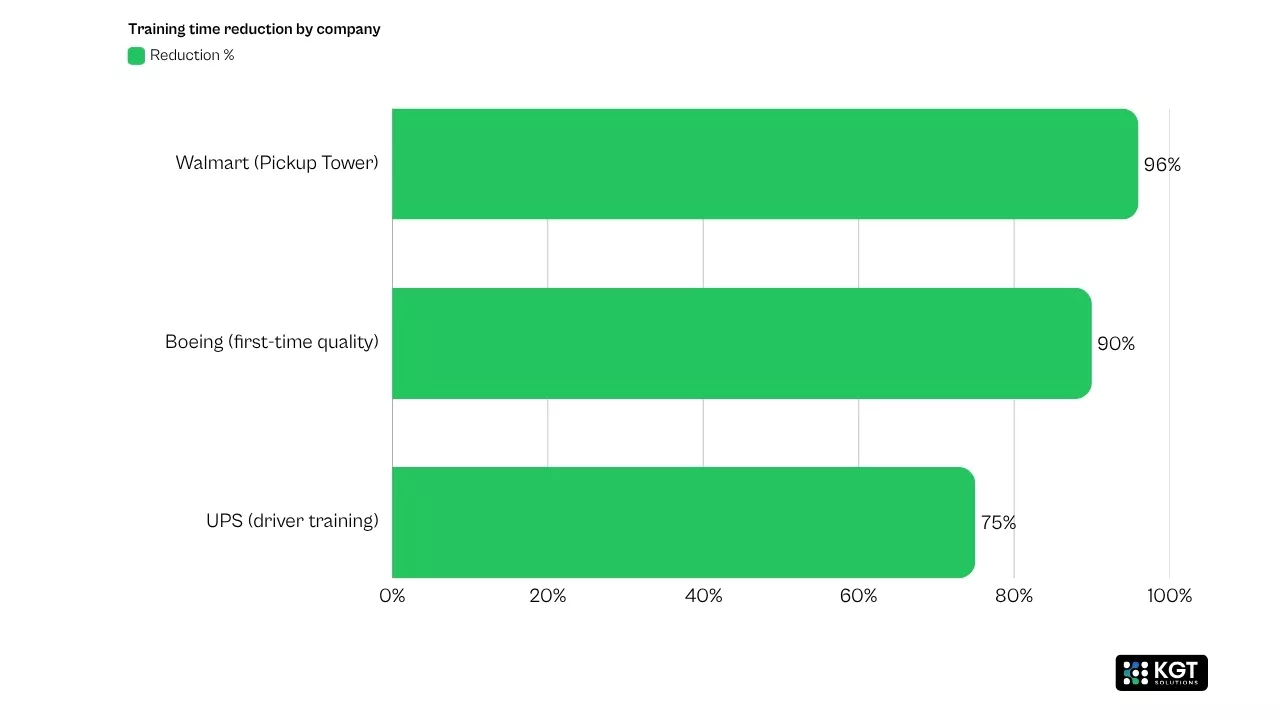
Third, training time shrinks. Walmart cut its Pickup Tower training from 8 hours to 15 minutes, a 96 percent reduction. UPS reduced driver training from 8 hours to 2. Boeing reported a 90 percent improvement in first-time quality when employees trained with XR tools. Shorter training means employees return to productive work faster.
Where do VR development companies deliver the biggest impact?
Not every training scenario benefits equally. The strongest results show up in three areas.
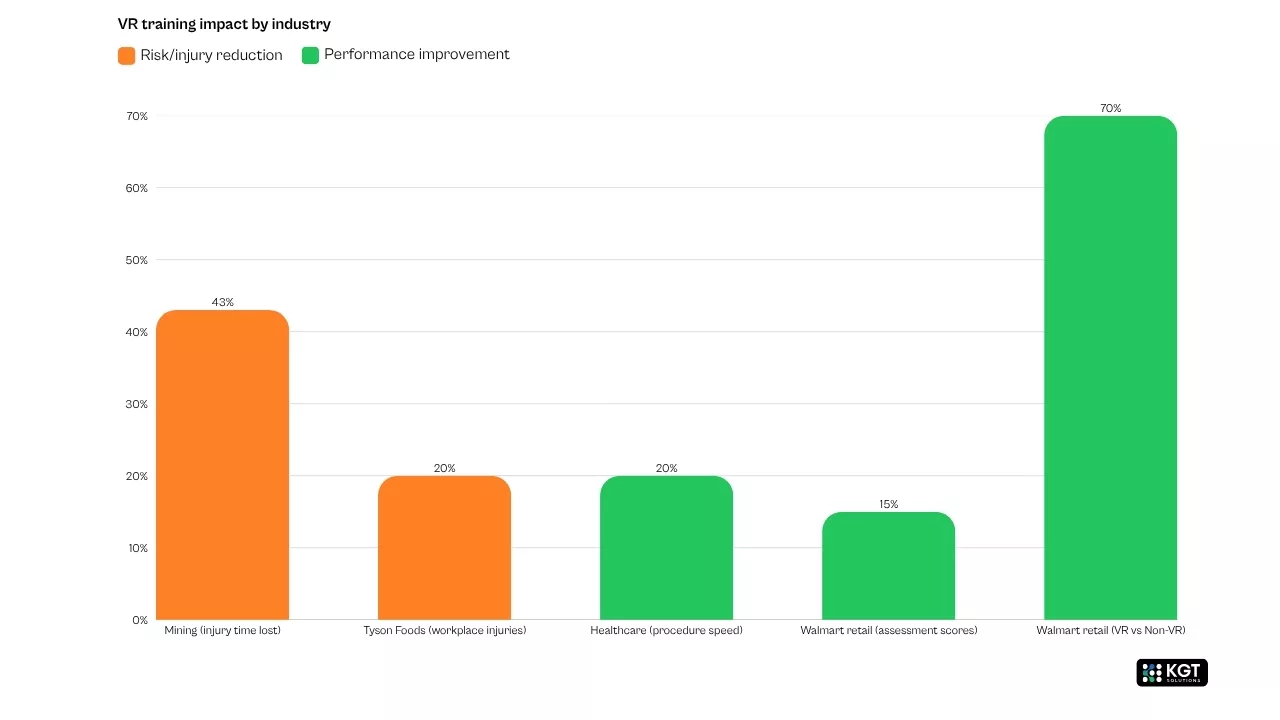
Safety training is where immersive simulations save the most money. The mining industry saw a 43 percent reduction in time lost to injuries after introducing VR safety programs. Tyson Foods reported more than a 20 percent drop in workplace injuries. U.S. employers pay roughly $1 billion per week in direct workers' compensation costs, so even a modest reduction pays for the VR investment many times over.
High-stakes procedural work is another area. Surgeons trained in VR completed procedures 20 percent faster than peers trained conventionally. Manufacturing plants using VR reported a 14 percent productivity boost. Simulations remove the risk of expensive damage during training.
Customer-facing soft skills round out the list. Walmart trained over a million associates on scenarios like de-escalating angry customers through VR. Their VR-trained associates scored 10 to 15 percent higher on assessments, and 70 percent of VR learners outperformed non-VR learners overall.
What about the upfront investment?
This is the part that gives CFOs pause. Building a quality VR training module is not cheap. Hardware, content creation, and deployment all carry real costs. An AR VR development company will typically quote a larger upfront figure than printing manuals and booking a conference room.
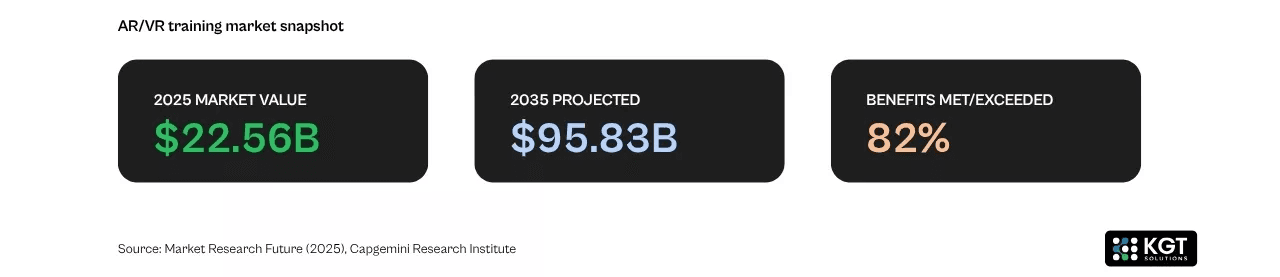
But calling it "expensive" misses the right comparison. The AR and VR training market was valued at $22.56 billion in 2025 and is on track to reach $95.83 billion by 2035, growing at a 15.56 percent CAGR. That growth is happening because 82 percent of companies implementing AR and VR say results meet or exceed expectations, according to Capgemini. Many VR development companies now offer training-as-a-service subscriptions, which lowers the barrier for mid-sized organizations.
How do emerging technology solutions connect to broader digital strategy?
Companies already working with a Web3 development company or investing in blockchain development services often find that XR development services fit into their existing stack without much friction.
Metaverse development services extend VR training into persistent virtual spaces where employees collaborate across locations without travel. Some organizations are pairing custom blockchain development with VR to create tamper-proof training credentials. When someone finishes a safety certification in VR, that record gets stored on-chain as a verifiable credential, which matters in regulated industries where proof of training compliance is not optional.
This overlap between XR development services and Web3 development services is growing fastest in the Asia-Pacific region. India is projected at a 48.2 percent CAGR through 2035, with companies building advance tech solutions that combine immersive training with decentralized credentialing from day one.
MVP Development Company: How Founders Choose Right

Is VR training worth it for smaller organizations?
For organizations with fewer than 300 regular trainees, the cost advantage of VR over classroom training is marginal. The break-even point sits around 375 learners for most implementations.
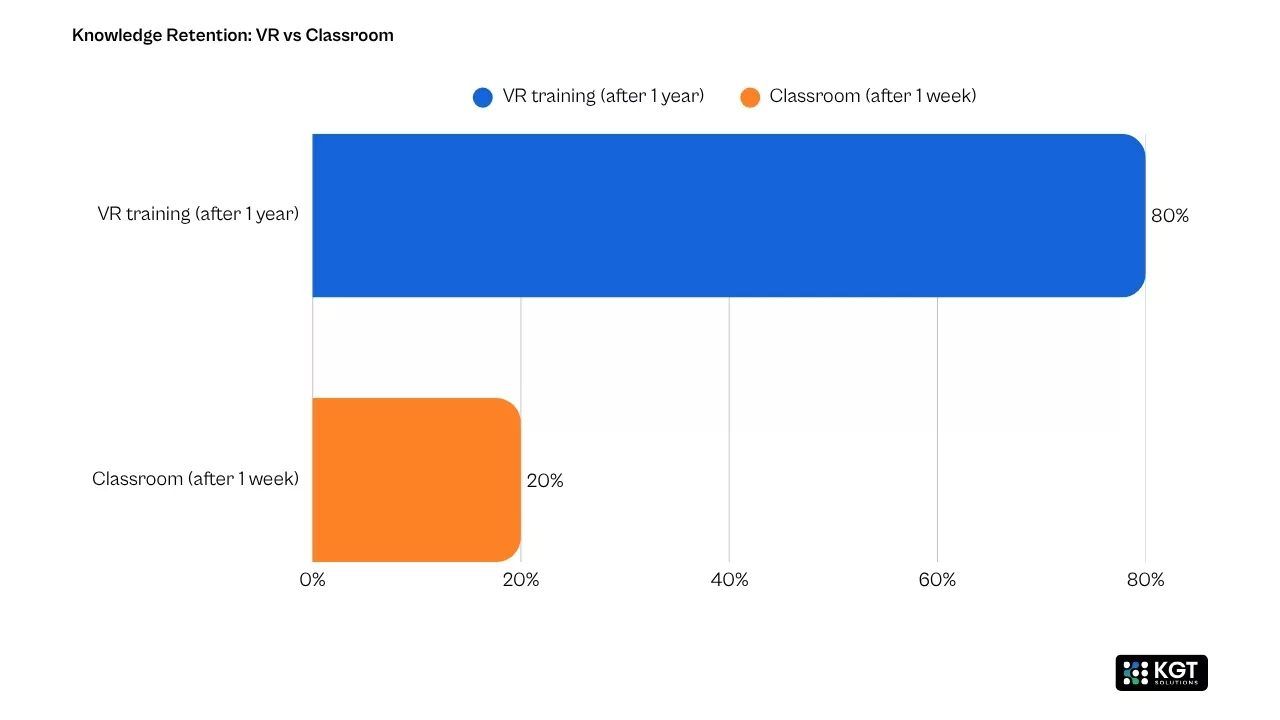
But cost is not the only variable. VR-trained employees retain up to 80 percent of what they learned a year later, compared to 20 percent retention one week after traditional classroom training. If poor training leads to expensive mistakes or compliance violations in your industry, the retention gap alone justifies the spend, even at smaller scales.
Practical advice: start with one high-impact use case. Pick the module that is the most expensive or the most dangerous to simulate physically. Build that in VR first. Measure the results. Then decide whether to expand.
The bottom line
An AR VR development company can cut training costs, but the savings depend on scale and industry. Direct expenses like travel, materials, and instructor time drop by 30 to 70 percent. The indirect benefits, faster onboarding, fewer injuries, better retention, often matter more but are harder to put on a spreadsheet.
The data says this is no longer experimental. Walmart has trained over a million people in VR. Boeing, UPS, and Tyson Foods have all reported measurable gains. The question for most organizations is not whether immersive training works. It is whether they can afford to keep training the old way.
Frequently Asked Questions
How much can AR/VR training reduce employee onboarding time?
What is the typical cost of developing a custom AR/VR training program?
Which industries benefit most from AR/VR training solutions?
Do employees need technical skills to use AR/VR training systems?
How do you measure the ROI of AR/VR training compared to traditional methods?
Sources:
PwC, "The Effectiveness of Virtual Reality Soft Skills Training in the Enterprise" (2022)
Market Research Future, "AR and VR in Training Market Report" (2025)
WiFi Talents, "VR Training Data Reports" (2026)
ArborXR, "Walmart's Blueprint for Training 1M+ Employees in VR"
Strivr, "Walmart Reduces Training Time by 96%" (2024)
Oberon Technologies, "ROI of Virtual Reality Training"
Capgemini Research Institute, "Augmented and Virtual Reality in Operations"
Future Market Insights, "AR and VR in Training Market" (2025)
PIXO VR, "VR Training Statistics for Adoption, Efficacy and Real World Results"
Stay Ahead of Systems Innovation
AI-first SaaS, Web3, and XR insights covering systems, product thinking, and technologies that move from idea to production.