How to Hire a SaaS Development Company: 9-Point Checklist

To hire a SaaS development company, vet partners on multi-tenant architecture, cloud stack depth, AI-native readiness, pricing model fit, and verifiable case studies. The right partner shortens time-to-revenue, hardens unit economics, and protects runway against the 92% startup failure rate.
Key takeaways
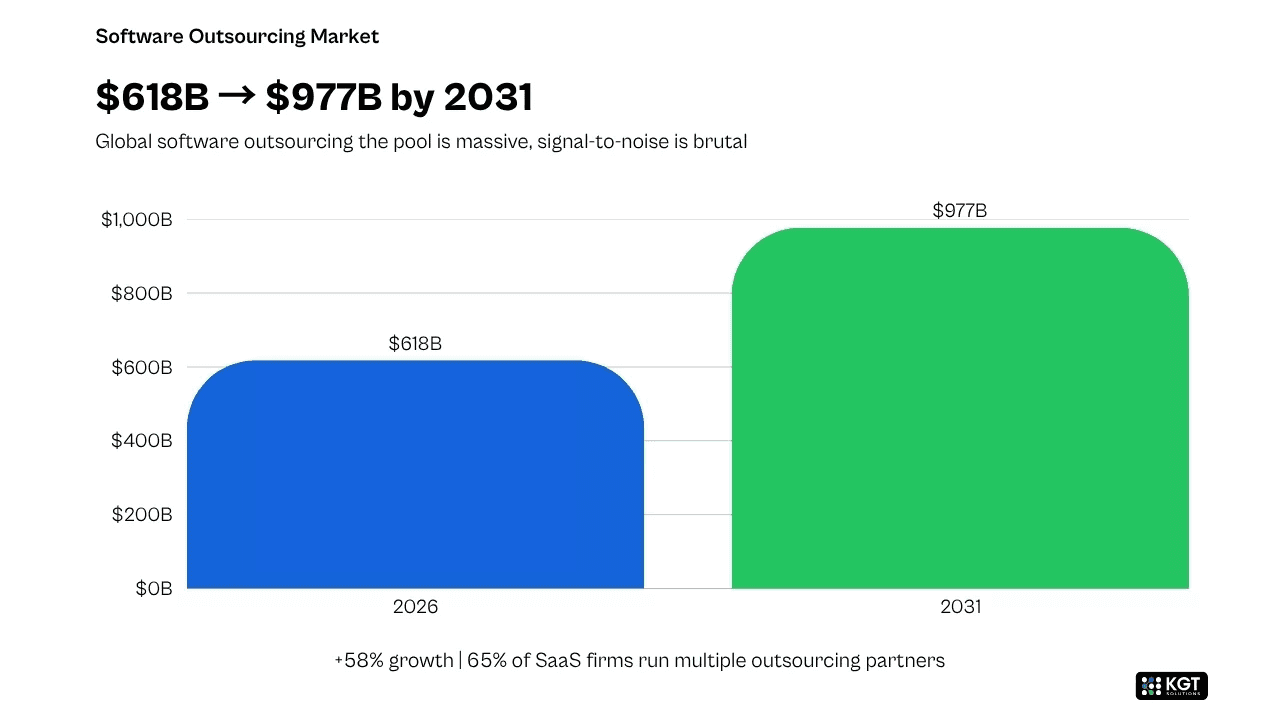
The global software outsourcing market hit $618 billion in 2026 and is projected to reach $977 billion by 2031, so the partner pool is enormous and the signal-to-noise ratio is brutal.
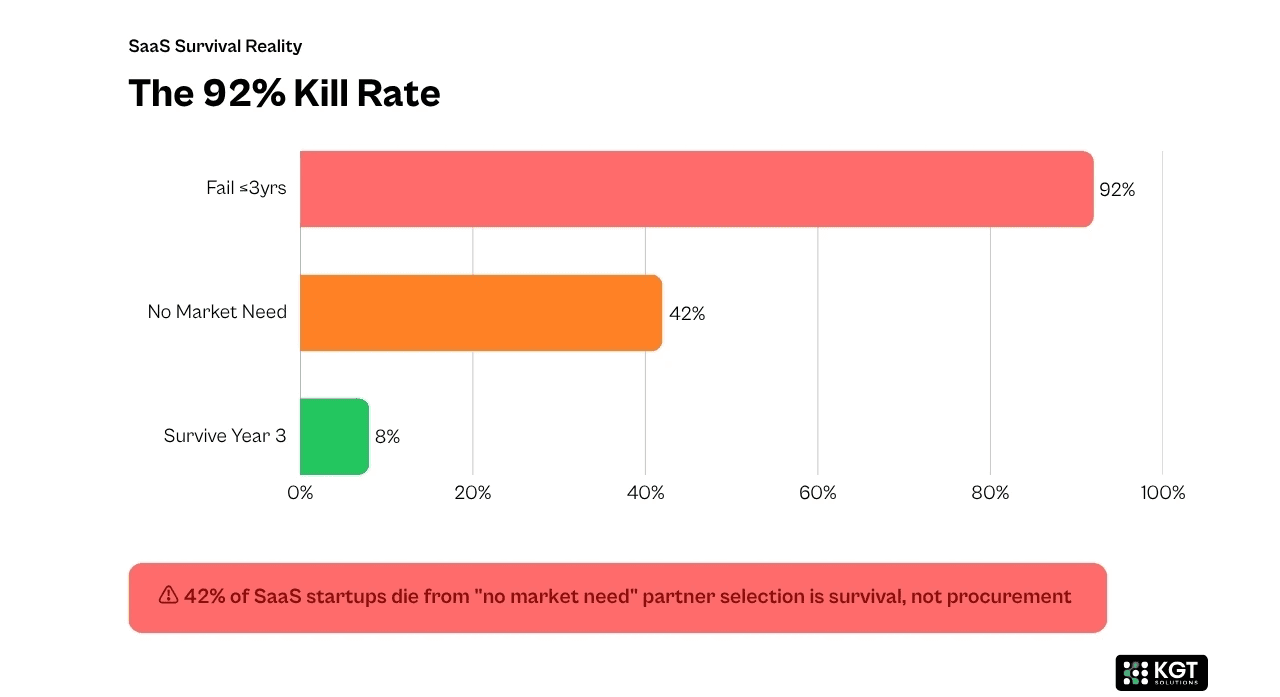
92% of SaaS startups fail within three years and 42% die from "no market need," making partner selection a survival decision, not a procurement one.
Onshore mid-market firms bill $120-$250 per hour while seasoned nearshore partners bill $40-$85 per hour, a 60% delta that compounds across 14-22 week MVP timelines.
Introduction
Most founders pick a vendor on price and portfolio polish. That is how runway vaporizes. With 65% of SaaS and tech firms running multiple outsourcing partners and only 8% of new SaaS products surviving year three, founders who hire a SaaS development company without a checklist are coin-flipping the company.
What Does a SaaS Development Company Actually Do?
A SaaS development company designs, builds, and maintains multi-tenant cloud software with subscription billing, role-based access, and continuous deployment pipelines. Strong saas development services cover product strategy, architecture, full-stack engineering, DevOps, and post-launch growth iteration under one accountable roof, end to end.
The work spans four layers: product discovery, architecture, engineering, and growth instrumentation. A real partner translates your business model into a multi-tenant data layer, integrates Stripe or Chargebee for subscription billing, hardens RBAC, and ships through CI/CD on AWS, GCP, or Azure. Anything less is a body shop.
The 9-Point Checklist to Hire a SaaS Development Company
To hire a SaaS development company that protects your runway, score every shortlisted vendor against nine non-negotiable criteria covering technical depth, commercial fit, and operational discipline. Skip any one of these and you import risk that compounds quarterly across the entire build cycle.
S.No | Criteria | What to Verify | Red Flag |
|---|---|---|---|
1 | Multi-tenant SaaS experience | Live products with 1000+ tenants | Generic web app portfolio |
2 | Cloud stack depth | AWS, GCP, or Azure certified leads | "We use whatever you want" |
3 | AI-native readiness | Working LLM, RAG, or agentic deployments | AI listed as buzzword |
4 | Subscription billing fluency | Stripe, Chargebee, Paddle integrations shipped | Manual invoicing workarounds |
5 | Security and compliance | SOC 2, GDPR, HIPAA where applicable | "We follow best practices" |
6 | Pricing model fit | Fixed, T&M, or dedicated team options | Only one model offered |
7 | Communication cadence | Daily standups, weekly demos, async docs | Email-only updates |
8 | Reference checks | 2+ live customer calls, not testimonials | "References on request" |
9 | Post-launch ownership | SLA-backed support and iteration retainer | "Project ends at handoff" |
Why Multi-Tenant Architecture and AI-Native Readiness Matter Most
Multi-tenant architecture and AI-native readiness separate real saas development services from agencies cosplaying as product partners. Founders who skip these two checks ship single-tenant apps that cap at Series A and lose ground to AI-native competitors inside 18 months of go-live.
Multi-tenancy is not optional in 2026. Your data isolation, billing logic, and feature flags depend on it.
AI-native readiness is the new table stakes. Ask your shortlist for production LLM deployments, RAG pipelines, or agentic workflows shipped in the last six months. If a vendor describes AI as a "future roadmap item," kill the conversation.
How to Pick the Right Pricing Model
The right saas consulting services pricing model depends on scope clarity. Fixed price fits scoped MVPs under $150k. Time and material fits evolving roadmaps. Dedicated teams fit 12-month plus partnerships where compounding velocity beats short-term cost certainty for venture-backed founders.
Fixed price works when your PRD is locked. Time and material protects you when discovery is active and scope flexes.
Dedicated team contracts, common in custom saas development, give you a unit-economics line item that scales linearly with output. Ask every vendor for blended hourly rates, ramp-up time, and replacement SLA before signing.
Enterprise AI Governance: Build Your Framework

What Should You Pay for SaaS Development Services?
Saas development cost in 2026 ranges from $30,000 for a thin MVP through an offshore agency to $340,000 for a nearshore-built B2B SaaS shipped in 14-22 weeks. Onshore enterprise consultants bill $400 per hour and up, which rarely makes sense for pre-Series-B founders.
Offshore teams in Asia or Eastern Europe bill $20-$50 per hour. Nearshore partners bill $40-$85 per hour. Onshore US mid-market firms bill $120-$250 per hour.
The 60-70% delta is real, and so is the communication tax. For SME founders building b2b saas development products, nearshore hits the sharpest cost-quality balance.
How long does it take to hire a SaaS development company?
A disciplined founder closes a partner in 3-5 weeks: one week to shortlist, two for technical and commercial evaluation, one for references, and one for paper. Anything faster skips diligence; anything slower burns runway.
What is the biggest red flag when you hire SaaS developers?
The biggest red flag is a vendor who cannot show live multi-tenant production traffic and credible AI deployments in the last six months. Vendors without recent shipped multi-tenancy and AI work are reselling stale playbooks at 2026 prices.
Should a small SaaS startup use offshore, nearshore, or onshore?
Most pre-Series-B SaaS startups should hire nearshore for product partnerships and offshore for scoped components. Nearshore saas consulting services give you timezone overlap and senior architects at $40-$85 per hour, while onshore makes sense only for regulated verticals or enterprise sales motions that demand local presence.
Frequently Asked Questions
What should you look for when evaluating a SaaS development company?
How much does it cost to hire a SaaS development company in 2026?
What red flags should you watch for when hiring a SaaS development partner?
Should you hire a specialized SaaS agency or a general software development firm?
What questions should founders ask during the evaluation process?
Conclusion
Hire the partner who can prove multi-tenancy, AI-native shipping, and post-launch ownership. Book a 30-minute architecture review with KGT Solutions to pressure-test your shortlist.
Sources:
Software Development Outsourcing Statistics 2026
How Much Does a SaaS MVP Cost? Full 2026 Guide
Offshore vs Nearshore vs Onshore Developer Rates 2026
Top 100 Startup Failure Statistics 2026
How to Hire SaaS Developers in 2026
Protocol AI Newsletter
Practical insights on AI, automation, and intelligent systems focused on real-world applications, not hype.