Warehouse Automation Systems: Buyer's Guide

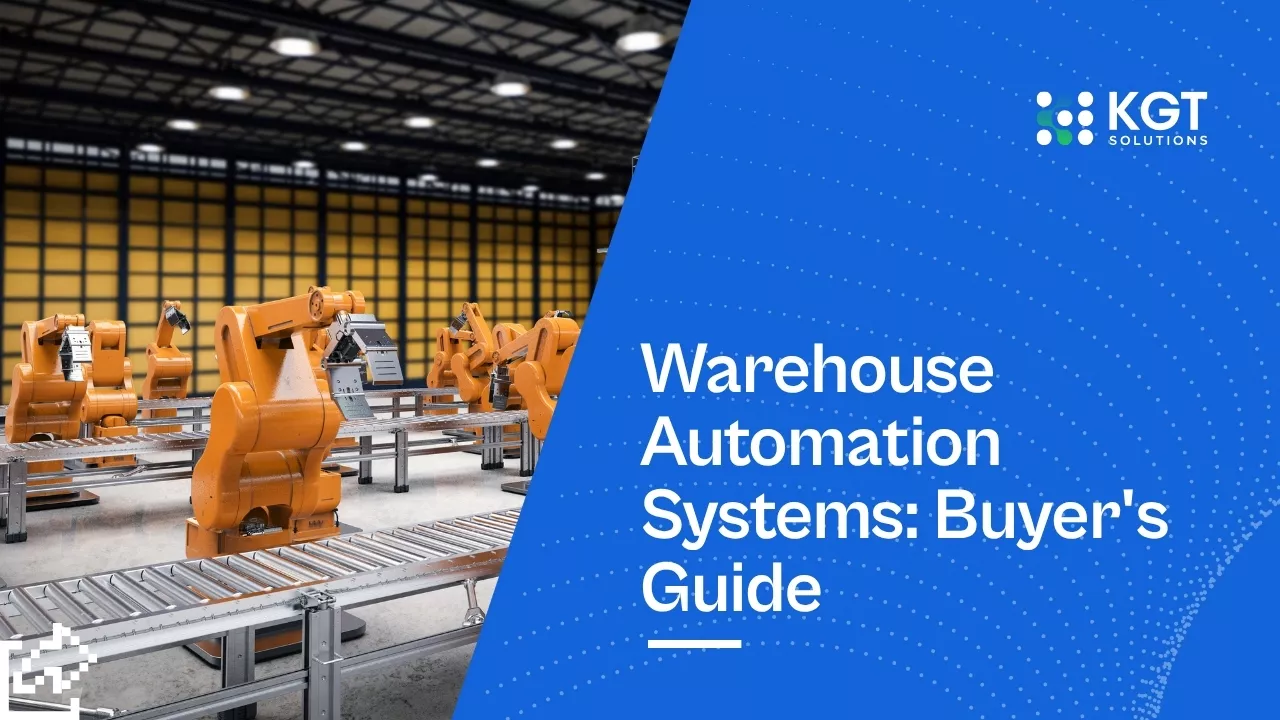
Warehouse automation systems reduce labor costs by 25-40% and increase picking accuracy to 99.9% - but only if you match the right technology to your facility's throughput, SKU mix, and growth plan.
Key Takeaways
Warehouse automation pays back in 2-4 years for facilities processing 5,000+ orders per day, with labor savings of 25-40% and error reduction below 0.1%
Goods-to-person systems (AS/RS, AMRs, shuttle systems) handle 300-1,000 picks per hour per station - 3-5x faster than manual operations
The global warehouse automation market hit $23.4 billion in 2025 and is projected to reach $41.2 billion by 2030, per LogisticsIQ
Start with your constraint: if labor is the bottleneck, deploy AMRs first; if space is the constraint, install AS/RS; if accuracy is the problem, add pick-to-light or voice-directed picking
Total cost of ownership matters more than sticker price - factor in integration, maintenance, training, and downtime during installation
What Are Warehouse Automation Systems and Why Do They Matter Now
Warehouse automation systems are technologies that replace or augment manual warehouse tasks - receiving, storage, picking, packing, and shipping - using robotics, conveyors, software, and sensors.
The pressure to automate isn't theoretical anymore. Labor shortages in logistics hit 490,000 unfilled positions in the U.S. alone in 2025, according to the Bureau of Labor Statistics. Meanwhile, e-commerce order volumes grew 11% year-over-year, pushing fulfillment centers to handle more SKUs with fewer people.
Manual warehouses top out around 60-80 picks per person per hour. Automated facilities routinely hit 300-1,000 picks per hour per station. That gap is why VP Ops teams are budgeting $2-15 million for automation projects that used to sit on the "someday" list. If you're evaluating broader industrial automation solutions, warehouse systems are typically the first deployment that justifies the capital.
But warehouse automation solutions aren't one-size-fits-all. It's a spectrum - from simple conveyor upgrades to fully automated warehouse systems running autonomous robotic fulfillment. Picking the wrong automated warehouse storage solutions wastes capital and creates bottlenecks worse than the ones you started with.
Types of Warehouse Automation Systems: What Each One Actually Does
Warehouse automation technologies fall into five categories - fixed automation, mobile robotics, goods-to-person, software-driven, and hybrid systems - each solving different operational constraints.
Here's what each category handles and where it fits:
1. Automated Storage and Retrieval Systems (AS/RS)
AS/RS uses cranes, shuttles, or mini-loads to store and retrieve inventory from high-density racking. These systems work best in facilities with 10,000+ SKUs and limited floor space. A single AS/RS unit can store 4-6x more inventory per square foot than static shelving.
Typical cost: $5-15 million for a mid-size installation. Payback: 3-5 years.
2. Autonomous Mobile Robots (AMRs)
AMRs navigate warehouse floors using LiDAR and computer vision, transporting goods between zones without fixed infrastructure. Unlike AGVs (automated guided vehicles), AMRs don't need magnetic strips or wires embedded in the floor.
Locus Robotics reported that facilities using their AMRs hit 2-3x productivity gains within 90 days of deployment. AMRs cost $25,000-75,000 per unit, and most facilities deploy 10-50 robots.
3. Conveyor and Sortation Systems
Conveyors move products between workstations on fixed paths. Sortation systems divert items to the correct lane, bin, or packing station. These are the backbone of high-volume fulfillment centers processing 10,000+ orders daily.
Conveyors are the oldest automation technology in warehousing, but modern sortation systems process 200-400 items per minute using tilt-tray, cross-belt, and shoe sorters.
4. Pick-to-Light and Voice-Directed Picking
Pick-to-light systems use LED displays on shelving to guide operators to the correct location and quantity. Voice-directed picking uses headsets to give verbal instructions, freeing both hands for picking.
These systems don't replace workers - they make workers faster and more accurate. Pick-to-light increases accuracy to 99.9% and boosts speed by 30-50% over paper-based methods, per Honeywell Intelligrated.
5. Robotic Picking Arms
Robotic arms with suction grippers or multi-fingered end effectors pick individual items from bins. This was the hardest automation problem in warehousing - each item has a different shape, weight, and fragility.
RightHand Robotics and Covariant now achieve 500-1,000 picks per hour with 99%+ accuracy on mixed SKU bins. But these systems cost $150,000-400,000 per cell and work best for standardized product categories.
Warehouse Automation Systems Compared
Cost, throughput, and payback by technology type
| Technology | Cost Range | Throughput | Payback | Best For |
|---|---|---|---|---|
| AS/RS | $5M-$15M | 150-400 txn/hr | 3-5 years | High-density storage, 50K+ SKUs |
| AMRs | $250K-$3M | 2-3x productivity | 1-2 years | Labor shortage, flexible layouts |
| Conveyor | $1M-$8M | 200-400 items/min | 2-4 years | High-volume, 10K+ daily orders |
| Pick-to-Light | $100K-$500K | +30-50% speed | 6-18 months | Accuracy problems, quick wins |
| Robotic Arms | $150K-$400K/cell | 500-1K picks/hr | 2-3 years | Mixed SKU bins, 24/7 ops |


How to Calculate Warehouse Automation ROI Before You Buy
Warehouse automation ROI depends on four variables: labor cost savings, throughput gains, error reduction, and space utilization - not the sticker price of the equipment.
Most VP Ops teams make a mistake here. They compare the purchase price of an AS/RS to their current labor costs and call it a day. That math ignores half the equation.
Here's the full ROI framework:
Cost side (total cost of ownership):
Equipment purchase or lease
Integration with existing WMS/ERP ($50,000-500,000)
Facility modifications (power, flooring, racking changes)
Training (typically 2-4 weeks per shift)
Maintenance contracts (8-12% of equipment cost per year)
Downtime during installation (plan for 2-8 weeks of disruption)
Savings side (annual):
Labor reduction: 25-40% of warehouse labor costs
Error reduction: returns processing drops 60-80%
Throughput increase: 2-5x picks per hour
Space savings: 40-60% more storage in the same footprint (AS/RS)
Injury reduction: workers' comp claims drop 20-30%
A 200,000-square-foot distribution center processing 8,000 orders per day typically sees payback in 2.5-3.5 years with a 5-year ROI of 180-250%, according to McKinsey's supply chain practice. For a deeper look at the per-order math, see our breakdown on how warehouse automation cuts cost per order.
Matching Automation Technology to Your Facility's Constraints
Labor Cost Savings by Automation Type
Percentage reduction in warehouse labor costs after full deployment (Year 1)
The right warehouse automation system depends on your primary bottleneck - labor, space, accuracy, or throughput - not on what the vendor is selling this quarter.
This is where most automation projects fail. A facility with a space constraint installs AMRs (which need open floor space to operate) instead of AS/RS (which maximizes vertical storage). A facility with an accuracy problem buys conveyors (which move things faster but don't fix picking errors) instead of pick-to-light.
Primary Constraint | Best-Fit Technology | Why It Works |
|---|---|---|
Labor shortage | AMRs + collaborative picking | Reduces headcount by 30-50% per shift |
Floor space limit | AS/RS (mini-load or shuttle) | 4-6x storage density per square foot |
Picking accuracy | Pick-to-light or voice-directed | Pushes accuracy to 99.9%+ |
Order throughput | Conveyor + sortation | 200-400 items sorted per minute |
Mixed SKU complexity | Robotic picking arms | 500+ picks/hour variable products |
All of the above | Hybrid system (AS/RS + AMRs + WCS) | Integrated solution |
Don't automate everything at once. Start with the constraint that costs you the most money today, prove ROI on that system, then expand.
IT OT Convergence in Manufacturing Explained
Automated Warehouse Racking and Storage Solutions Compared
Automated racking systems range from $500,000 shuttle systems for small facilities to $20 million crane-based AS/RS for mega-distribution centers - and picking the wrong density level wastes 30-50% of your investment.
Racking is the foundation of warehouse storage. Get it wrong, and every other automation layer underperforms.
Shuttle-based AS/RS uses small robotic shuttles that travel horizontally along racking levels, with lifts moving them between floors. Best for: medium-density storage, 5,000-50,000 SKUs, facilities under 100,000 square feet. Throughput: 200-400 transactions per hour.
Crane-based AS/RS uses floor-to-ceiling cranes running on rails in narrow aisles. Best for: high-density storage, 50,000+ SKUs, facilities over 200,000 square feet. These systems reach heights of 100+ feet. Throughput: 150-300 double cycles per hour.
Micro-fulfillment centers (MFCs) are compact, cube-based systems like AutoStore and Ocado's grid. Robots travel on top of a grid, diving into storage bins and delivering them to pick stations. Best for: e-commerce and grocery fulfillment with 5,000-20,000 SKUs. AutoStore claims 4x the storage density of traditional shelving in 25% of the floor space.
Vertical lift modules (VLMs) are enclosed systems with trays that deliver stored items to an ergonomic pick window. Best for: small parts storage, maintenance inventories, and facilities with high ceilings but limited floor space. A single VLM replaces 10-15 shelving units.
Implementation Timeline: What to Expect from Contract to Go-Live
Warehouse automation projects take 6-18 months from vendor selection to full production, with the integration and testing phase - not the hardware installation - causing most delays.
Here's the realistic timeline most VP Ops teams don't hear from vendors:
Phase 1 - Assessment and design (4-8 weeks): Facility audit, throughput analysis, system design, and ROI modeling. This is where you validate that the vendor's solution actually fits your operation. Skip this and you'll pay for it in Phase 3.
Phase 2 - Procurement and site prep (8-16 weeks): Equipment lead times vary wildly. AMRs ship in 4-6 weeks. AS/RS components take 12-20 weeks. Conveyor systems fall in between. Site prep runs parallel.
Phase 3 - Installation and integration (6-12 weeks): Hardware goes in, but the real work is software integration. Your WMS needs to talk to the WCS, which talks to the automation equipment. This handshake causes 60% of project delays, per MHI's annual industry report.
Phase 4 - Testing and ramp-up (4-8 weeks): You don't flip a switch and run at full speed. Expect 50-60% throughput in week one, scaling to 90%+ by week four. Training happens here too.
Total: 22-44 weeks (5.5-11 months) for a mid-complexity project. Mega-projects with crane-based AS/RS can take 12-18 months.
Warehouse Automation Technology Trends Reshaping 2026 Buying Decisions
AI-powered warehouse orchestration, robotic picking advances, and warehouse-as-a-service models are shifting the 2026 automation market from "buy big iron" toward flexible, software-first deployments.
AI-driven warehouse orchestration is replacing static WCS logic. AI-based systems dynamically route orders, balance workloads across robots, and predict bottlenecks before they form. Symbotic and Berkshire Grey both ship AI orchestration layers that claim 15-20% throughput gains on top of the base automation hardware.
Robotic picking is crossing the reliability threshold. Two years ago, robotic arms handled maybe 70% of SKUs reliably. In 2026, systems from Covariant and RightHand Robotics report 95%+ item handling success across mixed bins.
Warehouse-as-a-Service (WaaS) and robotics-as-a-service (RaaS) models let you deploy automation with OpEx instead of CapEx. A facility can deploy 20 AMRs for $3,000-5,000 per robot per month instead of buying them outright. It follows the same logic behind process automation paying for itself within 90 days in other operational contexts.
Common Mistakes That Kill Warehouse Automation Projects
The top three warehouse automation failures are over-automating too fast, underestimating WMS integration complexity, and choosing a vendor based on demo performance instead of production references.
Mistake 1: Automating before fixing your processes. If your pick paths are chaotic, your slotting is random, and your inventory accuracy is below 95%, automation will just move bad product faster. Your OEE metrics should be at baseline before you layer automation on top.
Mistake 2: Underestimating integration. Vendors love showing you the hardware. What they gloss over is the 3-6 months of WMS/WCS integration work. Plan for an extra $200,000-500,000 and 2-3 months of integration development.
Mistake 3: Buying for peak volume, not average volume. If you process 15,000 orders per day in Q4 but 5,000 the rest of the year, don't size your automation for 15,000. Use flexible solutions for peak surge and right-size fixed automation for your baseline.
Mistake 4: Ignoring maintenance and support. That $3 million AS/RS needs $240,000-360,000 per year in maintenance. AMR batteries degrade after 3-4 years. Build a 5-year maintenance budget before signing the purchase order.
How to Evaluate Warehouse Automation Vendors: The Buyer's Checklist
Evaluate warehouse automation vendors on five criteria - production references at your scale, WMS integration track record, maintenance SLAs, scalability path, and total cost of ownership.
Production references: Ask for 3+ customers running the same system at similar order volume and SKU count. Call them
WMS integration: Has the vendor integrated with your specific WMS before? Get this in writing
Uptime SLA: Industry standard is 98%+. Below that, you're paying for a system that sits broken 7+ days per year
Scalability: Can you add capacity in increments? Modular beats monolithic every time
Total cost of ownership: Get a 5-year TCO breakdown. If the gap vs labor projection is under 15%, the risk may not justify the disruption
What VP Ops Teams Get Wrong About Warehouse Automation Costs
The average warehouse automation project costs 30-50% more than the initial vendor quote because integration, facility modifications, and ramp-up downtime are consistently underestimated.
Facility modifications account for 10-15% of total project cost. AS/RS needs reinforced flooring (150-300 PSI). AMRs need smooth floors without expansion joint gaps wider than 0.25 inches.
Software licenses add up fast. Your WCS license runs $50,000-200,000. WMS upgrades cost $100,000-300,000. Annual maintenance fees run 15-20% of the license cost.
Lost productivity during cutover is the cost nobody budgets for. Plan for a 20-40% throughput drop during the first 4-6 weeks of go-live. For a facility processing $2 million in orders per week, a 30% productivity drop costs $600,000 per week.
Smart buyers add a 25-30% contingency to every vendor quote.
Frequently Asked Questions
How much do warehouse automation systems cost?
What is the typical ROI timeline for warehouse automation?
Can small warehouses benefit from warehouse automation?
How long does it take to implement automated warehouse systems?
What is the difference between AGVs and AMRs?
Conclusion
Warehouse automation systems are a capital-intensive bet that pays off when you match the technology to your actual operational constraint - not when you buy the most impressive system a vendor demos. Start by identifying whether your bottleneck is labor, space, accuracy, or throughput. Size your automation for average volume, not peak. Budget 25-30% above the vendor quote for integration, facility prep, and ramp-up costs. And before you sign anything, call three production references running at your scale. The gap between a good warehouse automation deployment and a failed one isn't the warehouse automation technology. It's the planning that happens before the purchase order.
Sources:
LogisticsIQ - Warehouse Automation Market Report 2025-2030
Bureau of Labor Statistics - Transportation, Warehousing, and Utilities Employment Report 2025
McKinsey & Company - Automation in Logistics: A New Era of Efficiency
MHI - Annual Industry Report 2025
Honeywell Intelligrated - Warehouse Performance Benchmarks
Locus Robotics - Customer Productivity Analysis 2025
AutoStore - Storage Density Performance Data
Industrial Autonomous Floor
Newsletter
Actionable insights on industrial AI, automation, and smart operations built for safe, secure, and compliant real-world environments.