How Does Warehouse Automation Cut Your Cost Per Order in Half?

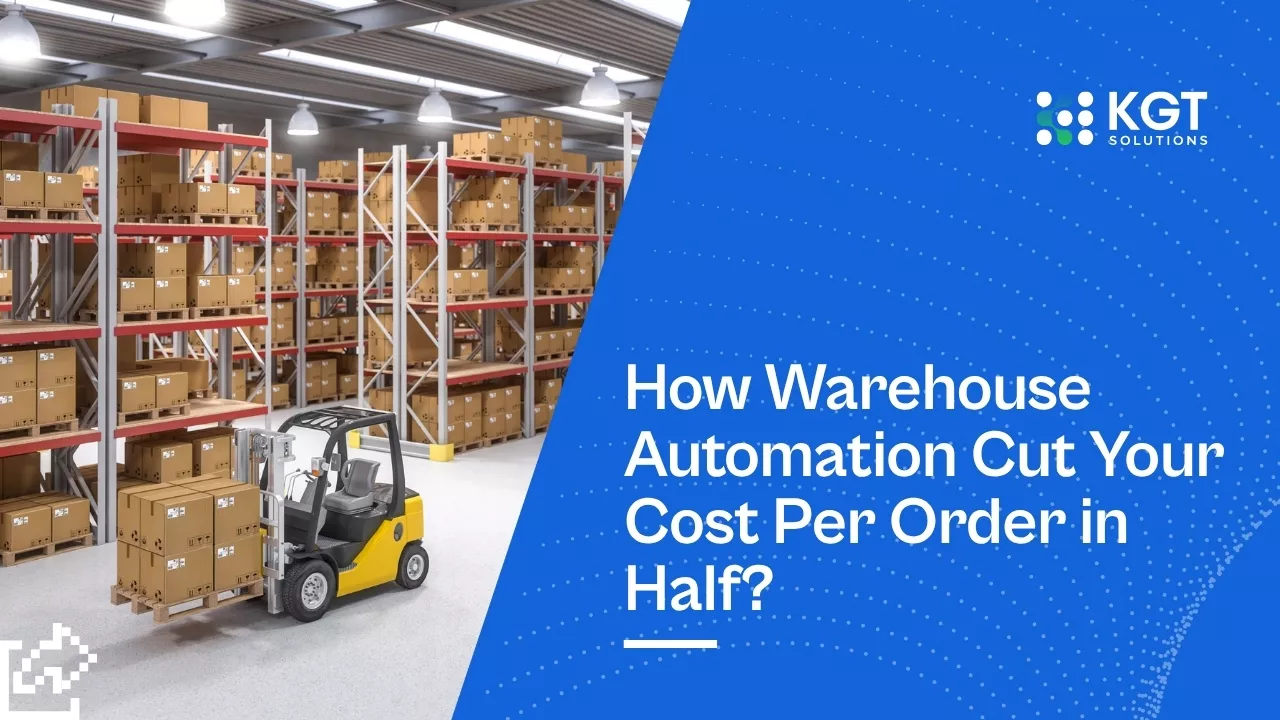
Warehouse automation cuts cost per order by replacing manual picking, sorting, and packing with AMRs, goods-to-person systems, and AI-driven inventory management. Facilities running automated warehouse robots report 30-40% lower labor spend, 99%+ pick accuracy, and payback periods under 24 months - turning fulfillment from a cost drain into a profit engine.
Key Takeaways
Manual picking costs $0.35-$0.55 per pick. AMR-assisted picking drops that to $0.15-$0.25 - a 50%+ reduction per order line.
Labor eats 50-70% of your total warehouse budget. Automation can slash that by 30-40% over five years.
The global warehouse automation market hit $29.98 billion in 2026 and is growing at 18.7% CAGR. Yet 80% of warehouses still run without it.
Introduction
Your warehouse is bleeding money on every order it ships manually. Between picking errors that cost $25 each, labor bills climbing 7-9% year over year, and fulfillment speeds that can't keep up with same-day expectations, the math is working against you. This guide breaks down exactly where automation removes cost per order - with real numbers, not theory.
What Is Warehouse Automation and Why Does It Slash Cost Per Order?
Warehouse automation is the use of robotics, software systems, and AI-powered processes to handle picking, packing, sorting, and inventory management with minimal human input. An automated warehouse replaces repetitive manual tasks where errors and labor hours pile up fastest, directly compressing cost per order at every stage of fulfillment.
Order picking alone accounts for up to 55% of total operating costs. More than half of a picker's shift is spent walking - not picking. That is where the money disappears.
AMRs and robotic systems fix this by bringing inventory to the worker instead of sending the worker to the shelf. Goods-to-person systems cut pick times by 60-70%. AMR-assisted picking drops the cost per pick from $0.35-$0.55 to $0.15-$0.25.
Cost Factor | Manual Warehouse | Automated Warehouse |
|---|---|---|
Cost per pick | $0.35-$0.55 | $0.08-$0.25 |
Pick accuracy | 96-97% | 99.96-99.99% |
Order fulfillment speed | Baseline | Up to 3x faster |
Error cost (5,000 orders/day) | $912,500/year | Under $100,000/year |
Labor reduction (5 years) | 0% | 30-40% |
How Do You Calculate the Real ROI of Warehouse Automation Solutions?
ROI on warehouse automation solutions comes from stacking four savings layers: labor reduction (the biggest chunk), error elimination, space optimization, and throughput speed. A mid-size e-commerce fulfillment center investing $4.2 million in goods-to-person picking and AMR fleets reported $3.35 million in annual benefits - payback hit at 14.3 months.
Most operations teams focus only on headcount reduction. That misses the full picture.
Where Automation Saves $3.35M Annually
Mid-size e-commerce fulfillment center - $4.2M investment, 14.3-month payback


The Error Math Nobody Runs
A warehouse shipping 5,000 orders per day at a 2% error rate generates 100 mistakes daily. At $25 per error - covering returns, reshipments, refunds, and customer service time - that is $912,500 per year burned on mistakes alone. Automated systems with barcode and RFID verification cut error rates by 90-95%.
Here is where the savings compound:
Labor productivity gains: $1.1 million annually (35% improvement)
Space utilization savings: $600,000 (avoided facility expansion)
Inventory accuracy gains: $400,000 (reduced carrying costs)
Throughput velocity: $800,000 (30% more orders per day)
Human-robot teams are 85% more productive than all-human or all-robot setups. The goal is not to replace your entire workforce. It is to stop paying six figures a year for walking and misplaced inventory.
Which Automation Tech Pays Back Fastest?
AMRs deliver the fastest payback of any automation category - under 24 months with 250%+ ROI in live deployments. Vertical lift modules and horizontal carousels follow close behind at 6-18 months. Complex fully automated systems take 5+ years, which is why phased rollout beats total overhaul every time.
Technology | Typical Payback Period | Best For |
|---|---|---|
AMRs | Under 24 months | Picking assist, transport |
VLMs / Carousels | 6-18 months | Parts storage, kitting |
Robotic picking arms | 2-3 years | High-volume each-pick |
AS/RS systems | 3-7 years | Dense storage, 24/7 ops |
Cloud WMS | 12-18 months | Accuracy, visibility |
Decathlon deployed robotic fleets across 25+ European facilities through its Skyfleet program. The result: daily order preparation doubled from 57,000 to 114,000 orders at a single facility.
Amazon runs 750,000+ robots across 1,000+ facilities and cut per-unit handling cost by 25%.
The warehouse automation news today is clear - the ROI is proven. The risk now sits with companies that keep waiting.
Which Automation Tech Pays Back Fastest?
Typical payback periods ranked by speed to ROI - shorter bars = faster money back
IT OT Convergence in Manufacturing Explained
Frequently Asked Questions
How much does automation actually cost per facility?
What percentage of warehouses use automation in 2026?
Can small warehouses under 50,000 square feet afford automation?
What warehouse size is needed before automation makes financial sense?
How does warehouse automation affect seasonal demand handling?
Conclusion
Run the error math on your own facility. If you are shipping 1,000+ orders a day on manual processes, you are leaving six figures on the table annually. Talk to our team about a phased automation roadmap built for your throughput and budget.
Sources:
Mordor Intelligence - Warehouse Automation Market Size 2026-2031
SellersCommerce - Warehouse Automation Statistics 2026
The Network Installers - 50+ Warehouse Automation Statistics, Market Size and ROI Data 2026
Synkrato - Warehouse Automation Statistics 2026: Growth, Adoption, ROI and Benchmarks
SVRC Robotics Center - Warehouse Robotics 2026: AMRs, Picking Robots and Automation Guide
GoASRS - Warehouse Automation ROI: How to Calculate It 2026
Esnaj Software - Warehouse Automation ROI Analysis: Beyond Labor Savings 2026
Industrial Autonomous Floor
Newsletter
Actionable insights on industrial AI, automation, and smart operations built for safe, secure, and compliant real-world environments.