Why Do Most Computer Vision Projects Fail?


Computer vision projects fail at a 70% rate not because the technology is bad, but because manufacturers treat the model like it is the whole project when it is actually one moving part inside a larger production system that needs solid data pipelines, SCADA wiring, proper lighting, and someone who actually owns the thing after the pilot ends.
Key Takeaways
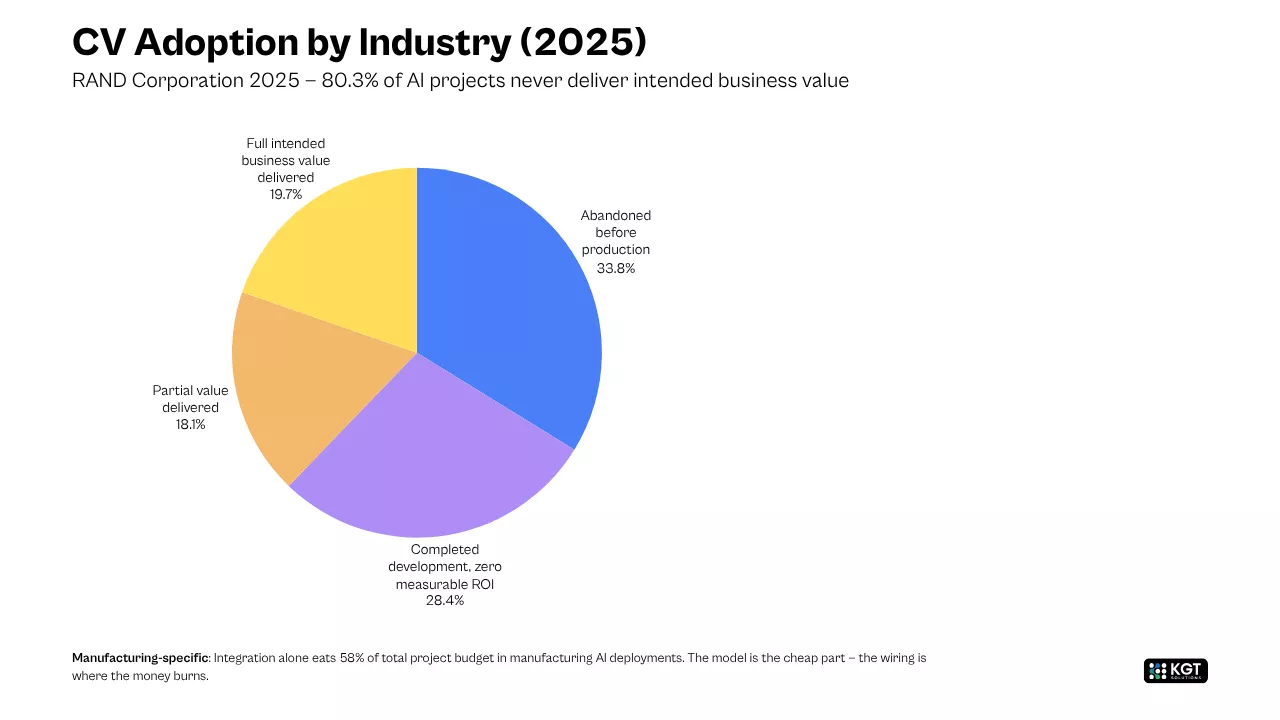
80.3% of AI projects never deliver intended business value - 33.8% get abandoned before production and 28.4% finish development but produce zero measurable ROI
One escaped defect in an automotive Tier 1 supply chain triggers $50,000 to $250,000 in chargebacks, making broken computer vision quality inspection an expensive habit
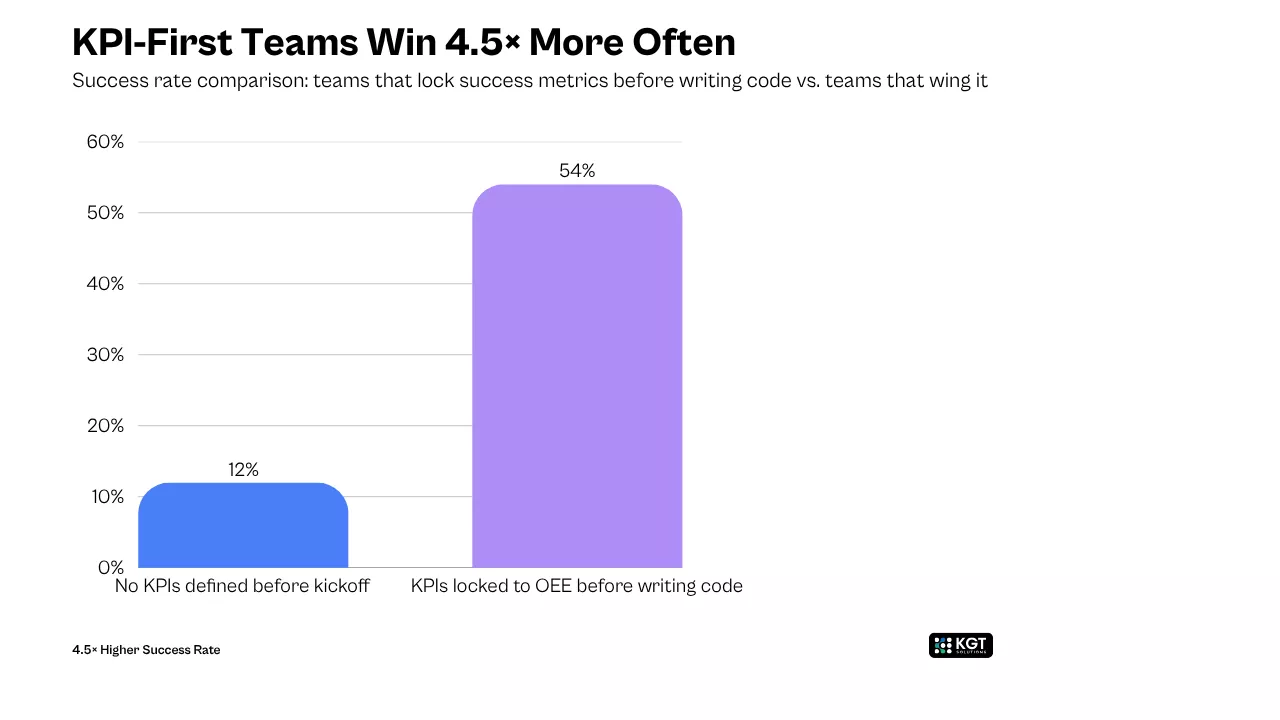
Teams that lock in success metrics before writing a single line of code hit a 54% success rate versus 12% for teams that wing it
Introduction
Your pilot looked great on the bench. Three cameras, one line, one engineer hovering over it like a nervous parent for 90 days. Leadership signed off on the rollout. Then the system started missing scratches your newest operator spots from ten feet away. That gap between lab accuracy and shop floor chaos is where 77% of machine vision pilots go to die. This guide walks through exactly why computer vision in manufacturing keeps failing and what you can fix before burning another budget cycle.
What Makes Computer Vision Projects Fall Apart on the Production Floor?
Computer vision and image processing systems fall apart on production floors because the clean, controlled pilot environment hides three problems that production makes worse - lighting and camera angles that shift constantly, training data that looks nothing like real production diversity across shifts and SKUs, and zero plan for wiring the vision hardware into existing PLC or SCADA infrastructure.
Here is a pattern you have probably seen before. RAND Corporation dug into this in 2025 and found that 33.8% of AI projects were abandoned before production. Another 28.4% crossed the finish line but delivered nothing useful. Integration alone ate 58% of total project budgets in manufacturing AI work.
Think about what that means on the floor. A defect detection system trained on 500 images of clean welds in an air-conditioned lab meets a production floor with three different MIG torch angles, temperature swings, and operators who hold parts at slightly different angles every shift. The model did not fail. Nobody set it up to succeed.
Why Does Collecting Training Data Take So Long?
Collecting training data takes so long because factories need extremely specific images that can take six months to a year to gather, and 54% of AI projects get permanently stuck at proof-of-concept because nobody planned for how painful the data collection phase would actually be, according to the MLOps Community's 2025 analysis.
Most teams wildly underestimate this. A visual inspection automation system for PCB solder joints needs thousands of labeled photos covering every defect type, every lighting shift change, and every board revision your engineering team dreamed up last quarter. Getting those images off a running line without shutting anything down is a logistics headache pretending to be a data science problem.
The answer is not throwing more data at the wall. Build structured data collection directly into the production workflow from day one. Use synthetic data augmentation to fill the holes that real-world capture cannot fill fast enough.

Why Does Bad Lighting Wreck More Projects Than Bad Models?
Bad lighting wrecks more projects than bad algorithms because poor illumination kills the contrast between surface defects and the base material, and once that contrast disappears even the fanciest defect detection software will sail past 30% of real defects no matter how good your cameras are.
Lighting is the thing nobody budgets enough time for. Coaxial, backlight, ring, and dome setups each work for different surface shapes. A system checking reflective metal parts needs a completely different rig than one scanning matte-finish packaging labels. Get this wrong and your false positive rate goes through the roof.
Human inspectors miss 15% to 25% of defects when they have been staring at parts all shift. A machine vision system with bad lighting misses even more - except now everyone trusts the machine and nobody double-checks.
How Do the Manufacturers Who Get It Right Actually Do It?
Manufacturers who get it right start by picking a measurable KPI before they pick a model, assigning one person who owns the system from pilot through full rollout, and designing the whole deployment around the messy reality of a production floor instead of a demo that only works on Tuesdays when the AC is on.
The global market for these systems hit $22.35 billion in 2026 and is growing at 11.15% CAGR. Manufacturing makes up 28.49% of that spend. Plenty of money is moving. The real question is whether yours lands in a system that pays for itself or in a pilot that quietly gets shelved after Q3.
What Goes Wrong | What to Do Instead |
|---|---|
Model trained in the lab, never sees real parts | Build on-line data collection with synthetic augmentation from the start |
One lighting setup for every product | Specify lighting per inspection point and surface type |
No plan for connecting to SCADA or PLC | Hire the integration architect before picking a camera |
No success metric picked upfront | Lock a KPI to OEE lift or defect escape rate before kickoff |
The pilot team owns it forever | Hand off to a dedicated production owner with a predictive maintenance mandate |
The teams that understand what automated inspection catches that humans miss and build around production reality see ROI within 6 to 12 months from less scrap, fewer returns, and lower inspection labor. The computer vision examples that work all have one thing in common: someone treated the rollout like a plant infrastructure project, not a science fair entry.
IT OT Convergence in Manufacturing Explained

What is the AI project failure rate for vision systems in manufacturing?
Vision-based AI projects fail at roughly 70% across industries, and manufacturing-specific deployments sit even higher at 76.4%. RAND Corporation data shows 80.3% of AI projects miss their intended business value, with integration eating 58% of total project resources.
How much does a failed vision deployment actually cost?
Failed deployments cost manufacturers in direct waste and escaped defects, with a single missed flaw triggering $50,000 to $250,000 in chargebacks for automotive Tier 1 suppliers. Food safety recalls from labeling errors that slipped through average over $10 million per incident.
What is the single biggest reason vision pilots never make it to production?
Vision pilots stall because the controlled pilot environment looks nothing like the chaos of real production, and 54% of projects get stuck at proof-of-concept when data acquisition problems show up during the jump from one test line to multi-shift, multi-SKU operations.
Frequently Asked Questions
What is the main reason computer vision projects fail?
How much does it cost when a computer vision project fails?
What data problems cause computer vision models to fail in production?
Can computer vision projects be rescued after they start failing?
What should companies evaluate before starting a computer vision project?
Conclusion
Stop paying for pilots that prove a model works and start paying for deployments that prove a production workflow works. If yours has no KPI, no integration architect, and no data strategy, it is headed for the 70%. Book a discovery call with KGT Solutions to build something that survives your actual floor.
Sources:
RAND Corporation - Identifying and Mitigating Failure Modes in AI Projects (2025)
MLOps Community - State of Production ML Report (2025)
Grand View Research - Machine Vision Market Size & Trends Report (2026)
Quality Magazine / ASQ - Automotive Tier 1 Defect Cost Benchmarks
FDA / USDA Recall Database - Food Safety Incident Cost Analysis
Gartner / McKinsey - Manufacturing AI Deployment Benchmarks (2024-2025)
Industrial Autonomous Floor
Newsletter
Actionable insights on industrial AI, automation, and smart operations built for safe, secure, and compliant real-world environments.