How Does Smart Contract Development Scale?


Smart contract development scales when teams split business logic from on-chain processing using modular code, Layer-2 rollups, and formal verification. Companies that keep heavy computation off the main blockchain already handle over 100,000 transactions per second while maintaining tamper-proof records that pass compliance checks and stay affordable at high volume.
Key Takeaways
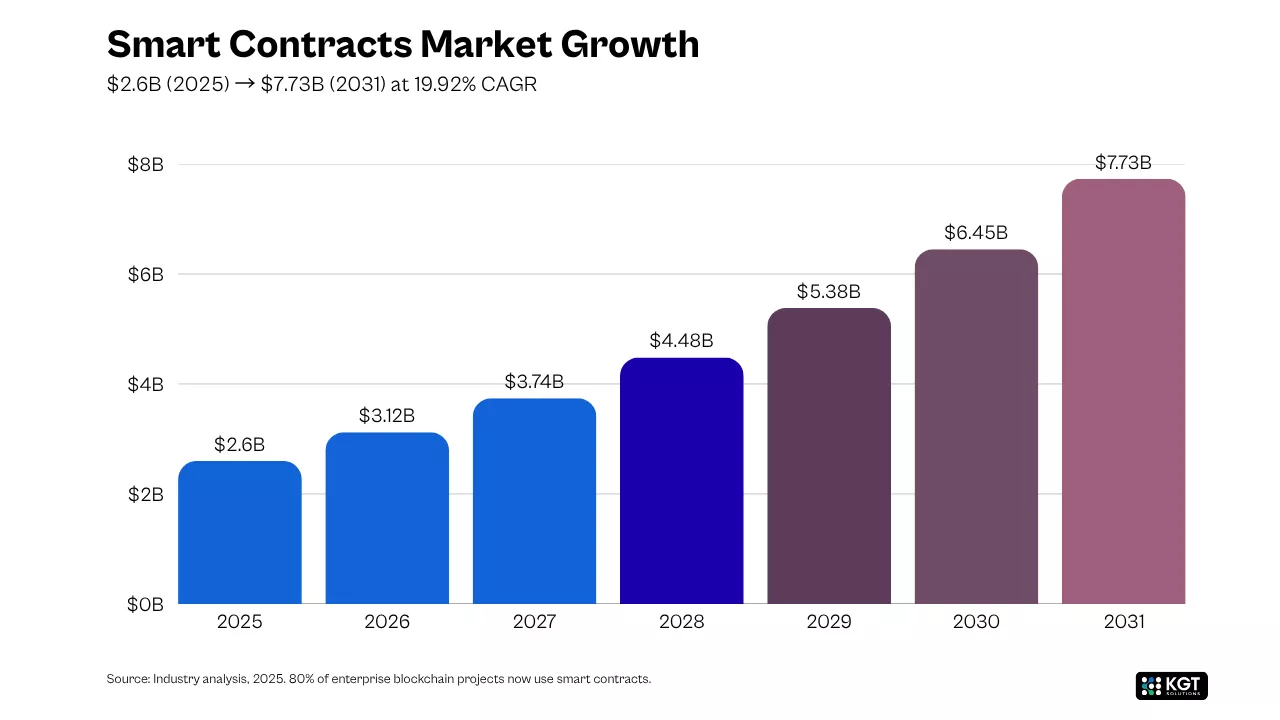
The smart contracts market hit $2.6 billion in 2025 and is headed toward $7.73 billion by 2031 at 19.92% CAGR. 80% of enterprise blockchain projects now use smart contracts.
Audited smart contracts have 98% fewer code-level exploits than unaudited ones. Formal verification is the single highest-ROI step before going live.
Layer-2 rollups cut transaction fees by 90-99% compared to running everything on the main chain, removing the cost barrier that kept most enterprise projects stuck in testing.
Introduction
Most smart contract development projects don't fail because the code is bad. They fail because the system was built for a demo, not for 10,000 real users hitting it at once. Fees spike. Transactions queue up. What worked in testing becomes a money pit within weeks. Here are the design choices that separate smart contract development built to last from projects built to collapse.
What Causes Smart Contract Development To Fail at Scale?
Smart contract development fails at scale when teams put all their code into one big contract and push it straight to the main blockchain. When token logic, user permissions, compliance rules, and payment processing all live in the same contract, you get rising fees, harder audits, and painful upgrades that get worse with every new user.
Most teams ship one oversized contract file. It works in testing. Then real users show up.
Ethereum processes around 100,000 transactions per second after moving to proof-of-stake. But that speed means nothing if your contract wastes fees on tasks that don't need to be on the blockchain at all. Over 35 million smart contract transactions run daily across all networks. The fight for block space is real.
The mistake that kills projects: cramming compliance checks, payment logic, and login verification into one contract. Every time a function runs, it pays fees to read the entire contract's stored data. A smart contract developer who builds this way ships something that works for 50 users and becomes too expensive to operate at 500.
How Do Scalable Smart Contracts Actually Work?
Scalable smart contracts work by keeping only the essential parts on-chain, things like payment settlement and ownership records. The heavier work, like business rules and data processing, runs on faster Layer-2 networks or off-chain systems, and only the final results get recorded back on the main blockchain to save money.
Your architecture decision shapes everything that follows in smart contract development. Here is how the four main approaches compare when they hit real traffic:
Architecture Pattern | On-Chain Cost | Speed | Upgrade Path |
|---|---|---|---|
Monolithic (Single Contract) | High - every call hits the main chain | Limited by block size | Must redeploy everything |
Proxy + Implementation | Medium - data stays on-chain, logic is swappable | Same speed limits, more flexible | Swap code without moving data |
L2 Rollup + L1 Settlement | Low - only batch results go on-chain | 2,000-40,000 TPS on rollup | Upgrade L2 independently |
Hybrid (Off-chain compute + L1 anchor) | Minimal - only proof hashes on-chain | Nearly unlimited off-chain | Most flexible, most complex |
Why Layer-2 Rollups Changed the Cost Equation for Enterprise Smart Contracts
Layer-2 rollups bundle hundreds of smart contract operations into one proof that gets posted to the main blockchain. This cuts transaction fees by 90-99%. Companies that walked away from blockchain because of high costs are now running live systems on Arbitrum, zkSync, and Optimism for less than a penny per transaction.
The blockchain market hit $94.89 billion in 2026. A big chunk of that growth comes from Layer-2 solutions making enterprise projects affordable for the first time.
A basic token transfer on Ethereum mainnet costs $2-5 in fees during normal traffic. That same transfer on a rollup costs a fraction of a cent. Spread that savings across 50,000 daily transactions and you've paid for your entire smart contract development services team. That kind of math gets procurement teams to sign off fast.
Formal Verification Is No Longer a Nice-to-Have
Formal verification uses math to prove your smart contract code does exactly what it should under every possible scenario. It catches entire categories of bugs that normal testing misses. The blockchain industry lost $1.64 billion in Q1 2025 alone from security holes that formal verification would have flagged before launch.
Audited contracts had 98% fewer exploits from code vulnerabilities. That stat alone should settle any argument about whether verification is worth the extra time.
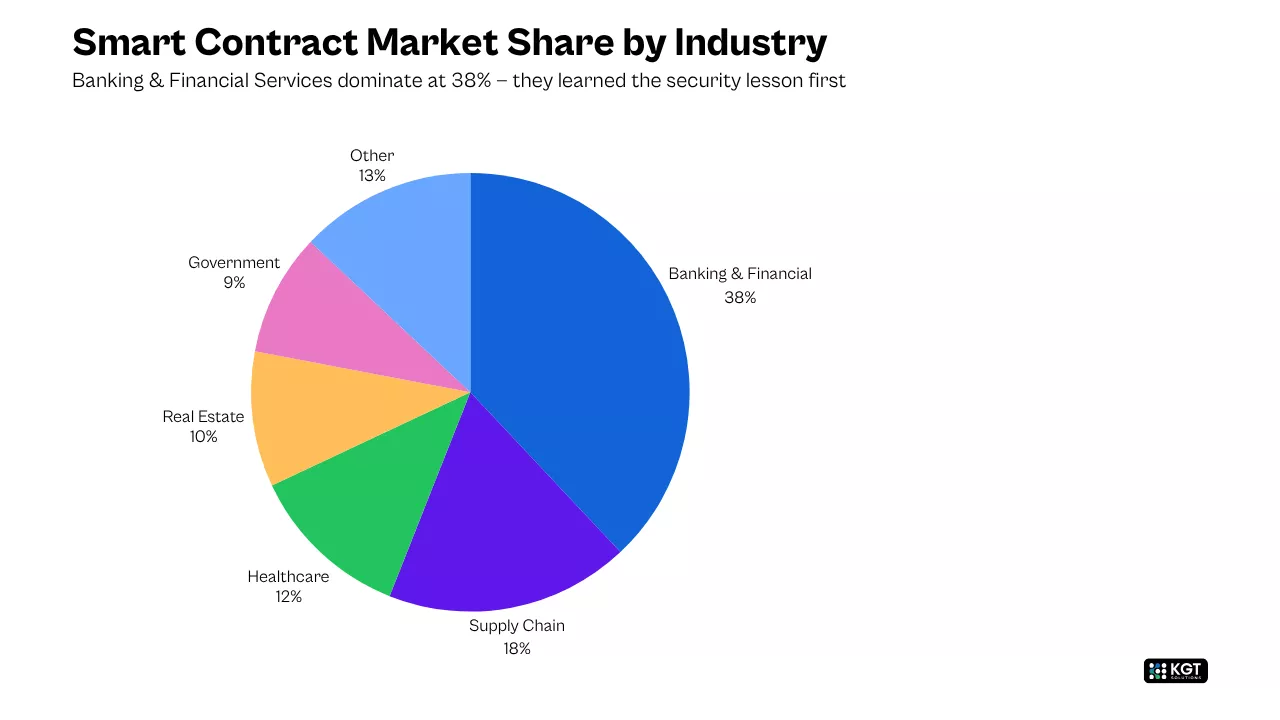
The real cost is not paying for the audit. It is what happens when you skip it. The Bybit hack in February 2025 drained $1.5 billion through one compromised signing tool. Smart contracts development services that skip verification are building on shaky ground. Banking and financial services, which hold 38% of smart contract market share, already learned this lesson the expensive way.
Enterprise AI Governance: Build Your Framework

What Separates a Real Smart Contract Development Company from a Tutorial-Level Shop?
A real smart contract development company gives you modular code design, formal verification as a standard part of the project, Layer-2 deployment know-how, fee optimization on every function, and monitoring tools that keep running after launch. The standard is not code that compiles. The standard is code that holds up under audits, regulators, and 10x traffic spikes without needing a rebuild.
80% of enterprise blockchain projects use smart contracts. But there is a massive gap between "we launched a contract" and "we run a secure, scalable system that handles real money." Most projects get stuck in that gap and never come out.
Here is what separates a production-ready smart contract developer from someone who learned Solidity last month:
Architecture-first planning: They ask about your expected transaction volume, compliance needs, and upgrade schedule before writing a single line of code.
Chain-flexible design: They build contract logic that works across Ethereum, Polygon, Arbitrum, or private chains like Hyperledger depending on what your project actually needs.
Fee optimization as a habit: They check every function for unnecessary data reads and writes. They use cheaper data formats where possible. They batch updates to cut per-call costs.
Built-in audit pipeline: They wire formal verification into the development workflow as a required step, not a one-time checkbox before launch.
The tokenized asset market hit $85.12 billion and is headed for $2 trillion by 2030. All of that runs on smart contracts. The blockchain development partner you pick now decides whether your product rides that wave or gets rebuilt from zero in 18 months.
Large companies hold 69% of smart contracts market share today. Smaller businesses that move now with the right partner still have a window to build systems that compete at enterprise level without enterprise budgets, especially if they invest in custom software infrastructure that treats the smart contract layer as one piece of a bigger system instead of the whole product.
Can smart contracts handle high-volume enterprise transactions without gas cost blowouts?
Smart contract development architectures built on Layer-2 rollups bundle thousands of transactions into single proofs posted to the main chain. This cuts costs by 90-99%. Live deployments on Arbitrum and zkSync already process enterprise-level volume for less than a penny per transaction.
How long does a production-grade smart contract development project typically take?
Smart contract development for live systems typically takes 8-16 weeks depending on how complex the contracts are, what audits are needed, and which blockchain you choose. Teams that skip formal verification ship faster but build up problems that cost 5-10x more to fix after launch.
Is Ethereum still the right chain for enterprise smart contracts in 2026?
Ethereum holds 48.3% of the smart contracts market and is still the most proven platform for high-value smart contract development. Layer-2 networks built on top of Ethereum fix the cost and speed issues while keeping the security and large developer community that enterprise buyers need.
Frequently Asked Questions
What is smart contract development and how does it scale?
What are the biggest challenges in scaling smart contracts?
How do Layer 2 solutions help smart contracts scale?
What programming languages are used for smart contract development?
How do enterprises ensure smart contract security at scale?
Conclusion
Your smart contract development has to hold up against real users, real transaction volume, and real auditors, not just a clean test run. Book a discovery call with KGT Solutions and get an architecture review that maps your business logic to a verified, scalable system ready for production.
Sources:
Mordor Intelligence - Smart Contracts Market Size & Share Analysis (2025-2031)
IMARC Group - Smart Contracts Market Report 2033
Precedence Research - Smart Contract Market Size, Share, and Trends 2034
Immunefi - Crypto Losses Q1 2025 Report
DemandSage - Blockchain Statistics 2026
CoinLaw - Smart Contract Audit Statistics
SigIntZero / FBI - Bybit Hack Analysis February 2025
Roland Berger - Tokenization of Real-World Assets Report
Ethereum Foundation - Proof-of-Stake Network Performance Data
Statista - Blockchain Market Size Worldwide
Protocol AI Newsletter
Practical insights on AI, automation, and intelligent systems focused on real-world applications, not hype.