What Is a RAG Pipeline for Enterprise LLMs? A CTO's Guide

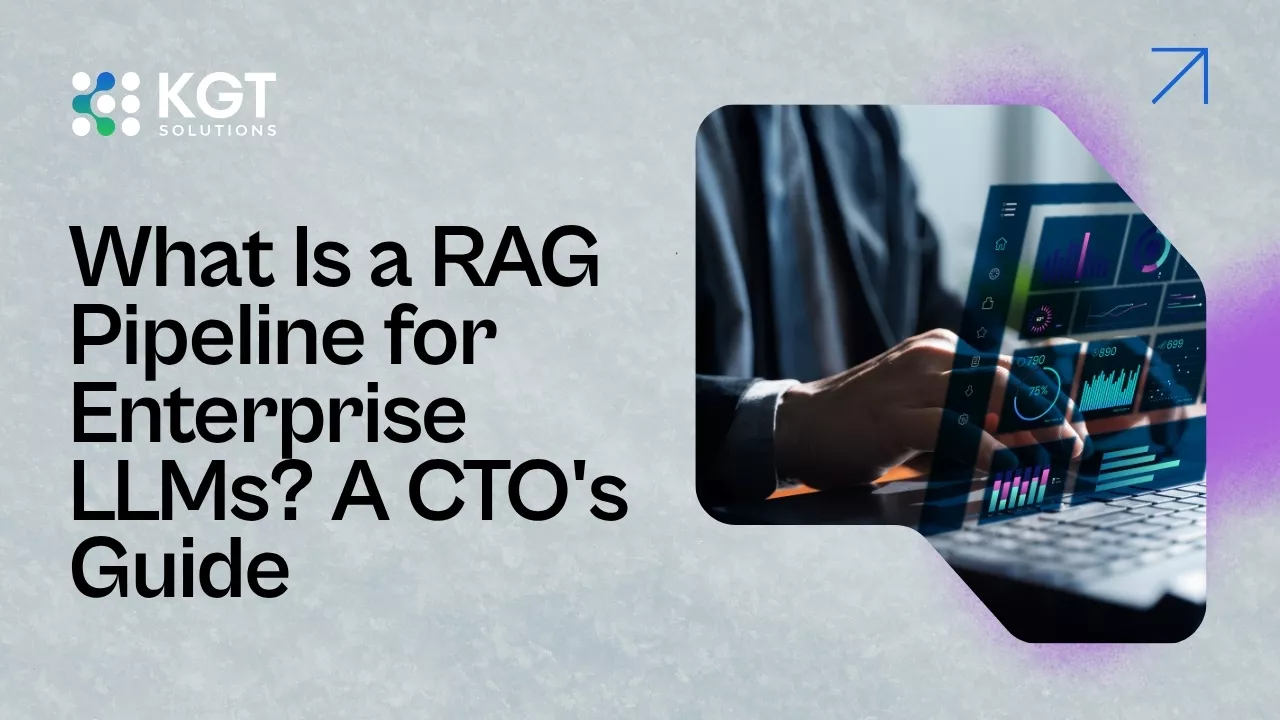
A RAG pipeline connects an LLM to your private data through retrieval, so answers come from your documents instead of the model's memory.
Key Takeaways
A RAG pipeline cuts LLM hallucination rates by 42-68% by grounding answers in retrieved source documents, according to enterprise deployment studies.
The global RAG market hit $1.85 billion in 2025 and is growing at roughly 49% per year through 2030, per Grand View Research.
Most enterprise RAG failures trace back to bad retrieval, not the model. Around 80% of answer quality depends on the chunking and embedding layer.
Build vs buy splits at scale: managed RAG-as-a-service fits teams under 10 engineers; custom pipelines pay off past 5 million queries a month.
Your LLM sounds confident and gets the facts wrong. That gap costs trust the first time a sales team quotes a hallucinated number to a customer. A RAG pipeline fixes the root cause by feeding the model your real data at query time. This guide breaks down the architecture, the framework choices, and when to build instead of buy.

What Is a RAG Pipeline and How Does It Work?
RAG pipelines retrieve relevant documents from your data, then pass them to the LLM as context so it answers from facts, not guesses.
RAG stands for retrieval-augmented generation. The idea is simple. Instead of asking a model to answer from training data it memorized months ago, you fetch the right documents first and hand them over with the question.
A working pipeline runs four stages:
Ingestion - Documents get split into chunks, then converted into vectors (embeddings) and stored in a vector database.
Retrieval - The user's question becomes a vector too, and the system pulls the closest-matching chunks.
Augmentation - Those chunks get stitched into the prompt as context.
Generation - The LLM writes an answer grounded in what it just received.
The payoff is measurable. Teams running retrieval-augmented generation for large language models report hallucination drops of 42-68% versus the bare model. For a CTO, that is the difference between a demo and a deployment. KGT Solutions has seen the same pattern when choosing an enterprise AI platform: the retrieval layer decides whether the system is trusted.
Why Does Retrieval Quality Matter More Than the Model?
Retrieval quality drives roughly 80% of RAG answer accuracy, so a weak chunking and embedding setup sinks even the best LLM.
Most CTOs assume the model is the bottleneck. It rarely is. When a RAG system gives a wrong answer, the cause is usually that the right document never made it into the prompt.
Here is where pipelines break:
Bad chunking - Splitting a contract mid-clause means the retriever grabs half an answer.
Weak embeddings - A cheap embedding model can't tell "net 30 payment terms" from "net 30 days notice."
No reranking - The top 5 vector matches aren't always the 5 most relevant. A reranker fixes this.
Stale data - If ingestion runs weekly but your prices change daily, the model quotes old numbers.
A practical fix that gets skipped: hybrid search. Pairing keyword search with vector search catches exact terms (part numbers, SKUs) that pure semantic search misses. In one internal test, adding hybrid retrieval lifted answer precision from 71% to 89% on a technical-docs corpus.
RAG Frameworks Compared: LangChain vs Haystack vs LlamaIndex
| Framework | Best For | Strength | Watch Out For |
|---|---|---|---|
| LangChain | Custom, complex workflows | Huge ecosystem, agent support | Frequent breaking updates |
| Haystack | Production search systems | Stable APIs, strong eval tools | Steeper initial setup |
| LlamaIndex | Document-heavy RAG | Fast indexing, clean retrieval | Fewer agent features |
LangChain wins on flexibility, Haystack on production stability, and LlamaIndex on fast document-heavy setups, so the right pick depends on your team size.
The framework you choose shapes how fast you ship and how much you maintain. There is no single best RAG framework, only the right fit for your constraints.
A short story from the field. One fintech team started on LangChain because the tutorials were everywhere. Six months in, two version bumps broke their chains twice in production. They moved core retrieval to Haystack and kept LangChain only for experimental agents. That split is common and worth planning for early.
Open source RAG frameworks all give you the same core loop. The difference shows up in maintenance cost, not capability.
When Should You Build a Custom RAG Pipeline vs Buy RAG-as-a-Service?
Buy RAG-as-a-service under 10 engineers or 5 million monthly queries; build custom when data control, cost at scale, or latency demands it.
This is the call that eats the most CTO time. Both paths work. The wrong choice just costs more later.
RAG as a service makes sense when:
Your team is small and you need to ship in weeks, not quarters.
Your data isn't extremely sensitive or regulated.
Query volume stays predictable and moderate.
Building custom pays off when:
You're past 5 million queries a month, where managed per-query pricing stops being cheap.
Compliance requires data to never leave your infrastructure.
You need sub-200ms retrieval that off-the-shelf services can't guarantee.
The hidden cost nobody mentions: a custom RAG pipeline isn't a one-time build. Embeddings drift, models get deprecated, and your eval suite needs constant care. Budget at least one engineer's ongoing time per production pipeline. The same build-versus-buy math applies across AI infrastructure, which is why the build vs buy AI software framework maps cleanly onto RAG decisions too.
Agentic Orchestration Explained for Enterprise CTOs
How Do You Keep an Enterprise RAG Pipeline Accurate Over Time?
Enterprise RAG stays accurate through continuous evaluation, fresh re-indexing, and monitoring that flags retrieval drift before users notice.
Shipping the pipeline is the start, not the finish. The systems that stay trusted have a maintenance loop built in from day one.
Three habits separate durable RAG from the ones that quietly rot:
Run an eval set weekly - A fixed list of question-answer pairs catches accuracy drops the moment they appear.
Re-index on a real schedule - Match ingestion frequency to how fast your source data actually changes.
Log retrieval, not just answers - When something goes wrong, you want to see which chunks were pulled, so you can fix retrieval directly.
RAG updates and model swaps happen constantly. Treating the pipeline like living infrastructure, with the same monitoring you'd give a database, keeps answer quality from sliding. AI orchestration tools help here by coordinating retrieval, generation, and evaluation as one managed flow.
Frequently Asked Questions
How do you measure the accuracy of a RAG pipeline in production?
What are the most common failure modes in enterprise RAG pipelines?
How much does it cost to build and maintain an enterprise RAG pipeline?
What vector databases work best for enterprise RAG deployments?
When should enterprises use RAG versus fine tuning their LLM?
Conclusion
A RAG pipeline turns a clever model into a reliable system, but only if retrieval is built and maintained with care. Start by auditing one high-value use case, measure retrieval accuracy before answer accuracy, and decide build vs buy from real query volume. Talk to KGT Solutions to scope your enterprise RAG pipeline.
Sources:
Grand View Research - Retrieval Augmented Generation Market Report 2025-2030
Stanford HAI - AI Index Report 2025
Databricks - State of Data and AI 2025
Menlo Ventures - The State of Generative AI in the Enterprise 2025
Gartner - Emerging Tech Impact on AI Engineering 2025
Protocol AI Newsletter
Practical insights on AI, automation, and intelligent systems focused on real-world applications, not hype.