Digital Twin For Urban Planning: $4.5B, 92% ROI Market[2026]

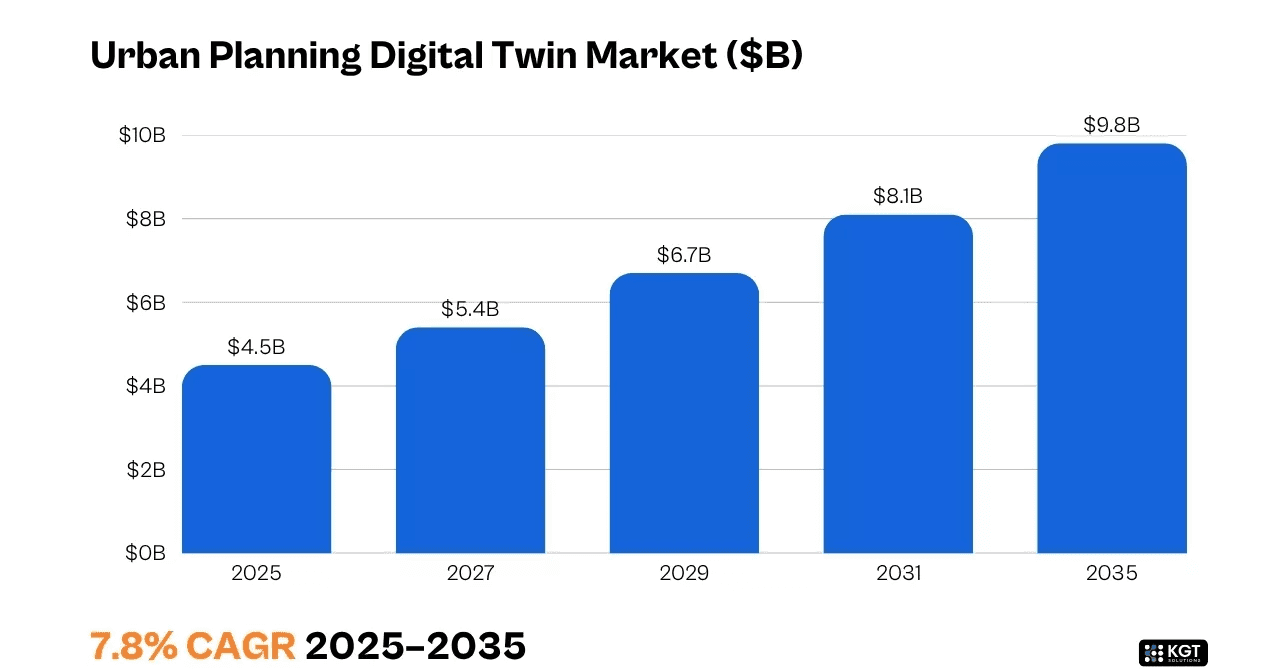
Digital twins for urban planning reached $4.5B in 2025, growing 7.8% yearly. 92% of deployers report ROI above 10%. The math is hard to argue with.
Digital twin for urban planning works by building a real-time virtual replica of a city's physical infrastructure - roads, utilities, buildings, transit networks - using IoT sensor feeds, GIS data, and AI-driven simulation models that let planners test development scenarios, predict failures, and optimize resource allocation before breaking ground.
Key Takeaways
Digital twins for urban planning reached $4.5B in 2025 and keep growing at 7.8% yearly. 92% of cities using them report ROI above 10%.
The global digital twin for urban planning market reached $4.5 billion in 2025 and is projected to hit $9.8 billion by 2035 at a 7.8% CAGR, with smart city initiatives driving adoption across Asia, Europe, and North America.
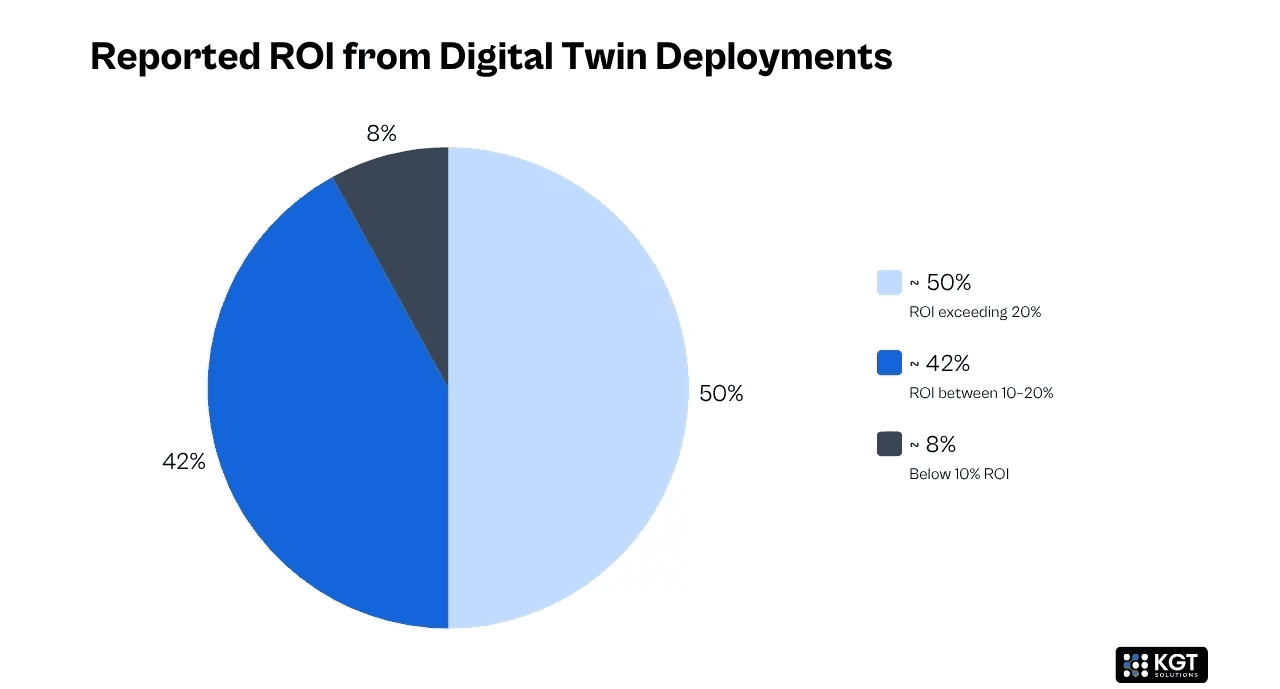
92% of companies deploying digital twins report ROI above 10%, and roughly half achieve returns exceeding 20%, making the technology one of the fastest-payback infrastructure investments available to municipal governments and private developers.
Singapore invested $70 million in Virtual Singapore, the world's first national-scale digital twin, cutting flood response planning time and enabling real-time traffic optimization across the entire island-state.
Introduction
Cities absorb 1.5 million new residents every week. Most urban infrastructure was designed for populations half the current size, using planning tools built around static 2D maps and quarterly review cycles. Digital twin for urban planning replaces that guesswork with a live, data-fed simulation layer that lets planners see consequences before committing concrete and steel.
How Does a Digital Twin for Urban Planning Actually Function?
It pulls live feeds from IoT sensors, traffic cameras, and satellites into a 3D model that flags problems as they happen, not after.
A digital twin city model functions by ingesting live data streams from IoT sensors, traffic cameras, utility meters, and satellite imagery into a 3D simulation engine where AI algorithms continuously reconcile the virtual model against the physical city, flagging deviations and projecting outcomes across thousands of variables simultaneously.
The process starts with data collection. Thousands of sensors embedded in roads, bridges, water pipes, and power grids transmit readings every few seconds. GPS data from public transit vehicles, environmental monitors tracking air quality, and smart meters logging energy consumption all feed into a centralized data lake.
That raw data enters a 3D modeling layer. GIS mapping, LiDAR scans, and BIM files create the geometric skeleton. The sensor data gives it a pulse. Helsinki built a complete 3D digital twin of the entire city, enabling planners to test new building proposals against wind patterns, shadow analysis, and pedestrian flow before approving permits.
Machine learning models then run scenario simulations. What happens to traffic if a new metro line opens on the east corridor? How does a 15% increase in commercial zoning affect stormwater runoff? The digital twin city model answers these in minutes instead of months.
What Data Sources Feed a Smart City Digital Twin?
These systems pull from IoT sensors, SCADA, traffic feeds, weather stations, satellites, and BIM files, all updating within seconds.
A smart city digital twin ingests data from IoT infrastructure sensors, SCADA systems, traffic management platforms, weather stations, satellite imagery, building information models, and citizen mobility data to maintain a continuously updated virtual representation of the urban environment that responds to real-world changes within seconds.
The variety matters more than the volume. A traffic-only model misses how a broken water main cascades into road closures, rerouted buses, and commercial delivery delays. The 70% of technology leaders investing in digital twin initiatives, per McKinsey, understand that value compounds when data sources interconnect rather than sit in silos.
Real-time feeds separate digital twins from traditional urban simulation tools. Static models produce reports. Digital twins for urban planning produce live dashboards where city operators watch infrastructure performance the way a plant manager watches an OEE dashboard on the factory floor.

How Do Digital Twins for Infrastructure Predict Failures?
Machine learning watches continuous sensor data on bridges and pipelines, spotting degradation 30-90 days before anything fails.
Digital twins for infrastructure predict failures by applying machine learning to continuous sensor telemetry from bridges, pipelines, and power grids, identifying degradation patterns 30 to 90 days before structural or mechanical failure and triggering maintenance alerts that prevent catastrophic downtime.
Predictive maintenance in urban infrastructure follows the same logic that saves factories millions annually. IoT-driven predictive maintenance cuts costs by 25 to 30% and reduces unplanned downtime by 35 to 50% in industrial settings. Applied to city infrastructure, the math scales dramatically. A single bridge closure in a mid-sized city costs an estimated $150,000 to $400,000 per day in economic disruption.
The digital twin infrastructure layer tracks micro-vibrations in bridge decks, pressure anomalies in water mains, and thermal drift in electrical substations. When patterns match historical failure signatures, the system flags a maintenance window weeks before anything breaks.
Digital Twin City Examples That Changed How Cities Operate
Singapore spent $70M on its Virtual Singapore twin and cut planning costs 15%. Helsinki and Dubai got comparable results.
Digital twin city examples from Singapore, Helsinki, and Dubai demonstrate measurable improvements in flood response time, permit approval efficiency, and energy consumption reduction, with Singapore's Virtual Singapore project alone saving the city-state an estimated 15% on infrastructure planning costs.
City | Investment | Scale | Primary Use Case | Measurable Outcome |
|---|---|---|---|---|
Singapore | $70M | National | Traffic, flood, urban density | Real-time flood response, traffic optimization |
Helsinki | Municipal budget | City-wide 3D model | Building permits, energy modeling | Shadow and wind analysis before construction |
Dubai | Smart City initiative | City-wide | Infrastructure management | Centralized operations dashboard |
Shanghai | Provincial funding | District-level | Traffic flow, emissions | 20% reduction in congestion modeling time |
Singapore treated the digital twin as national infrastructure, not a pilot project. Virtual Singapore connects government agencies, private developers, and research institutions on a single simulation platform.
Urban planners test population density scenarios while emergency services simulate monsoon evacuation routes on the same model. Transport authorities optimize bus frequency based on real ridership data, not estimates from five-year-old surveys.
Helsinki took a different path. The city released its 3D digital twin as open data, inviting citizens and developers to build applications on top of it. That transparency accelerated adoption and reduced the typical 18-month smart city procurement cycle.
IT OT Convergence in Manufacturing Explained
Why Are 75% of Businesses Now Investing in Digital Twin Technology?
The numbers make the case: 50% better operations, 15% cost cuts in year one, and 25%+ efficiency gains across deployments.
75% of businesses now invest in digital twin technology because the ROI data is conclusive - organizations report 50% operational improvements, 15% cost reduction in the first year, and 25% or greater efficiency gains, with payback periods that outpace most traditional infrastructure simulation tools across manufacturing, logistics, and urban planning.
The numbers tell the story. Five years ago, digital twins sat in trade show demos. Today, 59% of executives plan to integrate them by 2028. The broader digital twin market grew from $24.48 billion in 2025 and is projected to reach $384.79 billion by 2034 at a 35.4% CAGR.
For urban planning specifically, the drivers are different from manufacturing. Cities face compounding risks - climate events, population growth, aging infrastructure - that make reactive planning financially unsustainable. A city that spends $50 million repairing flood damage could have spent $5 million on a digital twin simulation layer that identified vulnerable zones and redirected stormwater infrastructure before the next monsoon season.
Capgemini research projects digital twin deployment will grow at an average rate of 36% within five years. Asia Pacific is the fastest-growing region, with the market reaching $6.7 billion in 2025 and projected to hit $9.57 billion in 2026.
FAQ
What is the cost of implementing a digital twin for urban planning?
Digital twin for urban planning implementation costs range from $500,000 for district-level pilots to $70 million for national-scale deployments like Singapore's Virtual Singapore. Most mid-sized cities start with corridor-level twins covering transit or utility networks before scaling.
Can existing city infrastructure support a digital twin deployment?
Existing city infrastructure can support a digital twin deployment when retrofitted with IoT sensors and connected to a centralized data platform. Cities with existing SCADA and sensor networks can integrate those feeds into a digital twin layer without replacing legacy systems.
How long does it take to build a functional digital twin city model?
A functional digital twin city model takes 6 to 18 months for an initial deployment covering a single district or infrastructure vertical, depending on sensor density, data integration complexity, and the maturity of existing GIS and BIM datasets.
Frequently Asked Questions
What is a digital twin in urban planning?
Why is the digital twin market for urban planning valued at $4.5 billion?
How do digital twins achieve 92% ROI in urban projects?
What data sources power an urban digital twin?
What industries beyond urban planning benefit from digital twin technology?
Conclusion
Pick one infrastructure vertical. Deploy sensors. Build the digital twin layer. Expand from there. If your city or facility still plans on spreadsheets and static maps, the gap between you and sensor-driven competitors widens every quarter. Talk to an integrator who builds digital twins connected to real operational data.
Sources:
Fortune Business Insights - Digital Twin Market
Global Insight Services - Digital Twins for Urban Planning Market
MindInventory - Digital Twin Statistics 2026
Hexagon - Digital Twin Statistics
Grand View Research - Digital Twin Market
Fireraven - Singapore Digital Twin
Toobler - Digital Twin in Smart City
Industrial Autonomous Floor
Newsletter
Actionable insights on industrial AI, automation, and smart operations built for safe, secure, and compliant real-world environments.