How Robotic Process Automation in Healthcare Reduces Cost?


Healthcare RPA drops claims costs from $4 to $1 per claim. Cleveland Clinic pulled $700K ROI in three years. Most hospitals see payback in 6-9 months.
Robotic process automation in healthcare reduces costs by deploying software bots to handle claims processing, billing verification, and patient scheduling - tasks that previously consumed thousands of staff hours annually. Hospitals using RPA report 30% to 80% operational cost reductions and achieve full ROI within six to nine months of deployment.
Key Takeaways
RPA drops claims costs from $4 to $1 per claim. Cleveland Clinic pulled $700K in ROI over three years running it
Automation cuts claims processing costs from $4 per claim to $1, a 75% reduction across more than 3 billion annual claims filed in the US alone.
Cleveland Clinic generated $700,000 in ROI over three years through bot-driven registration and claim automation, with processing times dropping 80%.
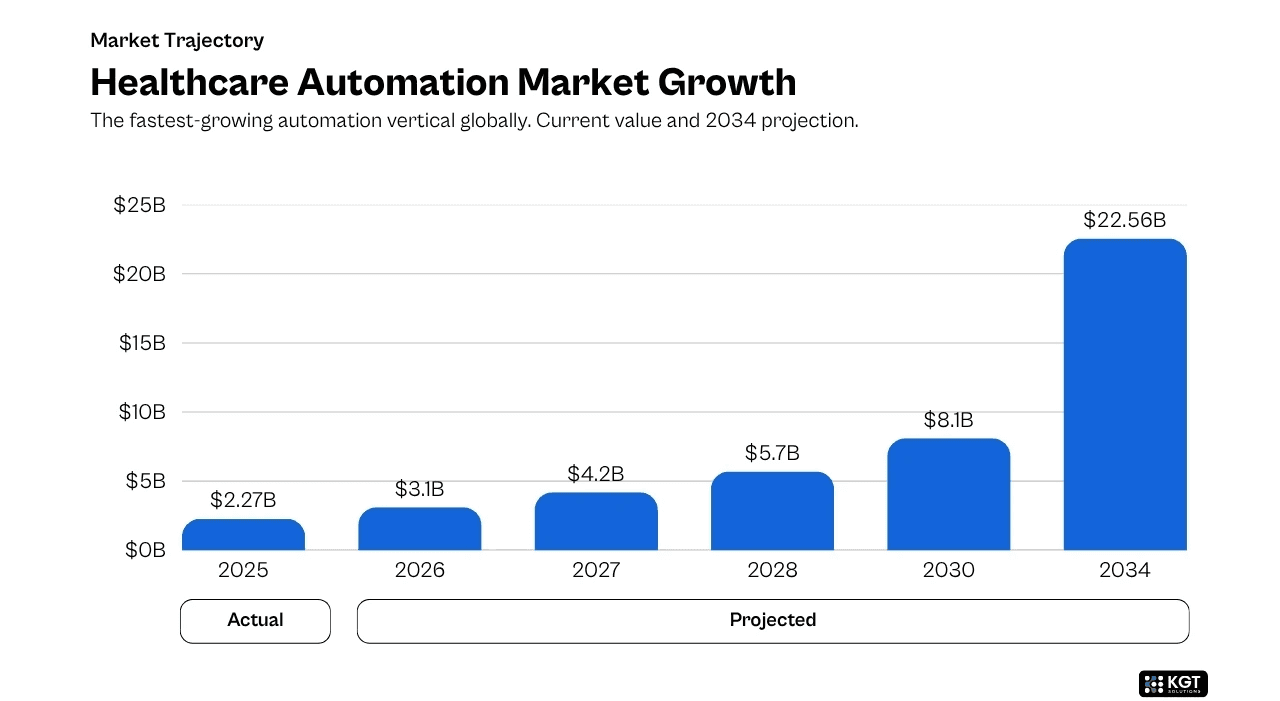
The healthcare automation market reached $2.27 billion in 2025 and is growing at 14.9% CAGR, making healthcare the fastest-growing segment globally at 30.89% compound annual growth.
Introduction
US healthcare burns through $4.5 trillion annually, and administrative overhead eats 15% to 30% of that spend. Staffing shortages compound the problem - 89% of providers struggle to hire. Process automation targets this exact bottleneck, replacing manual rule-based tasks with software bots that work around the clock without fatigue. Here is where the savings come from, how much hospitals actually recover, and what deployment looks like on the ground.
What Is Robotic Process Automation in Healthcare?
Healthcare RPA puts software bots on repetitive admin work like EHR entries and billing. They run at machine speed with almost no errors.
Robotic process automation in healthcare uses software bots to execute repetitive, rule-based administrative tasks across hospital information systems, EHRs, billing platforms, and claims management software without modifying the underlying IT infrastructure. These bots mimic human keystrokes and data entry at machine speed with near-zero error rates.
These bots sit on top of existing systems. They log into portals, extract patient data, populate fields across multiple applications, and trigger downstream workflows. No API integration required. No legacy system overhaul.
One thing to understand: the technology handles structured, predictable tasks. When paired with AI and machine learning, it becomes intelligent process automation - capable of reading unstructured documents, making contextual decisions, and learning from exceptions. 58% of healthcare organizations already use this combined approach.
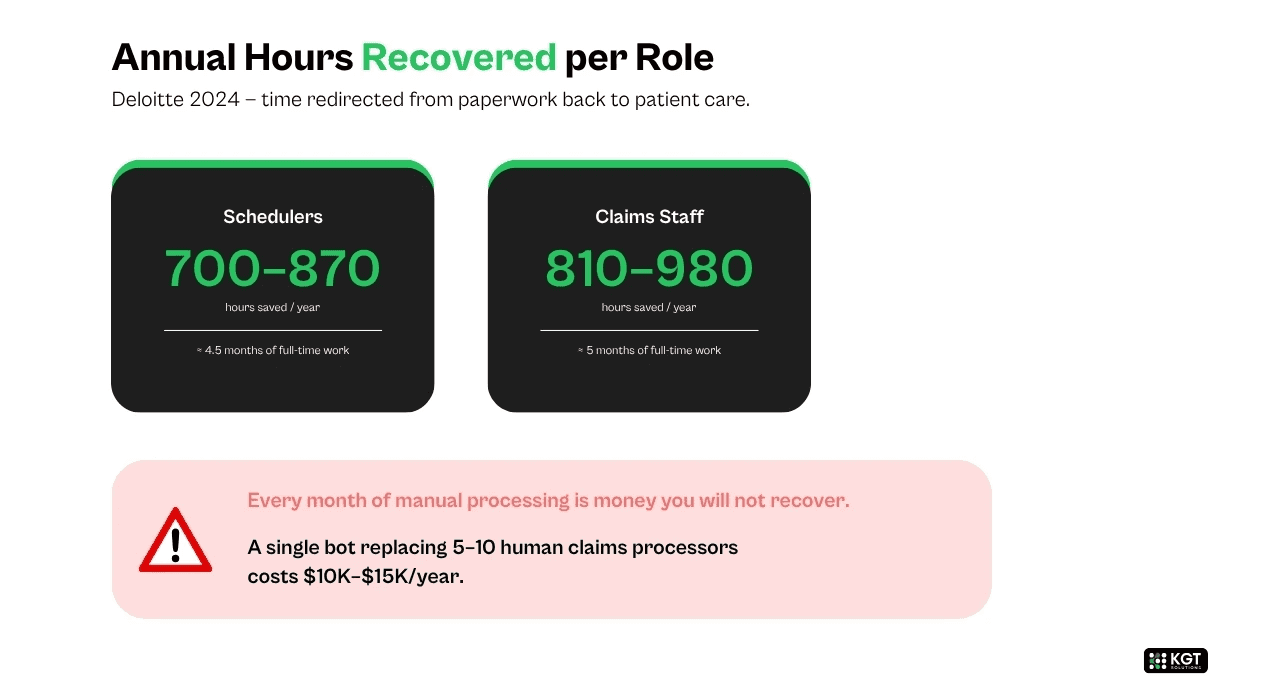
For organizations evaluating whether AI automation delivers real value before building, the entry cost is minimal. A single bot replacing 5 to 10 human claims processors costs $10,000 to $15,000 per year, including license fees, deployment, and maintenance.
How Does Healthcare Automation Cut Administrative Overhead?
It kills manual data entry, reduces claim denials, and compresses what used to take hours into minutes. Errors drop 85%.
Healthcare automation slashes administrative overhead by eliminating manual data entry, reducing claim denial rates, and compressing processing times from hours to minutes. Organizations deploying automation across billing and scheduling consistently report 85% fewer data entry errors and 90% improvement in billing accuracy.
Process | Manual Cost/Time | Automated Cost/Time | Reduction |
|---|---|---|---|
Claims processing | $4 per claim | $1 per claim | 75% |
Prior authorization | 45 min per case | 8 min per case | 82% |
Patient scheduling | 12 min per booking | 3 min per booking | 75% |
Data entry error rate | 15-20% | 2-3% | 85% |
Monthly FTE hours on claims | 750+ hours | Near zero | 83% |

Claims Processing Automation at Scale
APDerm saved $400K a year by automating claims. Days in AR fell 20%, and clean claim rates jumped 47%.
Claims processing automation handles eligibility verification, claim scrubbing, status checks, and denial management at volumes impossible for human staff. APDerm saved $400,000 annually by automating claims workflows, cut Days in AR by 20%, and improved clean claim rates by 47%.
Claims management already holds 32.8% of the healthcare automation market share. The math is straightforward: more than 3 billion claims get filed each year in the US. Extending auto-adjudication rates by just 10% to 12% through bots generates savings exceeding $1 billion industry-wide.
Avera Health documented $260,000 in employee-related expense savings through claims status and account verification automation alone. Northwell Health scaled its bots during COVID to bill 2,500 patients nightly for vaccinations - proof that bots handle demand spikes without headcount increases.
Revenue Cycle Management Transformation
Cleveland Clinic got $700K ROI from RPA over three years. Processing times for registration and claims dropped 80%
Revenue cycle management automation transforms the entire billing-to-collection chain by automating registration, coding verification, payment posting, and denial follow-up. Cleveland Clinic deployed bots across registration and claim edits, generating $700,000 in ROI over three years while reducing processing times by 80%.
A Tennessee health system reduced accounting errors from 30% to 2% and freed 32 hours per week through transaction automation. Cognizant documented a $4.15 million savings for a single health plan client, with 83% cost reduction and 750 FTE hours recovered monthly.
Deloitte's 2024 data quantifies the workforce impact of intelligent automation: schedulers reclaim 700 to 870 hours annually, while claims-processing staff recover 810 to 980 hours per year. That time goes back to patient care, not paperwork.
IT OT Convergence in Manufacturing Explained

What ROI Can Hospitals Expect from RPA Deployment?
Most hospitals see full RPA payback in 6-9 months. First-year returns typically land between 100-200%.
Hospitals deploying robotic process automation in healthcare typically achieve full ROI within six to nine months, with most projects generating 100% to 200% returns in the first twelve months. Enterprises integrating RPA with AI and analytics realize 2x to 3x faster ROI compared to rule-based automation alone.
These are not projections. MD Anderson Cancer Center saved $150,000 yearly by automating data synchronization between HR, attendance, and staffing systems. Max Healthcare, North India's largest hospital chain, cut government scheme processing time by 65% to 75% and halved turnaround time.
Scale amplifies returns. Organizations running bots across 50 to 100+ processes report 20% to 30% greater operational efficiency than peers. The market itself reflects this acceleration, projected to reach $22.56 billion by 2034 with healthcare posting the fastest CAGR of any automation vertical at 30.89%.
For operations leaders weighing automation investment against the real cost of skipping it, the numbers speak for themselves. Every month of manual processing is money you will not recover.
FAQ
What Healthcare Processes Benefit Most from Robotic Process Automation?
The biggest RPA wins in healthcare come from claims processing, eligibility checks, prior auth, and payment posting.
Robotic process automation in healthcare delivers the highest returns in claims processing, eligibility verification, prior authorization, patient scheduling, and payment posting. Claims management alone represents 32.8% of all healthcare automation deployments because these processes are high-volume, rule-based, and error-prone when handled manually.
How Long Does It Take for a Hospital to See ROI from RPA?
Healthcare automation projects typically achieve full return on investment within six to nine months of deployment. Most organizations document 100% to 200% ROI in the first twelve months, with enterprises that integrate AI alongside automation bots realizing returns 2x to 3x faster than those using rule-based automation alone.
Does RPA Replace Healthcare Workers or Support Them?
RPA kills paperwork, not jobs. Schedulers get back 700-870 hours a year, and claims staff recover 810-980 hours for actual patient care.
Robotic process automation in healthcare eliminates repetitive administrative tasks, not clinical roles. Deloitte's 2024 findings show schedulers save 700 to 870 hours annually and claims staff recover 810 to 980 hours per year, allowing these professionals to redirect their time toward patient care and higher-value strategic work.
Frequently Asked Questions
What is robotic process automation in healthcare?
How much can healthcare organizations save with RPA?
Which healthcare processes benefit most from RPA?
Does RPA in healthcare replace human workers?
How does RPA integrate with existing hospital EHR systems?
Conclusion
Your admin costs are leaking cash every billing cycle. Map your top three manual workflows, calculate the FTE hours burned, and run a 90-day RPA pilot. The math will make the decision for you. Talk to an automation team that builds these systems.
Sources:
Research and Markets - Robotic Process Automation in Healthcare Market
HealthManagement.org - RPA Driving Efficiency in Healthcare
Mordor Intelligence - Robotic Process Automation Market Trends 2026
Alsbridge - RPA Savings in Healthcare Claims Processing
Cognizant - Robotic Automation Health Plan Case Study
RamaMTech - RPA Statistics and Trends 2026
Coherent Market Insights - RPA in Healthcare Market Analysis
Itransition - RPA in Healthcare Use Cases and Benefits
Precedence Research - RPA Market Size Forecast 2035
AutomationEdge - AI and RPA in Healthcare
Yahoo Finance / MMR Statistics - RPA Market Growth Report
Industrial Autonomous Floor
Newsletter
Actionable insights on industrial AI, automation, and smart operations built for safe, secure, and compliant real-world environments.