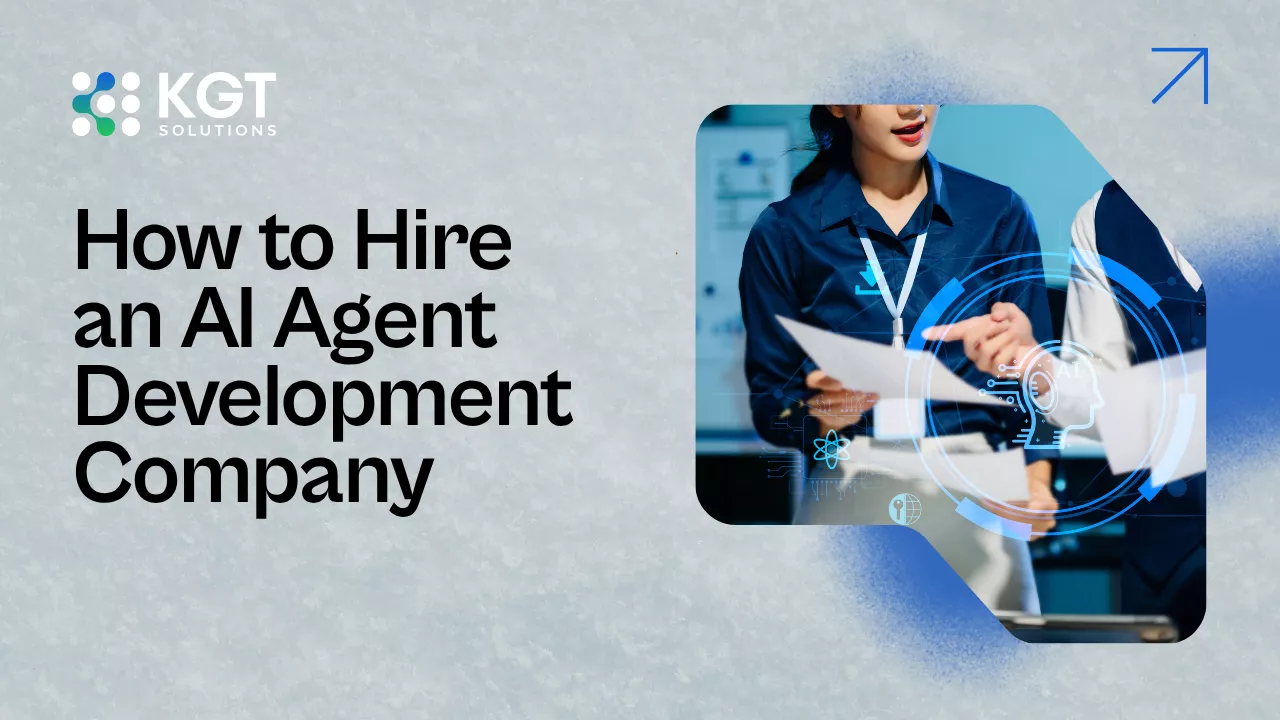
How to Hire an AI Agent Development Company

Key Takeaways
65% of failed AI projects cite wrong vendor selection as the root cause (McKinsey)
Agent development costs range from $50K to $500K depending on complexity (Forrester)
72% of enterprise AI projects never move past pilot (Gartner)
A structured evaluation framework cuts vendor selection time from 6 months to 6 weeks
The AI agent market is projected to hit $47B by 2030 (MarketsandMarkets). That kind of growth attracts every software shop with a ChatGPT wrapper to rebrand as an agentic ai development company. If you're a CTO with budget allocated, the real challenge isn't finding vendors. It's filtering out the ones who'll burn your runway on a pilot that never ships. This guide gives you the exact framework to evaluate development partners before you sign anything.
Why Picking the Wrong AI Agent Development Company Costs More Than Waiting
Wrong vendor selection causes 65% of AI project failures according to McKinsey - the cost isn't just dollars, it's 6-12 months of lost competitive positioning.
Most CTOs treat vendor selection like any other software procurement. But building autonomous agents isn't staff augmentation or SaaS licensing. You're hiring a team to build software that makes decisions on behalf of your business.
Get that wrong, and you don't just lose the project budget. You lose internal credibility for AI initiatives entirely. Gartner reports 72% of enterprise AI projects fail to move past pilot - and the pattern is almost always the same: impressive demo, messy integration, abandoned proof of concept.
And here's what makes it worse. Demand for AI agent developers grew 340% since 2023 (LinkedIn Economic Graph). That supply-demand gap means even mediocre shops are booked solid. The good ones are selective about which projects they take.
The 8 Criteria CTOs Should Use to Evaluate an Agentic AI Development Company
Evaluation criteria for an agentic ai development company should cover production deployments, agent architecture, integration depth, and support models.
Don't evaluate vendors on slide decks. Use this scoring framework instead.
Criteria | What to Look For | Red Flag |
|---|---|---|
Production deployments | Live agents handling real workflows | Only demos or proof of concepts |
Agent architecture | Multi-agent orchestration, tool use, memory | Single-prompt wrapper apps |
Integration capability | API-first, works with your existing stack | Requires full platform migration |
Domain experience | Built agents in your industry vertical | We can learn your domain |
Data handling | RAG pipelines, vector DBs, fine-tuning | Black-box proprietary AI claims |
Team composition | ML engineers + software engineers + domain experts | All generalists, no specialists |
Deployment model | Cloud-agnostic, on-prem options | Locked to one cloud provider |
Post-launch support | Monitoring, retraining, drift detection | Handoff after delivery |
Score each criterion 1-5. Any vendor below 30 total isn't worth a second meeting. Companies that actually deliver results with AI agents will score 35+ without hesitation.
How to Structure Your RFP for AI Agent Development
RFP structure for ai agent development company projects should specify the business process, decision boundaries, failure modes, and success metrics.
A traditional software RFP won't work here. AI agents introduce a category of risk that conventional projects don't: autonomous decision-making. Your RFP needs to address that directly.
Include these sections:
Business process description - Map the exact workflow the agent will handle, including edge cases
Decision authority boundaries - Where can the agent act autonomously vs. where does it escalate to humans?
Failure mode expectations - What happens when the agent is wrong? What's the blast radius?
Data access and governance - What systems does the agent read from and write to?
Success metrics - Specific, measurable outcomes within 90 days of deployment
Integration requirements - Every system the agent needs to connect with, including legacy
Companies spend an average of 3-6 months evaluating AI vendors (Deloitte). A tight RFP cuts that timeline in half because it forces vendors to give specific answers instead of generic pitches.
5 Questions to Ask Before Signing With an AI Development Company
Contract questions for an ai agent development company should probe IP ownership, model dependency, retraining costs, and exit clauses.
These five questions expose vendor quality faster than any reference call.
"What happens to our agent if you go out of business?" - Tests IP ownership and code escrow provisions. If they hesitate, your agent lives on their infrastructure and dies with them.
"Which foundation models does the agent use, and what's the fallback?" - Tests architectural resilience. A vendor locked to one model provider is a single point of failure. The agentic AI landscape is shifting fast - your partner should be model-agnostic.
"Show me a production agent that's been live for 12+ months." - Tests real operational experience. Anyone can build a demo. Running an agent in production for a year means they've handled drift, edge cases, and retraining cycles.
"What does retraining cost, and how often is it needed?" - Tests total cost of ownership transparency. AI agent development costs range $50K-$500K (Forrester), but ongoing retraining can double that if it's not planned upfront.
"Can we bring the agent in-house after the initial build?" - Tests vendor lock-in risk. Good partners build for eventual handoff. Bad ones build dependency.
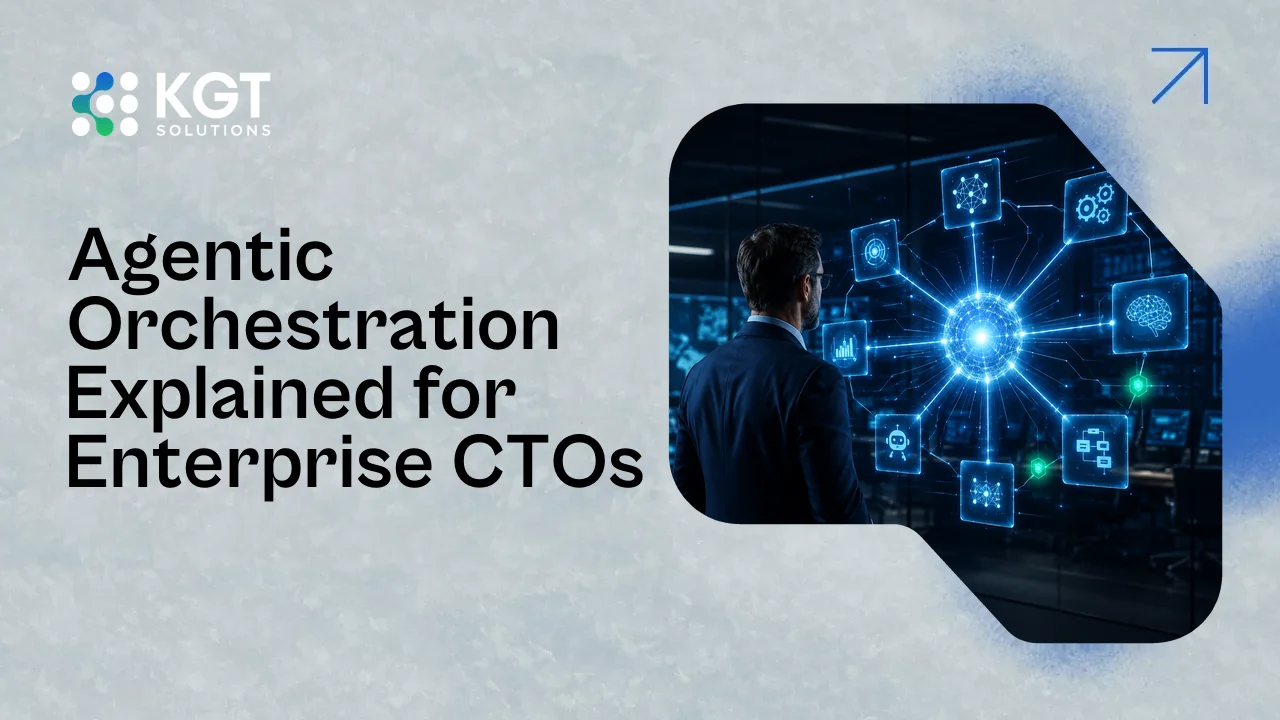
Agentic Orchestration Explained for Enterprise CTOs
Red Flags That Should Kill a Deal With Any AI Agent Development Company
Red flags in ai agent development company evaluation include vague pricing, no production references, proprietary-only tooling, and reluctance to discuss failures.
78% of CTOs plan to deploy AI agents by end of 2026 (IDC). That urgency makes it tempting to overlook warning signs. Don't.
Walk away if a vendor:
Can't name a single failed project. Every honest enterprise ai development company has failures. The question is whether they learned from them.
Quotes a fixed price without a discovery phase. AI agent complexity is impossible to estimate without understanding your data, workflows, and integration landscape. Bad implementation is what gets expensive, not the technology itself.
Sells "AI agents" but really means chatbots. There's a massive difference between an ai chatbot development company and a real agent builder. Ask for an architecture diagram - it'll tell you everything.
Has no ML engineers on staff. A custom ai agent development company without machine learning specialists is a web dev shop wearing a costume.
Won't do a paid pilot before a full engagement. Paid pilots protect both sides. Free pilots incentivize shortcuts.
What a Healthy Engagement Timeline Looks Like
Healthy AI agent development timelines run 12-16 weeks from discovery to production, with clear phase gates and kill criteria at each stage.
Here's what the engagement arc should look like with a competent ai agent development company:
Weeks 1-2: Discovery and scoping. The vendor maps your workflows, data sources, and integration points. You should see a detailed architecture proposal by the end of week 2.
Weeks 3-4: Paid pilot. Build one agent handling one workflow. Measure it against your success metrics. This is your kill gate - if the pilot fails, you've spent $15K-$30K instead of $300K.
Weeks 5-10: Full build. Iterative development with weekly demos. The agent should be handling real data by week 7, not synthetic test cases.
Weeks 11-14: Production hardening. Load testing, edge case handling, monitoring setup, and team training. Average enterprise saves 40% on operational costs with well-built AI agents (Accenture) - but only if the production deployment is solid.
Weeks 15-16: Launch and stabilization. The agent goes live with human oversight. Any serious agentic ai development company will watch dashboards alongside your team for the first two weeks minimum.
Understanding what AI agents actually do before you start this process will make every phase move faster.
Frequently Asked Questions
What qualifications should an AI agent development company have?
How do you evaluate the quality of an AI agent development company's work?
What is the typical engagement model for AI agent development projects?
How much should you budget for ongoing AI agent maintenance?
What mistakes do companies make when hiring AI agent developers?
Conclusion
Start with the 8-criteria scorecard, send your RFP to no more than 5 vendors, and require a paid pilot before any full engagement. Your next step is scheduling discovery calls this week - not next quarter.
Sources:
MarketsandMarkets - AI Agent Market Global Forecast to 2030
Gartner - Enterprise AI Adoption and Deployment Survey 2025
Deloitte - AI Vendor Evaluation Practices Report 2025
Forrester - The Total Economic Impact of AI Agent Development
McKinsey - Why AI Projects Fail Vendor Selection Analysis
LinkedIn Economic Graph - AI Talent Demand Trends 2023-2026
IDC - CTO Technology Investment Intentions Survey 2026
Accenture - AI Agent ROI in Enterprise Operations Report 2025
Protocol AI Newsletter
Practical insights on AI, automation, and intelligent systems focused on real-world applications, not hype.