Why Your Predictive Maintenance Software Predicts Nothing?

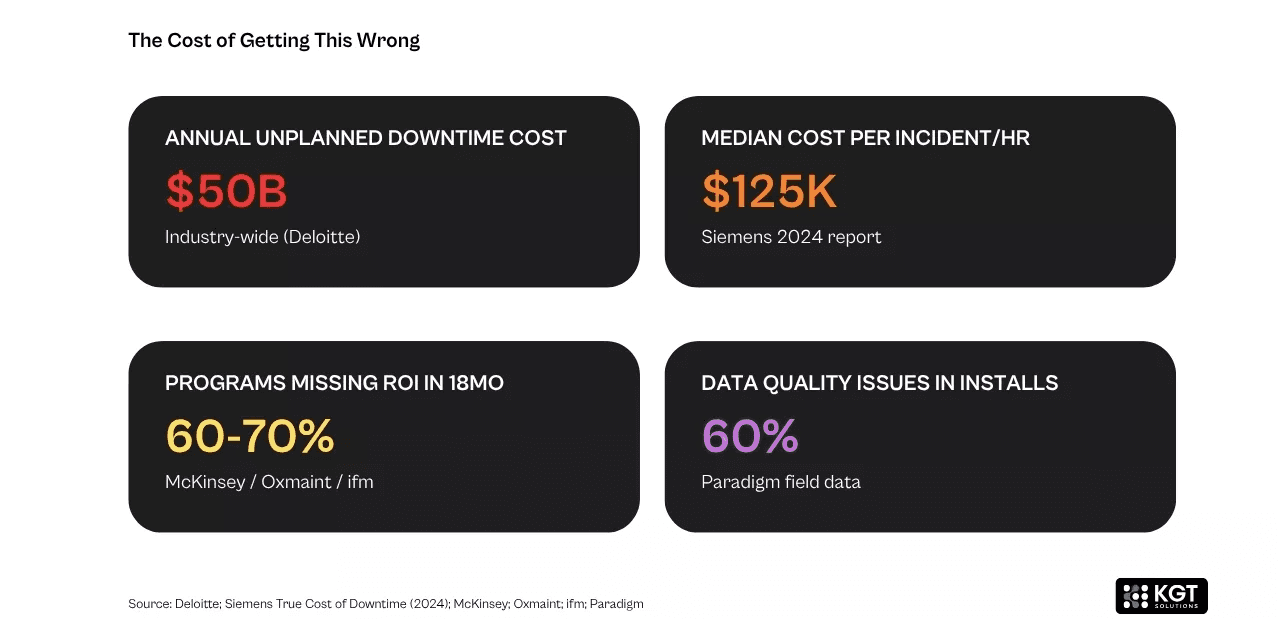
Unplanned downtime costs industry $50B a year, yet 60-70% of PdM programs miss ROI in 18 months. The model works fine. The workflow around it is broken.
Predictive maintenance software predicts nothing when it sits on dirty sensor data, runs disconnected from the CMMS work order layer, and forwards alerts no operator acts on. Around 60-70% of deployments miss their ROI target inside 18 months because the model is correct, but the surrounding workflow is broken.
Key takeaways
Unplanned downtime costs the industry $50B a year. 60-70% of predictive maintenance programs fail to hit ROI in 18 months because the workflow is broken.
Industrial unplanned downtime burns roughly $50 billion a year, with median per-incident cost above $125,000 per hour (Deloitte; Siemens 2024).
McKinsey benchmarks show working predictive maintenance software cuts downtime 30-50% and maintenance spend 18-25%, yet 60-70% of programs miss ROI inside 18 months.
The fix is not a new vendor. It is a closed-loop architecture: clean telemetry, predictive analytics, and an auto-triggered work order pushed straight into CMMS software.
Your team bought the platform. Sensors went live. The dashboard glows green.
Eight months later, emergency breakdowns are up 12% and your CFO wants the receipts. The problem is not the model. It is the six-step gap between "anomaly detected" and "bearing replaced."
This guide breaks down where these platforms fail and how to rewire them for a hard ROI.
What is predictive maintenance software, and why does it fail?
PdM software can forecast failures 30-90 days out. But 60% of installs flop because the data is dirty and CMMS is disconnected.
Predictive maintenance software ingests vibration, thermal, current, and acoustic telemetry from connected assets, then applies machine learning to forecast component failure 30 to 90 days out. Most deployments fail when sensor data is dirty, the model is disconnected from the CMMS, or the operator inbox absorbs every alert.
McKinsey research pegs the upside at 30-50% downtime reduction and up to 40% extension of asset life. Oxmaint and ifm both report that 60-70% of programs miss those numbers inside 18 months. Paradigm field data shows data quality issues affect 60% of installations.
The math is clean. The plumbing is not. For the underlying sensor stack, see our deep dive on predictive maintenance protocols.
Where the platform actually breaks
Four things kill your PdM ROI: sensor gaps, data drift, no CMMS connection, and manual alert handoffs that eat the prediction window.
Predictive maintenance software breaks at four specific failure points: sensor coverage gaps, dirty telemetry, isolation from CMMS software, and a manual handoff between alert and technician. Each point silently compounds the others until your $1.2M deployment behaves like a more expensive version of run-to-failure.
Failure point | What goes wrong | What it costs you |
|---|---|---|
Sensor strategy | Instrumented every asset instead of the top 3 by failure cost | Capex inflation, payback slips past 24 months |
Data quality | Vibration spikes from sensor drift, not bearing wear | False alerts, technician trust collapses |
CMMS integration | Alerts land in email, not as auto-generated work orders | Median time-to-action equals reactive maintenance |
Closed-loop action | A human reads the dashboard before anything moves | The 30 to 90 day prediction window evaporates |
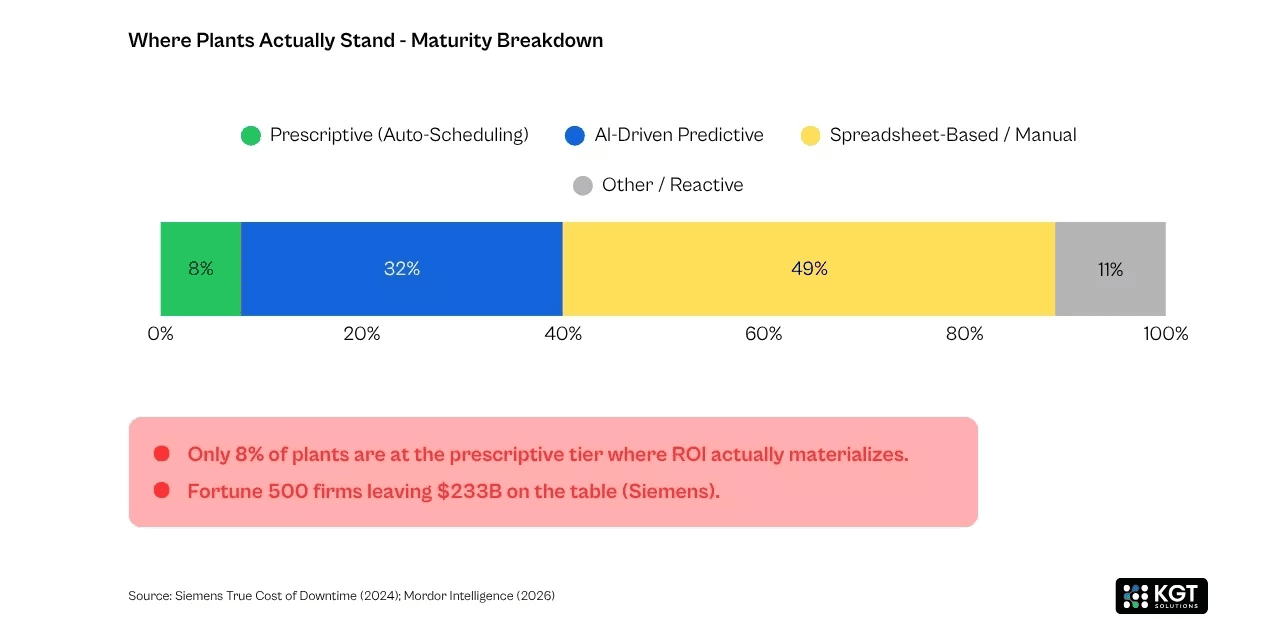
The Siemens True Cost of Downtime report estimates Fortune 500 firms could capture $233 billion annually if predictive maintenance tools were fully closed-loop.
Right now only 8% of plants operate at that prescriptive, auto-scheduling tier. 32% run AI-driven predictive. 49% still parallel-process critical maintenance data in spreadsheets.

How to diagnose your current stack in one afternoon
Pull 90 days of alerts and check work-order conversion. If fewer than 60% of alerts trigger action within 24 hours, your loop is broken.
Audit your predictive maintenance stack in five steps: pull the 90-day alert log, count alerts that triggered a work order inside 24 hours, measure sensor data completeness, map model-to-CMMS API calls, and compare breakdown rate before vs. after deployment. If work-order conversion sits under 60%, your loop is open.
Tag every alert in the last 90 days as actioned, ignored, or missed.
Score sensor data completeness. Target: above 95% uptime and under 2% drift.
Confirm the predictive analytics layer pushes work orders directly into the CMMS via API, not human triage.
Benchmark MTTR and unplanned downtime against the pre-deployment baseline. McKinsey's reference cohort logs 30% downtime reduction inside year one when the loop is closed.
What good looks like
Done right, PdM auto-generates CMMS work orders in minutes. Repair costs drop 4-5x and the system pays for itself within a year.
A working predictive maintenance stack writes its own work orders. Sensor data flows into a quality-gated lake, the model scores asset health every 5 to 15 minutes, and any anomaly above threshold spawns a CMMS ticket with parts list, technician, and SLA already attached. Zero email. Zero dashboard archaeology.
Companies running that architecture report 4-5x lower repair cost per asset compared with emergency response, and 27% of them clear full payback inside 12 months. The deciding factor is integration depth, not algorithm choice.
Most plants already own enough sensors. They do not own the workflow that turns a prediction into a fix. That is the operational gap behind the real ROI of industrial automation that nobody talks about.
IT OT Convergence in Manufacturing Explained

FAQ
Why did our predictive maintenance software stop catching failures?
The platform degrades when sensor calibration drifts, when firmware updates change baseline signatures, or when CMMS data goes stale and stops feeding the model historical context. Most teams catch the regression only after a high-cost surprise breakdown.
What is the realistic payback period for predictive maintenance tools?
Predictive maintenance tools deliver payback in 6 to 18 months when the program starts on the top 2-3 highest-loss assets, integrates directly with CMMS software, and tracks 10-15 baseline KPIs from day one. Boil-the-ocean rollouts push payback past 24 months and rarely recover.
Do we need a data science team to run this?
Predictive maintenance does not require an in-house data science team if the platform handles model tuning, anomaly thresholds, and CMMS integration in its managed service layer. You need a maintenance engineer who owns the closed loop, not a Kaggle grandmaster.
Frequently Asked Questions
Why do most predictive maintenance software implementations fail to predict anything useful?
How much data does predictive maintenance software actually need to work?
What sensors are essential for predictive maintenance to deliver results?
How do you tell if your predictive maintenance software is actually working?
What should manufacturers do before buying predictive maintenance software?
Conclusion
If your predictive maintenance software is not auto-writing work orders into your CMMS, you do not have predictive maintenance. You have an expensive dashboard. Book a 30-minute systems audit and we will tell you exactly which loop is broken.
Sources:
The ROI of predictive maintenance software
Predictive Maintenance ROI: Cost Savings for Manufacturers
The Key Factors Impacting ROI in Predictive Maintenance
Guide to Understanding Predictive Maintenance ROI
Top Challenges in Implementing Predictive Maintenance
Overcoming Predictive Maintenance Challenges: Complete Guide
The State of Manufacturing Maintenance: 2025 Global Industry Report
Predictive Maintenance and the Smart Factory
Predictive Maintenance: Cutting Costs & Downtime Smartly
Predictive Maintenance in Manufacturing: Software Layer Analysis
CMMS Benefits: The Quantified Business Case
Industrial Autonomous Floor
Newsletter
Actionable insights on industrial AI, automation, and smart operations built for safe, secure, and compliant real-world environments.