How Is Intelligent Custom Software Development Changing the Game?

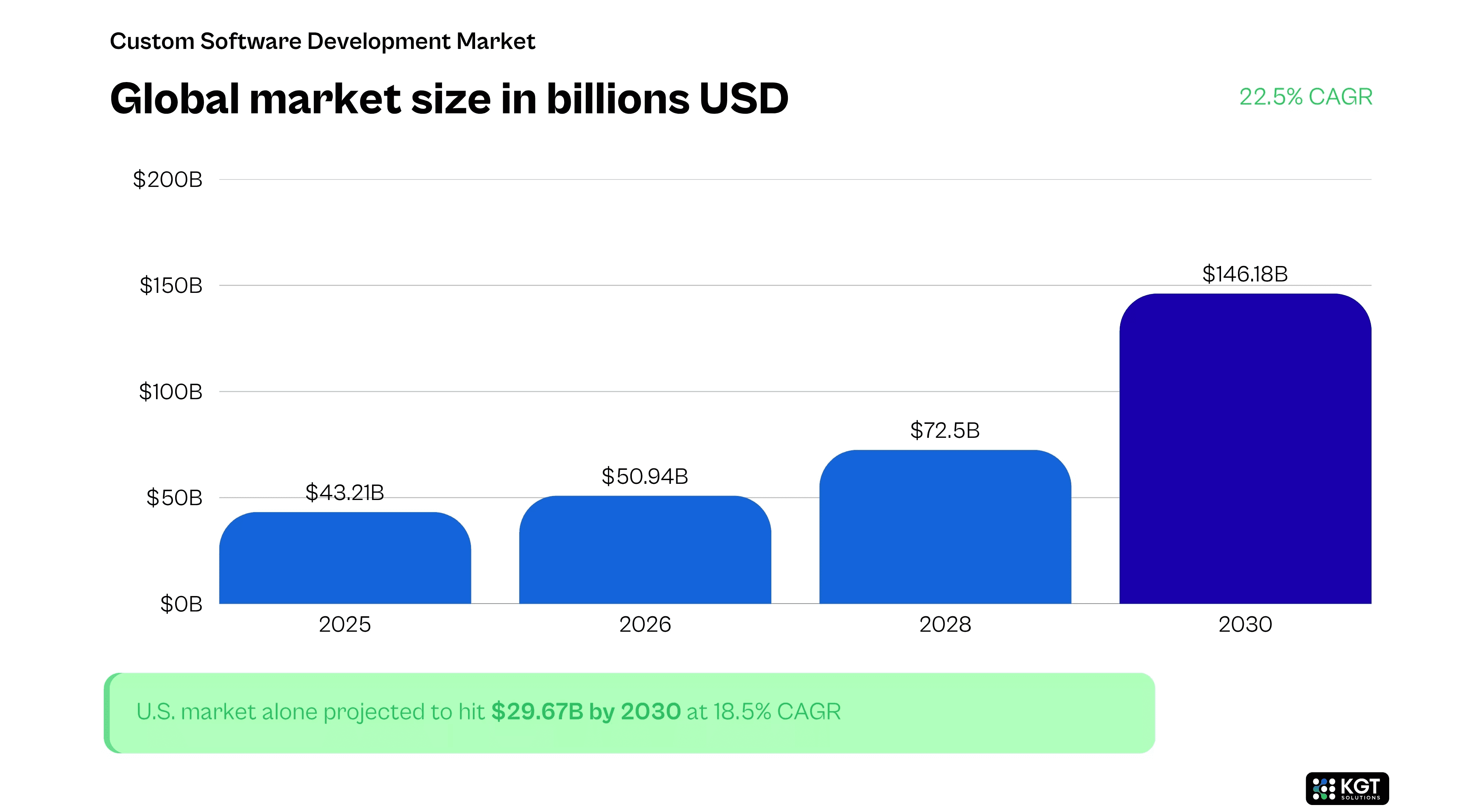
Custom software development is rewriting operational playbooks across industries by embedding AI, cloud-native architecture, and proprietary business logic into platforms built for one company's exact workflow. The $50.94 billion market is growing at 22.5% CAGR because generic tools cannot match tailored systems engineered around competitive advantage and real operational data.
Key Takeaways
The global custom software development market hits $50.94 billion in 2026, projected to reach $146.18 billion by 2030 at 22.5% CAGR.
Organizations using AI-augmented custom development report 35-45% productivity gains and 30% faster time-to-market.
61% of enterprises now require custom integrations to manage hybrid and multi-cloud environments that off-the-shelf software cannot unify.
Introduction
Your ERP is duct-taped to three SaaS tools, your data lives in five different formats, and your operations team burns hours on workarounds every week. That is the cost of generic software. This guide breaks down how intelligent custom software development replaces that fragility with systems that think, adapt, and scale alongside your business - not against it.
What Makes Custom Software Development the Strategic Play in 2026?
Custom software development gives enterprises full architectural control over data flows, security protocols, and integration layers that packaged software locks behind vendor roadmaps. Enterprise software holds 36.60% of revenue share in custom development because ERP, CRM, and industry-specific suites demand proprietary workflow logic no template can replicate.
The shift is measurable. The global custom software market was valued at $43.21 billion in 2025 and jumped to $50.94 billion in 2026. That is structural demand from companies that hit the ceiling of off-the-shelf tools and need platforms built around their operations.
Consider the difference: a generic CRM gives you 200 fields, but your sales process uses 14. A custom software developer builds exactly those 14 fields, maps them to your pipeline stages, and connects them to your billing and fulfillment systems without middleware bloat. That is what separates real AI implementation from expensive failure.
North America alone captured 38.13% of revenue in 2025, while Asia Pacific is on course for a 12.47% CAGR through 2031. The geographic spread signals one thing: this is not a Silicon Valley play anymore. Every enterprise market on Earth is moving away from rigid SaaS licensing toward tailored platforms that fit their regulatory and operational reality.
How Does AI Change the Custom Software Development Process?
AI-augmented custom software development services cut development timelines by 30% and boost code quality by over 50%, according to McKinsey's 2026 Technology Trends Report. Teams using AI-assisted coding, testing, and deployment now deliver production-ready software at speeds that manual-only workflows cannot match.
Where AI Hits Hardest in the Development Lifecycle
AI transforms custom software application development at three concrete stages: automated code generation for repetitive modules, intelligent testing that catches defects before staging, and predictive resource allocation that prevents scope creep from draining budgets.
48% of enterprises now deploy custom-built AI-enhanced modules for automation. That figure climbs to 52% for companies prioritizing API-driven custom software solutions that unify siloed data across departments.
Here is what that looks like on the ground. A fintech software development company building a loan origination platform no longer hand-codes every validation rule. AI generates the boilerplate, the custom software developer refines the edge cases, and the testing framework runs 200+ scenarios overnight. Three months becomes six weeks.
The Developer Talent Gap AI Actually Solves
A projected shortage of 1.2 million senior developers by 2026 turns AI-assisted development from a productivity tool into a survival mechanism for every custom software development company scaling delivery without proportional headcount increases.
This is the gap that stops companies before they even start building. AI does not replace your senior architect. It gives your mid-level developers the scaffolding to produce senior-level output while architects focus on system design and integration strategy.
AI spending is expected to double in 2026 from 2024 levels. The investment is no longer theoretical. Teams that embedded AI into their development workflows 18 months ago now ship at twice the velocity of firms still running fully manual pipelines.
Cloud-Native Architecture as the Default
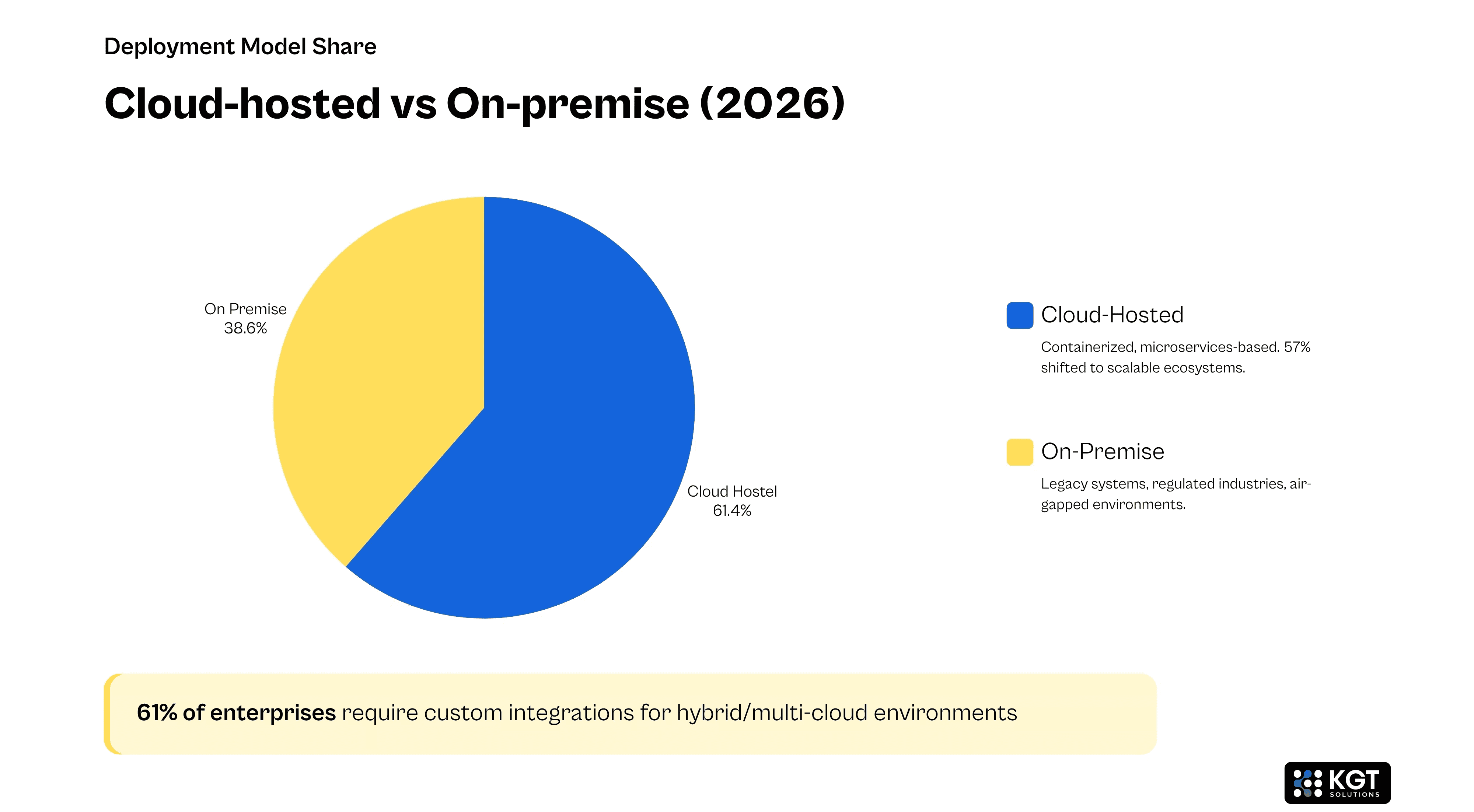
Cloud-hosted deployments hold 61.40% market share in custom software development because containerized, microservices-based architectures give enterprises the modularity to scale individual components without rebuilding entire systems.
57% of global deployments have already shifted toward scalable, containerized ecosystems. For a custom software development firm, this means building systems where the payment module scales independently of the user dashboard, and where a compliance update deploys in hours instead of weeks.
The practical impact: 61% of global enterprises require custom integrations to support hybrid and multi-cloud environments. A development partner that builds on AWS today can migrate a client's workload to Azure tomorrow without rewriting the core application. Off-the-shelf tools lock you into one vendor's infrastructure and one vendor's timeline.
Custom vs. Off-the-Shelf: Where the Money Actually Goes
Factor | Off-the-Shelf Software | Custom Software Development |
|---|---|---|
Upfront Cost | Lower ($5K-50K/year licensing) | Higher ($50K-500K+ build) |
3-Year TCO | Higher (licensing + customization + integration) | Lower (no licensing, full control) |
Integration | Limited API, vendor-dependent | Full API control, custom connectors |
Scalability | Vendor roadmap dependent | Architecture you own and extend |
AI/ML Integration | Generic modules, limited training data | Proprietary models trained on your data |
Security | Shared infrastructure, vendor patches | Custom security architecture, your timeline |
Customized software development services deliver lower total cost of ownership over three years because enterprises eliminate per-seat licensing, forced upgrades, and expensive third-party integration middleware that packaged tools require for basic operational workflows.
The U.S. custom software development market alone is projected to reach $29.67 billion by 2030 at 18.5% CAGR. Companies are voting with their budgets. Off-the-shelf tools break at the exact moment you need them most - when your processes become the competitive advantage, not the software itself.
Which Industries Are Betting Biggest on Custom Software Development Firms?
Healthcare software development companies and fintech software development companies lead enterprise custom software adoption because both industries face regulatory complexity, data sensitivity, and operational requirements that generic platforms cannot satisfy without dangerous compromises.
Healthcare organizations process patient data across EMR systems, billing platforms, insurance portals, and compliance databases. A dedicated development partner builds one unified layer that talks to all of them. A SaaS tool gives you an integration marketplace and a prayer.
Financial services face similar pressure. For a fintech operation processing 10,000 transactions per second, the difference between a custom-built transaction engine and a generic API gateway is the difference between 99.99% uptime and regulatory penalties. 36% of enterprises already depend on predictive analytics integrated directly into custom systems for exactly this kind of operational precision.
Manufacturing is the third vertical accelerating spend. Custom embedded and IoT software is scaling fastest at 22.35% CAGR as Industry 4.0 initiatives demand sensor-rich edge applications. Companies running intelligent automation on the factory floor already know that generic dashboards cannot parse the data their PLCs and SCADA systems generate.
The real struggle for CEOs and founders adopting these technologies is not budget. It is finding a custom software development firm that understands their vertical deeply enough to build systems worth the investment.
Enterprise AI Governance: Build Your Framework

How Do You Choose the Right Custom Software Development Companies?
The right custom software development firm demonstrates architecture-first thinking, ships modular systems with clean API layers, and shows documented ROI from comparable deployments rather than pitching feature lists or technology stacks disconnected from operational context.
Three filters that separate real partners from vendors:
Architecture ownership. You own the code, the infrastructure diagrams, and the deployment pipeline. If a custom software development company cannot hand you the keys to your own system, walk away.
AI-native development. 35-45% productivity gains come from teams that integrate AI into their workflows, not teams that bolt it on after the contract is signed. Ask for their AI-assisted development metrics before you sign anything.
Vertical expertise. A partner that built three healthcare platforms will outperform a generalist firm every time. Domain knowledge compounds. Technical skill alone does not.
Modular development frameworks have reached 44% adoption among mid-sized firms. That means even mid-market companies can now access the same architectural patterns that Fortune 500 enterprises use - if they pick the right custom software development services partner.
FAQ
How long does custom software development take compared to buying SaaS?
Custom software development typically requires 3-6 months for an MVP, compared to 2-4 weeks for SaaS deployment. The tradeoff is that custom platforms eliminate the 12-18 month integration debt that SaaS solutions accumulate as operational complexity grows.
What ROI should enterprises expect from custom software development services?
Custom software development services deliver measurable ROI within 12-18 months through eliminated licensing fees, reduced integration overhead, and operational efficiency gains averaging 30-50%. Organizations report that total cost of ownership drops below SaaS alternatives by year three of deployment.
Is custom software development worth it for mid-market companies, not just enterprises?
Custom software development companies increasingly serve mid-market firms because modular frameworks now reach 44% adoption among mid-sized businesses. A focused MVP costing $50K-150K can replace $30K-80K in annual SaaS licensing while delivering functionality that generic tools never will.
Frequently Asked Questions
What makes custom software development intelligent compared to traditional approaches?
What types of businesses benefit most from intelligent custom software?
How much does intelligent custom software development cost in 2026?
How long does it take to build and deploy intelligent custom software?
What is the difference between buying AI-powered SaaS and building custom?
Conclusion
The $50.94 billion custom software development market is not growing at 22.5% CAGR because of hype. It is growing because operational leaders ran out of patience with tools that almost work. Explore how KGT Solutions builds AI-native custom software that fits your exact operational architecture - not the other way around.
Sources:
Mordor Intelligence, "Custom Software Development Market Growth Report 2031" (2026)
Global Market Insights, "Custom Software Development Market Size & Share 2026-2035" (2025)
Grand View Research, "Custom Software Development Market Industry Report 2030" (2025)
Grand View Research, "U.S. Custom Software Development Market Size & Outlook 2030" (2025)
McKinsey, "2026 Technology Trends Report" (2026)
DreamzTech, "How AI Is Transforming Custom Software Development in 2026" (2026)
360 Research Reports, "Custom Software Development Market Growth, Size, Share & Industry Trends" (2026)
Emorphis Technologies, "The Software Development Trends Reshaping the Industry in 2026" (2026)
Equiteq Research, "Outsourced Custom Software Development M&A Report" (2026)
Keyhole Software, "Software Development Statistics 2026: Market Size, Developer Trends & Technology Adoption" (2026)
Protocol AI Newsletter
Practical insights on AI, automation, and intelligent systems focused on real-world applications, not hype.